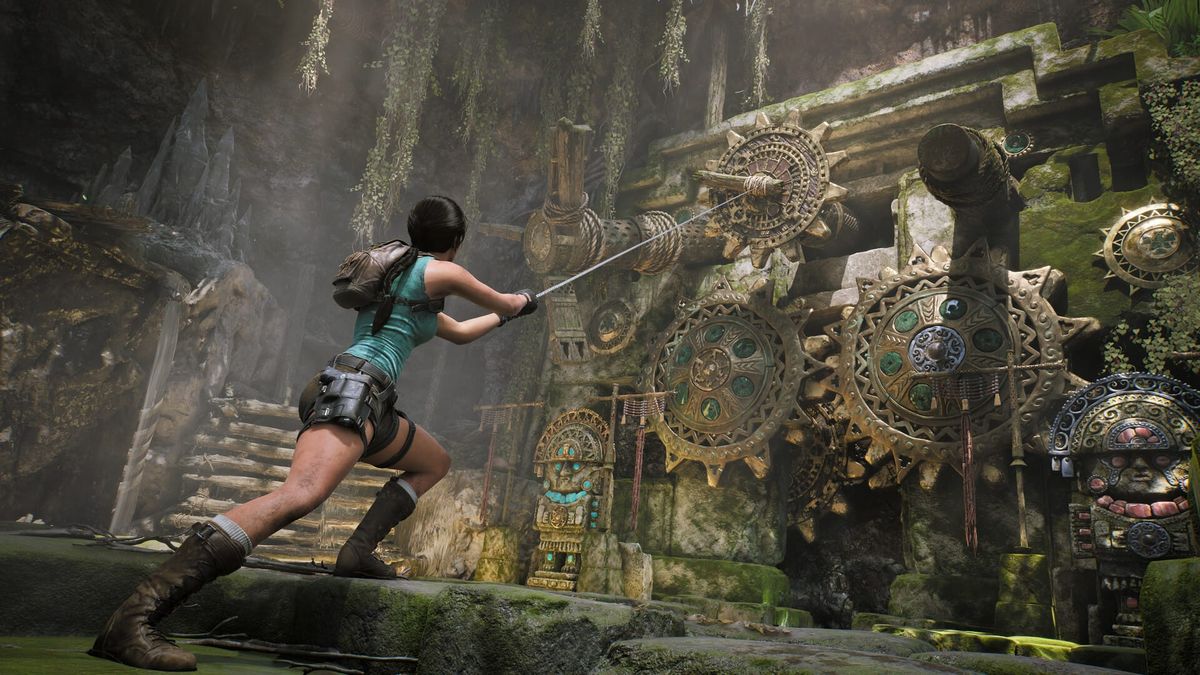
Summer Game Fest saw the continuation of a trend that has become all too predictable at this point: A major publisher discloses—usually due to Steam’s requirements—that a game made use of AI in development, at which point it’s hit with tidal waves of both backlash and speculation. Cornered, the publisher in question then provides a small amount of detail about how AI actually influenced the development process. More outrage and speculation ensues. Nobody is happy. Rinse, repeat.
This happened twice in the past handful of days: First with the upcoming Tomb Raider remake last week and then with Sega’s new Crazy Taxi over the weekend. It is particularly galling that one of these is a remake—a game that was previously crafted sans the ‘helping’ hand of a clueless plagiarism machine—and the other is a retro revival, but in both cases vague disclosures only exacerbated the problem further. After all, what does this disclosure, found on Crazy Taxi’s Steam page, even mean?
At SEGA Corporation, we utilize generative AI as a support tool for developers, aiming to provide better content to our users and enable developers to focus more on creative tasks.
We have used such generative AI support tools during development of Crazy Taxi: World Tour. No AI was used in reference to the performers in the game.
It is only natural to have questions after reading this statement. What kind of support? How pervasive is it? During which stages of development? For writing? Assets? Both? And while AI wasn’t used “in reference to performers in the game,” did it make it into the game elsewhere?
Game Informer managed to squeeze a statement out of Sega that, frankly, clarified almost nothing:
At SEGA Corporation, generative AI is available as an optional support tool for developers, enabling our teams to focus more on creative tasks and ultimately focus on what matters most: delivering better games to our consumers.
Generative AI was used to support our teams during the development of background assets for ”Crazy Taxi: World Tour”. Assets generated were still subject to review by the development team.
No AI was used in reference to the performers in the game.
Sure! OK!
Finally, series creator Kenji Kanno provided a more detailed explanation to Kotaku at Summer Game Fest’s Play Days event in LA:
We used [AI] as a reference. So our artists would pull up [and] generate some of their ideas and then they would look at that, you know, generated image and then they would draw the actual thing. So actual creators, everything from programming to assets, everything is made by an actual human. It’s only used as a reference for them to look at and then they would actually create the actual thing that would go into the game.
Does that still suck, especially when reference photos of real life exist in abundance and would inarguably lead to a more convincing, handcrafted game world? Absolutely. But the company also could have just said this part to begin with. May as well rip the band-aid off rather than getting chased around with pitchforks and torches for days at a time. As is, there’s now an even bigger stain on the game than there would have been otherwise.
But really, this goes back to a central, defining problem with AI: Its mere existence sows suspicion. People see it everywhere now, sometimes even in art and writing that did not actually employ it. If a company suggests that AI played any role in the proceedings—even if it swears up and down that humans hand-carved the end result—it’s only natural to wonder if other corners were cut. This goes double for games like Tomb Raider and Crazy Taxi, where the implication of the more detailed AI disclosures journalists and the public had to badger out of companies is that developers needed help with ideas, specifically—aka the easiest part of creating anything.
Don’t get me wrong: I’m glad that Steam makes companies disclose use of AI; it’s better than nothing. But the current requirements clearly aren’t doing the job, and there have been plenty of instances involving games both large and small where it’s been difficult to glean the actual scope of AI usage from disclosures—which can make it feel like developers are trying to hide something or are not being entirely honest.
The real solution to this problem, obviously, is for studios to just tear AI out of their production pipelines altogether. But if execs are going to insist on continuing to force it down the throats of both developers and players, we need a better, more comprehensive system for accountability. As is, I imagine other companies saw what happened to games like Tomb Raider and Crazy Taxi and might now be trying to figure out how to get around disclosing AI usage at all. That, in my mind, is a real worst case scenario.
Recommended
 Luke Plunkett