

I feel like every time I open up the internet I see a piece of movie or TV news getting shared on Bluesky or Instagram by someone I know, and every damn time, it's under the banner of Culture Crave.
Even if the name doesn't ring a bell, the avatar (pictured above) surely will: that trademark Darth Vader on a blue background, wearing sunglasses over his helmet visor, a profile picture you see every time someone you know or follow feels the need to share the box office takings of the latest movie, or how many post-credits scenes we can expect to see after a movie we haven't seen.
It's an account--or accounts, since they post on pretty much every major social media platform out there--that has over one million combined followers, makes a lot of money and exists to bombard its followers with information in much the same way all news media does in the age of SEO desperation and the battle of the attention economy. Here's a cast reveal, here's a quote from a celebrity, here are 6000 layoffs– everything is presented in quick succession and stripped of context. To follow the account, and others in the same space (like Pop Crave), must be a numbing experience.
 Luke Plunkett
I wouldn't know though, because I don't follow them, because fuck them. And not for the quantity of their posts, either. I don't follow them because they just straight up steal other people's shit.
Scroll down Culture Crave's timeline and between the trailers and teasers you'll see some quotes, news, data and footage that does not come from them. Much of it comes from other websites, the work of other reporters and writers and hosts. Sometimes those outlets will be belatedly mentioned via text in Culture Crave's original and most-shared post, but often their identities will be buried in a follow-up post (which is never the one shared), and sometimes just omitted entirely.
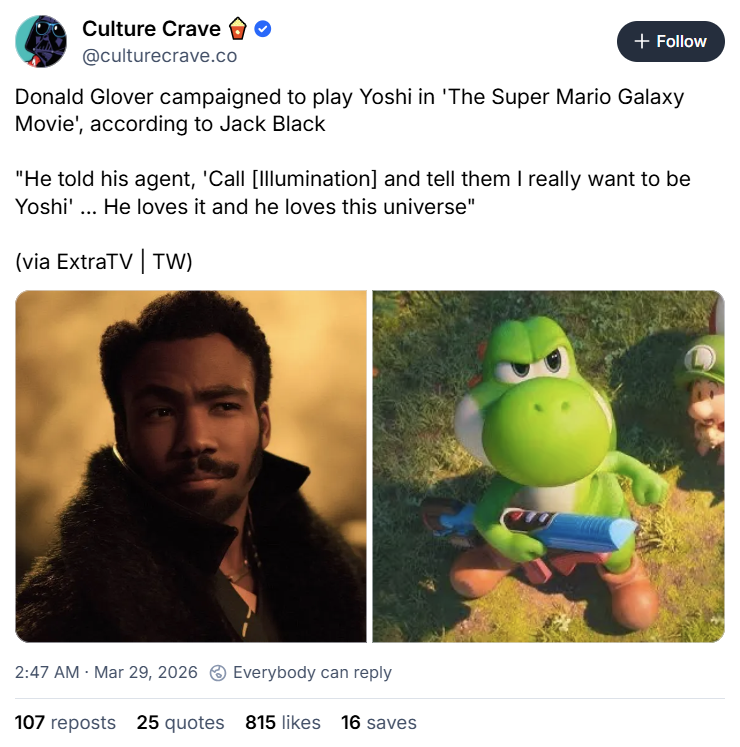
Here's an example: this post, about Donald Glover and the Super Mario Galaxy movie, credits Extra with a "via" then does not link the outlet in either this or a follow-up post. Culture Crave have simply taken news that Extra generated from an interview with Jack Black and Anya Taylor-Joy and lifted it wholesale, getting thousands of likes on Twitter in the process (you can see Extra's original interview here).
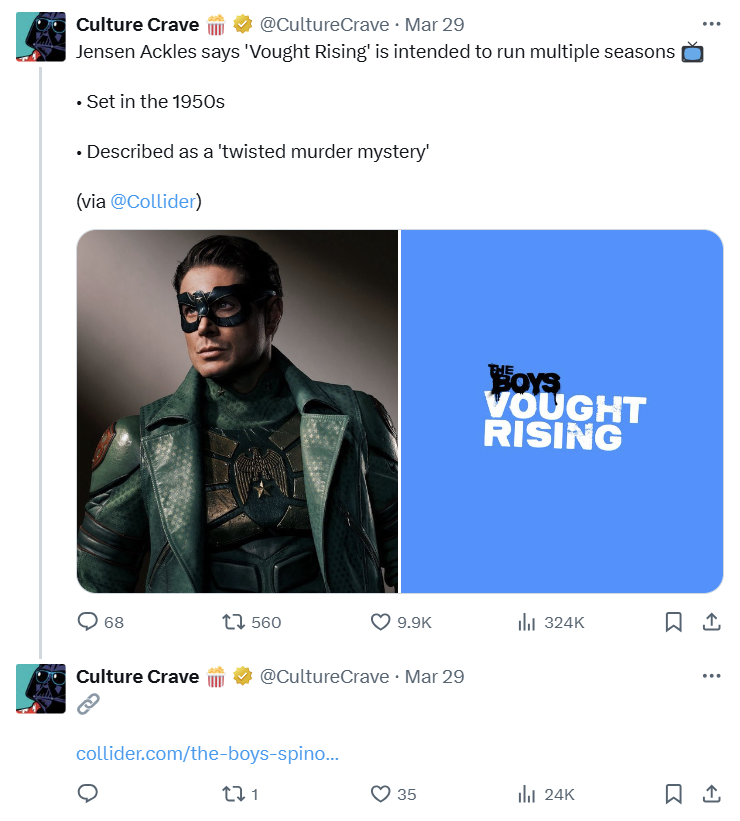
Here's another example of Culture Crave fuckery: of these two posts below, about yet another spinoff series based on The Boys, the top post--the one with the news and thousands of likes--does not link Collider's story that obtained the information, even though it very easily could have. The second post, the one with...35 likes, does.
You may think ah, this is just aggregation, but it's not. Aggregation is a practice that has been around since the dawn of the internet, and involves taking news somebody else has broken and re-writing it for your own audience. I've done a bunch of it over my career, but everyone from the New York Times to The Guardian to the Sydney Morning Herald has to also do it on a daily basis; if Bild breaks a huge story and L'Equipe has to write about it without adding any further reporting, that's aggregating.
The correct practice when aggregating, however, is to cite your sources properly. This is most often done with a clear mention of that source and a full link to the original piece as early in your own story as you can. In the above Super Mario Galaxy example the news wasn't "via" Extra, because "via" is usually used when the aggregator has merely seen a story elsewhere first, without ever coming across the actual source. In Aftermath terms, let's say a site called Tiny Little Blog broke some big news, but I first saw it on IGN (who linked Tiny Little Blog in their own report, which is how I would know!). If I chose to write about that news I'd fully credit Tiny Little Blog and give a "via" to IGN, and in a time where every link a website can get counts more than ever, I would link both of them.
 Luke Plunkett
Doing this is very easy. It's internet journalism 101, even for fansites and hobbyists, so to see a commercial account with over one million combined followers continue to wilfully refuse to properly credit and link to its sources drives me insane. There are no excuses for this! Sure, some social media platforms prefer a link in the second post, but not all; to see Culture Crave’s Bluesky posts follow a style you would expect on Twitter suggests they're either using a service like Postpone and can’t be bothered making slight adjustments to each platform’s post, or just don't care. Even if it's just on Bluesky, put the credit in the top post, you bozos! Platform preferences be damned, just do the right thing!
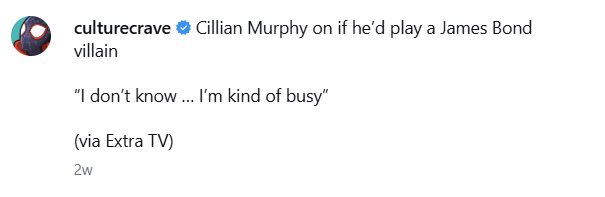
I'm not trying to shame anyone who is into this kind of news here, nor am I trying to call the Internet Police on the network. I just want to bring this back to where I started: I see people sharing Culture Crave posts all the time, on all kinds of platforms, and I think we could all be doing better! If you ever feel the need to share a bite-sized piece of pop culture news, I think the least you could do is to share the reporting of the sites (THR, Variety, even IGN!) doing the actual work.


