

You’re probably familiar with cartoonist Alison Bechdel from Fun Home (the book or the musical), or from the “Bechdel Test” for the portrayal of women in fiction. But unless you are or were a lesbian of a certain age, you might not remember her comic strip Dykes To Watch Out For, which ran from roughly 1983 to 2008. I have been obsessed with the strip ever since I was a lonely queer teen rushing through its book collections before someone at the bookstore saw me, and for as long as I’ve been reading it, I’ve been fascinated by its portrayal of food, and consumed with the desire to recreate it.
Dykes To Watch Out For follows a group of queer friends and lovers navigating a world of changing politics and relationships, trying to stay true to their values while still surviving and finding happiness. Its “star,” if it can be said to have one, is Mo, a neurotic lesbian leftist who struggles to find a lover, keep a job, and not drive everyone close to her away with her strident morals and tendency to gripe. Other cast regulars are her sex-positive friend Lois, her long-time couple friends Toni and Clarice, and Lois’ housemates Sparrow and Ginger. Add to that the people who enter their lives over the years: Sparrow’s cis male lover Stuart, Ginger’s girlfriend Samia, Lois’ girlfriend Jasmine and her trans daughter Janis, Mo’s ex Harriet, and her current lover Sydney. They all live in an unnamed progressive American town almost entirely populated by queers, replete with a co-op, feminist bookstore, and gay mechanic.
The strip ran in various queer newspapers and magazines over the years, and was periodically organized into small collections by Firebrand Books. In 2008 Houghton Mifflin published The Essential Dykes To Watch Out For–on a day that still lives in my memory because my roommate and I rushed to the bookstore to buy it and then worked out a strict schedule for who got to read it when–which is a compendium of almost all the strips in one volume.
When able to be seen as a whole, Dykes To Watch Out For becomes less a sendup of daily lesbian life and more a portrait of what it means to be a political queer surviving the passage of time. How much should your beliefs and tactics change as the world does? Can you fight the same battles against US militarism and homophobia year after year without succumbing to despair? Is it selling out to want a more stable life, and is it failing not to be able to get one? I was a teenager when I first encountered the strip, longing to live in the world it portrayed. As an adult, it reflects my own experience of aging in queer space, trying to grow and evolve without uncritically adhering to everything the new generation believes. The strip depicts how the chores and struggles of the everyday become a whole life, shaping who we are and the world around us.
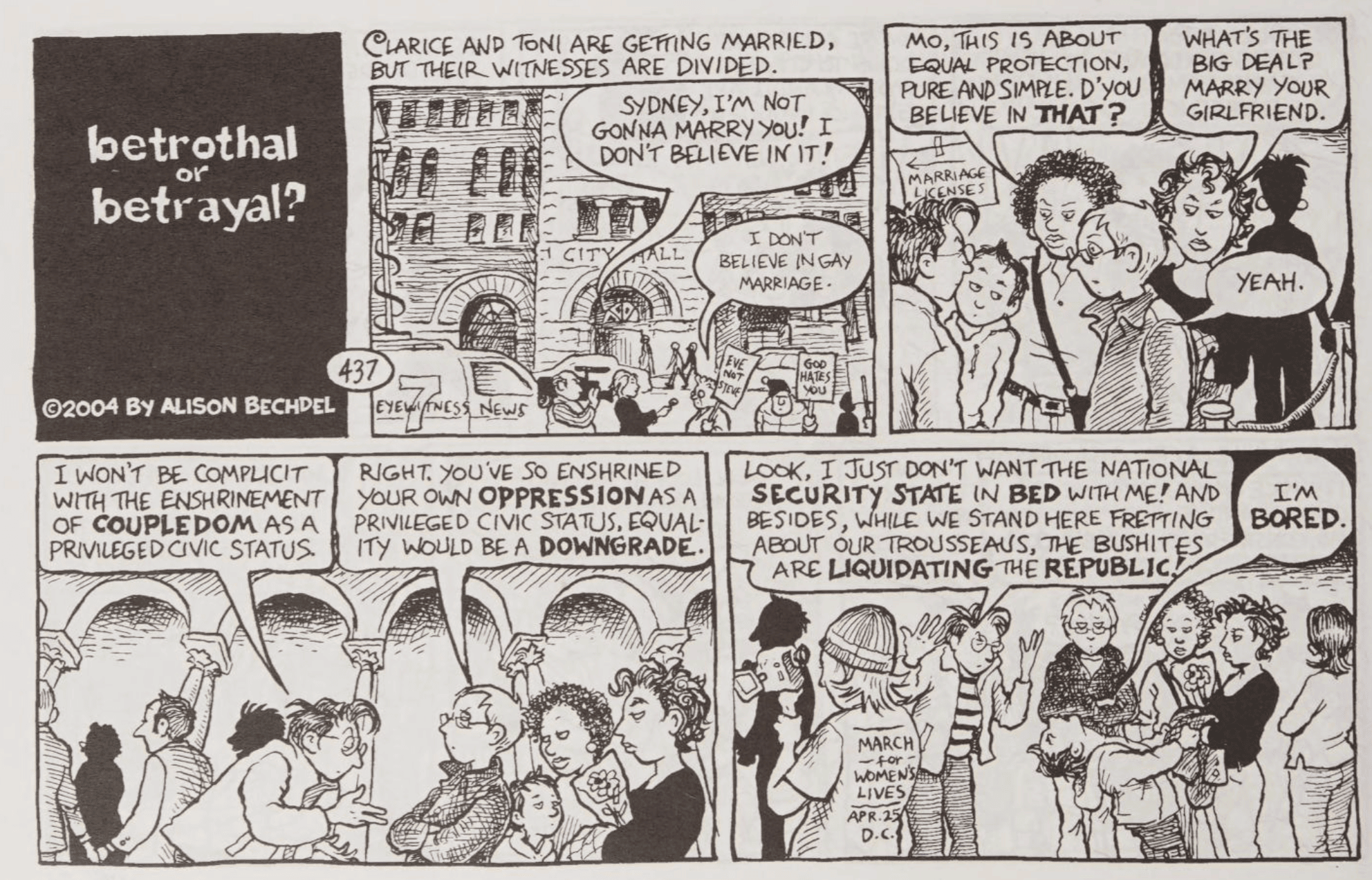
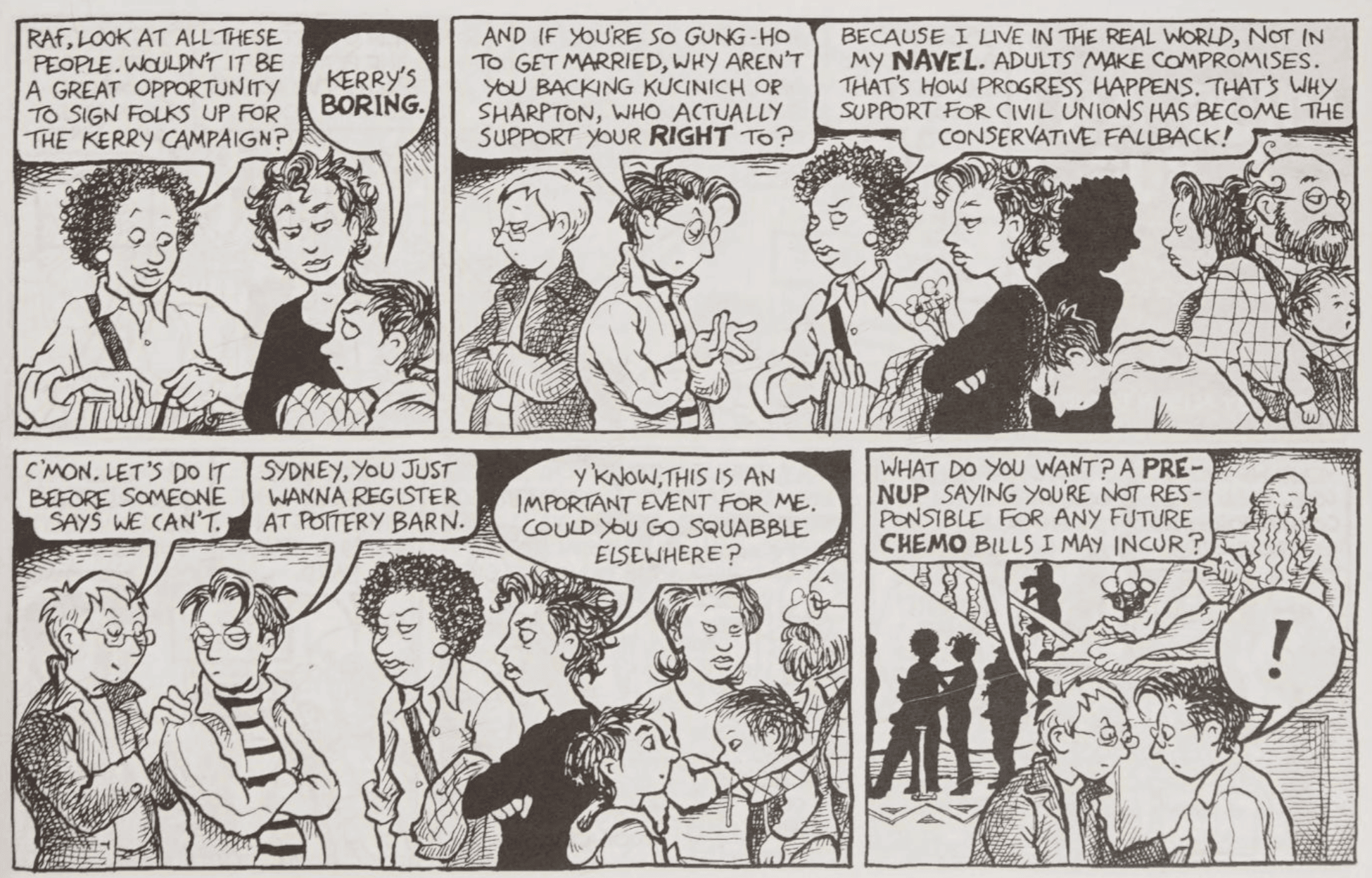
Dykes To Watch Out For
Food plays a notable role in that daily life. This is two-fold: for one, as a comic about a group of people way too involved in each other’s lives, characters frequently gather for dinner, cookouts, and pitstops on roadtrips. They eat at each other’s houses, gossip over meals at local stalwart Cafe Topaz or special occasion spot La Lentille D’Or, or experiment with growing their own food.
Food is also around a lot because it’s a queer comic, and food is super queer. From the potluck to the feminist restaurant to the counter-culture’s obsession with health food, progressive queer folks have long focused on where our food comes from, what it means for our bodies and the planet, and how we live our values through it. As such, much of the food in Dykes To Watch Out For is vegetarian. And as an essentially comedic strip, that food is often outlandish: disgusting or complicated combinations, nods to old-school food theories, or just the kind of tasteless, performative slop you’d expect self-serious queers to eat.
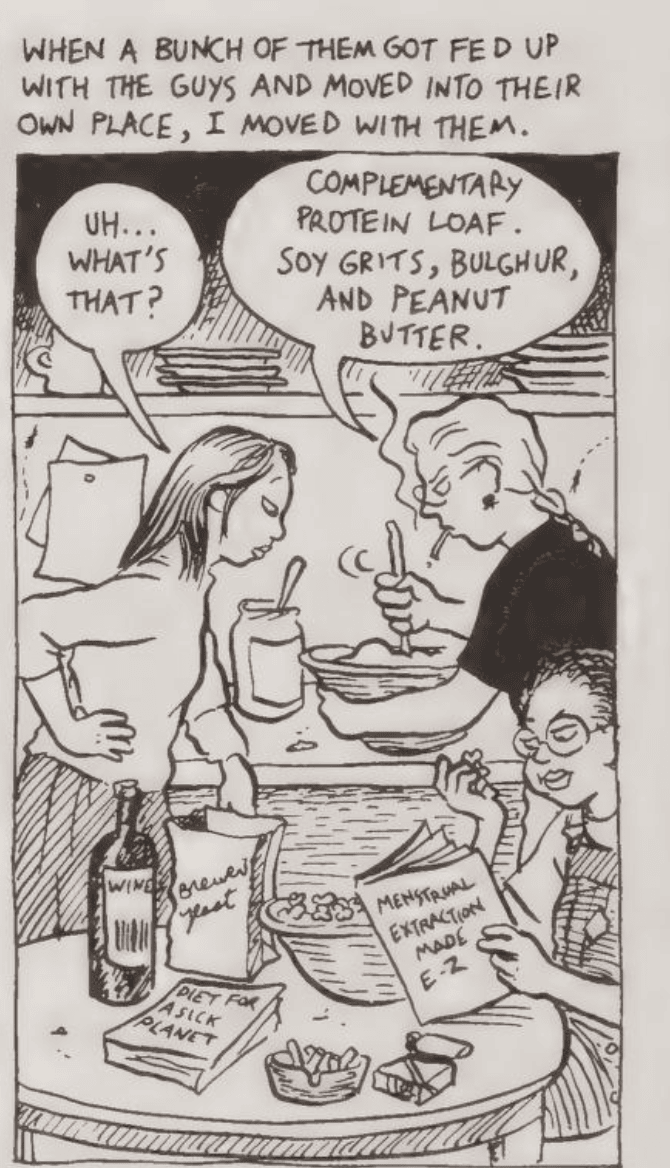
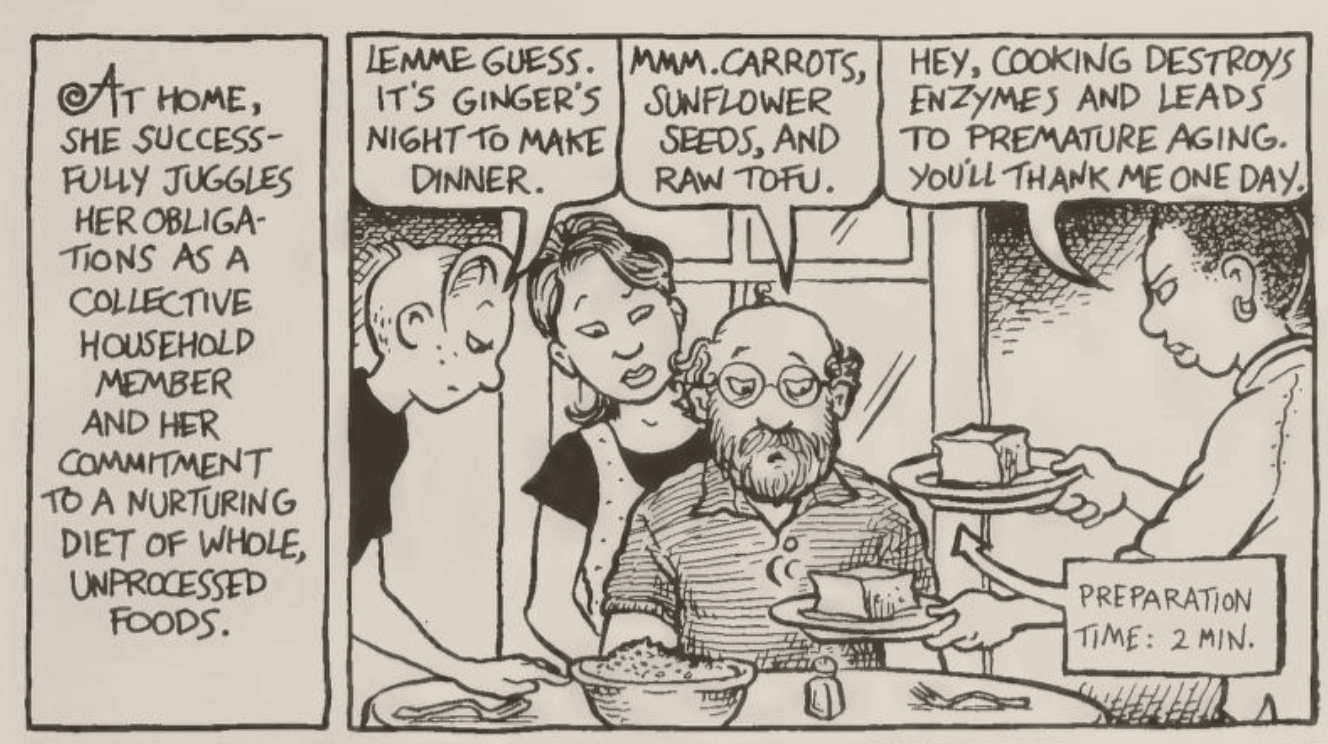
Dykes To Watch Out For
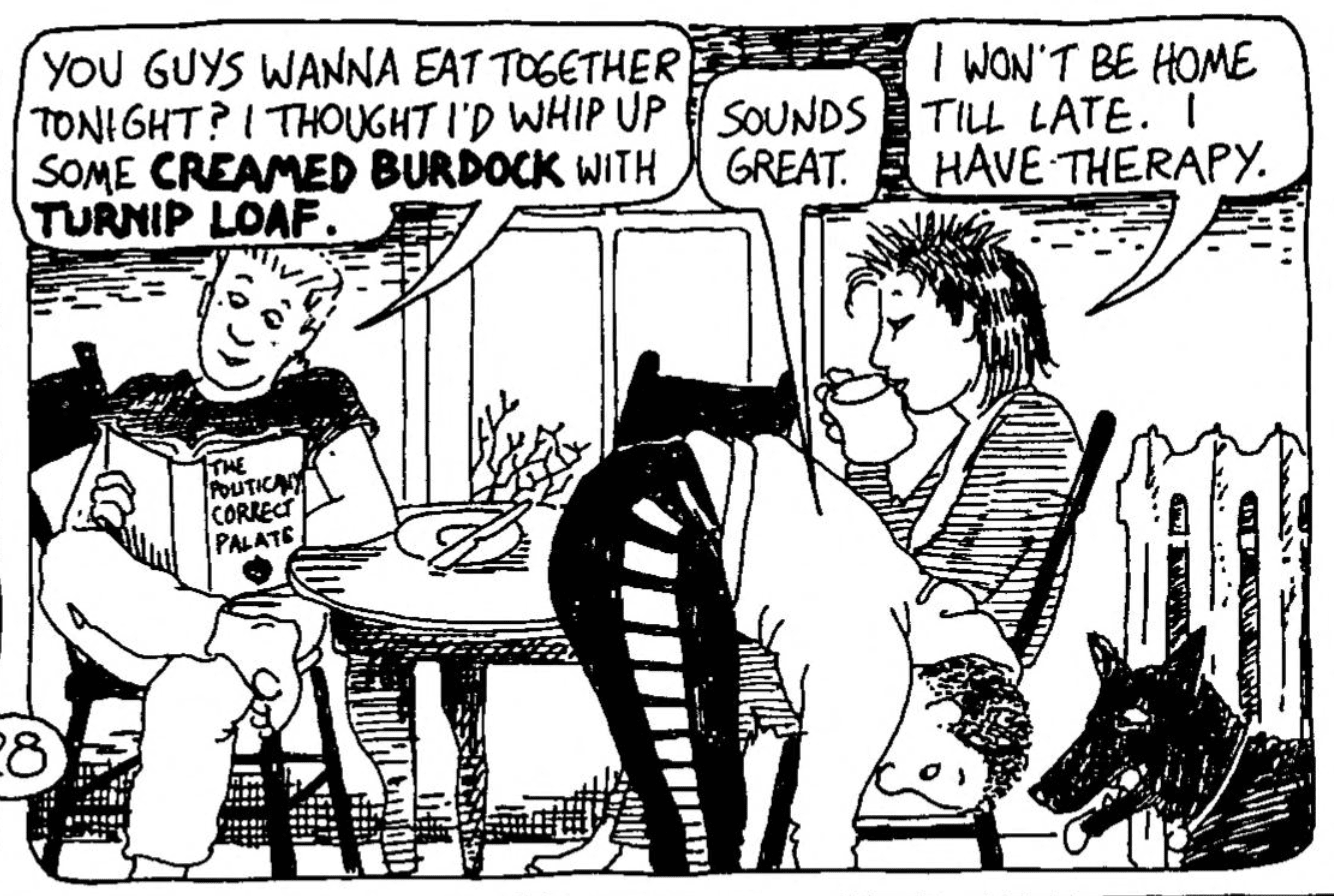
We need to take a bit of a detour to explain my particular relationship to the strip's food jokes. I first became obsessed with its food from a strip in the 1990 book New Improved Dykes To Watch Out For, where Lois offers to cook her housemates some “creamed burdock with turnip loaf.” It wasn’t just the absurd recipe that caught my eye, but the cookbook she’s reading from, called The Politically Correct Palate. This is a sendup of The Political Palate, a 1981 cookbook by The Bloodroot Collective, a group of women who operated the vegetarian feminist restaurant Bloodroot in Bridgeport, Connecticut, from 1977 until its closure in 2025, following the death of co-founder Selma Miriam at 89.
I worked at Bloodroot in the late 90s, when I was a teenager growing up in the next town over. I came out as a lesbian my freshman year, and swiftly declared myself a vegetarian after developing a tongue-tied crush on a hippie straight girl whom I thought might fall in love with me if I, like her, didn’t eat meat. (She didn’t.) It wasn’t easy being the only out queer in my high school, and it wasn’t easy being a vegetarian in the 90s, during which time I ate more oily pasta primavera and portobello mushroom caps on burger buns than any person should be asked to stomach. So discovering Bloodroot was a godsend: an entire restaurant full of food I could eat–actual menu choices!--with a vocally lesbian staff to boot.
My twin sister got a job there as a dishwasher just by asking for one, but when she broke her wrist I took over. For about two years I spent my nights and weekends washing dishes, making endless carafes of coffee, helping cook and plate meals, and cleaning the kitchen and dining room so thoroughly that I can still walk the entirety of it in my head. It was the first time I got to regularly be around other queer people in person, and the thrill of walking into a space full of people like me never wore off. I have indelible memories of pulling Sunday doubles the summer before I left for college: fending off swarms of mosquitos when I got sent out to gather produce from the backyard garden, yelping as I dipped my hands into frigid buckets of tofu in the walk-in, sharing leftover tofu scramble between brunch and dinner on the patio as the restaurant cats–named after Andrea Dworkin and Catharine MacKinnon–played in the grass.
Bloodroot is where I developed the work ethic I’m most proud of in myself: a love of effort and collaboration, how to be reliable and consistent, how to find satisfaction in being one of the people who, in the words of a Marge Piercy poem that hung on the wall, “jump into work head first/ without dallying in the shallows/ and swim off with sure strokes almost out of sight.” The owners would laugh about how I could be convinced to do anything if they started with “hey, do you want to be useful?..,” but coming from my sense of failure to live up to the hetero standards of my peers or my mom’s vision of femininity, I found so much confidence and joy in being of use, especially to other queer people.
My colleagues were eager to introduce me to all the culture I couldn’t access from my pulse-pounding forays into the gay and lesbian section of the nearby Barnes and Noble where I’d sneakily read Dykes, lending me books from the restaurant’s bookstore and explaining the women in the photographs that lined the walls. I went to their group house once to watch When Night Is Falling with one of the younger collective members, lying on the floor of her sweltering bedroom and trying not to act freaked out when I learned that they all kept a gun to deal with threats from their neighbors. Somewhere–possibly in the archives at Yale–there exists a photograph of me in a chunky earth-toned cardigan and silver, female body-shaped earrings made by a local artisan while a group of women teaches me how to spin wool into yarn from a drop spindle, an image so unlike who I am today that I can’t tell if it’s embarrassing or amazing.
My relationship to Bloodroot changed when I went away to New York for college, where I encountered new kinds of queer people. I took a feminist theater class that introduced me to other kinds of feminism than the one the Bloodroot women talked about. At Bloodroot, Mary Daly used to call on the phone to talk about her ongoing lawsuit with Boston College; at school, I read Judith Butler and met trans people for the first time. I asked the women at Bloodroot about Butler when I came home from winter break, and in return they gave me a book whose title I can’t remember but which spent pages hatefully dismissing Butler’s conception of gender, my first understanding that, like for the characters of Dykes To Watch Out For, there was conflict between what generations believed. I started learning exactly what figures like Daly, MacKinnon, and Dworkin thought and where they clashed with my own growing politics.
When I came out as trans in 2002, I had grown beyond the idea of gender essentialism and lived in a world mostly isolated from the conversations at the time that transition was “stealing” butches from the lesbian community (an idea that has, somehow, persisted in newer, stupider forms). But I still struggled with some of the particular losses transition brought on, how to navigate leaving women’s spaces like the New York women’s theater I was volunteering at (which appears in the background of Dykes To Watch Out For too), and how to incorporate my past as a woman into the narrative of my life without laying claim to things that didn’t belong to me anymore. This was a clumsy, sometimes painful time within my communities; there was plenty of drama that would have been right at home in Dykes To Watch Out For, and I’m often grateful for everyone involved that it mostly happened in person rather than online.
I did go back to Bloodroot once well into my transition, assuming no one would recognize me after several years on hormones. As I ordered, Selma peered at me from her seat behind the cash register next to the door before saying “We know you…” We didn’t talk about it when they came to chat at my table, and no one was rude about it, but it felt hard to sit in the intersection of my two lives, feeling a sense of loss despite how happy I was with my transition and how much my politics had changed. I never went back, mostly for regular life reasons, but also because the space held such a complicated role in my life.
In 2018, Bloodroot attracted criticism after a customer claimed Miriam and co-owner Noel Furie had said transphobic things to them in conversation. The controversy spilled out onto Facebook; I wasn’t surprised by it at all, but I also hated that this was how so many people were learning about a place that had meant so much to me, even as my politics sat firmly on the side of the restaurant’s critics. I don’t know how the collective grappled with trans issues after my departure or how its stance might have continued to change, especially as trans politics changed over the years both within queer circles and in the wider world. It’s cowardly, but I largely avoided learning about the restaurant in the years after I left, not wanting to dissect those important years through the lens of my adult trans life and politics. I assumed I was largely forgotten by the place, but a few years ago, I was complicatedly moved to discover that my birth name (the only name of mine the owners would know) appears in the front pages of the Best of Bloodroot cookbook.
I might no longer feel the same about Bloodroot and its politics that I once did, but I first learned how to be queer there, through work and through food. And ever since seeing Bloodroot as a side note in Dykes To Watch Out For, I’ve felt a kinship to the strip's satirical lesbian food. I can never pass by burdock at the farmer’s market without thinking of Dykes’ Bloodroot joke, and for years I’ve told my friends that one day I was actually going to try to cook the recipe.
Over the last week, I finally did–not the turnip loaf, alas, but other dishes pulled at random from the strip’s back catalogue, recreated as best I could figure from the information given. Alone in my kitchen on nights and weekends, playing a “90s lesbian coffee shop” playlist I found on Spotify (not enough deep cuts), it wasn’t like my old days, but it felt good to make expressly queer food from a seminal time in my life, even if most of it was never meant to exist.
Here’s what I made, in chronological order:
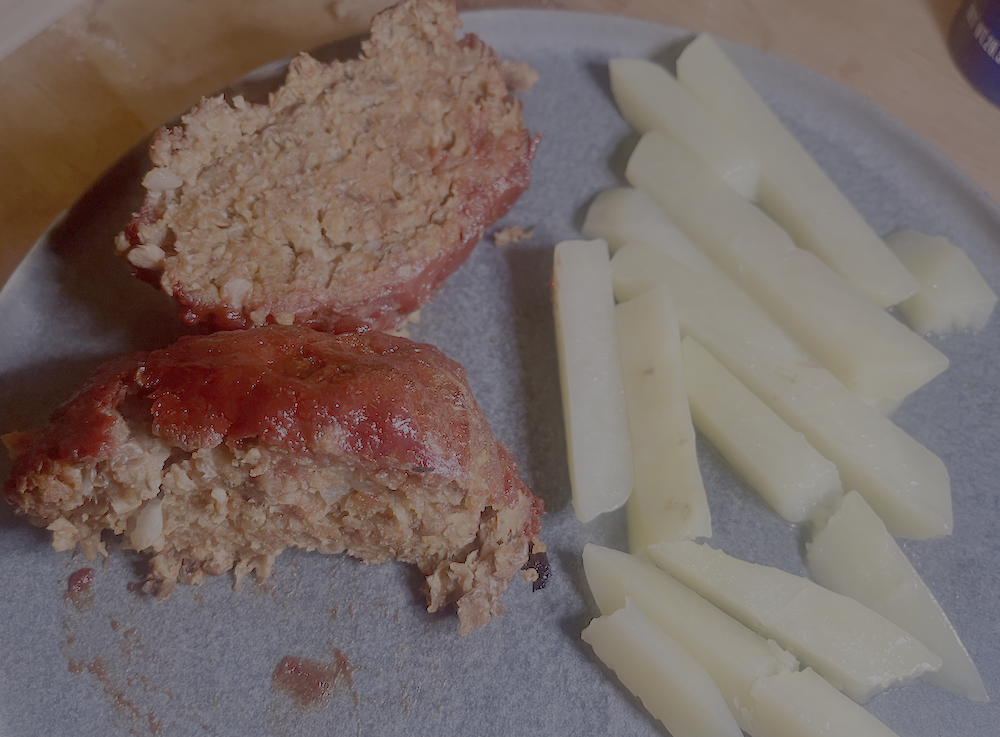
Vegetarian meatloaf with steamed french fries (New Improved Dykes To Watch Out For, 1990)
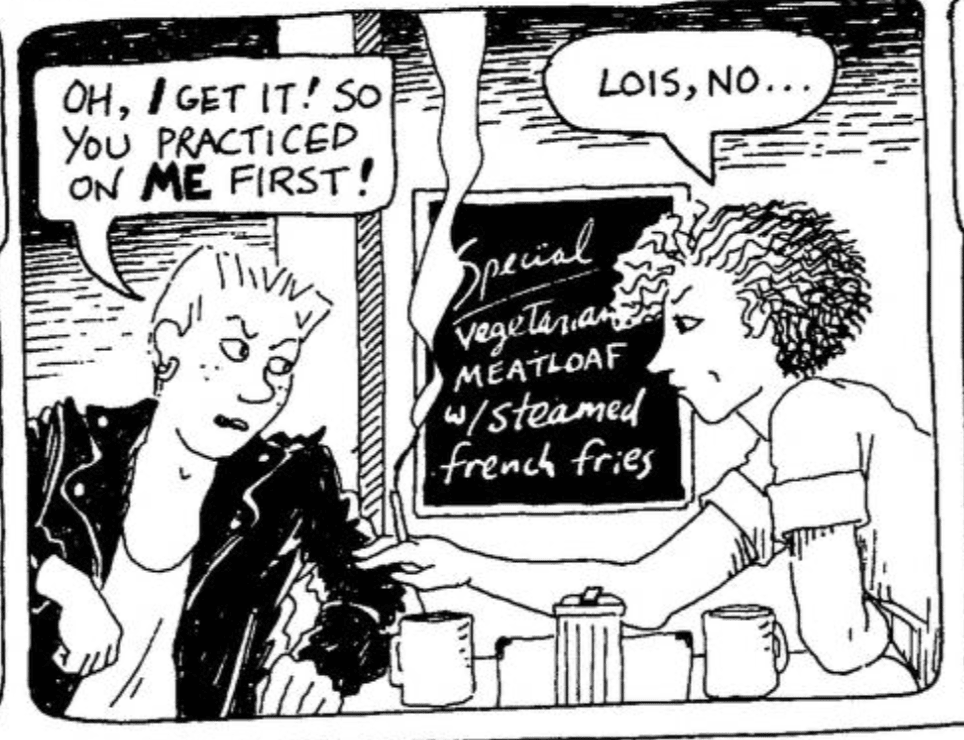
This recipe shows up on the chalkboard menu of Cafe Topaz, where Lois has a surprise lunch with Emma, the newly-divorced, newly-out friend of Lois’ boss at Madwimmin Books. They sleep together, and then Emma ends up falling in love with someone else but still wants to see Lois on the side, in an early exploration of the complexities of non-monogamy.
There’s initially another joke dish on the chalkboard in this strip, for “wheat-free, dairy-free pizza with no tomatoes.” I wanted to make this one too, but I became mired in a conflict over whether the obvious choice of cauliflower crust was a little too modern. I then fell down a research hole of wheat-free crusts that would have ended me up buying a lot of gluten-free binders and flours I figured would just sit in my cupboards until they went bad.
Making the vegetarian meatloaf felt a little bit like cheating, because I actually have a vegan meatloaf I make regularly, by the queen of vegan cooking from my punk days, Isa Chandra Moskowitz. This was the second recipe I made for this project, and I'm glad I did it early, because while all the joke recipes were essentially edible, they weren’t all stuff I wanted to eat. During the course of this project I frequently found myself staring at a fridge full of food, starving, but without anything I was willing to put in my mouth again.
Because it’s a legitimate recipe, the meatloaf was great, and if you’re willing to make something with a couple of steps, I’d totally recommend it. Vegetarian meatloaf isn’t as outlandish today as it was in the 90s; I made mine out of texturized vegetable protein (TVP), but you could surely use one of the modern meat imitations that, due to my lesbian restaurant past, I consider myself too good for.
The steamed french fries were another matter. While it was obvious how to make them, I had doubts they would work. I sliced some potatoes into fry shapes and steamed them for about 10 minutes, at which point they came out exactly like sliced steamed potatoes. I considered running them through the oven to crisp them up, but I assumed “steamed french fries” was meant to be a health food thing, and the oven felt like it was against the spirit. Many of them fell apart when I took them out of my steamer, but once tossed in some olive oil and salt, they were pretty good, if not something I’d ever do again.
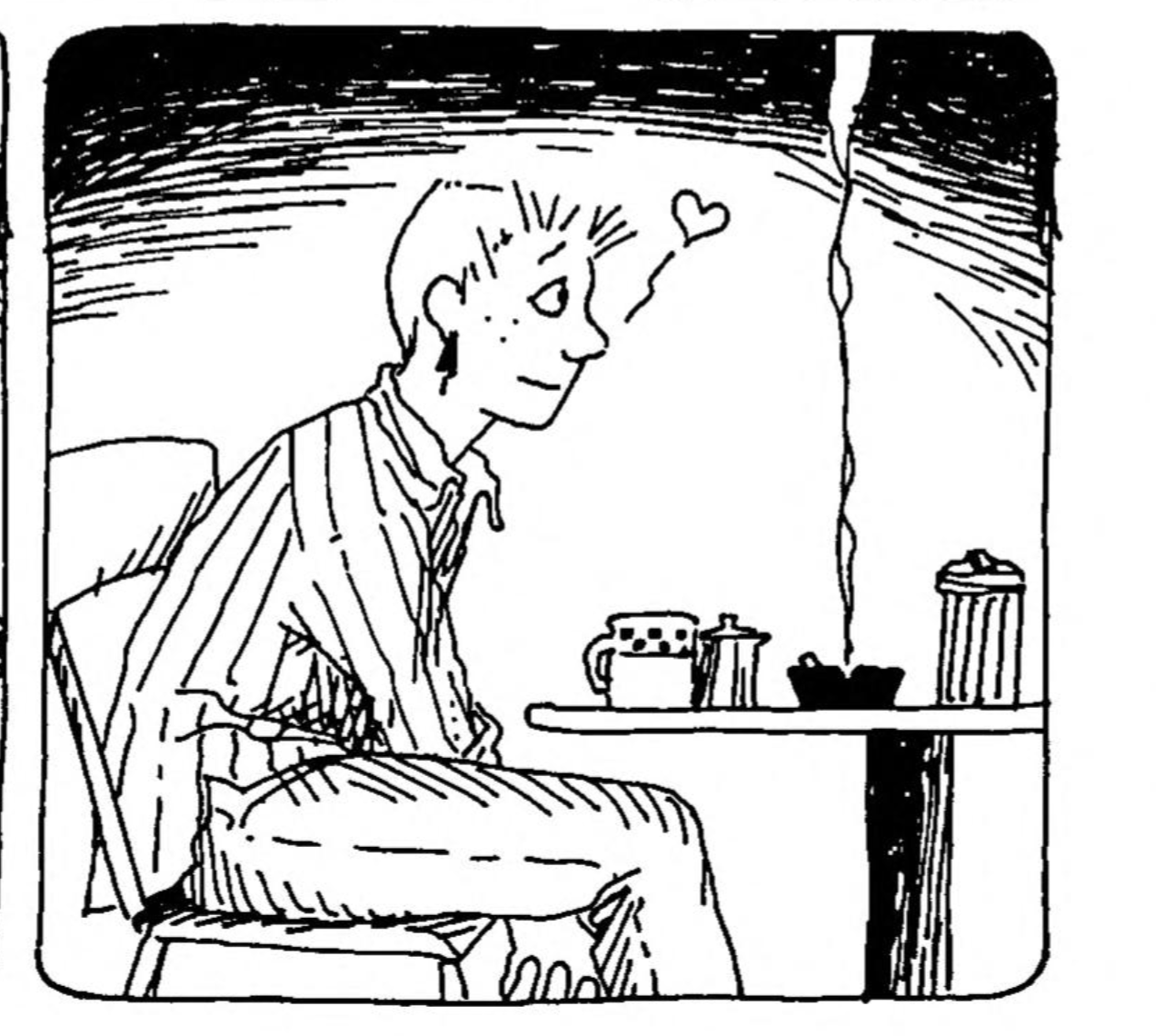
Incidentally, I have dreamed for years of getting the below panel from Lois and Emma’s relationship as a tattoo, but have never been able to decide if it would be gauche on a trans man.
Sweet and sour soybean succotash (Dykes To Watch Out For: The Sequel, 1992)
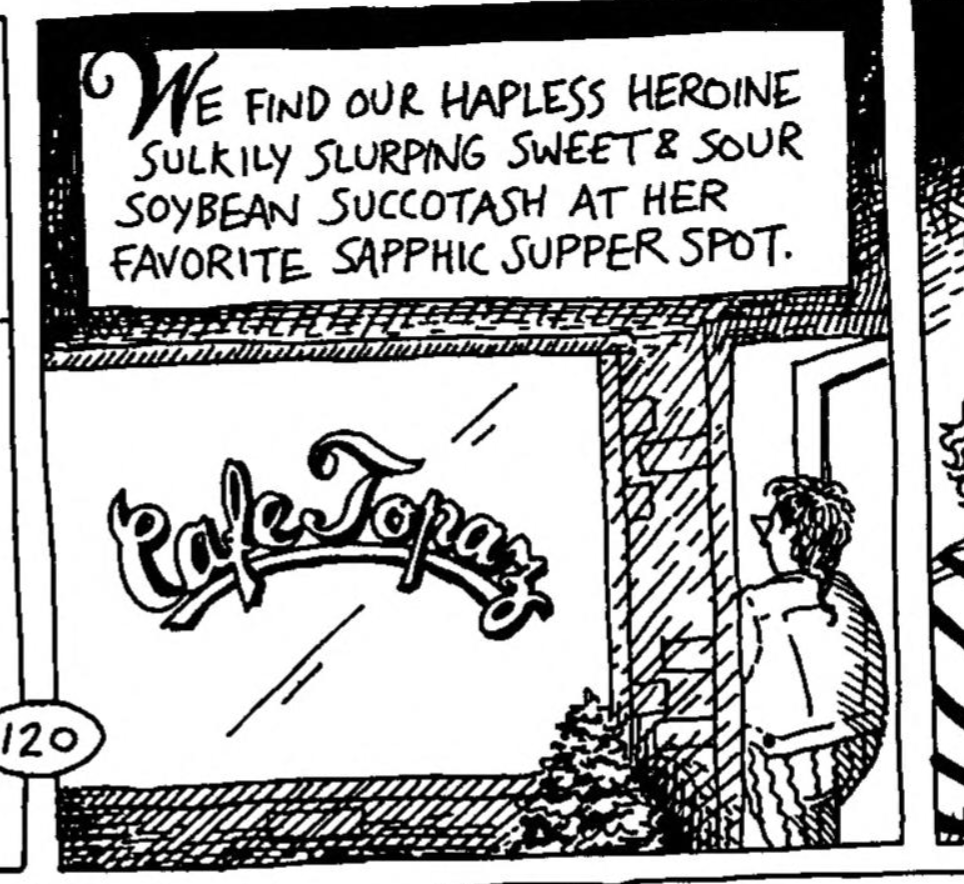
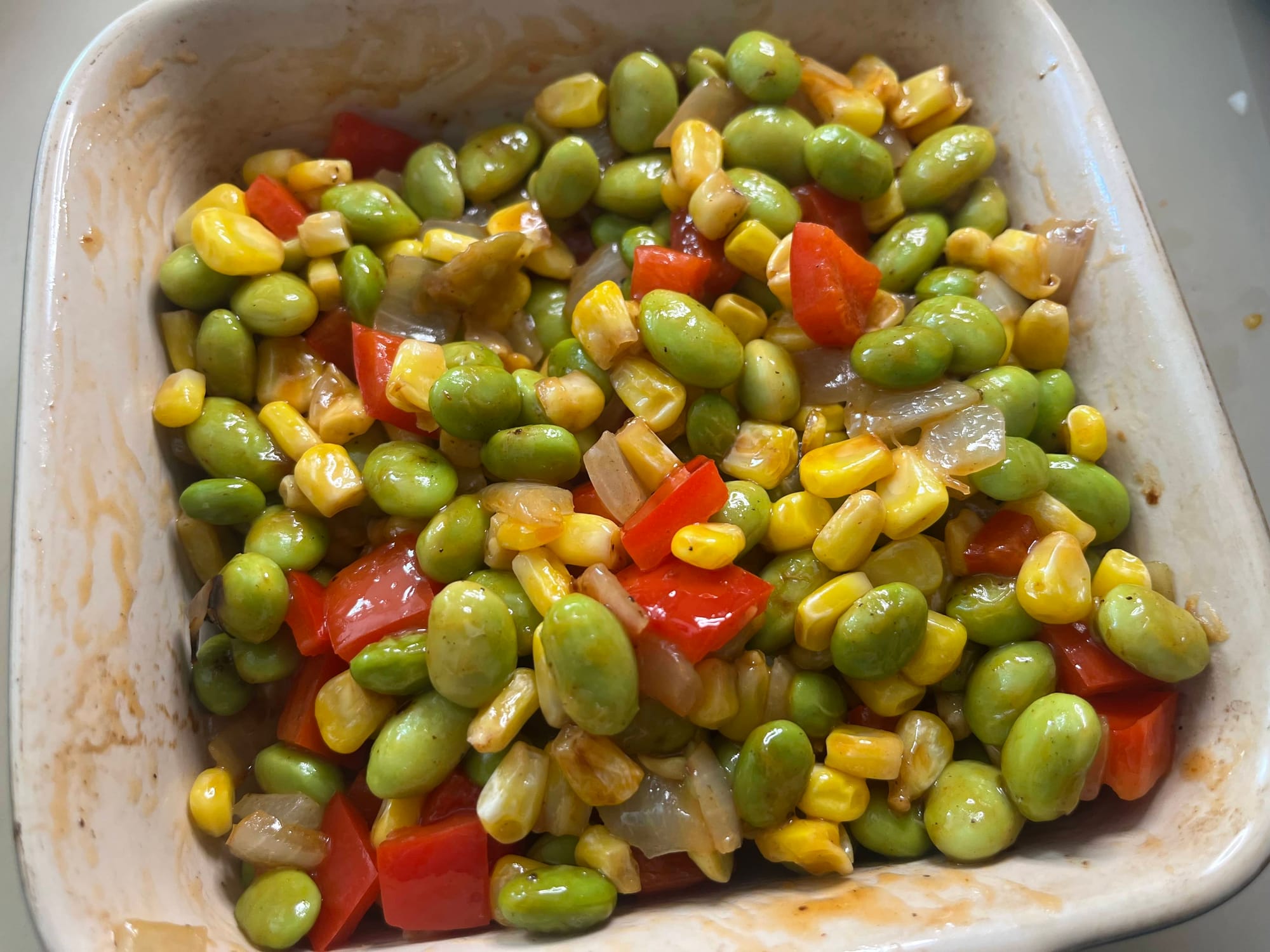
Mo eats this at Cafe Topaz, where she goes to commiserate with her partner Harriet after she doesn’t get a promotion at Madwimmin Books. Bechdel obviously invented this recipe for the alliteration, a joke that I, also a lover of alliteration, can appreciate.
This was easy to do: I made a succotash out of corn, red pepper, onion, and frozen soybeans, then dumped store-bought sweet and sour sauce on it. I would have made my own sauce, but the cost of the ingredients would have come out to more than a bottle of sauce was, and I had already spent enough money on this joke.
I fully expected this to be disgusting, but actually it wasn’t so bad. The sauce paired well with the sweetness of the corn and bounced pleasantly against the earthiness of the soybeans. I tried to sulkily slurp it like Mo does (more alliteration!), but it was hard to feel sulky when getting to do weird shit in my kitchen and rocking out to The Indigo Girls, so I just shoveled it into my mouth standing over a sink full of dirty dishes that had to be washed before I made more food.
I wouldn’t make this again–the sweet and sour sauce isn’t gross, but it’s weird–though it was a good reminder that I should make more succotash with all that summer farmer’s market veg.
Tempeh tartare with steamed celery (Dykes To Watch Out For: The Sequel, 1992)
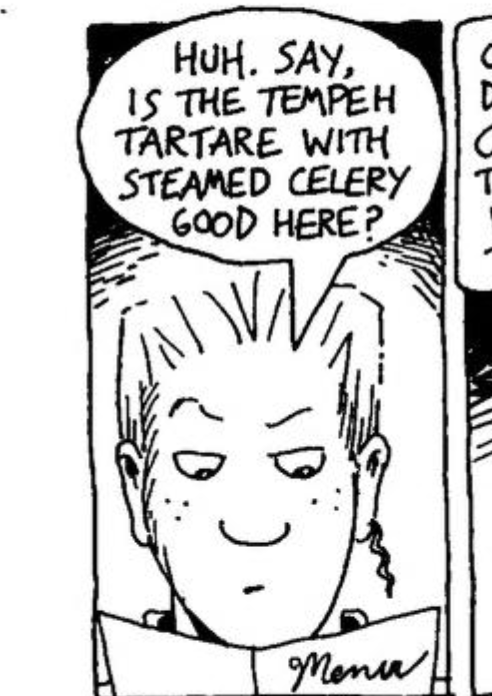
Lois wonders about ordering this at Cafe Topaz (everyone goes there a lot), where she’s having lunch with Clarice and Mo to commiserate about Clarice’s time in law school. I’ve never had a meat tartare–I stopped being a vegetarian on a trip to the Pacific Northwest in 2012, when I ate fish for the first time in almost 20 years and wondered how I’d ever lived without it. Still, I don’t cook or eat a ton of meat today, especially underdone or raw. A fun fact about me is that I was born without a sense of smell, so I’m super uptight about food safety and tend to overcook most meat even when I mean not to.
I was shocked to actually find a recipe for this one, which raises the question of whether tempeh tartare is a thing and not just another bit of Bechdel wordplay. I don’t tend to love tempeh and was dreading eating it after only a quick dunk in some boiling water, but the part of this I was dreading more was the celery. I fucking hate celery– not the taste per se, but the concept. Unlike carrots or parsnips, which at least in New York you can buy free-standing in the quantity you need, celery can only be purchased in giant packs. You almost never need more than a stalk or two, meaning you are stuck with a ton of tasteless, stringy water for basically the rest of your life. The only thing that could make celery worse would be steaming it, which I also had to do.
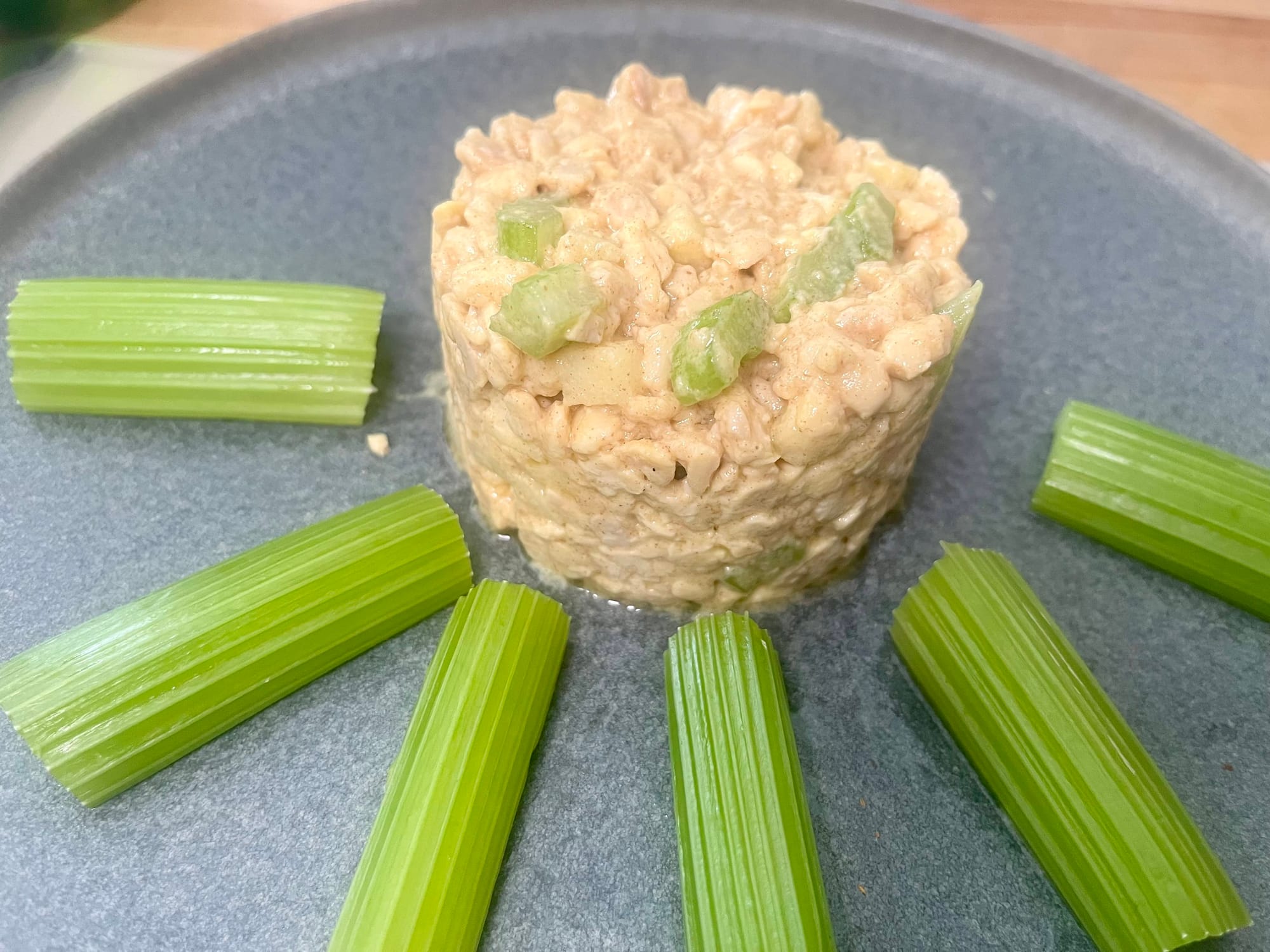
Despite all the things working against this recipe, it was actually stunningly delicious. Tempeh doesn’t taste like much, but mixed with vinegar and mustard and half a tart apple, it was tangy and satisfying and compulsively eatable. After looking at pictures of tartare online, I shaped it into a puck with a biscuit cutter, which made it really fun to plate. Steaming the celery made it too soft to make a dent in the little tartare tower, but when I scooped some tartare into a celery crevice with a spoon, the surprising sweetness and soft-but-still-a-little-crispy texture of the celery made for a great contrast.
This is the one recipe that I regret that I wasn’t able to share with my friends, but I would absolutely bring it to a dinner party if I was able to preface it with being a joke from Dykes To Watch Out For to encourage people to overlook its pale, damp appearance. I honestly can’t believe this one worked out as well as it did.
Carob-millet clusters (Spawn Of Dykes To Watch Out For, 1993)
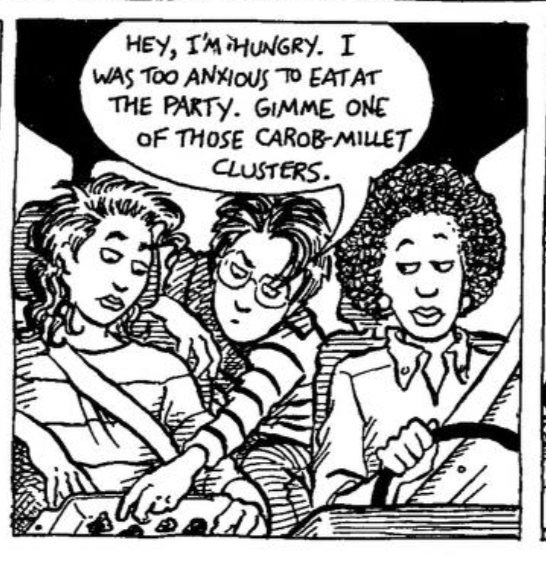
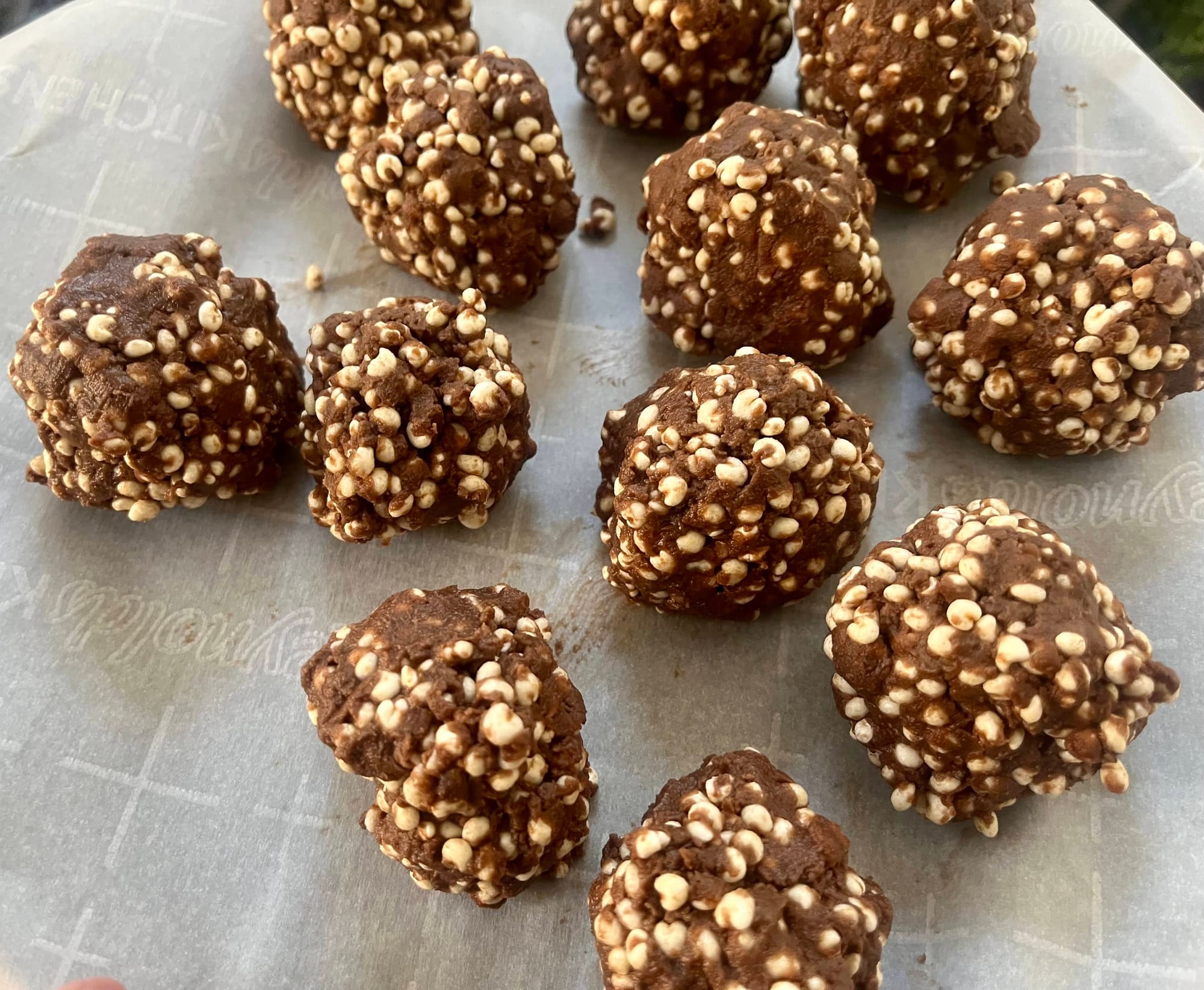
Mo asks for one of these after she sees her ex Harriett at Toni and Clarice’s backyard baby shower. I haven’t encountered the horrors of carob in decades; I feel like the whole world has moved beyond it and just eats chocolate like normal people now. Part of me was grateful when it didn’t turn up at a succession of grocery stores in my neighborhood. Just before I was either going to start exploring New York’s few remaining old-school health food stores or stand outside my neighborhood food co-op begging for mercy, I found carob chips at my local Korean bodega. I embarrassed myself trying to explain to the cashier how exciting but also bizarre this was, and how I was going to buy the carob but I didn’t want to, but I don’t think she got it.
I assumed a “cluster” was something like a rice krispie treat, so I figured I would pop some millet like popcorn and then coat it in melted carob. I spent an entire morning burning successive pans of millet before giving up and biking to one of the aforementioned health food stores for puffed millet cereal, which came in a pleasantly affordable but depressingly large bag.
The next challenge came in attempting to melt carob, which instead of getting liquid like chocolate turns into a clumpy mass. I figured it needed some fat added to it, but my open jar of coconut oil seemed too old to be trusted. I ended up plying chunks of butter into the appalling clump of carob in my bootleg double boiler until it turned into something I could stir the puffed millet into, then rolled the ensuing mess into balls and left them out to harden.
Carob turns chalky when it solidifies, and it’s cloyingly sweet in a way chocolate isn’t. But the nuttiness of the millet offset it a little, and I’ve actually been eating my carob-millet clusters at home despite my plan to take a picture of them and then consign them to the compost bin. This is the only dish I was able to share with friends, and while they didn’t finish the clusters I brought them, they did nibble on them and say they weren’t so bad. If I were to do this again, I’d either add nuts or other mix-ins, or do it in a loaf pan to turn them into some kind of bar. I do, however, hope to never buy carob again, so this seems unlikely.
Vermicelli with chard stems (from Hot Throbbing Dykes To Watch Out For, 1997)
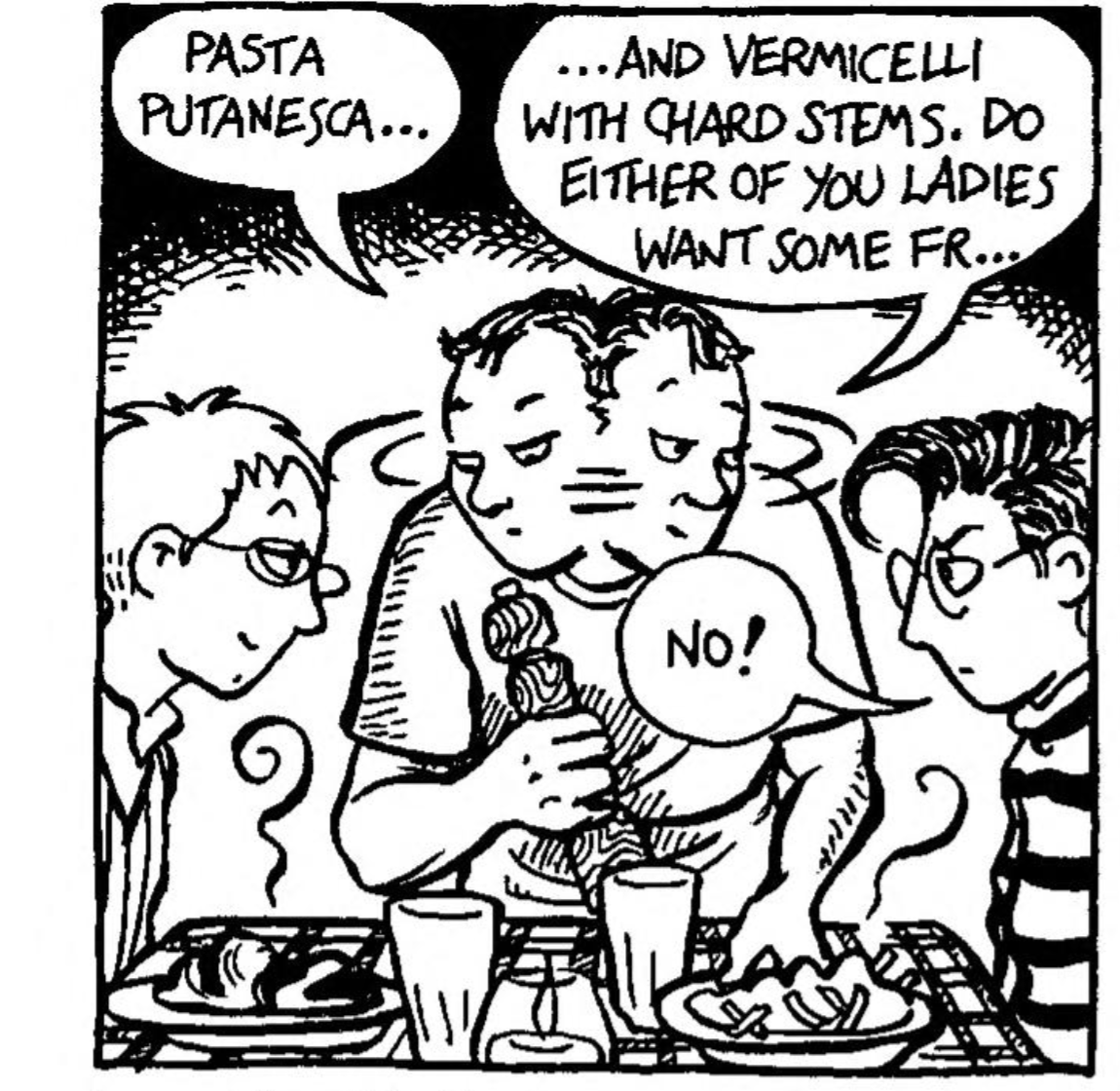
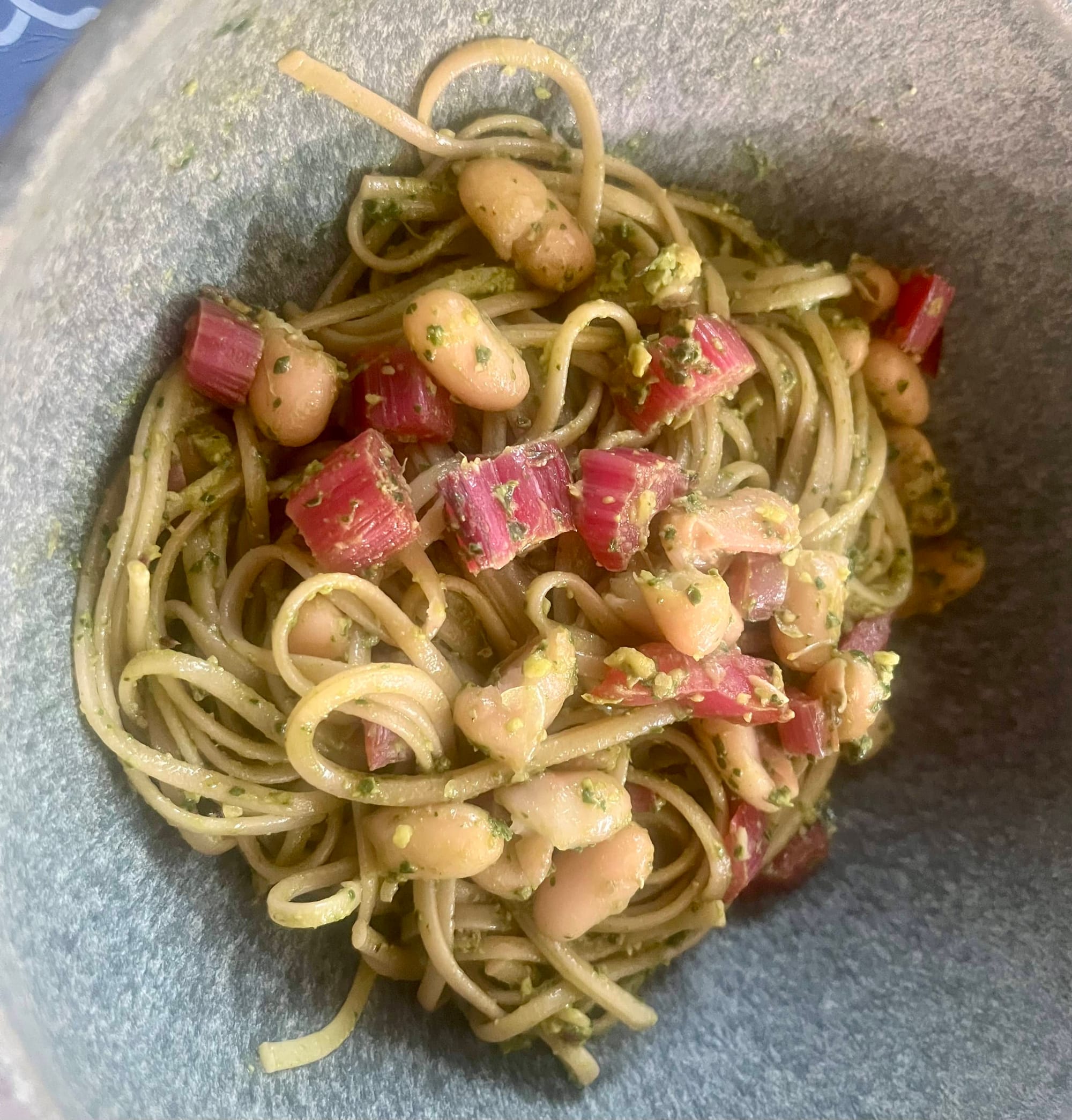
Mo eats this on one of her earliest dates with Sydney, the unlikeable academic who ultimately becomes her partner, when they have an emergency lunch at a place called Pastafazool after Mo finds out that Sydney once had an ugly breakup with Mo’s bookstore colleague Thea.
I feel like you don’t see vermicelli around as much as you did in the 90s. I couldn’t find it in the store and wound up going with linguine fini because I didn’t want to eat a pile of angel hair. The only other requirement here was chard stems, but of course I had a whole head of chard, so I sauteed the stems and then used the leaves to make my go-to vegan pesto, with cheaper walnuts instead of pine nuts and nutritional yeast in place of cheese. I added a can of white beans I had on hand for some extra bulk; since this made so much food, I figured I’d turn it into a meal.
This was the first recipe I made for this project, and like the meatloaf it ended up being something I could actually eat, which was very welcome. Unlike other things I made, it was easy, economical, and didn’t leave me with a bunch of leftover ingredients I don’t know how to use. I’d make it again, though I’d go with a thicker pasta. Skinny pastas weren’t as elegant as they made out to be in the 90s, and they aren’t elegant now.
Osso buco out of texturized vegetable protein (Post Dykes To Watch Out For, 2000)
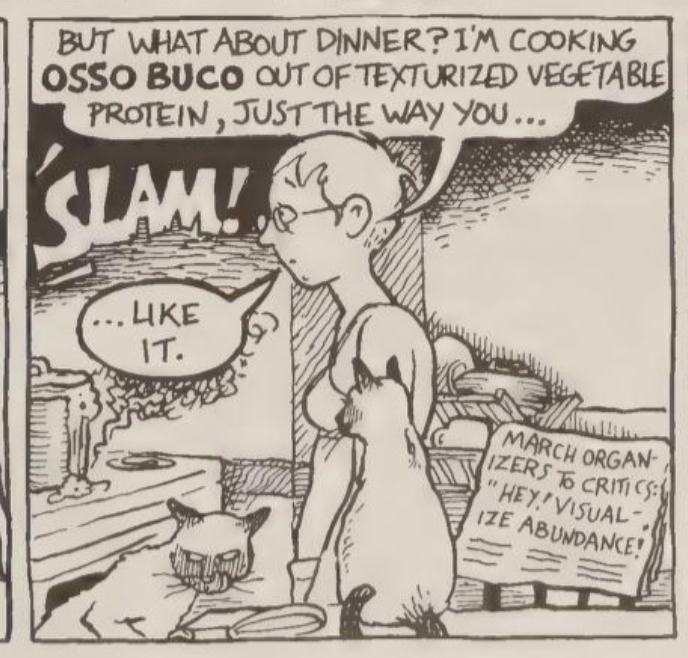
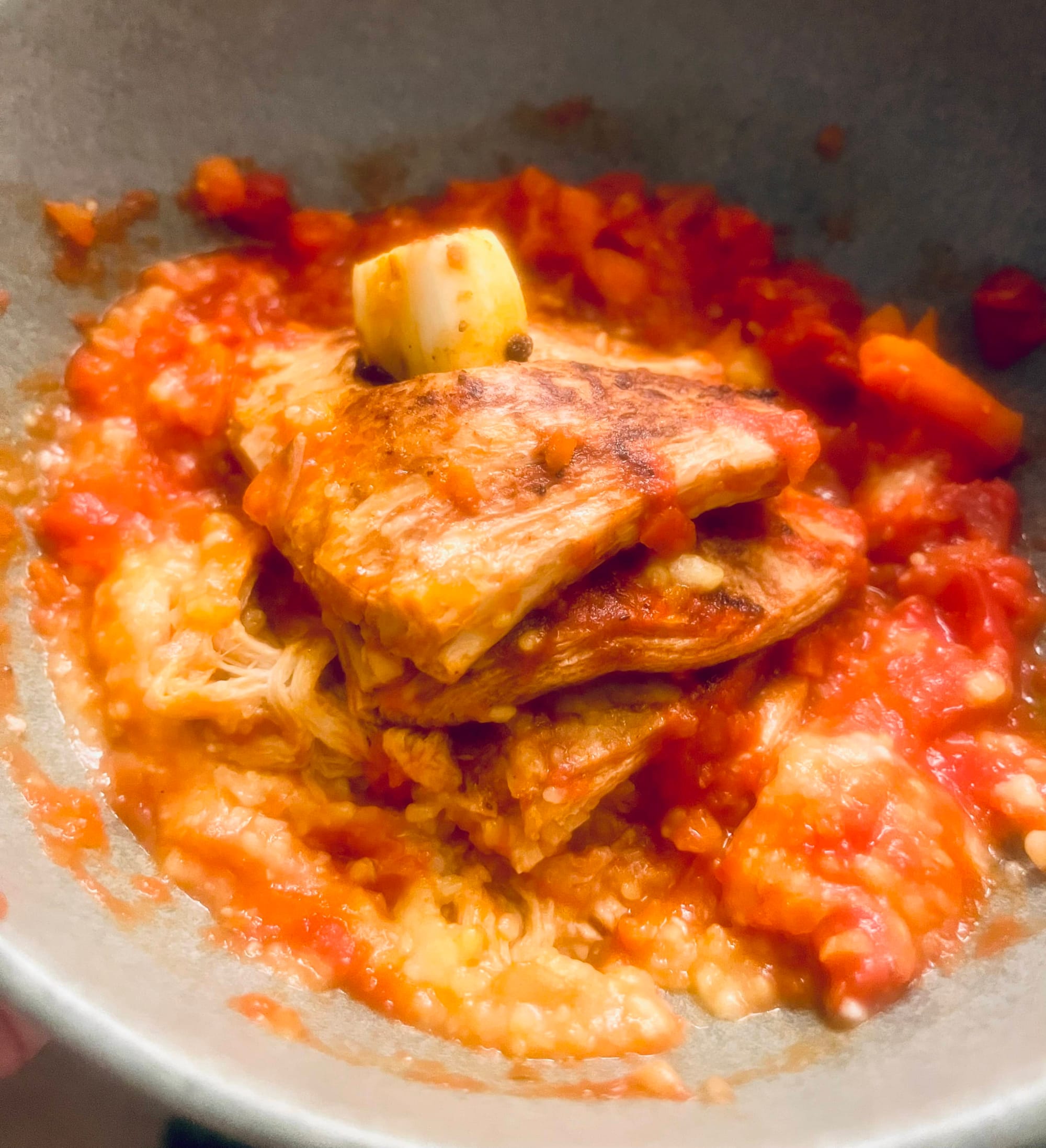
There were two foods in this project that I knew were going to be my Waterloo: this one, and one I bought all the ingredients for but regretfully couldn’t get to, curried artichoke and mung bean gumbo. (Gumbos take hours, and I ran out of time; if my friends find this project funny enough to want me to keep going, I will probably use the mung beans to try to make it for them.) Sydney is making this for Mo when Mo finds out that Sydney has been selling their Martha Stewart-themed online sex chats to a Penthouse knockoff called Panthouse, though Mo storms out and they never get to eat it.
This one presented a bunch of challenges. For starters, I have never had osso buco and didn’t actually know what it was. I’m pretty sure I’ve had veal at least once in my life, but I have no memory of what it tastes like or what its texture is. So not only did I have to make a famously meat-based dish vegetarian, but I had to make something I had no frame of reference for besides pictures online.
Another challenge was the required TVP. “Texturized vegetable protein” sounds unappetizing and performatively 90s vegetarian, which is possibly why Bechdel picked it, but it makes no sense as an ingredient for something that needs to mimic a hunk of meat. The most obvious thing to make vegetarian veal out of would have been seitan, though it would be hard to get it to mimic what I understand to be the tenderness of veal. But Sydney is using TVP, so I had to as well.
Unfortunately, the TVP I had at home was crumbles that were perfectly suited for the meatloaf, but not a great stand-in for veal. I spent a few days researching various vegetarian steaks or chicken cutlets looking for any that were TVP-based, but nothing came up. I debated just dumping a bunch of TVP crumbles into one of my go-to seitan recipes and hoping for the best, but it felt like getting clever with the requirements. I thought about making a TVP burger and shaping it like a veal shank, which could mimic the tenderness of veal, but it would fall apart in a crumbly way, instead of the way a “shank” should.
Finally, while wracking my brain, I remembered the existence of a whole store in Chinatown dedicated to vegan meat. I hadn’t been there in over a decade; so long, in fact, that I was surprised to learn it had changed its name from May Wah to Lily’s Vegan Pantry. If anyone would have some kind of TVP that might do, it would be them, so I took a lovely bike ride over the Manhattan Bridge. The store sold a literal vegan steak that would have been perfect, but it felt too much like cheating, especially since it was the kind of fake meat that I know for a fact wouldn’t have existed when Sydney was making this meal.
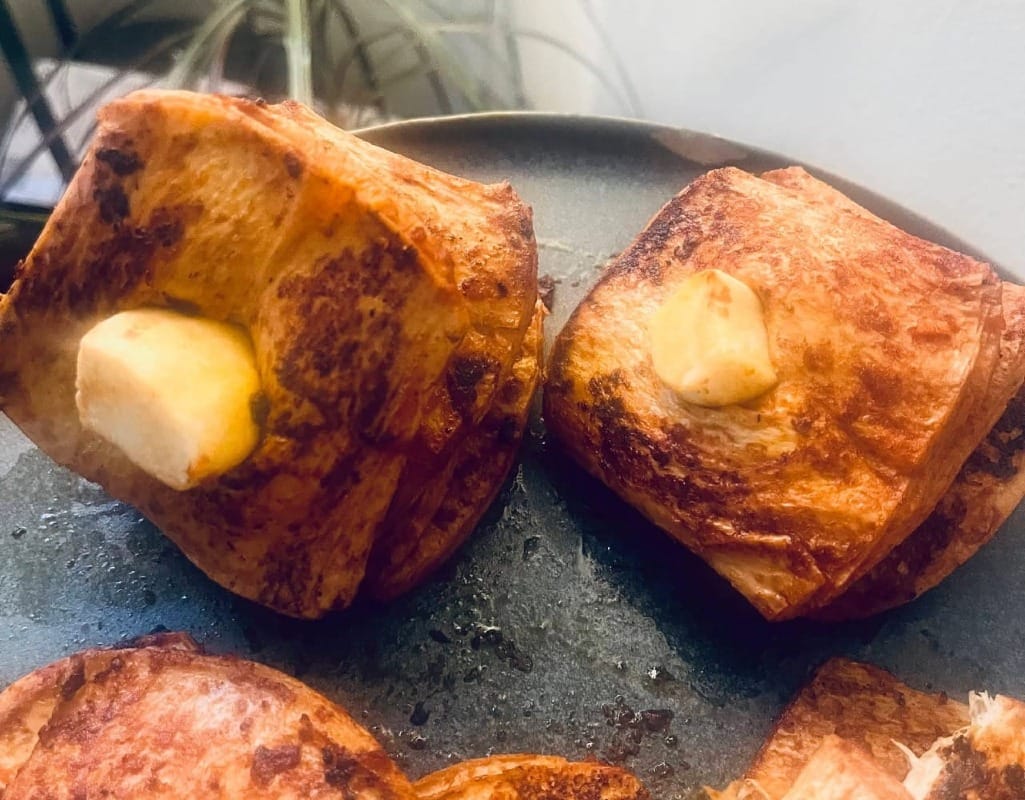
After trying to explain my dilemma to a guy who worked in the store and alienating him in the same way I had the cashier at the Korean bodega, I eventually settled on TVP slices. I rehydrated them and then coated them in a steak-like marinade of tomato paste, brown sugar, soy sauce, and liquid smoke. I did this because veal is beef, though I don’t think it’s supposed to taste like steak, but googling “what does veal taste like” didn’t give me a lot of information I could recreate with what I had on hand. I pan-seared the slices briefly to mimic the searing you apparently do in osso buco. They were pretty good; they were tender to bite into and mostly shredded like meat, but I’d had trouble rehydrating them (they kept floating to the top of my bowl until I weighed them down with another bowl and some bean cans), so not all of them were as tender as they could have been.
To mimic the appearance of a veal shank, I whittled down some parsnips and stuck them through a stack of TVP slices. I felt really clever about this; from a certain angle, they almost look like what I think veal looks like.
Then, I set about making the osso buco, pulling a recipe at random from the internet to go off. Since this is a special recipe I went all-out, even going to a nearby non-alcoholic booze store for NA wine to use for the white wine the recipe asked for. (Side note: the NA wine was delicious, which I couldn’t believe given my memories of how gross it used to be; with summer coming on, I’m definitely going to buy it again.) I’ll be honest that I don’t know if I did it right: it was very tomato-y, possibly because I used a can of pre-crushed tomatoes and it might have been too much tomato. I don’t eat a lot of tomatoes because they give me heartburn, which is such a “44 year old man writing about food from when he was a young lesbian” thing to say, which means that I ended up with a tupperware full of something that seemed right on paper, but wasn’t really something I enjoyed.
I also made polenta to go with it, which is what the internet said osso buco is served with. I don’t make a lot of polenta, and I forgot what a pain in the ass it is and how much it sucks as leftovers. This recipe took basically an entire day, and in Sydney’s defense, it really did feel like a labor of love.
Despite all that, and for the above-mentioned reasons, this one "worked" but I didn't really like it. I’d make it for a special occasion if someone really wanted it, but I’d make the meat out of seitan and be more thoughtful about the tomatoes. My go-to fancy vegetarian main is Moskowitz’s seitan loaf with shiitakes and leeks, which sounds like something you’d expect to find in a Dykes To Watch Out For joke but is delicious and not nearly as hard or expensive as making this osso buco was. Overall, finding a good NA wine felt like the biggest win on this one.

This week on Aftermath, we’re celebrating Woke 2. What does that mean? Pieces that dig into the origins of woke—not the empty, sanitized version peddled by companies, but actual culture created by people—as well as communities that are already charting a course to a bolder, better future where we can all just be chill to one another.


