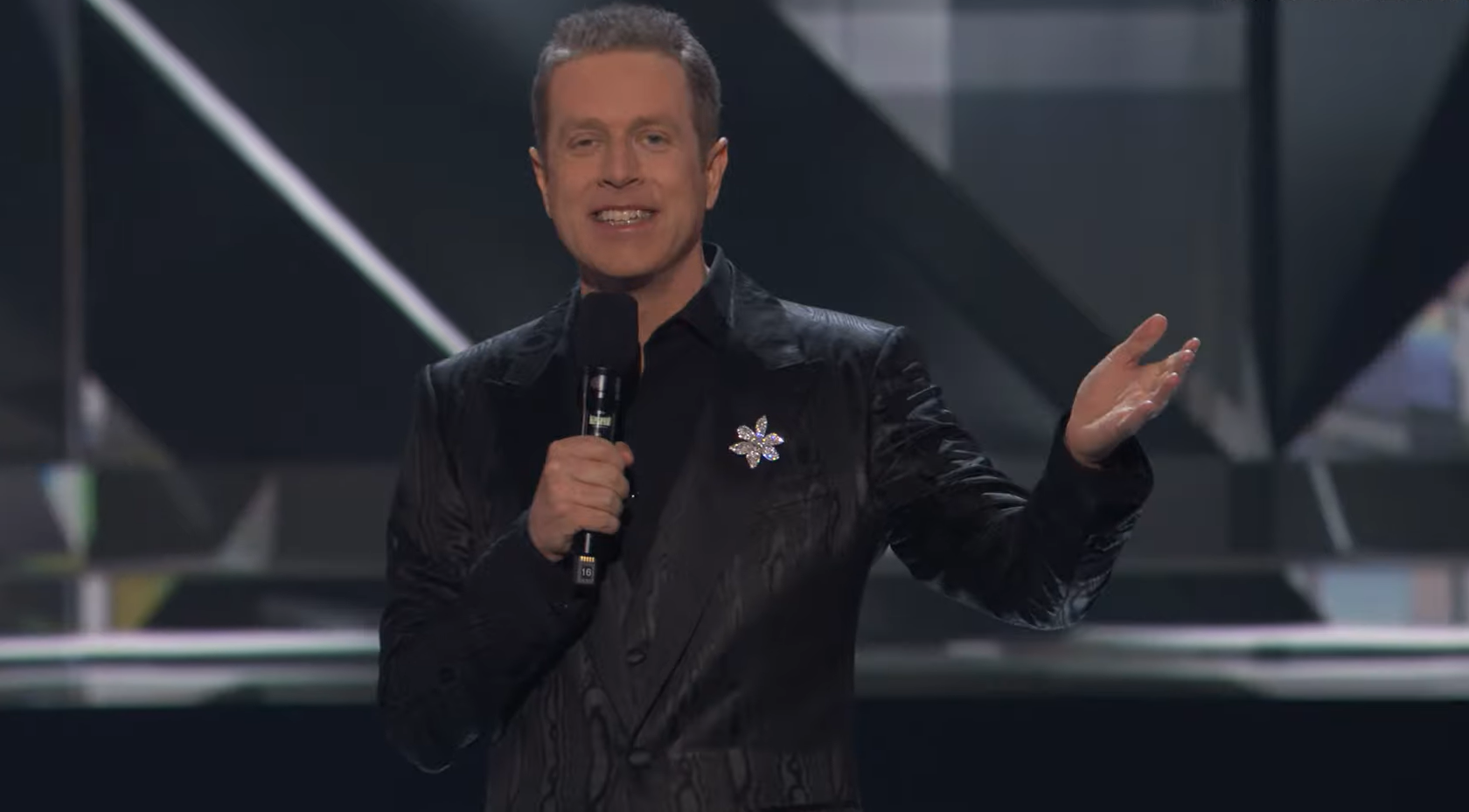
As is tradition, Geoff Keighley kicked off last week’s Game Awards with a speech. Defying the show’s established norms, he took things in a personal direction, informing the audience that in 2025 his house burned down in the LA fires, and his father passed away. He found solace, however, in games: “Games have this incredible ability to hold us when we’re hurting, to lift us up when we feel small, to give us somewhere to go when the real world feels unsteady,” he said. “That’s why we’re all connected in this moment: We’re here to celebrate the artists, technicians, and storytellers who help this medium soar to new heights.” But outside the show’s gilded walls, many felt ignored rather than celebrated.
Last month, Game Developer broke the news that the Game Awards’ Future Class – a program meant to honor and facilitate annual cohorts of industry professionals who “represent the bright, bold, and inclusive future of video games” – has effectively been put on ice. This followed a prolonged period of silence from the organization after Future Class members began demanding more from Keighley and those running it: travel, resources, funding, and networking opportunities more in line with the way the program had been presented over the years, as well as public statements acknowledging ills those in the world of games and beyond could no longer afford to ignore, like layoffs and the genocide in Palestine.
Outside the Peacock Theater in Los Angeles on Thursday, anger around the Future Class’ dissolution – as well as the callousness with which many companies handed shimmering trophies at The Game Awards continue to cast aside thousands of workers – coalesced into a protest organized by United Videogame Workers, the union anyone, even laid-off workers, can join announced by Communications Workers of America (CWA) at GDC earlier this year.
"The moment we actually tried to ask for something better – or for them to put their money where their mouth is – they just quietly killed the program.”
The theme of the protest was “The Industry Is Dead,” and many of the 50 or so developers who showed up took that to heart. A handful dressed in grim reaper outfits, while others carried signs shaped like tombstones. One read “RIP Future Class, Died Of Performative Allyship.” The UVW chair who made it, freelance writer and narrative designer Anna C Webster, was a former Future Class member.
“You’d think that we as the Future Class would at least know what the future of our program looks like,” she told Aftermath. “But they basically did not communicate that at all until we got together and said ‘Hey, what’s going on?’ To say that we’re disappointed is probably an understatement. It’s very disappointing that someone with the platform Geoff has is not using it for good. The moment we actually tried to ask for something better – or for them to put their money where their mouth is – they just quietly killed the program.”
Younès Rabii, a former Future Class member who organized an open letter urging Keighley and co to acknowledge Israel’s inhuman treatment of Palestinians, expressed a similar sentiment.
"The way that Future Class members were treated by The Game Awards, it feels like we outlived our usefulness of diverse faces smiling for the camera,” Rabii, who did not attend this year’s Game Awards, told Aftermath. “Once we tried to ask the structure to put money where its mouth was, the facade crumbled. I vividly remember that during the only meeting we had after the 2023 show, when I asked Geoff Keighley why he ignored our open letter, he angrily replied ‘This is my show, and nobody gets to tell me how I should use my platform.’ What else is there to say?"
around 40 game developers affiliated with @videogameworkers.bsky.social have gathered outside the peacock theater, where the game awards will take place in a few hours, for a “the industry is dead” demonstration
— Nathan Grayson (@nathangrayson.bsky.social) 2025-12-11T23:13:36.959Z
Despite the outcry that followed the initial headlines last month, Webster said that she and other Future Class members haven’t heard a peep from Keighley or program organizers since: “Nope. Nothing.”
The protest outside The Game Awards focused on far more than just the Future Class, with pro-union and anti-CEO chants filling the air. “Our industry is dead, lay off CEOs instead,” protesters shouted at various points. “No more layoffs, no more lies, no more playing with our lives.” A pamphlet handed out by UVW members summed up the grim truth of the day: “In 2025 alone, upwards of 3,500 video game workers have lost their jobs, healthcare, and security. That number skyrockets to more than 40,000 workers when you include all tech and game workers laid off in the past three years.”
Kaitlin “KB” Bonfiglio, a writer and designer who also serves as UVW's local secretary, pointed to recent reporting that suggests a Game Awards trailer spot can cost between $450,000 and over $1 million.
"There's a lot of pomp and circumstance around it," she told Aftermath, "so we wanted to make sure that we were here representing game workers – the people who make these games – raking in millions for these executives."
This was not an entirely hassle-free process. Security attempted to prevent protesters from claiming a spot outside the theater. "We had to produce our own statutes regarding this particular terrace, which is part of LA Live," said Webster. "We also have legal council, and we had them prep the information we'd need to say 'Hey, we're allowed to be here.' Eventually, they let us in, but they were trying to turn us away."
There is a history of protests outside The Game Awards, with SAG-AFTRA leading two in 2023 and 2024 as part of the since-concluded voice actor strike. Members of SAG, though not representing the guild at large, were among those who attended Thursday’s protest. Sherveen Uduwana, a freelance game developer and treasurer with UVW, said others’ past efforts served as inspiration for this year’s protest.
"This is an escalation. People have shown up in previous years to push these issues forward,” Uduwana told Aftermath. “We want to make it clear to the bosses that this is not a problem they can just wait out. We're gonna be prepared to speak to these issues: mass layoffs, taking away healthcare, generative AI. And make sure we win on those issues and workers have protections."
Midway through the protest, a procession of developers gave speeches into a megaphone.
"We are the ones who poured our blood, sweat, tears, sanity, and health into these games,” shouted one who paid tribute to a friend who’d just passed, who he said loved video games and hated corporate exploitation. “The ones who made the games are outside. [Bosses and executives] are inside patting themselves on the back. ... And what was our reward? Many of us were cast aside as soon as the products were created because we weren't needed anymore. And those who were lucky enough to stay [now] find themselves debugging ChatGPT code."
Some present had direct personal experience with the video game industry’s current layoff-centric strategy. Earlier this year, Timothy Staton-Davis, who attended the protest dressed in a grim reaper cloak and holding a plastic scythe, was part of a small round of layoffs at Brass Lion Entertainment, which is currently working on Wu-Tang: Rise Of The Deceiver.
“There were a few of us they had to let go of because of monetary issues,” Staton-Davis told Aftermath. “It’s their first game. They’re trying to pull through. They’ve been negatively affected by the current industry situation in a lot of ways because of mismanagement of money. It’s not the studio’s fault, but from our partners and all that kind of stuff.”
“My first studio gig was at Monolith,” he continued. “Now they’re gone. Unfairly so. All these studios I’ve been connected to have been negatively affected in some way, shape, or form by people not doing the right things with their money and taking advantage of folks.”
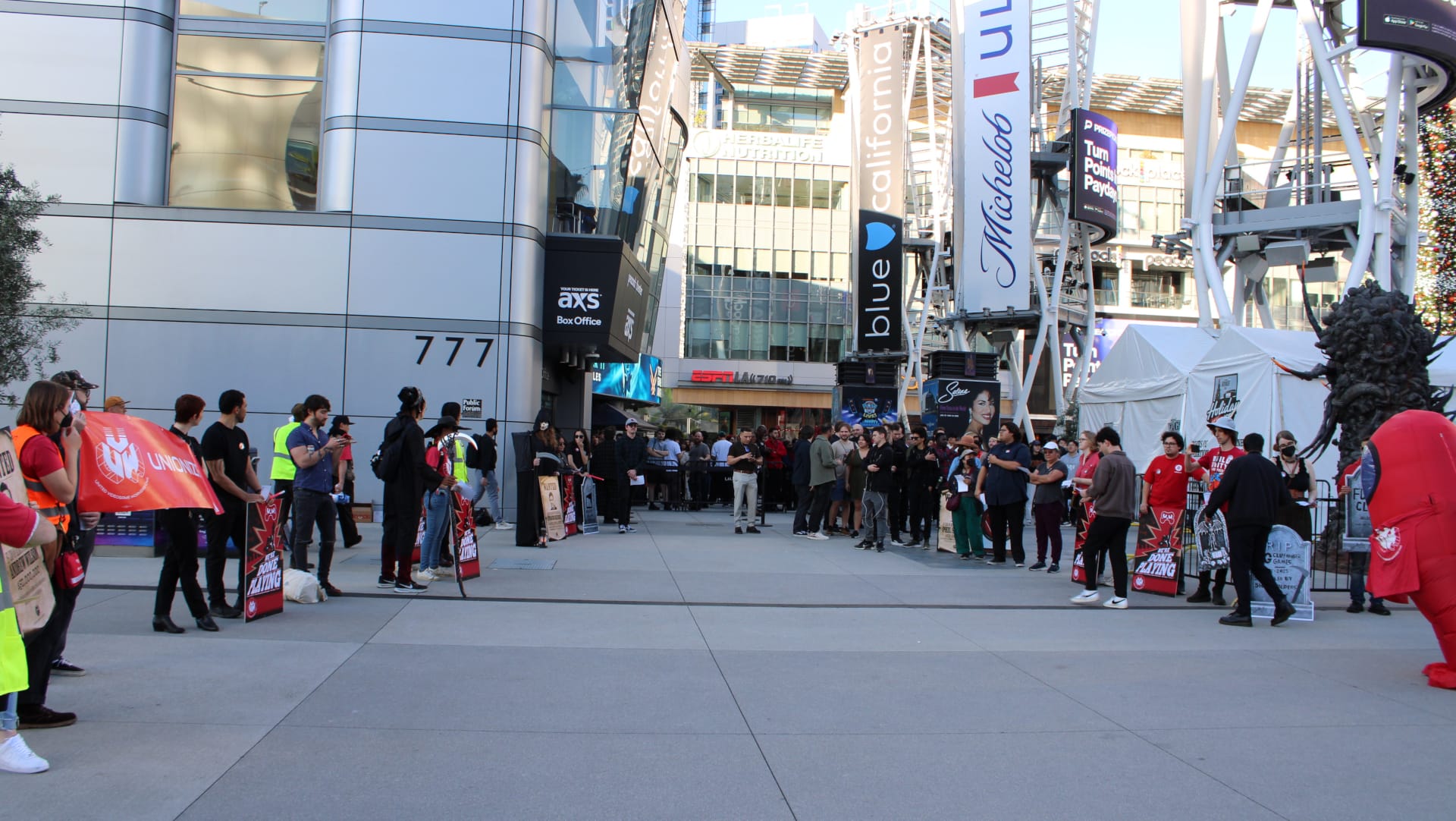
Others were there to show solidarity.
“I’ve had so many friends affected [by layoffs],” said a developer doing organizing work with UVW named Audrey, who declined to provide their last name or place of employment, but who noted that they’ve yet to be laid off despite four years working in games. “I’m out here for the industry. I’m afraid that if I lost my job, I’m not gonna be able to find another one. The amount of power that gives our employers is just insane. I’ve had to work three crunches so far. The last one sent me to the hospital. I was in some of the most excruciating pain of my life. I thought my appendix had burst. Turns out, it was just stress.”
There are silver linings, though. Webster views UVW as a more authentic attempt at paving the way for a better games industry than Future Class ever was.
“We are disappointed in Geoff,” she said. “We are building the future of the games industry with or without his branding, and if he wants to join us, he can anytime.”
“UVW as an organization, a lot of the stuff that benefits Future Class members – whether it’s visibility or financial support or community – we have resources to also do all those things,” added Uduwana. “We’re looking to actually be able to make that kind of tangible change that The Game Awards and Geoff have shirked the responsibility of.”
“They decided that’s too hard,” said Webster, “so we’ve gotta do it ourselves.”
Webster and Uduwana also noted that as of now, UVW boasts 560 members.
"I’m afraid that if I lost my job, I’m not gonna be able to find another one. The amount of power that gives our employers is just insane."
"The main thing [UVW] has done for me so far is build connections – and not in a controlled forum, where we can actually be honest and have real conversations about the industry," said Aubrey. "Especially as a queer person, companies will have affinity groups and stuff like that, but HR is always there. If you say something too out there, you never know. You can't be too honest in those spaces."
Emma Kidwell, one of the Future Class members who ultimately forced an answer about the program’s fate out of The Game Awards, likes what she’s seen so far of UVW.
"I think UVW-CWA and the solidarity they've shown the [Future Class] alumni has been really great," Kidwell told Aftermath. "They're doing good, important work and using their platform to make the industry a better place."
In addition to supporting UVW, Staton-Davis is taking matters into his own hands. This year he opened a worker-owned studio called Melanated Game Kitchen.
“I’m also trying to contribute to the work of a more sustainable, equitable industry by starting a co-op studio myself,” he said. “We focus on fun gameplay, obviously, but narratives as well that tell cultural stories. It’s BIPOC-led, and we’re trying to bring that to the forefront. We don’t see enough of those stories in the industry, so we want to do more of that – and collaborate with everyone else who’s also trying to do that same thing.”
Recommended
 Nathan Grayson