

From March 13-19, Imirt, the Irish Game Makers Association, is running a Steam event and sale showcasing games made in Ireland or by Irish creators. Like any Steam event, there are far too many games to check them all out (Imirt says over 150 are being highlighted), but I was excited to see that the Steam page specifically lists games in the Irish language.
I’ve been learning Irish for about a year, but far too slowly and inconsistently to make the progress I wish I were. I’m currently in a class where I’ve been learning a lot (if almost being able to count is “a lot”), but I definitely don’t study as much as I need to. Unlike other languages, I don’t tend to encounter Irish much if I don’t actively seek it out through radio or TV shows, which means that in addition to having to muster the time and effort to study, I have to muster even more effort to bring the language into my everyday life.
So Imirt’s event felt like a chance to solve several problems at once: to practice my Irish, to see more Irish in my day, and to get some work done for Aftermath, the thing that most frequently prevents me from having the time and energy to do things like study my Irish. After playing several games in the event, I definitely do not know enough Irish to play a game entirely in it, but I did expand my vocabulary in video game-specific ways, and find some new ways to incorporate Irish into my life.
Terry’s Other Games
Super Hexagon creator Terry Cavanagh released a collection of his smaller projects back in February 2025. Irish appears in the introductory texts to the collection and to the games themselves. Because one of the few things I have mastered in Irish is introductions, playing this collection first gave me an unearned sense of confidence in my ability to play games in Irish.

Most of the games I played from this collection were wordless, which meant my confusion came down to how to parse their odd mechanics or slightly janky prototypes rather than a language barrier. The games can be hit or miss depending on your tolerance for them, but I enjoyed a lot of them. You can play some of Cavanagh’s other other games, like Super Hexagon and VVVVVV, in Irish as well.
Dicey Dungeons
Dicey Dungeons is a Cavanagh game from 2019 that I’ve heard about forever but have never actually played. All of the text can be shown in Irish, from the menus to the interface to the dialogue. It’s a much more robust and polished game than those in Terry’s Other Games, which also means it has a lot more words, and a lot more wordplay to try to grasp.
I was able to piece together some of what was happening narratively, especially when I pulled in my dictionary. Most of the Irish I work with is educational, which often tends to be a bit dry, so it was fun to encounter text with more flourish. But this was also a challenge for my rudimentary comprehension skills; as in any other language, phrases often don’t mean what they translate to word-for-word, so I’d sometimes understand most of the words in a sentence but not what was actually being said.
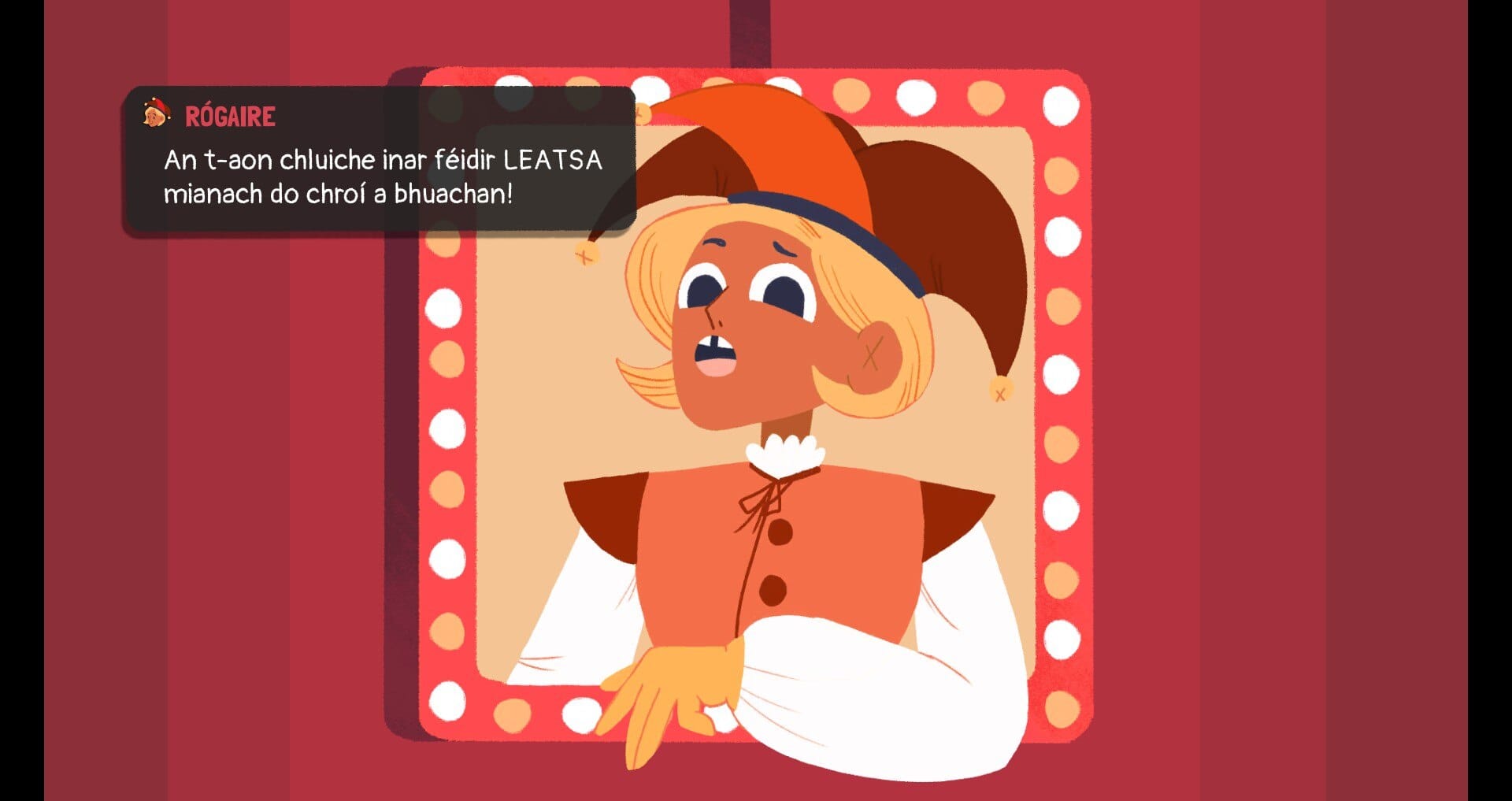
I tend to be impatient with introductory cutscenes in games, overly eager to play (a long-running flaw of mine), so once I thought I had the basic idea of what was going on in Dicey Dungeons, I dove into the game itself. I definitely struggled to learn a game with unique dice-related mechanics in a language I don’t speak, and I quickly got over my head. Pretty lost as to how to actually play, I mostly used my time with the game to count the dice rolls aloud in an effort to practice my numbers.
I’ve heard really good things about Dicey Dungeons and would like to actually play it, so I’m excited to start it again in English to come to grips with it, before switching it back to Irish once I understand it better.
Éalú
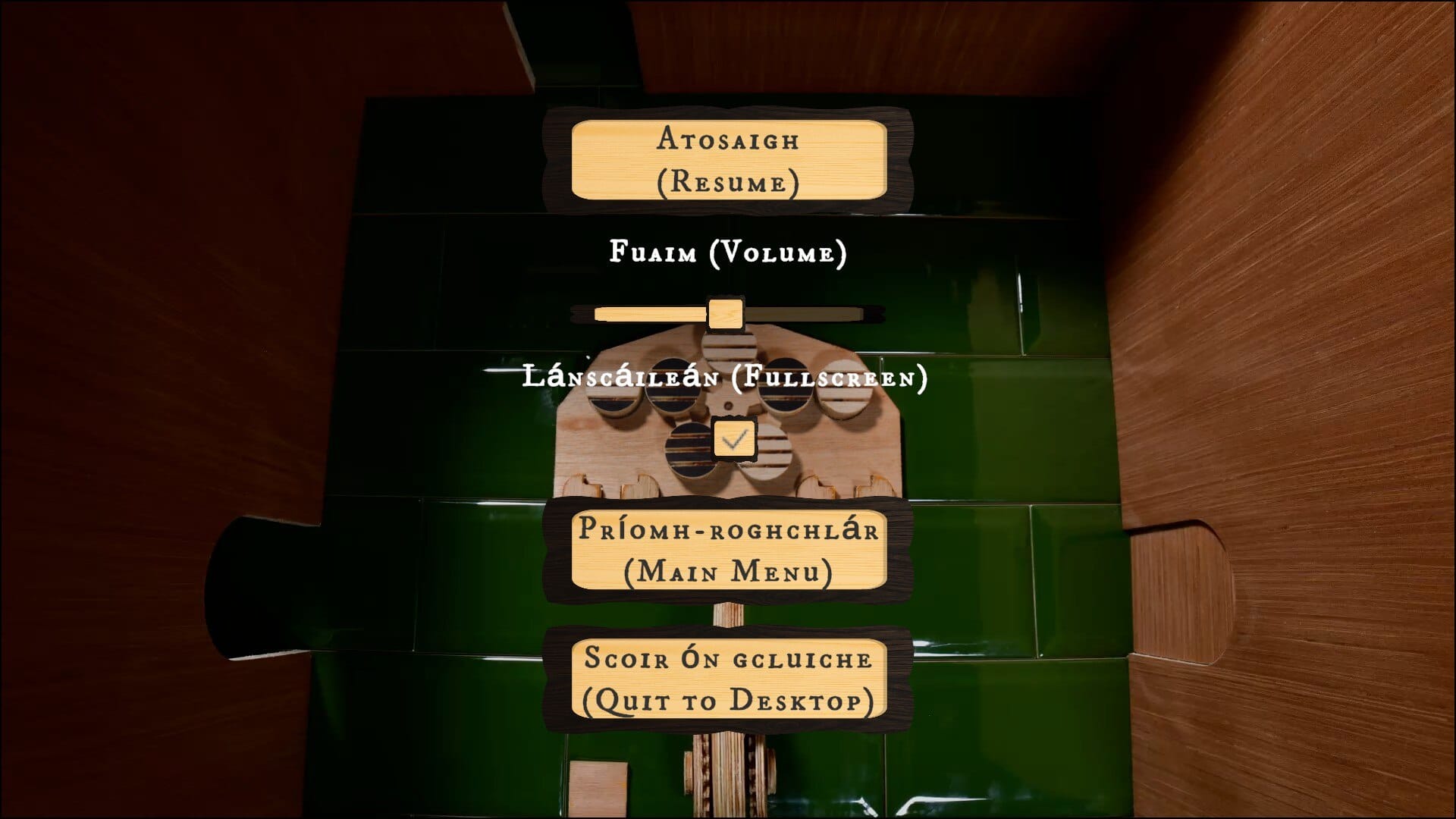
This game doesn’t have any words in it, with only the menus being in English and Irish. As such, it was a good way to familiarize myself with the kinds of words I’d see in a lot of other games in Irish, like “quit,” “volume,” and “main menu.” It also taught me a new word in the title itself, which means something like “escape,” a good title for a game about being a mouse trying to escape a maze.
Éalú is entirely handmade and done in stop motion, which is cool as hell. The game itself is a bit confusing–there’s not a lot of help navigating the maze, and some of the puzzles are absolutely baffling–but even when I was lost or frustrated, the game’s mix of cute and creepy vibes was really compelling. Watching the little mouse “die” (it gets disassembled and then the game restarts) was never not upsetting, and it made me jumpy around every new item I encountered in the maze, which gave me more compassion for how anxious mice always look when I see them in my house. I definitely want to spend more time actually playing it; I’m glad the Steam event pointed me to it, because I don’t think I would have heard of it otherwise.
Drive Rally
This game puts the menus and interface in Irish but retains a German-inflected English voiceover that honestly I might have found less annoying if it were in Irish. I’m not sure if the voice is always disdainful or was just disdainful of me because I suck at driving games, but it definitely got on my nerves a little. The game itself is pretty straightforward: drive around rally tracks in cool little cars, trying to both go fast and not crash.
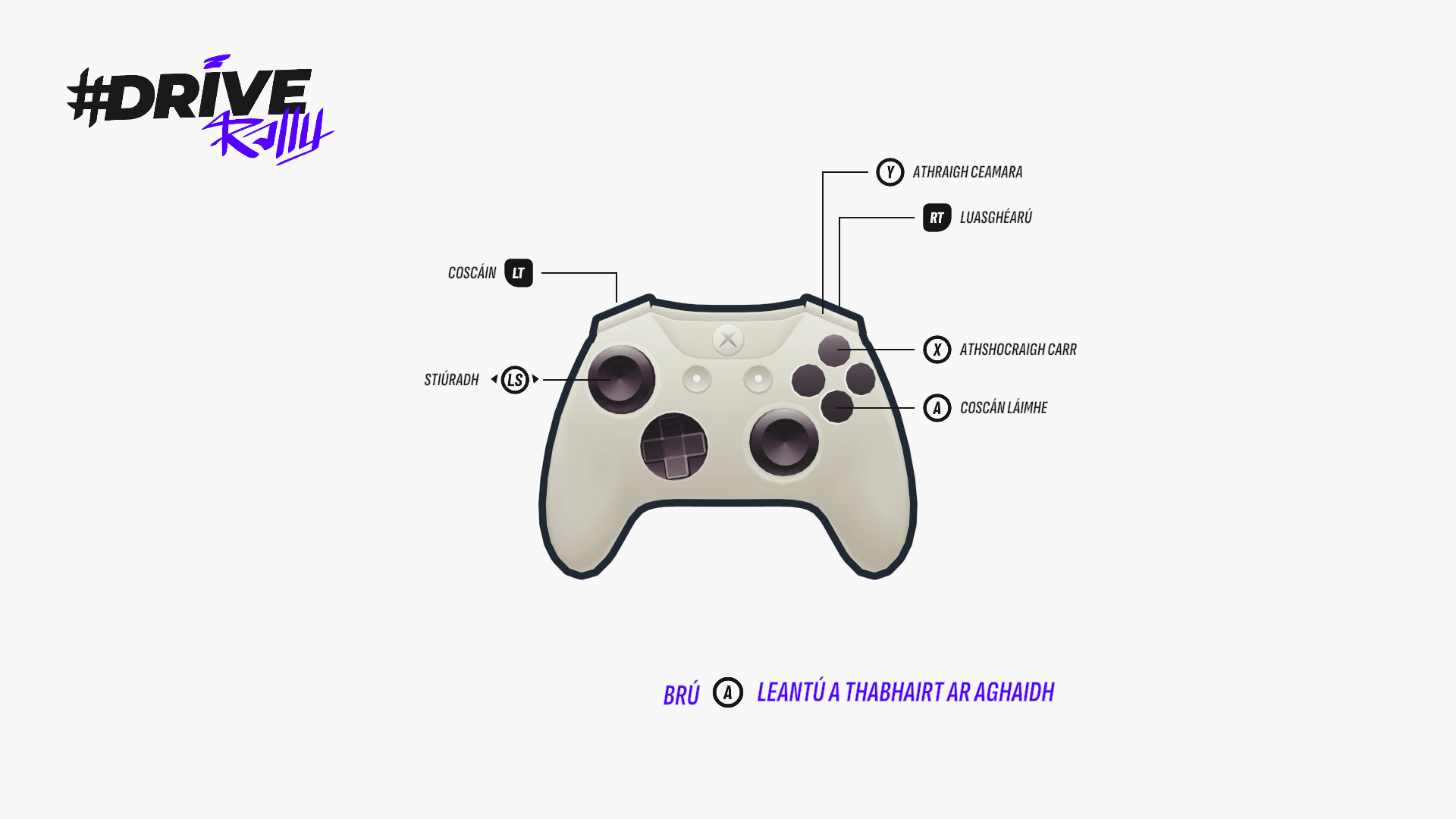
At the level of Irish I’m at, I was at my most competent in games like this, where Irish was in the interface and menus. Like with Éalú, it was helpful to see common games words in Irish that I could parse out with context or trial and error. It was also a good way to push myself to think in Irish when I had the opportunity; replacing “handbrake” with “coscán láimhe” in my head was a useful nudge to make the effort to use my Irish in any context available to me. (Fun fact: last week I derailed my Irish class asking the teacher why the Irish for “arm” and “hand” and for “foot” and “leg” are the same, and if it ever causes problems for people.)
The Corner Cafe
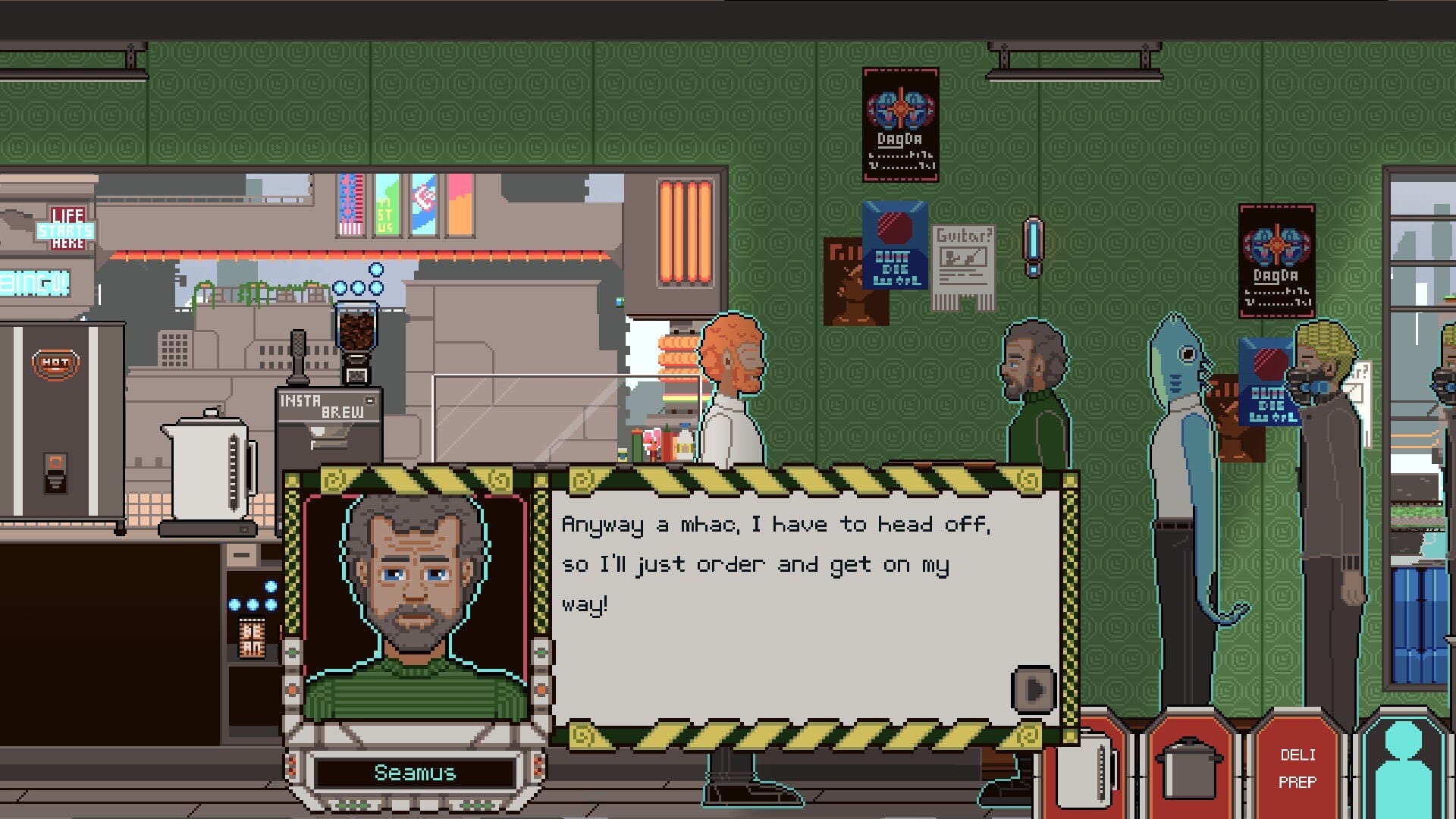
This in-development game has a demo, which introduces you to its world of corporate-controlled future Galway. You play as Dan, who leaves his dead-end job to run a coffeeshop, as so many video game protagonists do. You play minigames to make coffee, food like soup and chicken fillet rolls (apparently a big thing in Ireland; Irish game developer and translator Úna-Minh Kavanagh made a whole game about them), and serve customers. After the coffee shop closes, you wander the city, in one instance to the delightful fancied-up beat of an Irish trad song I can play on my mandolin but cannot for the life of me remember the name of, as is the case with 90% of the songs I can play.
The Corner Cafe demo features bits of Irish in its English text, with characters calling each other pet names like “stóirín” and “a mhac.” It’s not a lot of Irish, but, like Drive Rally, was a good reminder that there are always opportunities to sneak more Irish into my day. Learning a language often feels like all or nothing in a way that can be intimidating, when in reality any usage is probably better than none. It’s a similar message to a queer Irish podcast called Gaylinn that I often listen to when I’m running, in which the hosts pepper their English with Irish words or sentences. These kinds of things help remind me that the language isn’t just a thought exercise but an actual language, and the use of English around the Irish words helps me understand them from context clues instead of having to run to my dictionary.
There are a bunch of other games in the event that feature some amount of Irish that I haven't been able to get to yet, including Mini Metro, Factorio, If Found, Among Us, and more. And there are plenty of games that just have a connection to Ireland either in their topics or their teams and that don’t require you to attempt to learn another language.
If you, like me, try to avoid going outside for St. Patrick’s Day to avoid being surrounded by people drinking, staying in to play some video games is a pretty good alternative. That said, there's an Irish language meetup at a bar near my house this week that I will probably steel myself to attend; maybe someone will want to talk about video games, and I can use my new words.
 Riley MacLeod