

The annual Game Developers Conference in San Francisco is, on a structural level, best understood as several thousand flotillas of ships passing in the night. Everyone has somewhere to be—a talk, a party, an appointment, a meeting, an interview, a garden gathering drowned out by loud music—except where they are right now. So naturally, people often ask where others are headed. At one point last week, a group of devs caught me on the way to an Nvidia demonstration, so in response to their question, I replied: “I’m gonna go ask Nvidia how it’s pretending everything is business as usual while also causing a hardware crisis that threatens the whole industry.” The developers cheered and implored me to give Nvidia hell. Resentment was no longer bubbling beneath the surface. It was out in the open, for all to see.
The ensuing encounter proved deflating. There were no execs, leads, or directors to be found in Nvidia’s green-tinted slice of hotel space, where the games hardware manufacturer-turned-AI-behemoth was showing off new features like DLSS 4.5 multi-frame generation, RTX Remix particles, and upgrades to GeForce NOW, ostensibly meant to make developers’ lives easier. An employee who was on hand to demo those products, admittedly unprepared for my line of questioning, provided a stock answer: "We'll still do a lot of work on the gaming side [as opposed to transitioning fully into AI]. Thankfully, we're all still employed. [Gaming] has been our bread and butter, and it's been what allowed us to grow and be ready for the AI stuff. We have a lot of these [graphics] cards, and we try to support all gamers, even with the new features that we introduce."
Despite the aforementioned hardware crisis already forcing Valve, one of gaming’s most immutable constants, to delay its Steam Machine rollout, the next Xbox was the (vague) talk of the town at GDC, with Microsoft briefing developers on the machine’s cutting-edge tech and PC interoperability, but also adding that dev kits won’t be in their hands until 2027. Notably, Microsoft did not even begin to comment on speculation that Project Helix, as it’s known internally, could cost upwards of $1,000, a source of much anxiety among developers, as Polygon noted.
Which is not to say that Microsoft isn’t also feeding the insatiable AI beast and, thus, the hardware crisis as well. Copilot integration with Xbox was another big talking point during Microsoft’s GDC presentation, allowing players to consult a robot at every turn instead of learning a game’s ins and outs the almost assuredly more rewarding way developers intended (Nvidia showed me a similar feature that it’s integrating into games like Total War: Pharoah, called Nvidia ACE.).
Companies’ response to this ever-multiplying hydra of challenges? Layoffs and studio closures. How can developers begin to find stability when the ground beneath their feet won’t stop shifting?
Almost half a decade into its tenure as tech’s goose that does not lay golden eggs so much as it produces golden something else, AI remains a series of solutions in search of problems. No one is asking for a chatbot that will play the game for you. No one is asking for a different chatbot that will pretend to be a video game character, throwing any sense of drama or pacing out the window so you can try to break it with sweet nothings. No one is asking for eerie yassified mannequin faces that clash with a game’s art direction. Developers, especially, are not asking for these features, which threaten to pave over their hard work with a messy Slip ‘N’ Slide of slop. Years after we were promised that generative AI would be the future, this is the best some of the biggest companies in the world can offer. The future is now, and it sucks just as much as it did several years ago.
At GDC, concerns about AI dovetailed with a greater sense of uncertainty around gaming’s previously less-shakable pillars. One prominent indie developer who’d just met with Microsoft confided to me that they were feeling apprehensive about what the future holds on the publishing side of things, especially given that the dust has yet to settle following a regime change that ousted Phil Spencer and installed Asha Sharma, who was president of Microsoft's CoreAI product before getting the call to Spencer's old office.
Meanwhile, Valve hosted a presentation of its own that similarly raised more questions than it answered—albeit in a different though equally revealing fashion. The company boasted that more games than ever are seeing revenue of $100,000 per year, with a graph showing that the number was around 3,000 in 2020 and now sits at 5,863. That’s almost double! But what Valve did not mention, much to developers’ chagrin, is that the number of games releasing on Steam per year has also just about doubled. Moreover, as Kotaku noted, Valve didn’t take inflation into account; yesteryear’s $100,000 is today’s $125,000. And as we at Aftermath can attest, $100,000 per year doesn’t go that far, even if your team is tiny.
On top of all that, many of the games that made $100,000 on Steam last year did not come out last year. This goes hand in hand with another alarming stat that’s been haunting game developers for the past few months: The playtime spent by all Steam users on games that came out in 2025 was a paltry 14 percent. So while the audience that spends money on video games might seem vast, there’s less pie to go around for those making something new—of which there are now more than ever before. Simon Carless, perhaps the best third-party cruncher of Steam’s many numbers, estimated the total of new games earning $100,000+ on Steam last year to be around 1,700, or less than ten percent.
All this while others, like analyst Matthew Ball, have found that gaming’s real areas of growth in terms of new players are China and Roblox—the latter of which, according to his latest report, matches the combined playtimes of Steam, PlayStation, Fortnite, and other gaming platforms—while more traditional games struggle to compete for attention against the likes of TikTok and (yuck) Draft Kings. To the extent that it ever truly existed, there’s no longer a monolithic, Pangea-like video game industry; instead, Roblox, single-player triple-A games, live service games, indies, mobile games, and numerous other subcategories each represent islands unto themselves—not directly competing, necessarily, but still sharing an attention economy with each other and also literally everything else. Companies’ response to this ever-multiplying hydra of challenges? Layoffs and studio closures. How can developers begin to find stability when the ground beneath their feet won’t stop shifting?
Valve says more titles are finding success on Steam than ever before, despite concerns of over-saturation on the storefront.
— Chris Kerr ➡️ GDC (@kerrblimey.bsky.social) 2026-03-10T23:40:34.805Z
In the face of so much uncertainty, it can be easy to succumb to doom and gloom—too easy, said Paul Kilduff-Taylor, developer of 2011’s Frozen Synapse and publisher of 2021’s Fights In Tight Spaces, who has survived multiple supposed Indiepocalypses over the years.
"It looks to me like the important revenue categories on Steam are in fact stable or slightly growing, even as unthinkable numbers of games arrive each week, meaning that you're still ‘competing’ at roughly the same level,” he wrote. “What changes are we supposed to make based on this information [from Valve]? Trim budgets even further? Give up entirely? None of this seems to lead to any kind of productive development or behavioral alteration. … Personally, my career has been impeded much more significantly by pessimism and anxiety than by material market conditions and I don’t want that to happen to anyone else."
But GDC was characterized by a central tension that illustrates where games, writ large, are at. The powers that be—or those that remain, diminished as they are—won’t even acknowledge the many fires everyone is struggling to put out.
"What has irked me here, is that [Valve] also continuously love to make out publicly like everything is absolutely fantastic, no problems here at all, while the industry burns down," No More Robots founder Mike Rose told Polygon. "It feels so disingenuous, and also just comes across as 'Well, we are making more money, therefore the industry is fine.'"
Papers, Please
Tandem to all of this was another great anxiety, one that took root before the show even began: America, the country GDC calls home, has become dangerously hostile toward anyone it perceives as a foreigner—or even just an insufficiently compliant citizen. In the months leading up to the show, many stalwart GDC attendees lamented that they’d need to steer clear this time around, with GDC’s annual survey finding that 31 percent of international developers (and 47 percent of LGBTQ+ workers) had cancelled their plans to travel to the US, with another 33 percent considering it. The final tally bore this out: GDC 2026 attracted just 20,000 attendees, the lowest number since 2011 according to industry veteran Rami Ismail, who did not trek out to San Francisco this year.
In a release announcing the numbers, GDC didn’t really acknowledge any of this.
“This was the first year of a bold new concept for GDC,” said Nina Brown, president of GDC. “We are thrilled that 20,000 unique attendees representing our global community showed up from over 85 countries and trusted us with this evolution. The energy across the Festival, from packed sessions to a vibrant show floor and thousands of meetings happening throughout the week, demonstrates how powerful it is when our industry comes together to learn from one another, build partnerships and shape what comes next for games. This transformation was built directly from community feedback, and we’re excited to continue listening, learning, and evolving the GDC Festival of Gaming as we look ahead to 2027.”
The dual prospects of detainment both at the border and on the street weren’t entirely to blame for GDC’s soft numbers. The show underwent a “Festival Of Gaming” rebrand that did not, as some feared, open floodgates to rowdy members of the general public, but that still confused prospective attendees and made certain passes more expensive. Cost has always been a sticking point for those hoping to rub elbows with gaming’s best and brightest at GDC, but with economic uncertainty looming larger than ever, many likely could not afford passes that range in price from hundreds to thousands of dollars. We’re also talking about an industry that’s taken the scythe to tens of thousands of jobs, with many still unable to find gainful employment months or years later.
"I have a full, palpitating anxiety response to ever having to enter the US. I really sympathize with people not wanting to come to the US."
But at the show last week, the absence of many developers from non-US countries was keenly felt, as were the concerns that led them to stay home in the first place.
"Everybody was at least a little bit concerned, because it's so unpredictable,” Paulo Santos, founder of Brazilian studio Potato Kid, told Aftermath. "Our booth, the Brazil booth, has been larger than this in the past. It's still a big delegation from Brazil, because the event is so important for us, but I can see it's smaller. Lots of people I know didn't attend; people from Europe didn't fly here."
Still, for developers outside typical epicenters of game development, GDC represents a series of opportunities that are, at least for some, too important to pass up.
"For me, for my company, it's really important to be here, being from so far away,” said Santos, whose game, Talaka, is being published by Acclaim. “We need to be at these events to see people and be seen. It's important to get that human connection and get to know people that we're working with—that we [otherwise] just know by video conference. ... I talk to my producer every week, but I didn't know him in person."
International devs who did attend couldn’t help but feel anxious about what they were up against.
"I've been held at the US border before and denied entry, and it was terrifying and horrible,” Honey Watson, a writer on Disco Elysium successor Zero Parades, told Aftermath. “And now every time I enter the US, they fingerprint me and the alarm goes off, and I have to go into the special interview room. So yeah, I have a full, palpitating anxiety response to ever having to enter the US. I really sympathize with people not wanting to come to the US."
"I did consider, like, should I take a burner phone just in case," Siim “Kosmos” Sinamäe, another writer on Zero Parades, told Aftermath. "At the end of the day, I thought 'No risk, no story.' If I get [rounded] up and put in a detention center, it is kind of funny."
“It’s not fucking funny,” replied Watson. “I guarantee: It’s not funny.”
Even developers on major games like Marvel Rivals acknowledged that things felt off this year.
"We definitely see [that] attendance [is] smaller,” Danny Koo, executive producer at Marvel Games, told Aftermath. “People are right to have concern about anything that [makes] them feel uncomfortable to come to. But again, we're such in a digital world. We can connect to each other with other means. … Sad to see a lot of layoff announcements, but we have so much talent and so much knowledge over the past 20-30 years. It would be a waste if we don't continue down and reinvent ourselves and make sure that knowledge is retained for the new generation as well. Because we have to bring up the new generation to make sure we pass the torch to them."
"This year, what really took me aback was [questions during the panel about] ICE. 'How is possibly being deported, even as a US citizen, affecting you?'"
Relatedly, one group did seem more prominent as a result of this year’s rebrand, according to developers to whom Aftermath spoke: students.
"What I've seen a lot of in just day one on the Expo Floor is North American students,” Kaitlin “KB” Bonfiglio, game design professor and secretary of United Videogame Workers, CWA's direct-join union, told Aftermath. “A lot of students have been around, and that's great. I think students need a place to convene and talk about game design education, but the Game Developers Conference used to be for game developers in the industry, right?"
Organizations dedicated to supporting developers in the US and beyond, like Latinx In Gaming, found their focuses shifting alongside members’ needs.
"We've run these GDC roundtables since the inception, and the first one was like 'Why use the word Latinx? Why can some Latinos not speak Spanish? How hard is it for Latinos to get hired?’” Latinx In Gaming chairman of the board Cristina Amaya told Aftermath. “In the last few years, I've noticed the questions start to get darker—like two years ago, it was 'How can you guys help us with our visas? It's getting harder [to obtain one].'"
That led to the establishment of an immigration panel, as questions about how to stay in the US grew more common.
"This year, what really took me aback was [questions during the panel about] ICE,” said Amaya. “'How is possibly being deported, even as a US citizen, affecting you?' Even our vice president, Diana Rodriguez, had recently traveled back from Japan with me, because we went on a fun trip, and at the airport she got stopped on her way in [to the US] because of her last name. Even the customs agent was like 'It's because you have a Latino last name.'"
"We brought it up at the panel, and other people started bringing in their experiences,” she added. “It's just so crazy to go from 'We're Latinos, and we love that. We're another diversity group that has its own feelings and thoughts' to 'Are we going to be fucking deported without legal and due process?'"
Not everyone made it to the panel—or GDC—unscathed.
"For the people that were attending from Latin America, a couple of them did have problems at the border,” said Amaya. “We had a couple of Panamanian devs who said that they got held for three or four hours, which is crazy because they're indie devs. What are they bringing? They were a little scarred by it, but they were trying very hard to be hopeful, because GDC is supposed to be this big place of opportunity, right?"
“We had a couple of Panamanian devs who said that they got held for three or four hours, which is crazy because they're indie devs. What are they bringing?"
Some game workers prepared for a worst case scenario.
"At GDC right now, we have people who have taken ICE observer trainings who are monitoring, making sure that if any sort of immigration officials are present, that people are alerted and aware of what's going on," Aurelia Augusta, president of United Videogame Workers, told Aftermath.
Fortunately, as far as developers and industry figures Aftermath spoke to are aware, there were no ICE sightings near the convention center.
"[No sightings] that I'm aware of, but it's something that we wanted to be on top of, rather than waiting to react," said Augusta.
But UVW-CWA members recognize that this is much bigger than a single event.
"We also have a 'We Don't Play With ICE' campaign, which is a way that any game worker who is working in a workplace can say 'Hey, I want to sign up to talk to my employer to make sure we can get them on board,'” said Augusta. “‘I'm not even asking you for a new contract. I'm not asking you for anything other than to follow the US Constitution and say that if someone wants to come in, they need a warrant.’ So [ICE] can't just come in and grab people. We as game workers traditionally have seen ourselves as media workers or tech workers, but we have academics getting snatched from labs, so we should be protecting ourselves and our fellow workers."
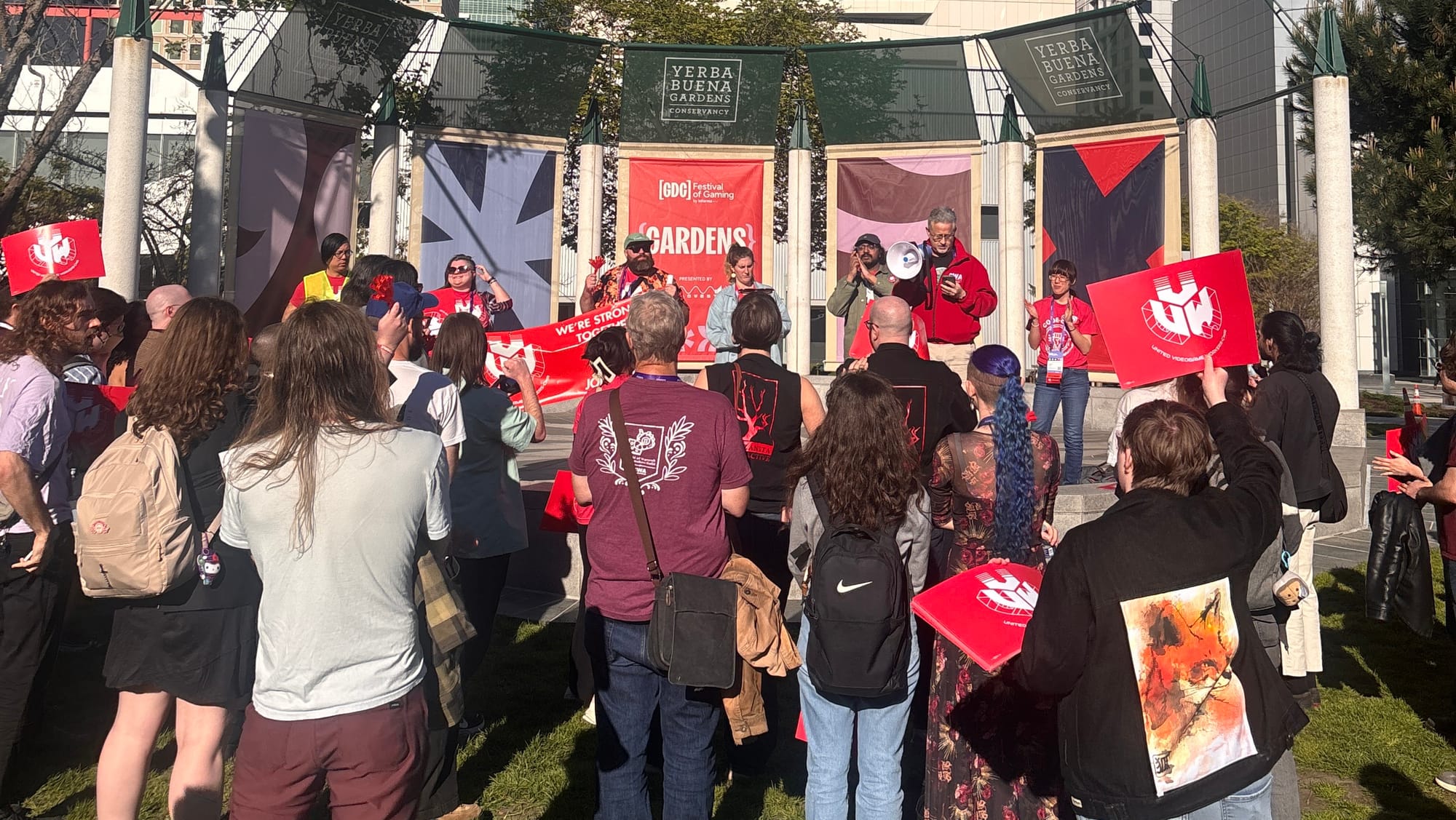
As long as the United States continues to grow more expensive and dangerous for all involved—especially members of the international community—questions about the United States as GDC’s central staging ground will remain.
"Even the cheapest [badge] was cost prohibitive," said Bonfiglio. "I think people for the last five years or more have started to realize, like, 'Why are we always going to San Francisco, especially if we're coming from outside the US?' ... Immigration was always an issue for many people, but now with Trump and ICE and all the immigration enforcement, [it's even worse]."
Amaya views the situation like any other in our rapidly crumbling country: If those with power won’t protect regular people, then it’s up to everyone else.
"Our community is there for people,” she said. “This is a hard time to be Latino. They want to separate us. They want us to stay down. They want us to be scared. The best way to show up is to show up for each other."
Recommended
 Nathan Grayson