
Highguard, the PvP “raid shooter” with phantom horses from former Titanfall devs, is out today. The road to this point has been long and winding, albeit only in terms of how it’s felt to traverse: Revealed as The Game Awards’ “one more thing” final trailer in December, Highguard proceeded to disappear into a month-long cloud of speculation and derision.
What was this generic-looking multiplayer game that dared to occupy a slot reserved, in viewers’ minds, for Half-Life 3 or Elder Scrolls VI? Details were scant bordering on nonexistent. Ragebaiters and clip farmers on X and YouTube feasted. Highguard, the narrative went, had doomed itself to being the next Concord. As of today, we finally have an answer to the question of how Highguard actually plays – decently enough, apparently – as well as a greater understanding of how we ended up here in the first place. It didn’t have to be this way! But it also sort of did.
Speaking with Kotaku, Wildlight Entertainment co-founder Chad Grenier explained that the plan since “day one” had been to shadow drop the fantastical FPS, as it had worked out well for his previous project, Apex Legends. But then Geoff Keighley, an old friend, stepped in.
“We’ve known Geoff for a long time, and he said, ‘let me do something,’ that’s maybe a little risky in hindsight – but different, [to] take a free to play PvP Raid Shooter and do something with it,” Grenier said. “So we rushed a trailer together. I wish the reception had been better, but in hindsight we made a trailer to entertain really quickly, and didn’t show the gameplay loop, and what’s different and unique.”
Releasing your first game as an independent – although clearly well-funded – studio, who’d turn down that kind of free marketing? Especially when your game is cannon-balling into a crowded genre rife with high-profile failures? In a previous era, it would have been a no-brainer, a gift horse you wouldn’t even think about looking in the mouth. But a confluence of modern and age-old factors quickly turned the tide against Highguard.
Much of the ensuing ugliness stemmed from the fact that Wildlight went radio silent following the initial Game Awards reveal. Those who expected a more traditional marketing campaign – a drip feed of character and map reveals, or even just a more elaborate trailer – got nothing, so they used their imaginations to fill in the blanks. In response, Wildlight decided to maintain course.
“We stayed silent because we knew that the first time, the next time that we say anything to the audience, it better be the game and let the game speak for itself,” Grenier told Kotaku.
Depending on how you measure it, this ended up being a mistake. I totally understand the allure of a splashy, Apex Legends-style shadow drop, but after doubling back and deciding to reveal the game shortly before release, you can’t really have it both ways. Moreover, the internet of now is very different from the internet of 2019. Covid transformed social media into an endless, awful conversation; once you pop, the horrors never stop. Debuting and then disengaging isn’t really an option – at least, not if you want to keep the vultures away. Recent years have only worsened this dynamic, with short-form video content taking over as the predominant mode of expression and giving rise to a generation of caustic clip farmers who yank at the udder of any perceived drama of the week until it’s chafed and bone dry. Then they move onto the next thing and deploy the same playbook again.
Highguard got hit even harder than it otherwise might’ve due to the fact that, at least in games, December constitutes the dead of winter, and there wasn’t really a “next thing” for cynical, opportunistic content creators to monkey-bar over to. So one video became two, and then three, and four, and so on. With each passing week, continued silence from Wildlight functioned as additional evidence that something was amiss. The Highguard mystery, unfortunately, lent itself perfectly to sloptubers’ regular stream-of-videos approach.
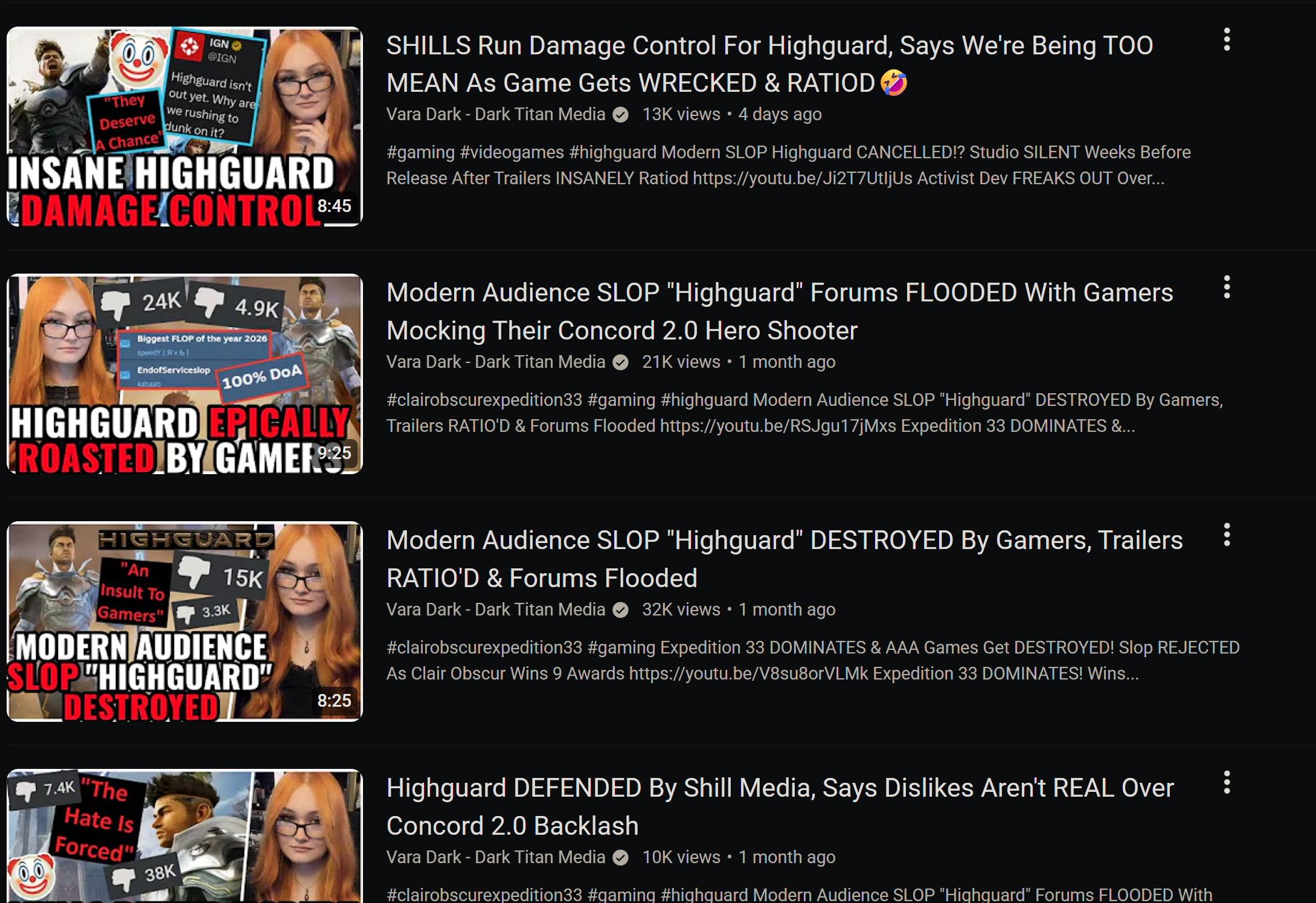
And then there was the Concord of it all. While comparisons were clumsy at best – Highguard does not have major publisher backing, for one – the facts of a situation do not matter in the modern social media landscape. Feelings dictate people’s response, and they are easily and algorithmically manipulated. The rough outline of a situation similar to Concord’s was there, and that’s all content creators needed to whip portions of the internet into a frenzy: The Game Awards, in this case, functioned like Sony, an institution propping up a safe-looking hero shooter no one asked for.
Rage at the industry, misdirected or not, did the rest. Certainly, there is warranted fatigue around live service games emerging from the triple-A (or in Wildlight’s case, triple-A-adjacent) sector. Big, more traditional video game companies want a ladle full of the perpetual stew Fortnite, League of Legends, and a small handful of others have transformed into an infinite food supply, and in pursuit of that, they’ve misused and abused once great studios and released a series of duds like the aforementioned Concord – by no means a terrible game, but something so aggressively Fine that it failed to really grab anyone.
But right-wing sloptubers have repeatedly harnessed this energy to feed their endless culture wars, claiming that diversity is the reason these games fail. More than that, they want them to fail; they approach the prospect with a sort of knives-out glee. All of it fits their narrative that even with hundreds of thousands or millions of followers, they are the brave little guy(s) speaking truth to power amid an industry of shill-happy journalists and agenda-pushing developers. Within this framework, there is room to advance conspiracies, to present the industry as a series of shadowy cabals working against The Common Gamer (rather than a series of out-in-the-open cabals working against everyone except themselves). Again, Highguard’s prolonged period of silence – after a push from Geoff Keighley, gaming’s self-appointed kingmaker – provided a perfect seed bed for those kinds of tall tales to take hold.
Facing down a truly nightmarish minefield, it’s hard to fault Highguard’s developers for opting to disengage from all the engagement bait. Arguably, there was no correct way to play this. Turn down an opportunity to get millions of eyes on your game during the biggest event of the year? No shot. Spin up a whole marketing campaign when your trailer was already a last-second effort? Basically impossible. Play whack-a-mole with conspiratorial nonsense ginned up by the usual sloptuber suspects? Would’ve almost certainly been used as additional fuel for the fire. Maybe a little good faith communication directly from the developers would’ve helped put faces to names and engender trust, but there’s no way to know – and the risk was obviously very high.
Regardless, Highguard now finds itself positioned awkwardly at the starting line, albeit well ahead of where many others begin. On one hand, you can’t deny that all of this free publicity bolstered the game’s player count, with its launch day numbers peaking at nearly 100,000 concurrents (and hundreds of thousands more watching on Twitch and YouTube). That is… uncommon, for an indie shooter, to say the least. On the other, public sentiment is not great. Technical issues and performance problems are being received even worse than they otherwise would be, and every design decision has been met with intense doom-and-gloom scrutiny – despite the fact that this is day one of a game meant to have a long tail. The game’s Steam reviews have cratered to “mostly negative.” Geoff is running a weird sort of victory lap, which probably isn’t helping matters.
Lending more credence to my assertion that the internet has decayed past the point of usefulness, meanwhile, is the fact that Guy "DrDisrespect" Beahm – a sad middle-aged man who dresses up like an even sadder middle-aged man and who in 2024 confessed to inappropriate DMs with a minor – lied about attending a Highguard event last week, going so far as to post an image of a fake badge. This led to outrage and controversy, followed by debunkings that, per how these things tend to work, almost certainly didn't spread as far as the initial misinformation.
Where things go next from here is anybody’s guess, but I imagine many will be watching with great interest – and not necessarily for the right reasons.
Recommended
 Nathan Grayson