

It can seem a bit silly to recommend a way to tie your shoes, but some knots are just more secure than others. For decades I have favored two specific shoelace knots: Ian’s Fast Knot and Ian’s Secure Shoelace Knot. Ian’s Fast Knot is done so effortlessly as to look like a magic trick, and Ian’s Secure Shoelace Knot has never failed me.
But who is Ian? Ian Fieggen, who also goes by “Professor Shoelace,” is the guy who runs Ian’s Shoelace Site, the internet’s prime destination for learning how to tie your shoes. His website is simple, intentionally focusing on common vernacular over standardized knot terminology, and has been operating as a discrete section of his personal site since 2003. Ian’s Shoelace Site does not need to change; it is perfectly functional the way it is, and people have been discovering his many knots and lacing techniques for decades.
The Granny Knot/Granny Bow is probably why your shoes keep coming undone.
Ian’s Secure Shoelace Knot is a double slip knot, only marginally more complicated than the “bunny rabbit” style kids tend to be taught. Though Ian’s Secure Shoelace Knot can also be tied incorrectly, it is far more secure than the knot many people tie under most circumstances, which tends to fall apart when tied incorrectly.

Ian’s Secure Shoelace Knot is done by doing a standard left over right starting knot, creating two loops (bunny ears), crossing the loops right over left so that one sits over the other, looping both loops over each other and pulling them through the “hole” in center so the loops exit in opposite directions, and neatly tightening the resulting knot. It’s a wonderful compromise between security, convenience, and ease of execution. It does not require a sloppy double knot, which can get easily snarled, and it’s easy to untie with a single pull. There is no perfect knot, but Ian’s Secure Shoelace Knot has yet to fail me after over a decade of use.
This one....this one is the best.
“I try not to over-sell the merits of this knot,” Ian Fieggen told me over email, “as people have become complacent about every product on earth being touted as ‘the best.’ I reckon that those who blindly follow what they are told end up believing everything and knowing nothing. I'm therefore most pleased when people discover for themselves that the Secure Knot lives up to my claims, especially when (as in your case) it follows a lengthy period of usage.”
The Ian Knot is the flashy and fast one, but still secure if done well.
There are, of course, other knots. I have seen other people on YouTube and Reddit recommend the Berluti Knot. I have also seen many people who are fans of the Surgeon’s Knot. Ian’s pride and joy, which he claims to have invented and has a page documenting its history, is Ian’s Fast Shoelace Knot, also simply known as Ian’s Knot, which is so rapid that it makes you do a double take. But what makes Ian’s site truly great is not that it documents a few knots, but is a cornucopia of methods for tying and lacing your shoes. Ian’s Shoelace Site is from a different time on the internet, when people simply made websites that they were passionate about.
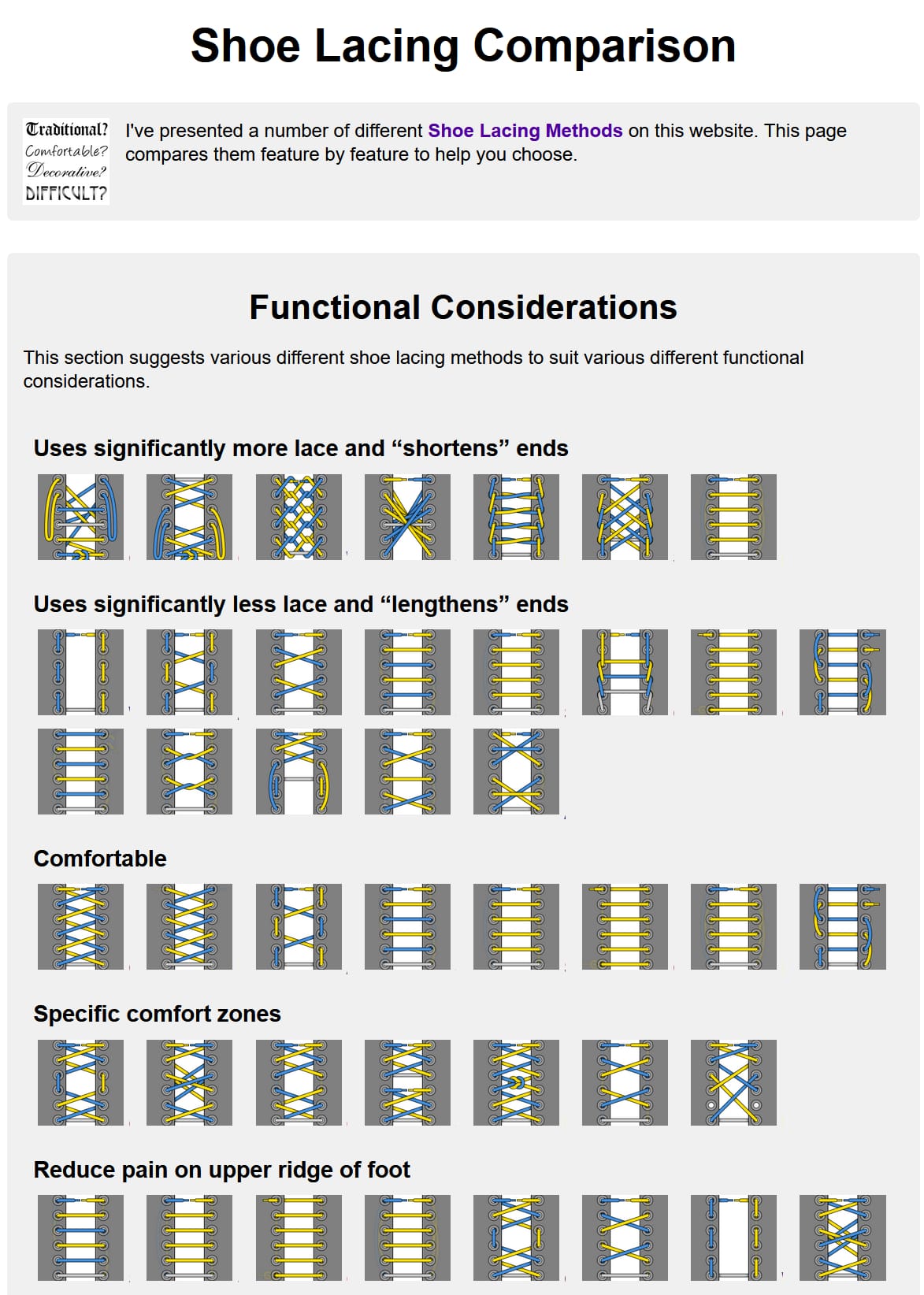
The full breadth of Ian’s site is a marvel to behold given its simple subject material. Not only does he passionately cover every shoelace knot he knows, he also covers every factor of lacing: why knots get jammed, aglet repair, user knot ratings and the seemingly countless methods for lacing your shoes. Being a subsection of a personal site, Ian has written extensively about other topics including an history of his father, a computer programmer who passed away in 2022.
People who know Ian’s Shoelace Site love it. But like all passion projects that seem eternal on the internet, even Ian’s site is vulnerable to the forces destroying the internet.
“Have you ever wondered,” Ian asked, “why websites like mine are disappearing from the Internet?”
He has his theories. The Shoelace Site is kept alive via fairly unobtrusive ads, but he says the rise of ad blockers has made that income precarious. He also claims that people copy the information on his site without attribution, both wholesale and to go viral. A quick search of YouTube and especially TikTok is rife with people doing Ian’s Fast Knot without either knowing or disclosing the source. “Around half the copycat videos on YouTube are tying it incorrectly as a granny knot, which comes loose,” Ian said. “This has given my knot the undeserved reputation of being faster at the expense of reliability!” To the extent that one can “own” a knot, Ian has been robbed.
Ian, more than many writers and publishers on the internet, sees with cold clarity the catastrophic effect of AI on the continued survival of an independent web. “Today, my website is constantly being harvested by AI bots,” he said. “That content is then reused, typically without giving credit, in what amounts to little more than wholesale computerised plagiarism.The search engines, which we previously tolerated showing snippets of our content because they brought people to our websites, are now showing AI generated versions ahead of those snippets. These can be sufficient for visitors to remain on the search website and never end up visiting. Generative AI already allows folks to ask for something – such as a diagram on how to lace shoes with stars – and again, never find my website filled with diagrams on which that AI diagram was based.”
For Ian, the cumulative effect of all of these factors is a deep sadness, a sinking feeling of exhaustion and futility. What is the point of adding value to the internet if it is only going to rob you? Why do research, make diagrams, and develop new knots?
“Why keep feeding the hungry beast that the internet has become?” Ian asked.
Ian says his site is OK for the foreseeable future, kept alive via the occasional donation, ad revenue for people who don’t use blockers, affiliate links, and kind words from strangers. But, like the site you are reading, content that you believe to be immutable and immortal on the internet is constantly in peril. These places only exist when the people investing their time and energy know that they are appreciated, credited, and supported. The whims of companies like Google seek to alter the deal that has kept much of the internet alive, threatening its basic foundations. This is true for blogs, for journalism and for the forum culture that the internet is built on. It even seeks to threaten and consume something as simple and necessary as tying your shoelaces.


