

UPDATE March 13th 12:59 PM: Fighting game community member Ludovic Mbock was granted bond in a Maryland court today after spending weeks in detention. Mbock was detained by U.S. Citizenship and Immigration Services after going to the Baltimore field office for a routine appointment to renew his work permit. In a brief statement to Aftermath, Nikhil “Aeriqui” DeLaHaye said the judge was moved by the overwhelming support of Mbock's family and friends who showed up to the hearing. Mbock is currently detained in Georgia and his family hopes to have him released some time today.
On Tuesday February 17th, Ludovic Mbock, a staple of the Maryland and Virginia fighting game community, went into the U.S. Citizenship and Immigration Services Baltimore field office to renew his work permit.
He did not come out.
What began as a routine administrative task, one Mbock has done for more than a decade, has warped into one of the many similar nightmares playing out across the United States. While going about their daily lives, people, regardless of their immigration status or criminal record, are being disappeared by the US government, often with no word or warning to their families and in contravention of the law. Mbock was detained by the USCIS, and since then his family has retained lawyers who’ve filed habeas petitions to keep him in Baltimore. Despite that, Mbock has been moved twice; first to Louisiana, and now Georgia, where he currently remains in a detention and processing facility. His family fears he could soon be deported and, together with his FGC colleagues, are working around the clock, in the face of destabilizing grief and confusion, to bring him home.
“It just came out of nowhere,” Diane Sohna, Mbock’s sister, told Aftermath. She described getting a collect call from her brother hours after he was detained. “He said, ‘yeah, ICE got me,’” she recalled. “He gave me some numbers to call, and from there, we've been on a roll.”
One of those numbers put Sohna in contact with Nikhil “Aeriqui” DeLaHaye, Mbock’s friend for over a decade and another member of the greater DMV fighting game community. With assistance from his colleagues in the FGC, DeLaHaye is coordinating a massive effort to keep aware of Mbock’s movements as he’s forced through a punitive system of human misery dressed up in the trappings of government bureaucracy. “If we don't act right now, we miss our window to do something about this,” DeLaHaye told Aftermath.
![Photo of Ludovic [right] facing off against a friend in a mock fight.](https://aftermath.site/content/images/2026/02/20260224_100743.jpg)
In the wake of the Trump administration’s brutal deportation program, hundreds of thousands of people have been moved around the country or removed from it entirely within days of arrest and often without notifying families. The speed with which the deportation system moves people often outpaces a family’s attempt to mount a legal defense. And even when they can, as Mbock’s family has done, legal orders get ignored anyway.
For years, judges have allowed immigrants to remain free on bond while their cases work their way through immigration court. New policies from the Trump administration have effectively eliminated that standing precedent, forcing arrested individuals to be held indefinitely. To challenge these detentions, lawyers have been using what’s known as habeas petitions to get them out. According to a report in the New York Times, as the number of habeas petitions continues to rise, judges have overwhelmingly sided with immigrants, releasing them before they can be sent beyond the reach of families. There was hope the habeas petition filed by Mbock’s lawyers would do the same.
“He was in Baltimore on the 17th and 18th,” said DeLaHaye. “We filed a habeas petition that was on the docket by 10 AM on the 19th. They had him on a flight to Louisiana at 1[PM].”
Since his arrest, Mbock has been moved to Louisiana and again to Georgia. His family said they don’t know if he’ll be moved again or where he’ll be sent. The family’s greatest fear is that he’ll be deported. He emigrated from Cameroon and could be returned there, where they say he faces danger as an openly gay man in a country that criminalizes LGBTQ+ relationships. He could also be deported to any number of random countries as a part of the government’s “third country removals” plan, which permits deportation to countries detainees aren’t from or have never lived in.
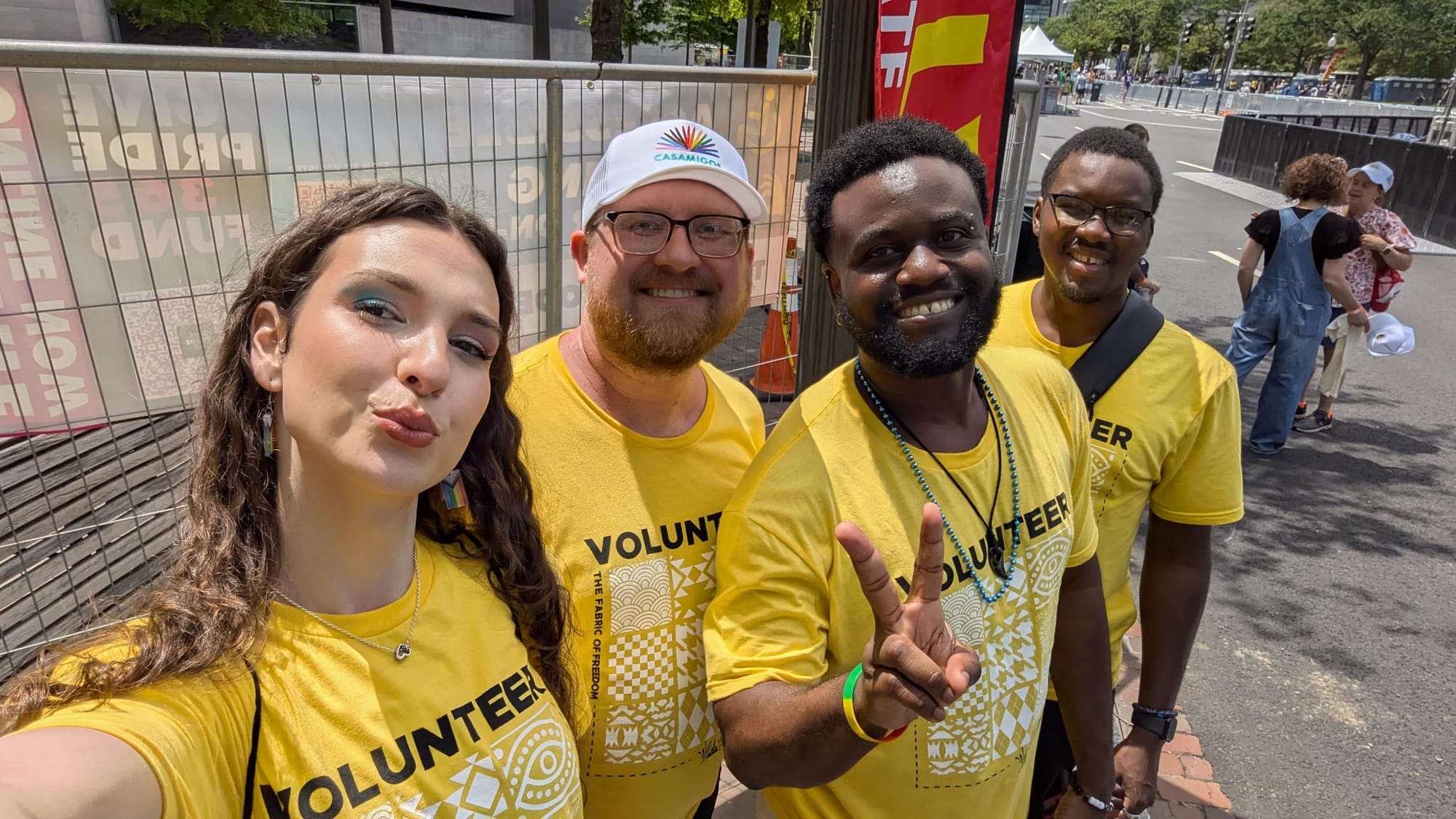
Mbock’s safety stateside is a concern too. In the brief but regular conversations he’s allowed to have with them, Mbock’s family said he tries to appear in good spirits but that the situation is clearly weighing on him. “He says every time, ‘I'm okay. It's okay,’” Sohna said. “But I know my brother, He's just trying to shield us from really what he's going through.”
In the first days of his incarceration, Mbock was kept at the Baltimore USCIS field office, which according to the family is little more than an office building. DeLaHaye said Mbock has described worse conditions in Louisiana and Georgia. Mbock told DeLaHaye that he was kept in chains from 10PM to 5AM on a bus with no heat as he waited for transportation from Louisiana to Georgia.
“He said it was horrendous,” DeLaHaye said. “That it was like slavery shipping them out.”
Though Trump has said those targeted for deportation are violent criminals, the facts don’t support that claim. A recent Guardian report found that over 70 percent of people who entered the deportation process for the first time last year had no criminal convictions. Mbock didn’t have one either. DeLaHaye and Sohna said their friend and brother was typically reserved until you got to know him.
“He's always been on the quiet side until he knows you, then he really shows you his funky side,” Sohna said. “He loves to dance, he loves to play games. He loves to eat. He loves video games. He loves sleeping, like he's the normal happy guy.”
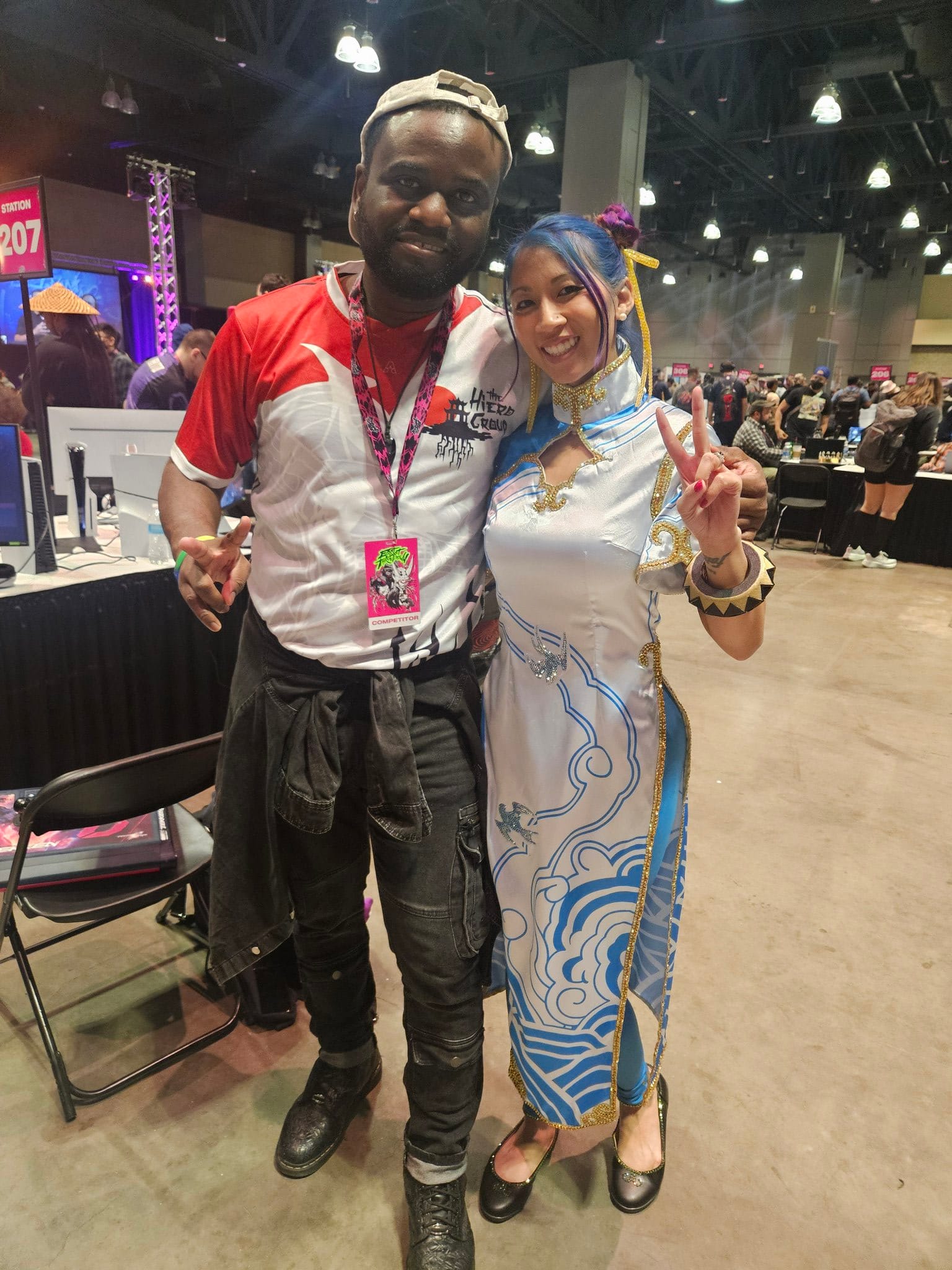
DeLaHaye met Mbock at a Street Fighter tournament, noticing each other because they were wearing the same Chun-Li shirt. “We took a picture together, and I was like, ‘Wow, that's such a cool guy. I don't know if I'm ever gonna see him again,’” DeLaHaye said. But he would. The two travelled in the same FGC circles and eventually ran into each other at different events throughout the DMV region.
“There's been multiple times I've been at tournaments and I haven't told people what my tournament schedule was, and I would turn around while I was in the middle of a bracket match and see Lud behind me cheering me on with a group of friends,” said DeLaHaye. “That was the type of person he was, he just took care of people and cheered up people and cheered them on.”
I would turn around while I was in the middle of a bracket match and see Lud behind me cheering me on with a group of friends.
Mbock’s family and community are hoping their lawyers can secure his release, and have set up a GoFundMe to pay for legal fees. They’re also reaching out to state and federal representatives and lawmakers, hoping to make them aware that USCIS has violated court orders in moving Mbock. The idea is to make as much noise as loudly as possible to put pressure on the government to return him, because at any time, he could literally vanish.
There are numerous reports from across the country of families unable to find their loved ones in the system due to inadequate communication from the government. DeLaHaye described how when Mbock was moved from Louisiana to Georgia they didn’t know about it until hours after he got there, when Mbock called them himself. Typically, USCIS is obligated to timely notify lawyers of where their clients are; not doing that costs families time as they try to muster appropriate resources. Lawyers, for example, can only operate in states where they’re licensed. Moving a client state-to-state effectively stymies efforts to get them the representation they need.
“It takes time to set everything up, get everything signed. And in that same time frame, [USCIS will] move them out of that lawyer being able to do something,” DeLaHaye said. “If people didn't have, essentially, a fleet of people behind them, you would lose track of them.”
It is particularly cruel that such hypervigilance is required from people at a time when they’re also grieving the disappearance of a loved one.
“My mom is in shambles,” Sohna said. “It makes me feel like I lost my brother.”
But he’s not lost yet. The GoFundMe has exceeded its original goal of $16,000 and currently sits at over $83k. With the excess, the family is hopeful that they’ll be able to afford the expense of reopening Mbock’s immigration case to eventually get him citizenship. But friends and family can do more than just send funds. DeLaHaye has also set up a Discord where people can leave encouraging messages for Mbock, and people have also done that on their own on social media.
“There's a thread ongoing right now on X with hundreds of people all talking about individual fantastic experiences with Lud,” DeLaHaye said. He described going to a Tekken tournament in Sweden a few weeks ago where he mentioned he was friends with Mbock. “People from Lithuania knew who Ludovic was, people from Croatia, people from Denmark knew who he was,” he said. DeLaHaye said the response he’s seen from friends and colleagues reaffirmed his love of fighting games and the communities they inspire.
“I can go anywhere on the planet, bring a fight stick and bring my friends, and we have something to bond over. That's beautiful,” he said. “And not only do we bond over it, we will show up for each other in times of crisis.”


