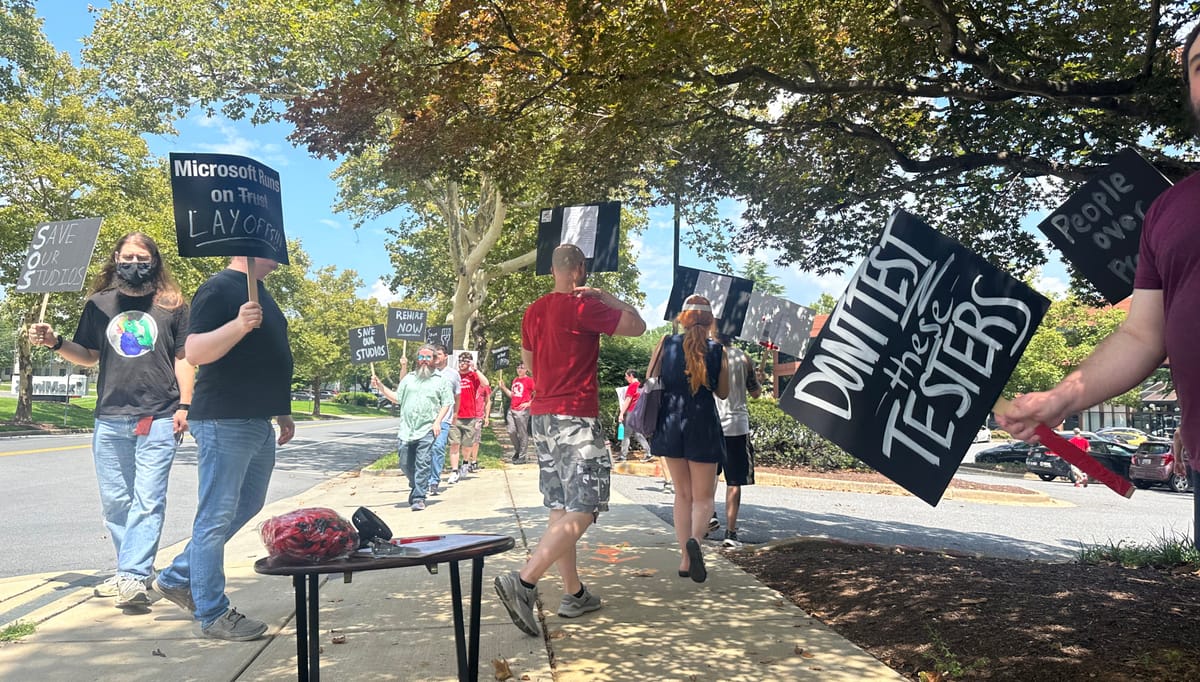
Today the overwhelming majority of workers at Doom studio id Software – 165 of around 185 total employees – announced that they’re forming a wall-to-wall union in conjunction with Communications Workers of America (CWA), the union that’s aided thousands of game workers across Microsoft in organizing.
"id Software is historically important – one of the more famous American studios that survived a length of time that few others have,” id Software producer Andrew Willis, who was part of the organizing effort from the jump and filed the initial paperwork to CWA, told Aftermath. “So it feels really awesome to get this done for something with such historical and cultural importance."
Workers at id began organizing around a year and a half ago, but things kicked into high gear following Microsoft’s unceremonious closure of several Bethesda studios in 2024.
"With Bethesda unionizing, it was a push for people [at id] to start talking, and that's when it started,” id Software lead services programmer Chris Hays told Aftermath. “But then the big push that got it rolling was the closure of Tango [Gameworks] and layoffs within Microsoft at Arkane Austin. It was a wakeup call for a lot of people. People decided that it was time that we took our future into our own hands."
"The big push that got it rolling was the closure of Tango [Gameworks] and layoffs within Microsoft at Arkane Austin. It was a wakeup call for a lot of people."
id itself, Hays said, has suffered “a few” layoffs “here and there” in recent years, but nothing comparable to the scale of Zenimax Online Studios, which lost hundreds of employees earlier this year amid Microsoft’s latest round of mass layoffs and project cancellations. Now, he believes, is the time to secure workers’ rights – before the scythe swings, as opposed to after.
"Not that we're not scared that [layoffs] will one day come," said Hays. "In fact, avoiding each of the previous rounds has made us more anxious about if the next round will be us. And the most recent round of layoffs happened after several [studios] had already organized. People [at id] can see what it was that they got. We got to see them negotiating where they didn't actually lose their jobs [for a couple months]. They were still on payroll. They still had their health insurance. ... They had the extra time to make sure they could get their lives [in order], and many have actually gotten their jobs back through negotiations on where they could place people in the company."
CWA has been able to successfully unionize so many studios within Microsoft and Activision Blizzard in large part due to a legally binding neutrality agreement it struck with the company in 2022 when it was facing regulatory scrutiny over its $68.7 billion purchase of Activision Blizzard. That deal lapsed earlier this year, but according to Hays, only on the Activision Blizzard side of things.
"For us under Zenimax, there's actually a separate neutrality agreement, and that one is still valid until May [2026]," said Hays. "But that was definitely on our minds when we were looking at when we wanted to think that we had enough support [to unionize]. … We knew that it was really special for us to have the neutrality agreement, to have the freedom to be able to talk to each other more openly and not face the kind of pushback you would have in other unionization campaigns. We wanted to make sure that we took advantage of the benefit while we had it."
While the union plans to conduct a bargaining survey before members go to the table with Microsoft to hammer out a contract, preliminary discussions have focused on a few pillars: benefits, remote work, and AI.
"There's a lot of blind spots in our benefits, and a lot of us don't know what we have and what we don't and where things are lacking,” said Hays. “When talking with a lot of people, some would say 'Oh, I think we're lacking this particular kind of benefit, or something around child care.' Personally, I'm really motivated to get protections around remote work and responsible use of AI."
"There's definitely a directive from Microsoft to use [AI] more.”
Remote work has been a sticking point at multiple Microsoft studios, with many issuing return-to-office mandates despite teams’ demonstrable success collaborating from across the country – and even the globe – in 2020 and 2021.
"We actually launched Doom Eternal during covid,” said Hays. “The month of [the launch], we started our work from home. ... We did a launch event, the whole internet fell apart, and we had to learn how to do all of that remote. And then starting a project [Doom: The Dark Ages] from the beginning, all remote, we learned a lot of lessons. On my team, we learned to change how we work, to be more remote friendly. We ended up becoming more productive as a result. So we've done this before. We've learned lessons, and I think we can continue to use that. We shouldn't just throw away all the great wins we got with remote work."
As for AI, Willis was cagey about precisely how it’s being used within id, noting that going into specifics would involve divulging secrets about proprietary tech. But he said that in his view, some of the current applications are “good,” while others are… less so.
"There's definitely a directive from Microsoft to use [AI] more,” Willis said. “In what ways and how careful they're being about implementing it within the studio to actually benefit the creation of a better game or a more efficient process, I personally don't think that's being done in a careful enough way to have it be beneficial.”
Last year, the Zenimax QA union secured AI protections that commit the company to uses of AI that "augment human ingenuity and capacities ... without causing workers harm" and require that Zenimax provides notice to the union in cases where "AI implementation may impact the work of union members and to bargain those impacts upon request." Willis and Hays hope the new union can make something similar happen under id’s roof.
"We are going to be in a fortunate position in that we have a lot of other people who've gone through this,” said Hays, “so we can look at what they have bargained for, especially around AI, and take that as a starting place, which hopefully means that it's going to be easier for us than anyone before."
Microsoft’s support of Israel’s genocide in Gaza – which continues despite a supposed ceasefire – is also potentially on the docket.
"It would be difficult to say [if we’ll make Israel a core bargaining issue] without seeing what the bargaining surveys comment on, but I can say for myself personally that, yeah, I want no part in [Israel's] usage of Microsoft tools and the deals between Israel and Microsoft," said Willis.
"The folks that are in charge of a lot of these decision-making processes, it's a lot of Ivy League MBAs, a lot of folks with zero game experience."
More broadly, Willis believes the union will allow for more input from developers, as opposed to execs who have never shipped a game and, indeed, might not play them at all.
"We see the direction the industry is headed,” said Willis. “The folks that are in charge of a lot of these decision-making processes, it's a lot of Ivy League MBAs, a lot of folks with zero game experience – not just from the management standpoint, but zero experience in actually making games. ... I find little evidence of them really enjoying games or playing games personally."
“I think the more video game studios that unionize, and the greater percentage of video game employees that are in a union, it's not just better for them as individuals or folks that are raising families or have mortgages; it keeps talent from shedding,” he added. “You get to keep people in the industry who have experience and the amount of game credits that allow them to do things and create games that a contract-only or much more volatile workforce simply couldn't.”
Recommended
 Nathan Grayson