

It’s happening again: a game that contends directly with manhood, the feminine, and how gender norms intersect with societal structures and systems is being reviewed almost exclusively by men, and those reviews almost entirely ignore the prevalence of gender in the game’s purpose and themes. (Step it up, male reviewers. Do we have to do everything around here?) The game in question is Esoteric Ebb, the new Dungeons & Dragons-inspired, Disco Elysium-like, choices-matter narrative created by Christoffer Bodegård and, in his words, in collaboration with publisher Raw Fury and a bunch of other folks.
This piece originally appeared 3/11/26 at Mothership, a worker-owned outlet providing gaming coverage for her, for them, and yes, for him. If you like what you see, consider subscribing!
Kicking off your first run in Esoteric Ebb is punishingly confusing, particularly if you aren’t familiar with D&D or Disco Elysium, but that’s exactly where my issues with this game end. What you need to know is that in Esoteric Ebb, you can only play as a Cleric; you can make choices later in the game that lead you towards different classes, like Rogue or Druid, but everyone you meet will assume you’re a Cleric.
Like in Disco Elysium, where the protagonist’s abilities are like voices in his head that tell him what to do, Esoteric Ebb’s main character Ragn also has abilities that advise him. But in this game, those voices are the six classic D&D abilities: Strength, Dexterity, Constitution, Intelligence, Wisdom, and Charisma. These abilities speak to you and to one another as they perform saving throws for almost every interaction in the game. They have competing motivations and ideologies, but they always tell the truth. A failed roll will give you limited or useless information, but never false information.
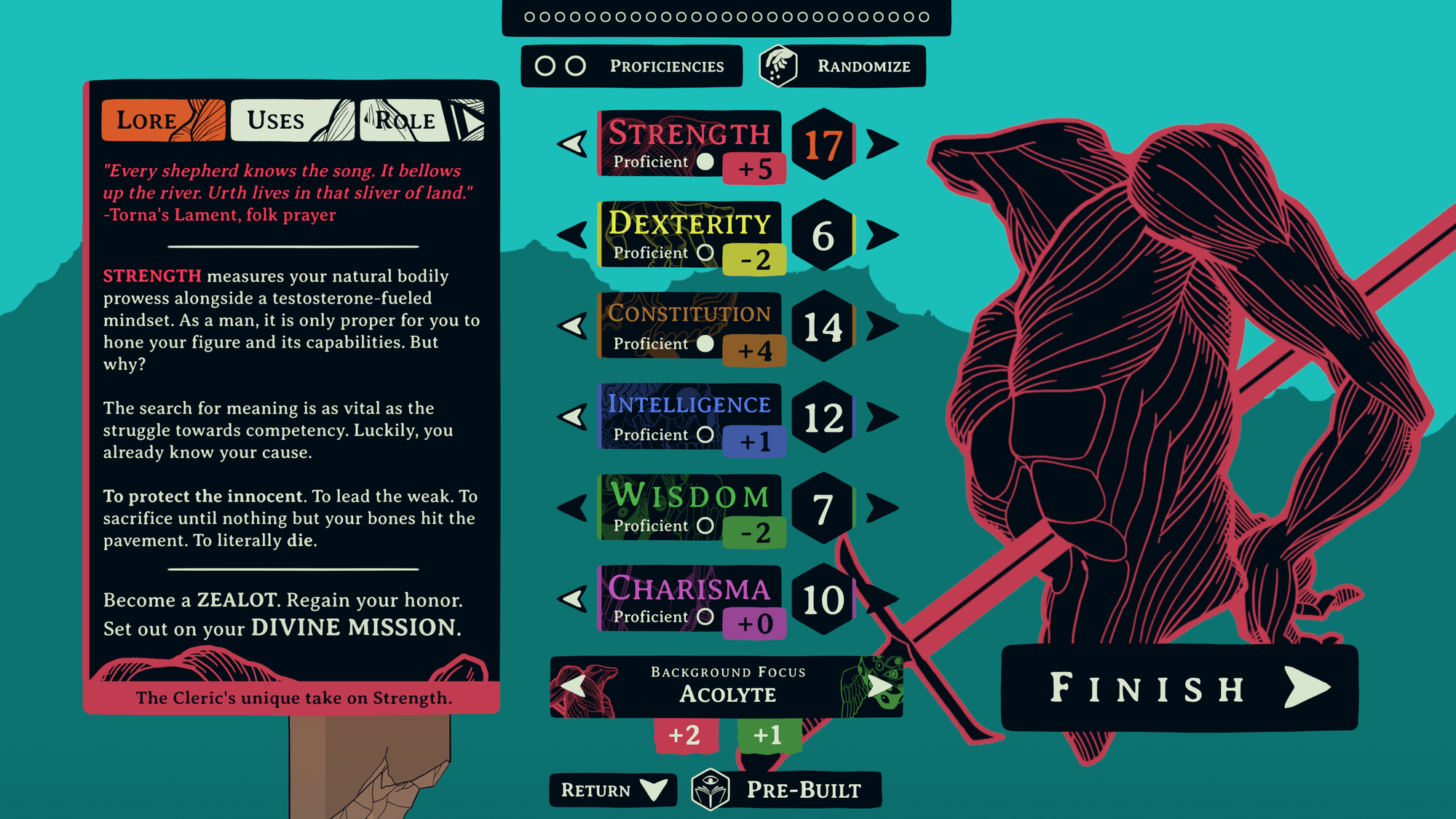
You play as Ragn, a human Cleric who drowned in the river and was then revived. When you awaken after a short cutscene, a minimal tutorial teaches you what to click and when, and then you’re off on your own. Much like Ragn, who has lost his memories, you don’t really know what to do, so you just start poking around. Whatever you decide to do first in the game — you could speak to the undead being who’s stacking apples in the mortuary basement where you woke up, or walk upstairs and start an argument with a kobold, or eat a rotten apple, or pray to the Clerics’ god Urth — it is clear very early on that the concept of manhood is hugely important to whoever Ragn was before the drowning incident. Strength, whose personality aligns with the U.S. Republican-esque Nationalist party, is constantly reminding you to be a man, which in Strength’s ideal, means asserting dominance and upholding the law. Topical.
The narrator, or DM, or maybe Christoffer Bodegård himself, occasionally gives you some context, but for the most part you’ll likely spend your first five or so hours in the game walking around trying not to get yourself into shit and ideally picking up a companion or two. It’s delightful, especially as the game’s narrator cheekily lets you know that you have a fairly generous five days to solve the main quest of finding out who blew up the town tea shop. There are also a lot of side quests, which your player-character is obsessed with amassing with a fervor that serves to warmly poke fun at all of us, the players. I do love a goddamn quest.
I’m D&D naive, so I wasn’t surprised that Ebb gave me a lot of the same feelings I had at the beginning of my journey with Baldur’s Gate 3 — I was enamored with the complexity, the art, the characters; I was completely lost and had no idea what I was doing. My advice is to just let yourself fall into it (but try not to fall into a pit anywhere in Tolstad… or do, it’s kind of fun). I ditched my first playthrough after about two hours, starting over not because I had failed but because I had learned so much about how the game worked in those first few hours that I wanted to start over with more intention, and more notetaking.
Thus began a full week of me asking Maddy approximately every 24 hours whether she’d started her playthrough yet. I have become obsessed with learning everything about this game, seeing its psyche, finding what I imagine is Bodegård’s psyche inside it. I’ve stayed up too late playing it, I’ve tried to explain it to my friends who don’t play video games nor D&D, I’ve pulled it into conversations it has no business being in. Suffice it to say: this game has the juice (or, as Moises Taveras put it in his review, it’s got teeth).
Esoteric Ebb does not shy away from the things many of us are always thinking about when we interact with others, like, “Who are you voting for?” and “What does being a man mean to you?” Manhood and masculinity are most important to Strength, but the other abilities engage with it, too, and so does the game itself. When you speak to female characters, you often have an option to flirt. That’s not to say queerness doesn’t exist in the game, but it’s obvious from the conversations you have with other characters and with the abilities that you are expected to present as both straight and celibate as a Cleric working for the city.
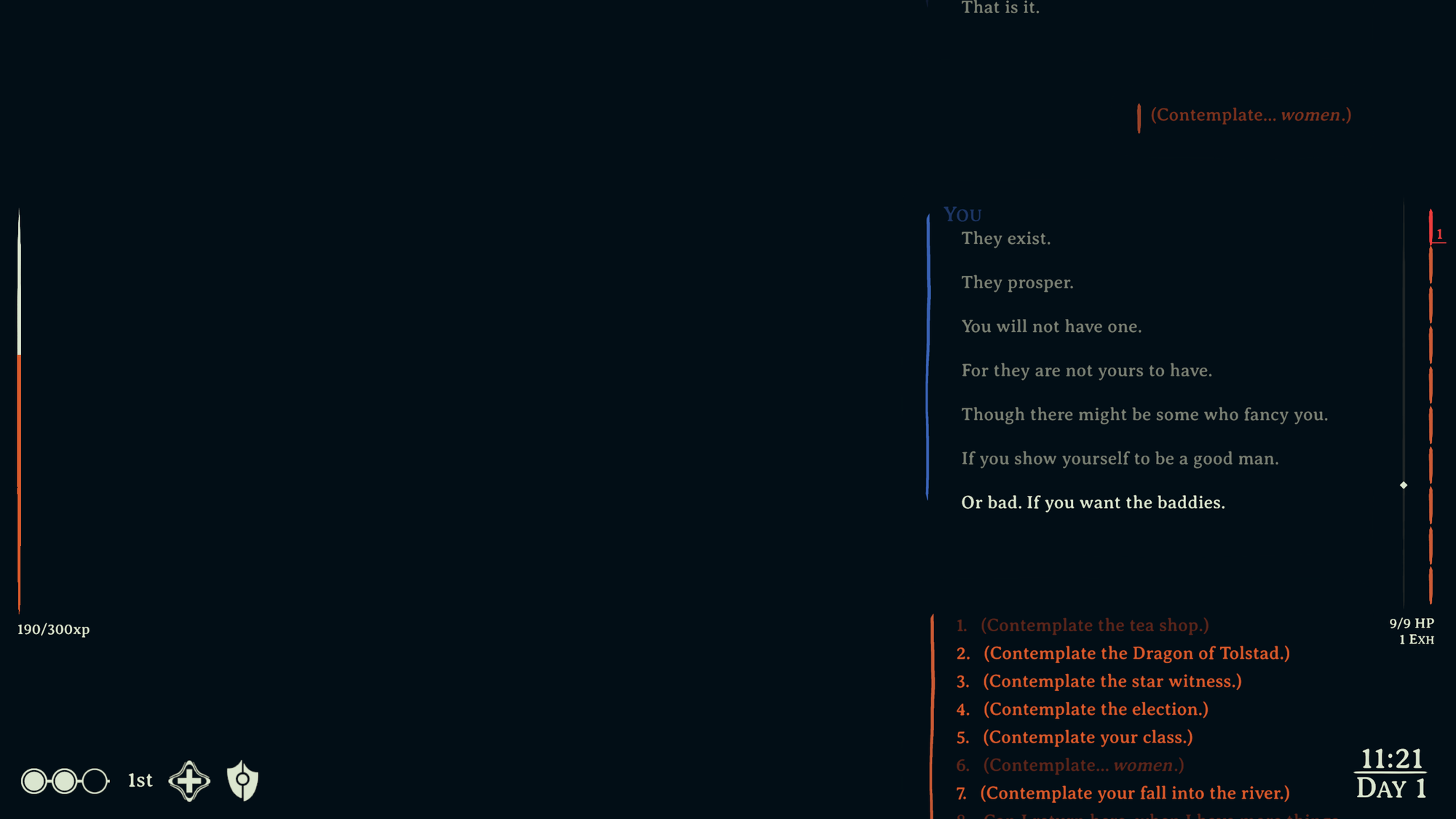
The non-player characters are also frequently entangled in questions of gender norms and what their role is here. In many moments, it feels like Bodegård is speaking directly to a type of male player whose mind he hopes he can change by just exposing them to the right ideas. For instance, when you pray at a shrine, you have the option to “Contemplate… women.” Your thoughts? “They exist. They prosper. You will not have one. For they are not yours to have.”
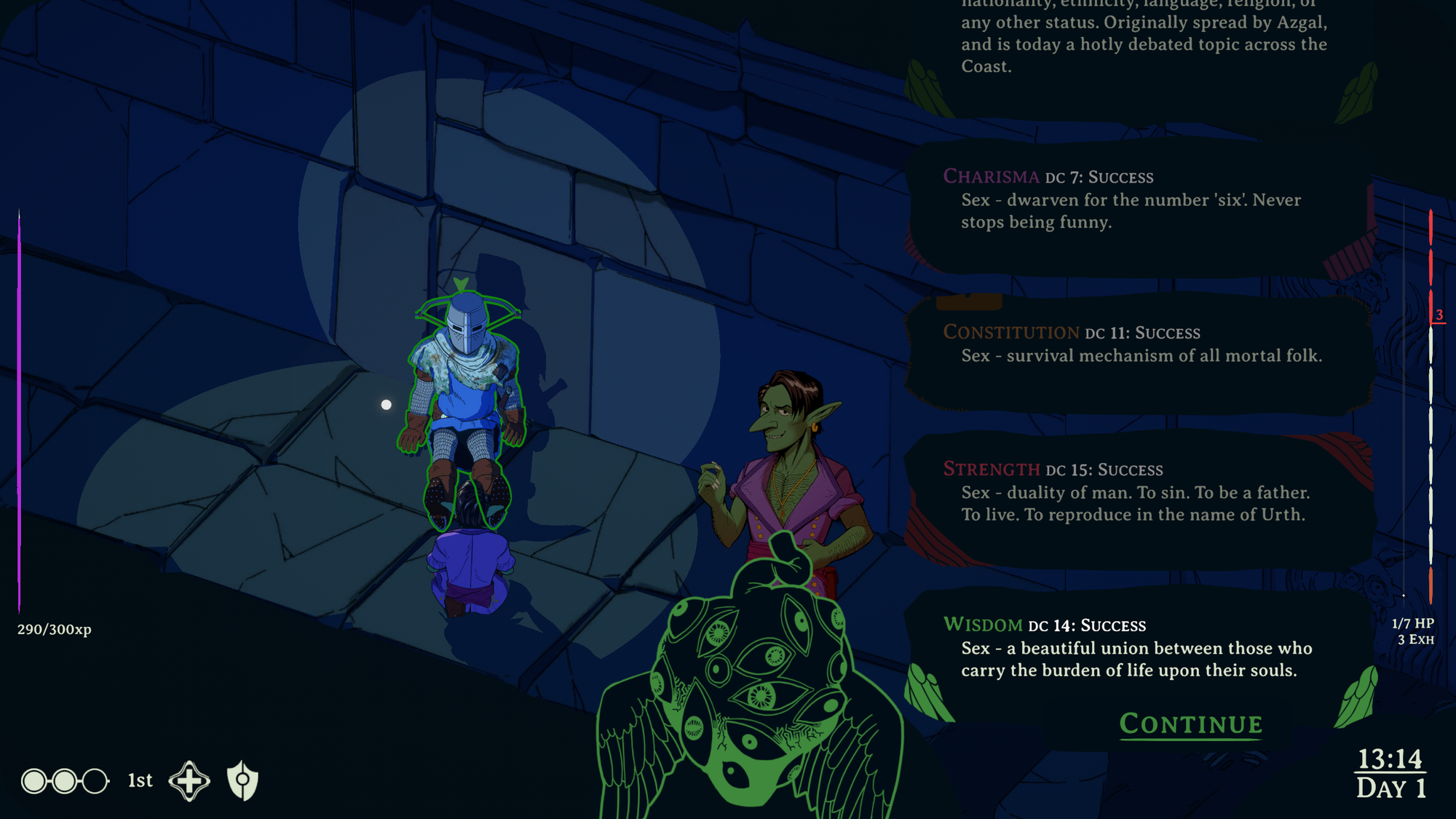
Bodegård beautifully uses feminist concepts like these, as well as narration and dialogue about the nature of gender, as a way to teach the player about what each ability’s attunements are. You can click on text that pops up in orange to unlock a definition of certain terms, and often there are a few definitions. When you first ask to define the word “sex,” each ability responds differently. Charisma makes a joke about the word being dwarven for “six,” Constitution calls it a survival mechanism, Wisdom deems it love-making, and Strength says it’s all about “the duality of man. To sin. To be a father. To live. To reproduce in the name of Urth.”
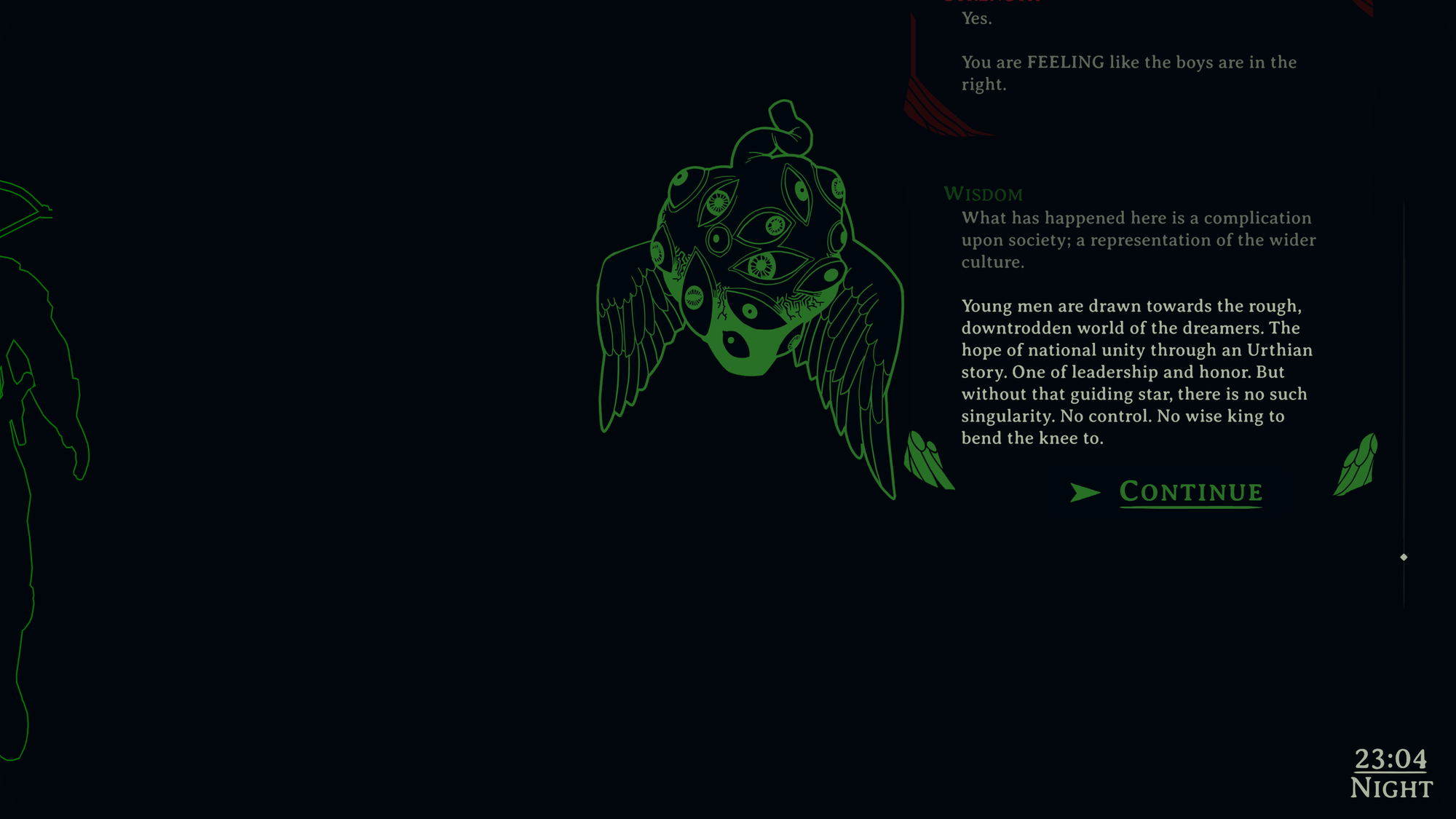
In case you didn’t catch on, Strength is kind of the worst — but Bodegård doesn’t write in such a way that you have a desire to inherently avoid the ability that you, the player, like the least. I’ve been playing by following my real-life heart, which means I’m an Azgalist Druid, a.k.a., a pro-union soft nature guy. But on my next playthrough I’m compelled to be what Strength wants me to be, just to experience what it’d be like to really believe in the government, organized religion, and a strictly defined expression of masculinity. Strength is often icky to me, advising Ragn to talk down to marginalized races and use physical force to get what he wants — but it isn’t always inherently evil or wrong. Instead, it presents an incredibly realistic and thus incredibly flawed view of manhood: stoic, unchanging, positive it’s correct despite evidence to the contrary.
And that’s what I love about Bodegård’s clearly nuanced understanding of feminism. It is a political ideology that is actually also about men, who are underserved by rigid gender norms. It is about the things Strength misses out on because it refuses to move or change. It is about the ways Strength abuses institutional power opportunistically, even if it means hobbling through an encounter early in the game. There is no option to play as a woman or nonbinary person in this game, and there shouldn’t be. This game is about the expectations we have of men and of people who are not men, and the things men can do to accept or reject those expectations. It’s not a man writing feminism by way of writing stereotypical “strong female protagonists,” it’s a man writing feminism by way of speaking directly to and about other men. Isn’t that nice, for once?
To be crystal clear, the game is also about a lot of other things like what socialism looks like in practice, the nefarious creep of fascist censorship, and of course, what happened at the tea shop. It’s also hilarious and self-referential in a refreshingly pat way that isn’t trying to do more than it needs to. When you load a save, for instance, a note from “Chris” explains the story so far. It’s a nice touch that reminds you you’re sitting down for a sesh, not just trying to beat a video game.
Esoteric Ebb also represents Raw Fury’s refusal to quit publishing bangers by artists with politically nuanced, philosophically rich stories to tell. The Seance of Blake Manor came out not six months ago and Esoteric Ebb is right on par with it in terms of depth, artistry, and writing prowess. Raw Fury is also Blue Prince’s publisher, and Sable and Dandara and Kingdom Two Crowns and more games I have yet to try.

Mothership is a website, a channel, and a community co-founded by Polygon veterans Maddy Myers and Zoë Hannah, where staff and freelancers cover how gender and identity relate to games.


