

Wordle fever has largely come and gone, as has the frantic explosion of spinoff games. But the game itself lives on under the ownership of The New York Times, and many of the games inspired by it are still thriving. So I wasn't exactly surprised to come across an Irish language version this morning, but I was surprised to see that it was still updating with daily puzzles. And I was even more surprised to win today's game, a clear sign that I am an Irish language genius.
Foclach is Wordle, but in Irish. ("Foclach" means "wordy" or "verbose," and is a word I didn't know before; thanks, game!) It was created in 2022 by Linda Keating, who told the Irish Independent that "part of the pure joy [of it] is pulling together this community of Irish language speakers" around the game, which had over 10,000 players in 2022. A fan of word games, Keating built the game using a Wordle clone and drew from several lists of five-letter Irish words. Unlike Wordle, Foclach has a practice mode, and Keating told the Irish Independent that adding the mode was when the game "really took off." She said she has no plans to monetize it--"I’ll never put it behind a paywall or I’ll never put ads on the website"--and that its simplicity is part of its charm, saying "it’s the kind of thing you would have seen on the web going back to the 1990s."
I've been learning Irish since the spring from a combination of books, in-person and online classes, and the horrors of Duolingo. It's been tough--it's a complicated language, and there also aren't as many opportunities to encounter it in daily life as there are with other languages that are more widespread. (On Friday I went to a play at New York's Irish Arts Center, and I was so smitten with the fact that the building has signage in Irish and that I could read that signage that I trespassed up several floors before I realized it.) All of this is to say that Foclach presented me with a unique challenge: unlike Wordle, I just don't know that many Irish words to guess.
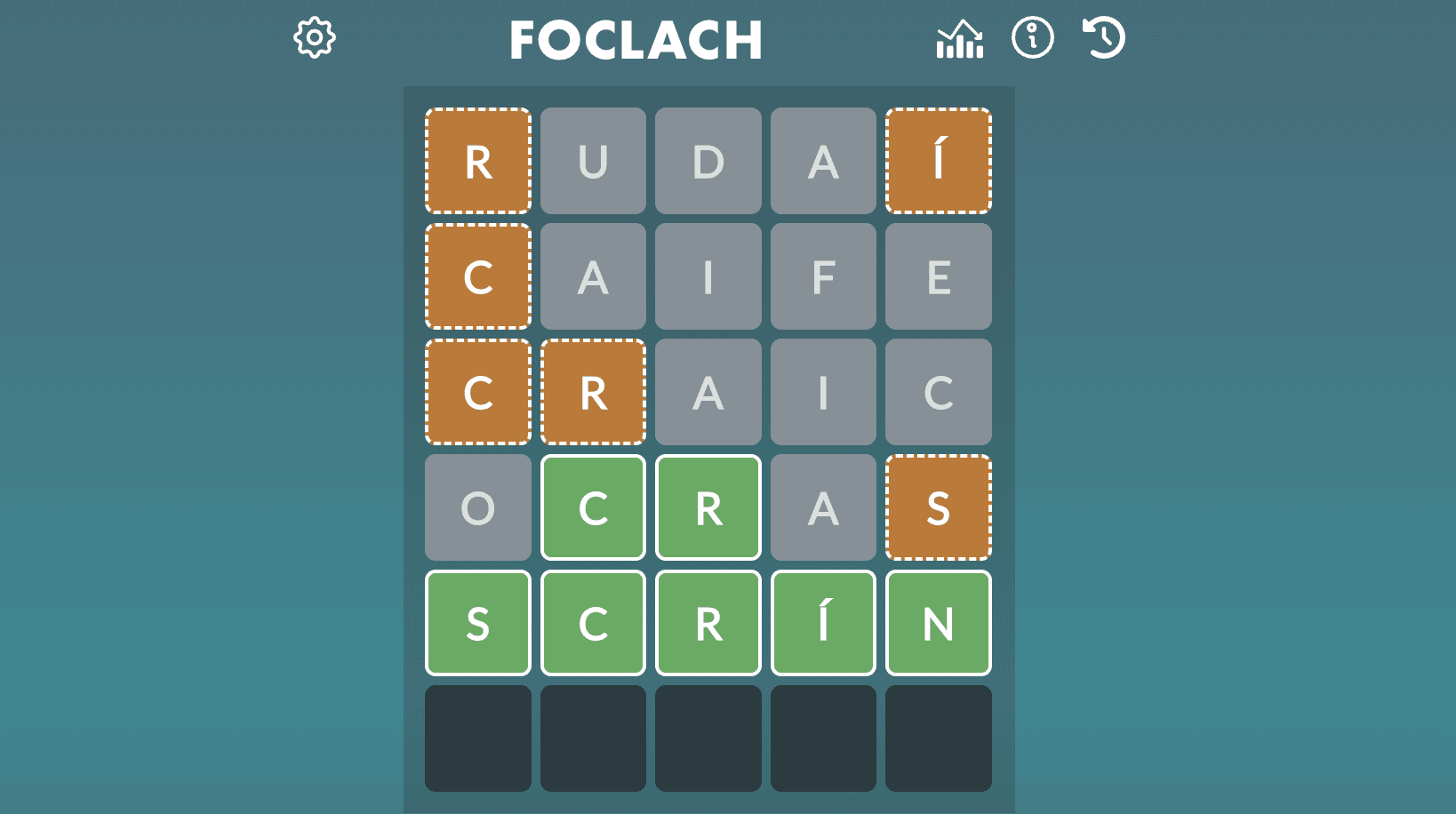
So I was shocked when I got Tuesday's daily puzzle on my fifth of six tries, relying solely on my own knowledge of Irish. (Spoilers ahead if you're going to play it yourself.) I feel like it's key to start off with a good first guess in games like this, so I decided to go with "rudaí" ("things") because it contains a variety of vowels, including a fada, or accent mark. (Fada add another complication to Foclach; there are some words that are spelled the same but mean different things depending on the fada.) I definitely wasn't as economical with my guesses as I am in English, using letters I knew weren't in the answer because they were in words I knew. But I managed to get close enough to make an educated guess at the last letter, and was pumped when I got it right.
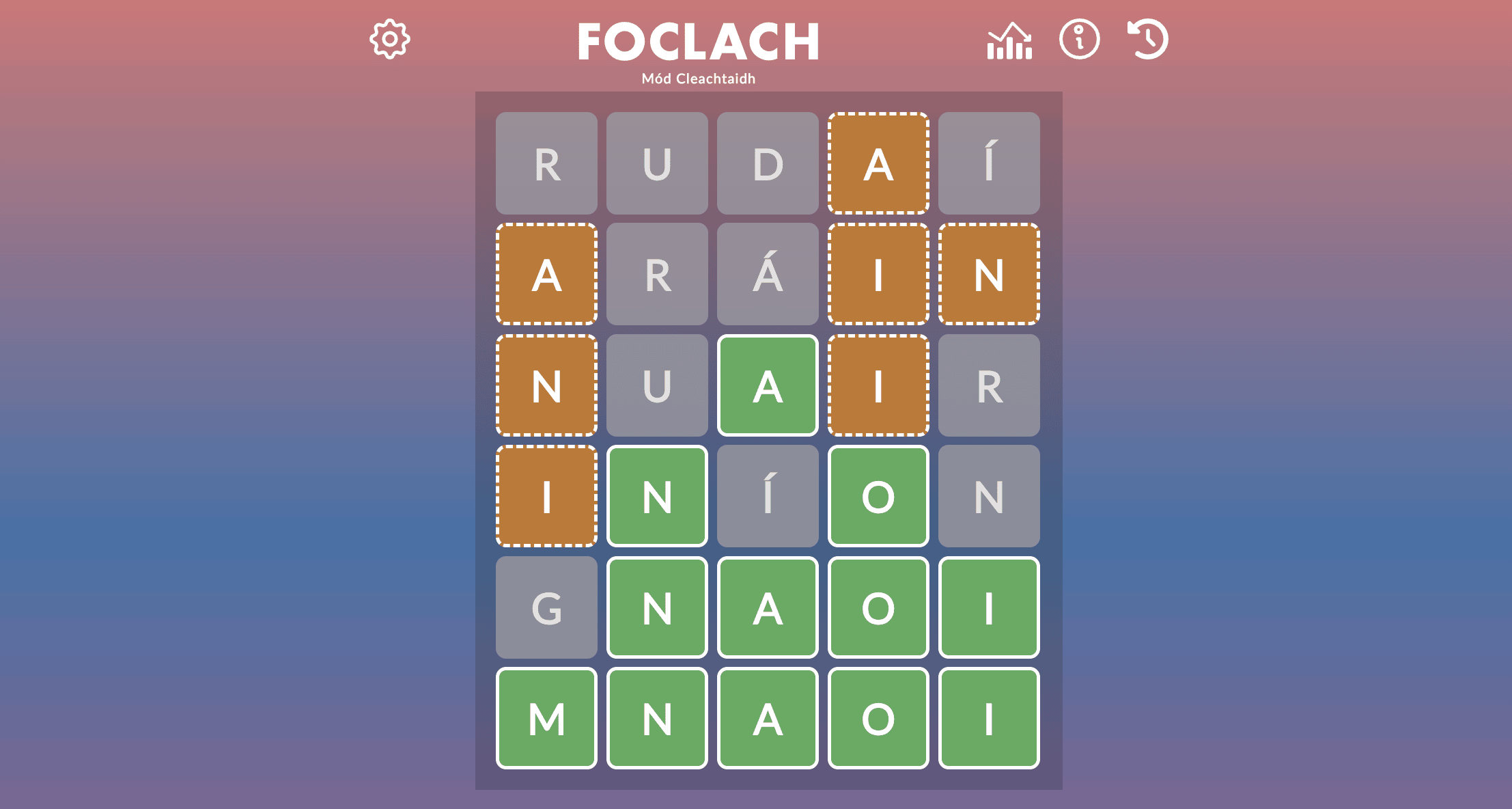
Things didn't go as well when I picked a practice puzzle at random. "Rudaí" only got me an "a," and from there I floundered for appropriate words. My vocabulary was lacking, but there were a few guideposts to help me: vowels in Irish are divided into "broad" (a, o, u) and "slender" (e, i) and have to stick together in certain ways, which helped me pin down the order of a bunch of vowels. But then I was stuck with one missing letter. I went to the dictionary, but without the first letter, it was hard to search. I even looked up some of the word lists Foclach is based on, but they didn't help much either. Eventually, much like in Wordle, I just went through each remaining letter to see if they'd form a word--but unlike in Wordle, I didn't really know if my results were actually words at all. I managed to get the practice puzzle's answer of "mnaoi" (an unusual form of "bean," or "woman") by being familiar with the cluster of "mna" as a plausible run of letters ("mná" is "women," the plural of "bean.").
What's really fun for me about Foclach is how it asks me to use my language skills in a totally different way than Wordle. In the English game, I'm guessing words, drawing on my vocabulary knowledge in a way that makes the game's primary pleasure being proficient with English. I felt smart when I used to get the Wordle in a few tries (I don't play it anymore). But with Foclach, my key strategy can't really be vocabulary, because my Irish vocabulary is so small. So I have to pull on the related skills I employed above, like spelling rules and other words I know. It feels like a totally different way to think about both word games and Irish, and instead of feeling clever when I got the answers, I felt like I'd climbed a mountain. It's a really cool way to engage with a language I'm learning, and I love how it forces me to explore the dictionary and learn new words.
Thanks to the practice mode, I have years of Foclach to go through, and I'm so excited to play more of it. It's definitely going into my daily rotation alongside my other Irish game, dictionary website Teanglann's spelling game, which I'll say I'm pretty good at as long as I limit the dialects it draws from. Obviously I won't be able to maintain my 100% win rate forever, but I'll relish in it while I can.


