

I just got back from spending two weeks in Japan, and if there’s one thing that defined the trip (other than having a very good time) it was the constant awareness of the country’s growing overtourism problem, coupled with the nagging guilt that I was observing it while also... contributing to it.
If it helps with the incoming hypocrisy allegations, here’s some context for my holiday. I’ve been going to Japan for almost 20 years--my first trip was to cover the 2007 Tokyo Games Show--and having visited a bunch more times in the years to follow, for more Tokyo Games Shows and even my honeymoon (in 2009), I went in 2014 with my kids (they were four and one at the time) for a longer stay.
We had such a good time that we spent years trying (and failing) to get back for another holiday, one my children would actually remember. Maybe in 2016, we said at the time. Haha. Some changes to my job, followed by more changes, followed by covid, followed by even more changes to my job and then an inflationary crisis meant we could never get the money together until, finally, a tax return and some consultancy work in 2025 let us scrape enough cash together to make the trip in April 2026.
Because I’d travelled to Japan many times--but not since 2014– my expectations for this holiday were influenced heavily by those 2000s-2010s trips, when few people could speak English, I had to take loads of cash everywhere with me and whole sections of the rail networks were almost impossible to navigate, a time when tourism in Japan for most Westerners was largely relegated to tours, hotels and the most well-known spots.
The Japan I visited in 2026 is a very different place. Over the last decade Japan has courted tourist dollars to help prop up a flagging economy, helped slash the cost of flying into the country and in the lead-up to the Tokyo Olympics added a ton more English-language support to its train and subway networks. While sadly those Olympics tourists were never able to make it, the work has nevertheless paid off in the long run: in 2025 Japan attracted over 40 million visitors, a new record.
Those visitors are arriving and buying stuff, so much so that money made from international tourists–cash which for accounting purposes Japan classifies as an export–now “ranks as the [country’s] second-largest export industry after the automobile industry”. And holidaying in Japan has never been easier! Contactless payment is now everywhere, more Japanese people (especially younger generations) speak English and Google Translate has gotten so good that workers like train attendants will whip it out like a gunslinger and be able to give you complex directions and instructions in seconds. But that revenue and accessibility have come at a cost, particularly an increasing overcrowding of certain towns and landmarks, and a growing sense of unease among some locals caused by what can generously be described as a clash of cultures.
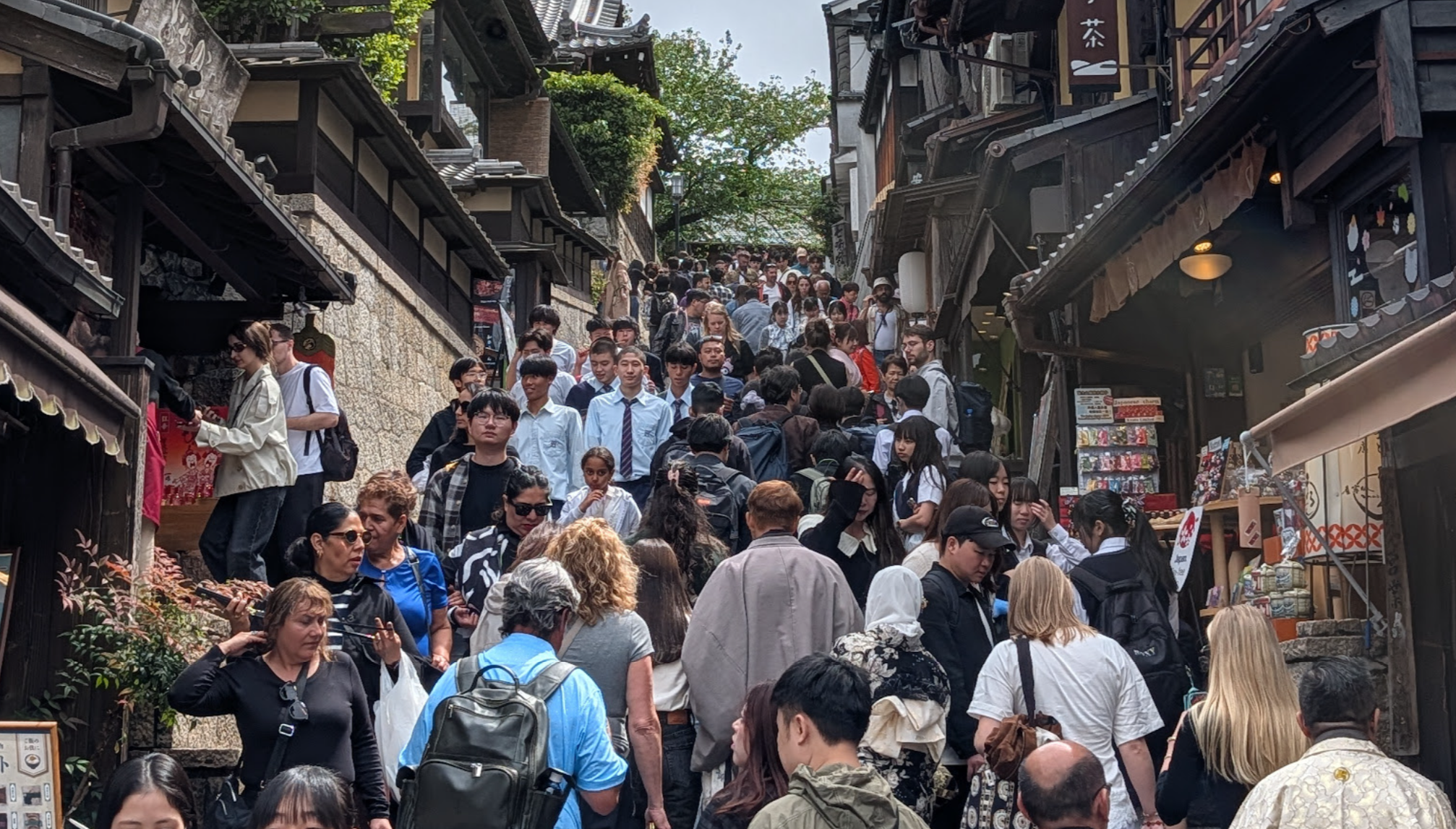
You can read countless examples of overtourism stories written over the last few years; after my most recent trip, though, I thought I’d help out with some personal observations. I have travelled all over the world in the last 30 years, and have never seen anything like the density of assholes I just encountered in Japan, but what I found wasn't a horde of Westerners simply being rude, or spaces where there were too many Westerners, it was tourists being an unbearable menace specifically while on and around their phones.
The last time I was at Shibuya Crossing, in 2014, I crossed the street, went upstairs to have a coffee at the Starbucks overlooking the landmark and spent a nice, quiet 20 minutes watching the ebb and flow of commuters. In 2026 you couldn’t move without hitting a Westerner filming themselves for some kind of content, their cameras raised above them while they narrated the event (whether there was actually an audience I’ll never know), each one an oblivious centre of their own universe while the 1000 people around them were just trying to get past them so they could cross the road and get home.
The last time I was at Don Quixote in Dotonbori, I marvelled at a store so big it had its own ferris wheel, bought what I needed and got out. In 2026 the store was overrun, again with Westerners, again all filming themselves for content, blocking almost every aisle on both the first and second floors, each offender desperate to boast in front of a camera that they too had been to the latest spot that had blown up on social media, and that they too had bought the latest viral Japanese skincare product. Any local in there who just wanted to buy a bottle of water was shit out of luck.
While in Kyoto doing some shopping I came across a group of Russian women taking photos and videos (again, content!) of each other on some historic steps. One of them, at the top of the stairs, had her arm out and was physically blocking anyone trying to get down, to stop anyone from walking in front of their video. That included the understandably frustrated Japanese locals just trying to get back from their lunch break, on their own streets, in their own town.
I went to Nara for a day, mostly because Nara is my own hometown’s sister city so I’d always wanted to check it out, and after arriving almost instantly regretted it. The frenzied walk to the famous deer park felt more like a line at Disneyland than a site of national importance, and the way so many Americans, Australians and Europeans were racing between the poor animals, taunting them on camera with their food and recording frenzied selfie videos, was extremely gross to witness.
In none of those examples were the size of the crowds of tourists the problem, or even their general behaviour. The vast majority of people were fine! The problem was the tourists with their phones out shooting themselves for a video or taking endless selfies, blocking crowds, barring entrance to stores and just generally getting in everyone's way in the most annoying way possible. I know simply blaming TikTok and Instagram and YouTube Shorts for so many flashpoints is an overly-simplistic explanation, but also, from everything I saw in my two weeks (where other kinds of rude or offensive behaviour outside the occasional jerk were rare), it was kinda true.
While I've used the term "overtourism" a lot here, it's important to note that what's happening in Japan generally (we'll get to exceptions in a minute) isn't the same as what's happening in, say Venice, where the city itself cannot physically cope with the influx of visitors. Japan's two largest cities (and two of its most popular tourist destinations), Tokyo and Osaka, are some of the biggest on the planet, and things like their public transport systems and accommodation networks can comfortably cope with the number of tourists moving around on a daily basis.
The overtourism I kept seeing, over and over, was more of an over-concentration of obnoxious, obstructive individuals, and a locust-like swarming of stores and attractions that had blown up online. A mass experiment in personal vanity, sparked by streaming video platforms and the shitty incentives they encourage. The resulting viral trends were driving tourists and content creators–often it was hard to separate the two–to either be assholes in the expected places, or sending them to specific and unsuspecting places to be assholes, where many residents don't have much experience with Western tourists (and a lot of tourists don't have experience with Japan).
This problem is only getting worse. The New York Times ran a big piece on Japanese overtourism just last week (“In the Foothills of Mount Fuji, the Fight Is On Against Unruly Tourists”), giving examples like a guy who moved out of the big city to the quiet country town of Fujiyoshida, only to now have thousands of tourists overrun his front yard every week because photos of Mt. Fuji taken nearby have gone viral. It also includes this quote which sums up pretty much everything I'm writing about here:
On a recent day, a group of friends from the United States ventured off the main path to snap selfies under the cherry blossoms. “I saw this gorgeous photo on social media, and I was like, ‘How can I get myself here as fast as possible’?” said Julia Morrow, 26, a retail worker from Ohio. “If you don’t get that photo, it’s like, what’s the point of the trip?”
This recent Reddit thread is also interesting because much of it matches my own recent experience; the change to the tourism landscape has been relatively quick, only really taking off in the last few years, and social media seems to have played a big part, with the most horrific stories often involving content creators and those chasing a taste of virality striking unsuspecting towns, shrines and stores like freak weather events.
All of which is having an effect on those living and working near tourist hotspots, so much so that governments have already begun to take action to try to address some of the worst offenders. AirBnBs have been regulated for a few years now, and the departure tax at Japanese airports is about to triple. Some attractions are already jacking up prices for foreigners, and increasing numbers of restaurants are declaring that they’ll only serve locals.
How much those relatively minor changes will have an effect on the wider overtourism problem, though, is anyone’s guess. Will slowly increasing prices across the board for tourists lead to a gradual decrease in the number coming? Can Japan simply wait it out for social media trends to move on? Would laws restricting the use of cameras, or at least the way you use them, in certain places help? I don’t know! And every step made to curb tourism is a double-edged sword, because the whole point of encouraging them in the first place was to help juice the national economy.
The only solution I can offer is that, if you’re insisting on going to Japan, do the same thing you should be doing when you visit any other country: be cool. If the locals have expectations and behaviours, do your best to meet them. Learn some phrases, be patient, be nice to everyone and most importantly, don't run around shooting video everywhere and getting in everyone's way, because you are not the centre of the social media universe, you're a guest in someone else's country.


