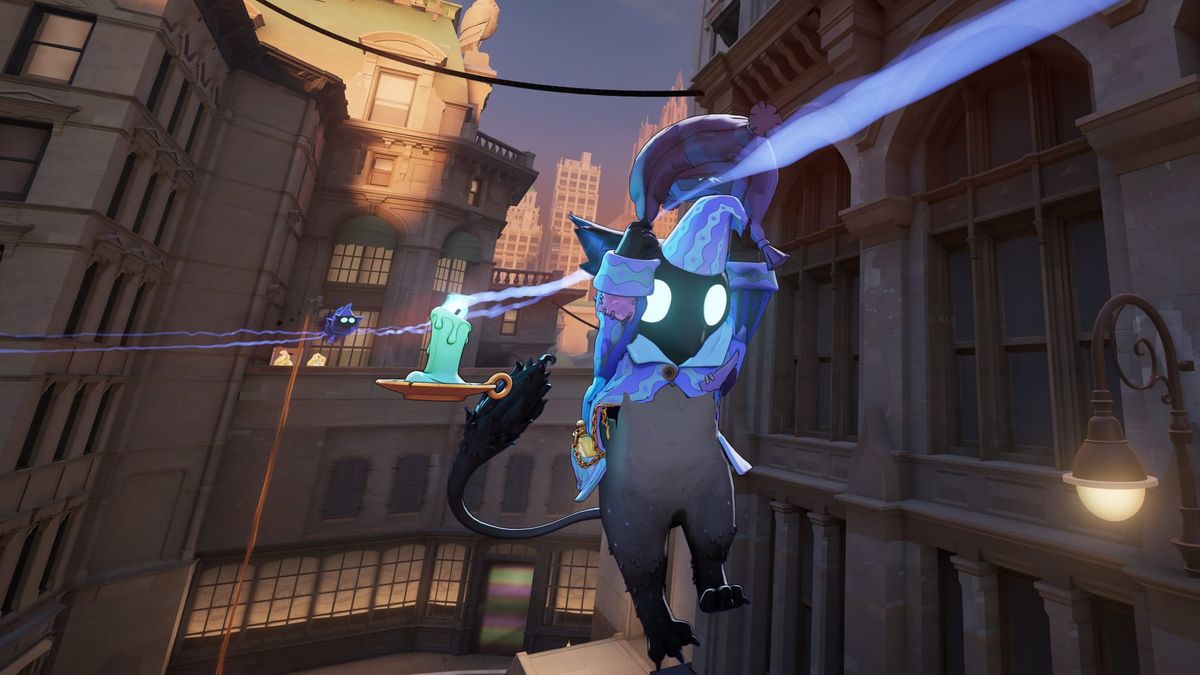
Over the past few years, I’ve witnessed the emergence of a very specific trend: Someone on social media will post this graffiti from 2008’s Left 4 Dead—which reads “WE ARE THE REAL MONSTERS” followed by comments from numerous others disputing it and calling the original wall scrawler an idiot—and it will attract hordes of likes (or upvotes). Most recently, I’ve seen the screenshot proposed as a counterargument to AI, which makes sense: As more and more games lean on AI to fill their worlds with crucial but gnawingly soulless details, many hark back to a time when humans did the work, resulting in spaces that felt lived-in, even as they were thematically steeped in death.
But it’s no coincidence that Left 4 Dead and its 2009 sequel have come to be regarded as shining examples of the form. In this case, as with so many others, Valve went above and beyond. Jay Pinkerton, a writer at Valve who’s worked on Portal 2, Team Fortress 2, Half-Life: Alyx, and other VR projects in addition to Left 4 Dead and Left 4 Dead 2, was responsible for the latter two games’ graffiti, but he was hardly alone.
"My memory of the Left 4 Dead graffiti is that it was an early attempt at crowdsourcing," Pinkerton told Aftermath. "I remember we covered several walls of the office in butcher paper and laid out dozens of markers, pencils and pens, and we invited literally anyone who happened to be walking past to contribute. If they weren't feeling creative, we let them flip through a big script book of things we'd pre-written and let them pick one that felt right to them, and encouraged them to rewrite it in whatever style they liked. If people wanted to go off script, that was also fine. We tried to reinforce that this shouldn't be taken lightly, obviously, they should picture themselves in a tight situation with maybe only a few moments to write something on a wall quickly that a loved one might see. But otherwise we offered very little oversight."
"If people wanted to go off script, that was also fine."
This resulted in scraps of conversation scattered throughout every level, which—while often very funny—felt like back and forths between real people. Some were tense, like:
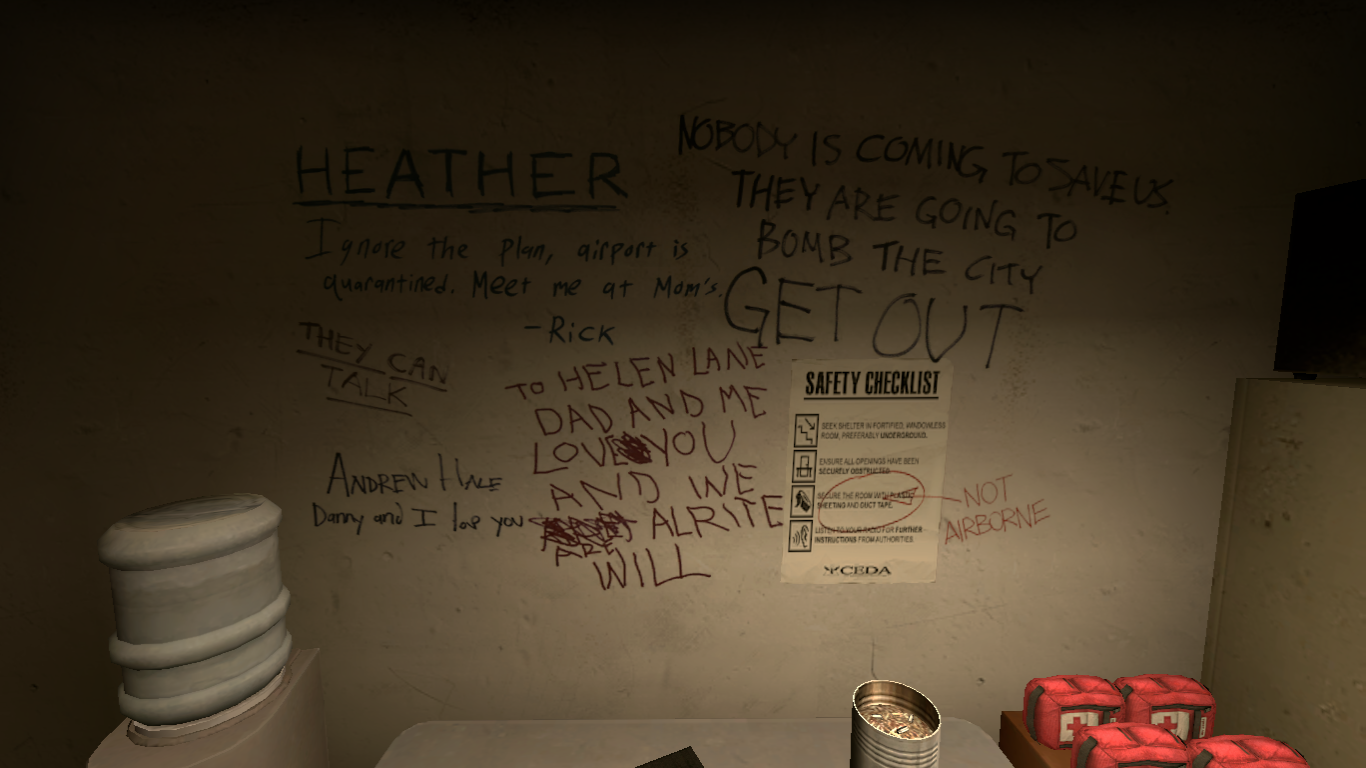
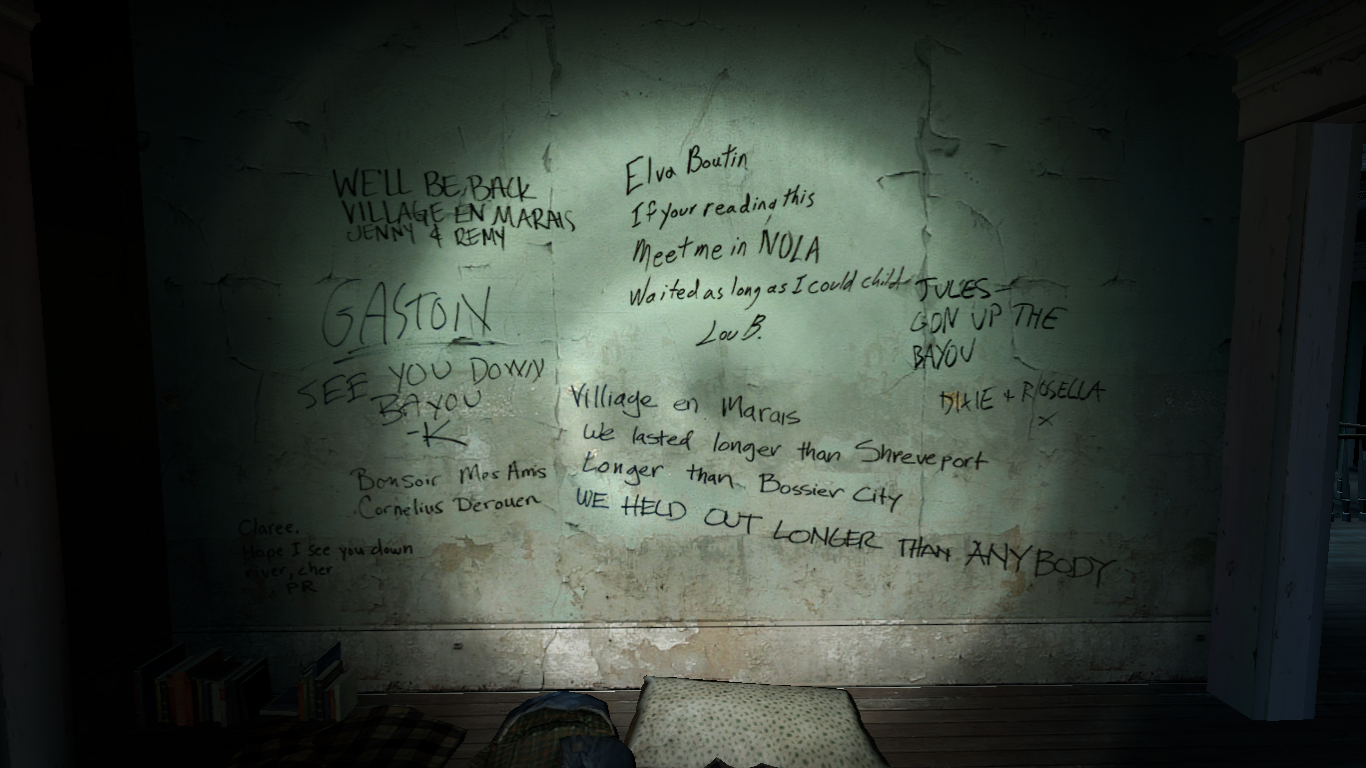
Others were remarkably hopeful and collaborative, considering the setting:
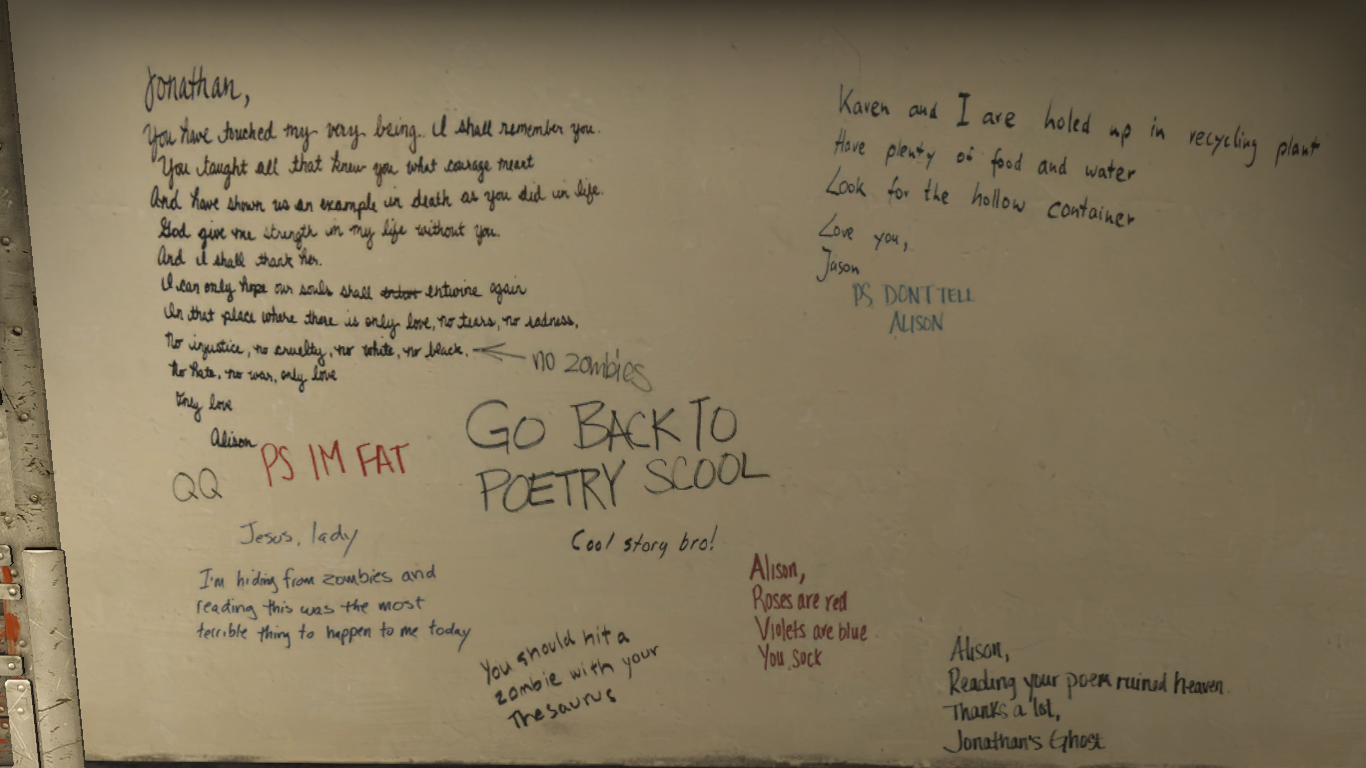
And some of the most memorable were arguments that felt like they’d spilled out of web forums and onto whatever wall desperate but still comically human survivors could find:
Even to this day, many games contain garbage graffiti. It’s either painfully on the nose or an ill-advised attempt at tutorializing. Pinkerton and others at Valve, wary of both traps, made sure that Left 4 Dead swerved to avoid them.
"We threw in a few tips here and there—’Listen for them and walk around!’—but slowly reading things off a wall would have been a terrible way to teach all the game mechanics," said Pinkerton. "The goal of the graffiti walls was always breadth. We wanted to convey the sheer breadth of this global disaster. It would have felt too small if the player had just kept seeing the same three handwriting styles. We wanted different voices, different tones. We wanted it to look like we thought a wall like this might actually look like: messy and chaotic and jumbled. An apocalyptic bulletin board."
Pinkerton and other writers acted as cooks in the kitchen while numerous interlopers contributed ingredients. Together, they created a sort of perpetual stew.
“The result was a wide variety of responses paraphrased from things the writers had written, sometimes verbatim, sometimes paraphrased, intermingled with responses we likely wouldn't have come up with on our own,” said Pinkerton. “Some were responses to existing graffiti. Some blossomed into full conversations. … There were heartfelt ones, clever ones, angry and betrayed ones. Some were even small and insignificant, maybe a note from someone who hadn't quite realized the depths of their predicament, who figured help was on the way at any moment. I think from there we started to take it all, almost like puzzle pieces, and put it into some kind of order, so there was some kind of shape and pacing to it, if not a narrative. But it was lightly supervised chaos.”
"We wanted different voices, different tones. We wanted it to look like we thought a wall like this might actually look like: messy and chaotic and jumbled. An apocalyptic bulletin board."
Left 4 Dead’s replayable cooperative structure presented unique storytelling challenges, especially for the time. How do you parcel out some semblance of a coherent narrative while keeping things varied enough that players will want to keep going back to the same levels over and over? Graffiti proved to be one of many solutions.
“The team knew the entire story—where the infection had started, how long it took to spread—and then had the restraint to just tuck it into the margins,” said Pinkerton, who was only just cutting his teeth on writing for video games at the time. “A stray line of dialog, a headline on a newspaper blown up against a fence. It was all there for anyone interested enough to hunt around and piece it together, but it was never intruding on the fun. The point of Left 4 Dead was that players would want to play it over and over again. Hell, I wanted to play it over and over again, it was the most fun game I've ever had to playtest. Could you imagine how irritating it would have been to have the four characters explaining how a zombie outbreak started with the same six lines of dialog every time you jumped in a game? It was a great lesson in knowing when to let the story get out of the way.”
Flash forward to today, Pinkerton still draws on lessons he first learned while turning Left 4 Dead’s walls into his urban Sistine Chapel: "The graffiti specifically and the environmental storytelling in general has always stayed with me, in terms of story being told in the margins instead of as something you're being hit over the head with. Maybe a character shares a little more if the player lingers, maybe you can stumble on a little nugget of story if you look a little harder. Just the idea of rewarding people looking for the story without bothering the people who aren't."
Could AI do something similar? Pinkerton is skeptical.
"I'm not nearly smart enough to comment on where the industry is heading with AI or what it will look like in five years or five months,” he said. “Right now, I don't find it especially useful in generating memorable plots or dialog. It's serviceable, but I don't think I've ever read anything especially clever or memorable—nothing I'd have been proud to ship in a game."
He is, however, not entirely opposed to dipping a bucket into AI’s well from time to time.
“I might ask it to generate a word cluster for me, or to give me twenty different ways a plot could go,” he said. “I won't use anything it spits out, but it usually helps get me to an idea I wouldn't have otherwise had. In some ways, it's not much different than conducting a writers room, where there's a lot of free association going on. It's not really the flurry of ideas getting tossed out that's valuable, it's choosing what deserves to get written down. I guess I wouldn't currently trust AI to choose what deserves to get written down. But as a constantly spraying word hose, I will occasionally drink.”
"The graffiti specifically and the environmental storytelling in general has always stayed with me, in terms of story being told in the margins instead of as something you're being hit over the head with."
The “WE ARE THE REAL MONSTERS” graffiti from back in the day, though? 100 percent human (or monster, depending on how you measure it).
“We watched a lot of zombie movies and read a lot of zombie comics prepping for Left 4 Dead,” said Pinkerton, trying to recall the graffiti’s exact origin. “The ‘Who are the real monsters... the zombies... or US?’ trope came up so often, we all got absolutely sick of it. It seemed, at least to us, like the go-to genre crutch. It's been a long time, but I suspect that was us having a little fun at the genre's expense.”
But that’s not Pinkerton’s personal favorite. He prefers a line that appears just below the "monsters" exchange. In his mind, it feels more like a natural byproduct of Left 4 Dead’s unique style and structure.
“I think ‘I miss the internet,’” he said. “It was a nice organic commentary at what was naturally emerging on the walls.”
Recommended
 Chris Person