

The name makes this sound like something that’s either a mobile strategy game with deeply misleading Facebook ads, or something for the ‘Oceans are now battlefields’ crowd to play while they all wait and hope for Total War to go back to its historical roots. Lucky for me, you and all of us, Master of Command is the latter.
It’s a roguelike Total War game (bear with me!) set in 18th-century Europe during the Seven Years’ War, and puts you in command of an army that has to roam the countryside attracting new recruits, scavenging for supplies and upgrading your gear. Which sounds slightly mad given the historical context–I’m a general in the British Army, surely I have maps and supply chains, why am I wandering around fields looking for boxes of apples and hiring French regiments–but the narrative justification for all this meandering makes enough sense that I stopped questioning it pretty quickly and just rolled with it.
It’s not like the idea of coats-and-muskets armies being multinational forces was an alien one; the British army regularly included German troops, and Napoleon’s Grand Armee featured everyone from Poles to Austrians to the Irish. And living off the land was also a legitimate tactic; Napoleon himself relied on it all the time, which is one of the biggest contributors to his disastrous retreat in Russia, whose winter left nothing for him to scavenge. Putting a roguelike slant on all this is close enough to the time period’s reality for it to make sense.
And in this context it’s maybe the most interesting thing about Master of Command. We’ve played tactics games and shooters and card games with roguelike tendencies, but Total War’s enormous real-time battles are something new, and as a huge fan of that series I’ve been really impressed with Master of Command’s attempts at replicating Creative Assembly’s formula. And I do mean replicate: from the main menu down to the in-battle interface, Master of Command isn’t so much looking over Total War’s shoulders as it’s just tracing right over its lines.
Which is fine, because aside from cavalry being kinda broken and OP, and there being a few less tactical options for your units, for the most part Master of Command plays exactly like a battle in Empire or Napoleon Total War. In some ways it’s even better, like the way units will break much more easily here, resulting in lower and more realistic casualty counts, while some nice battlefield additions like a musket reloading progress bar over your units helps you better plan your tactics.
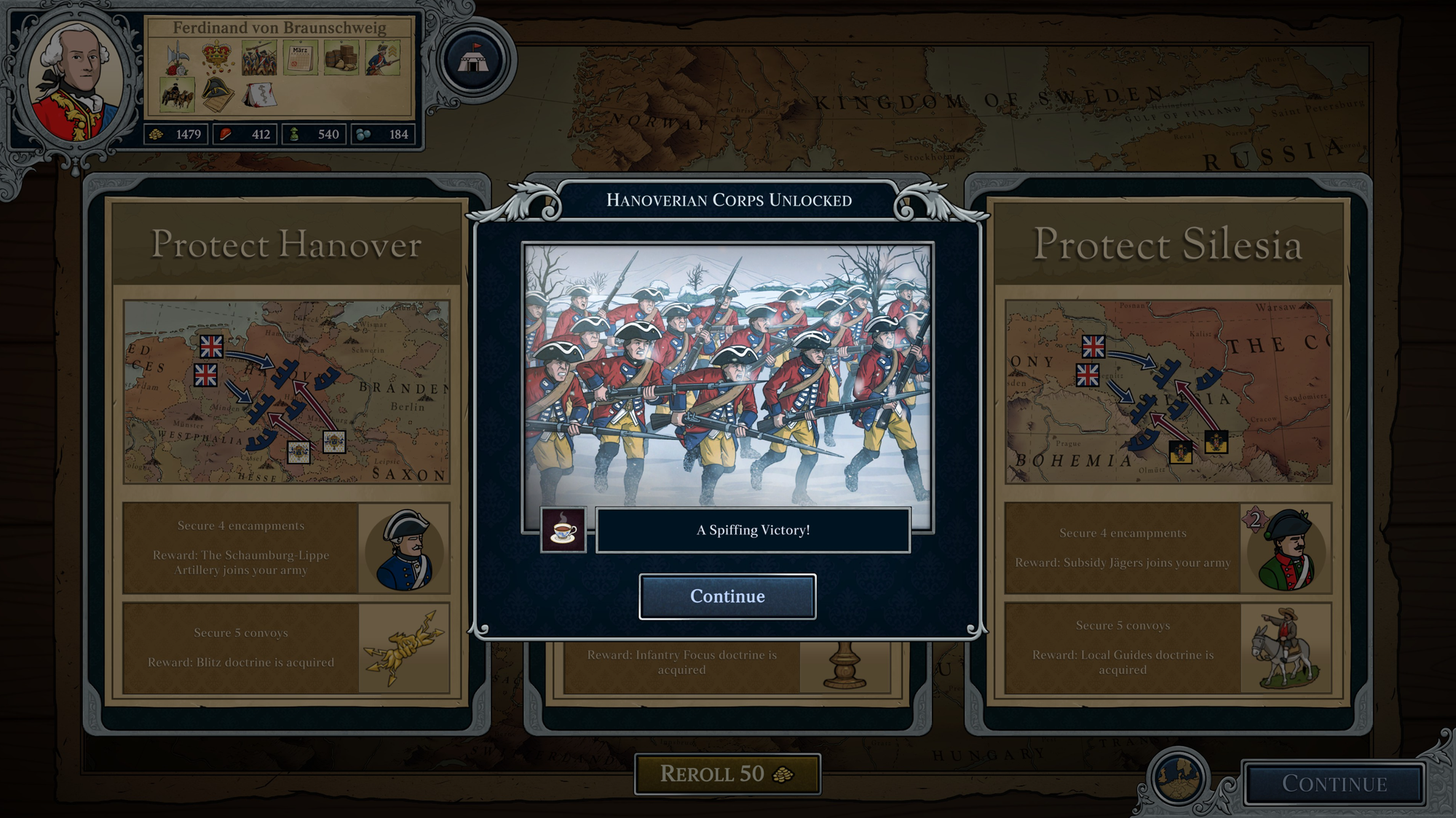
There’s a campaign and a loose act-based structure here, where you have to complete sidequests before tackling an end-of-level army, but the basic loop throughout remains the same. You fight real-time battles, you wander around reinforcing, having random encounters and messing with your army, then you get back on the battlefield and do it all again, juggling your resources and keeping an eye on your objectives the whole time.
I really like it. The battles are snappy enough that I never feel too bogged down playing so many of them in quick succession, and the roguelike structure makes me very invested in keeping as many of my guys alive as possible. I’d also like to take this opportunity to apologize to both the game and its art; I was recommended this game by many, many people last year and noped out immediately because the art shown in the game’s trailer looked so bad. On the screen, though? It’s fine! Many of the loading screens are better than fine, they look great!
Even if you’re not a huge muskets and horses person, the roguelike implementation here is still really interesting. Seeing these trappings added to an existing genre is something we all encounter at every waking moment of our lives these days, but the way it’s done here, and how it slides so seamlessly into your feeling of investment and control over your army, is fantastic. If this had just been a tactical RTS I’d be nowhere near as into it as I am, knowing how much it costs to replace every casualty I suffer and every musket ball I expend.


