

After what feels like years of expectation, Nintendo finally announced an Ocarina of Time remake on Tuesday. I can see why it's big news: It is an all-time classic, many people's pick for the greatest video game of all time.
The original, first released back in 1998, is a game that despite its accolades also had its quirks, ranging from its famous water temple to its N64-based control scheme. In the words of my 13 year-old son, it also "looks like shit". So I can see, on the distant horizon, the arguments for why this remake is happening. That it'll allow a whole new generation to experience the game, or maybe that it'll let us all experience the Ocarina story the way its creators originally intended.
Which is fine, but also, I am growing tired of all these big, expensive remakes. On a conceptual, strategic level, I think the AAA (and AA!) end of the industry's growing obsession with them sucks. Video games are a miracle, the product of dozens or hundreds or even thousands of people working together, often at their limits, for years at a time, all working to turn an idea (or even a dream!) into something people can play.
The process by which that is achieved involves nothing but compromise. Allowances need to be made for the team, its size, their skills, their experience and their health. The amount of money the developers have at their disposal makes a huge impact. They're only given a certain amount of time. There are technical restrictions (memory, speed) imposed by the target platforms, and the layout of the controllers that will be used need to be considered. A video game's design needs to thread its way through all those factors, and more, before it comes close to getting in the hands of players.
So every game you've ever played and grown to love, including Ocarina of Time, is simply a product of its time, and a reflection of the limitations placed on its creators. That, as much as any napkin sketches or all-hands meetings, is what defines the game. Its size, its scope, how many characters there are, what they look like, what everything sounds like–it's all a result of compromise and limits.
Ocarina of Time is a Nintendo 64 game. They are inseparable, and they define each other. I have zero interest in playing the game outside of that context! To remake the game for the Switch 2 is to bring it somewhere it was not made for, and somewhere that already has newer, different Zelda games that define their own era, games that have built upon and diverged from that decades-old formula and found huge success of their own.
Of course big publishers like Nintendo don't give a shit about any of that. That stuff is a worry for people who write blogs for a living, not anyone who counts money. What Nintendo is thinking here is how effective the continued weaponisation of an ageing player base's nostalgia is, and how remaking Ocarina must be one of the surest bets this company has ever made.
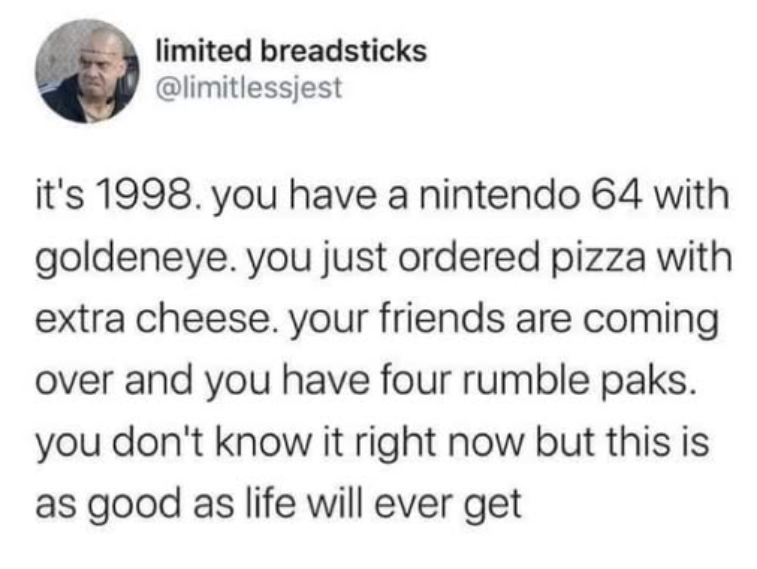
Fans love the old shit! The good old days, the classics, the games for consoles that just played games, from those times where you weren't facing climate disaster and the rise of fascism and global job insecurity and a looming economic meltdown. What could sound more enticing to an adult Nintendo fan than the chance to play Ocarina of Time one more time (or one more time, if they played the now-15-year-old DS remake), only now with better graphics and a different menu?
I don't want to make it sound like I'm picking on Nintendo specifically here. This game is just at the front of my mind because it was both announced this week and is such a big deal for people. Nintendo are far from alone; loads of publishers are doing this, and have been doing it for years now, though it does feel like the pace of bringing the old stuff back has started to quicken. Case in point: this list of "new" games announced recently:
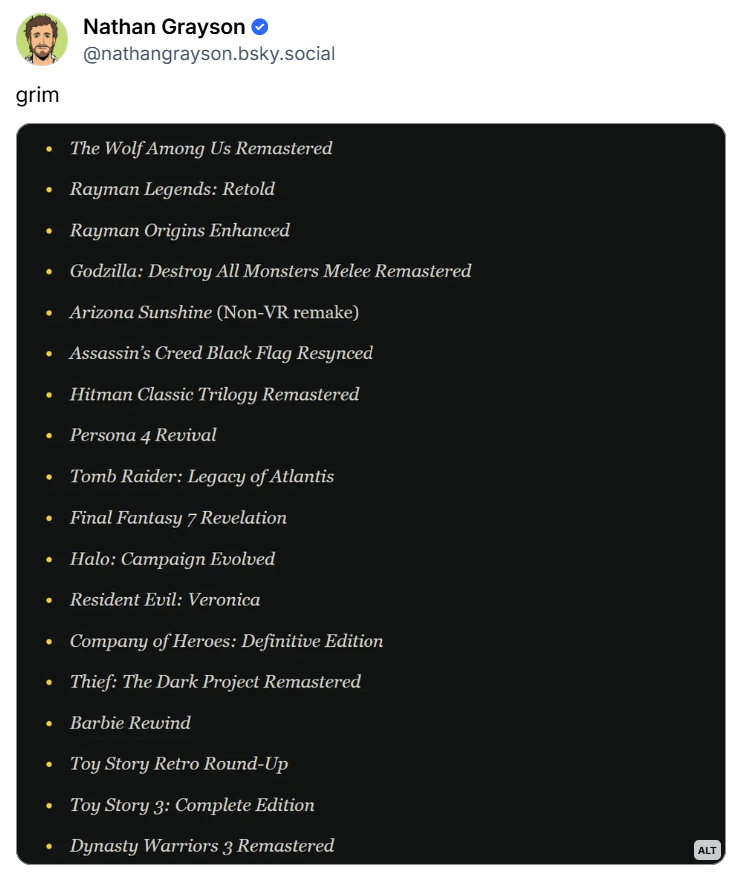
The lack of imagination and creative risk-taking here is simply staggering. We are being served reheated classics faster than anyone could ever stand to consume them. Consider this about every game announced above: Imagine that every cent and person and hour spent on these remakes could have been spent on telling new stories or creating new experiences. Instead, the tacit admission behind this craze is that there are holes in the release schedule that must be filled, and this is the cheapest and easiest way to fill them.
New games are expensive and risky! Old games with established Metacritic scores, Edge 10/10s and rabid fanbases are just sitting there, waiting to be remade and resold to millions of people all over again. As this excellent Inner Spiral blog elaborates:
It is much safer to sell a game to an audience that already loves it than it is to try and convince a new audience to fall in love with something they've never seen before. The publishers leverage the emotional connection you formed when you were 10, effectively weaponizing your own fondness for the past to guarantee their quarterly earnings. They are not selling you a game; they are selling you the safety of a known quantity, packaged in a prettier bow so it feels new enough to justify that 80 dollar price tag.
I find it especially frustrating when you look at that list of games above and realise that, even if you did think that games periodically require a fresh coat of paint (I don't), so many of them don't need a single piece of work done. Black Flag still looks great in 2026. Persona 4 remains perfect. The Wolf Among Us looks as wonderful as it did on the day it was released. And Halo has already been remade once already!
Because this is a subject where I don't think anyone can be truly wrong, by now you may be itching to hit the comment button and come at me with counter-points and exceptions to the rule, so let me try to head you off at the pass and anticipate some sample questions.
"But I never played this!"
Well, I think you should play it as it was originally intended, because that was the game. If you can buy a direct port of a classic game, do that. If you can't, well…
 Luke Plunkett
"I loved this game, I want to play it again!"
You may see a lot of 45-year-olds say this over the next few months, and if you do--or if you're one of them!--consider that as well-reviewed Ocarina of Time was at the time, as many 2000s GOTY lists it topped and as misty-eyed as you may remember it, you were also younger and more carefree then, and it was the bees knees because it came out in 1998. Those bees' knees are now as creaky as your own.
"What about remasters?"
I find pretty much every remake a waste, but remasters I think need to be assessed on more of a curve. Because I am both practical and imperfect, I can see plenty of scenarios--like an emulator or backwards-compatible console simply making some polygons look shinier--where it's mostly fine. I can watch Ben Hur on Blu-Ray; it's not the same as watching it on a shitty old cinema screen, but it's close enough. A remake, where an entire game is rebuilt from the ground up, is an entirely different proposition.
"What about stuff like Octopath Traveler 0?"
Look, that's a very weird outlier, please don't try to trip me up with niche cases, you're on your own there.
"Shut up man, I love remakes and I'm gonna buy this instantly."
Well, good for you! I'm a games critic, I write about this stuff in order to make a personal case and share some thoughts. You don't have to listen to me, do what you want, you're an adult!
Look, I'm not trying to force anyone to abandon your enthusiasm for remakes and remasters if you are genuinely excited to play altered versions of games you've already enjoyed, or if it's the first time you're getting to experience a title you've heard is good but has been difficult/impossible to play previously.
But maybe next time you do sit down with an expensive remake of an existing game, consider just why you're getting it and so many more of them, and what it says about the video game industry that some of its biggest announcements for today are for the games of yesterday.


