

I don’t play Wordle anymore, though I enjoy its Irish-language equivalent– fears about the game’s acquisition by The New York Times in 2022 have borne out not necessarily in the degradation of the game but in difficulty supporting The Times. On Tuesday, Wordle creator Josh Wardle released a new game, Parseword, which is about as far from the simplicity of Wordle as you can get.
Parseword is a cryptic crossword, which The New Yorker writes is a genre popular in the UK but not necessarily in the States. Rather than the clues-to-number-of-boxes standard in American crosswords, cryptic crosswords use language in their clues that suggest what you should do to a word or series of words to get the answer. In Parseword, this can be words like “reduce” to tell you to remove letters; “with” or “after” to tell you to combine words; “grabbing,” “hiding,” or “wraps” to indicate putting one word inside another; and even words like “French” or “Spanish” to suggest transforming a word into a foreign language. The goal is to eventually get two words that mean the same thing, such as, in one introductory round, transforming the phrase “Animal among basketball amateurs" into “llama,” with the “among” pointing you to the word hidden within “basketball amateurs.”
Parseword has a robust tutorial to walk you through all of this, explaining the concepts and then letting you try them out for yourself. In gameplay, selecting a word can show you a synonym, or selecting a series can show you various options of what the words might turn into. There are also different difficulty levels, with the easiest giving you hints and answer lengths and the hardest leaving you to your own devices. The New Yorker writes that Wardle hopes the game can “introduce newcomers to the joys and agonies of the cryptic,” and that “Rather than asking newcomers to memorize a rulebook, Parseword makes the algebra visible, guiding players through a sequence of discrete steps. The mystery remains, but the path to clarity is no longer obscure.”
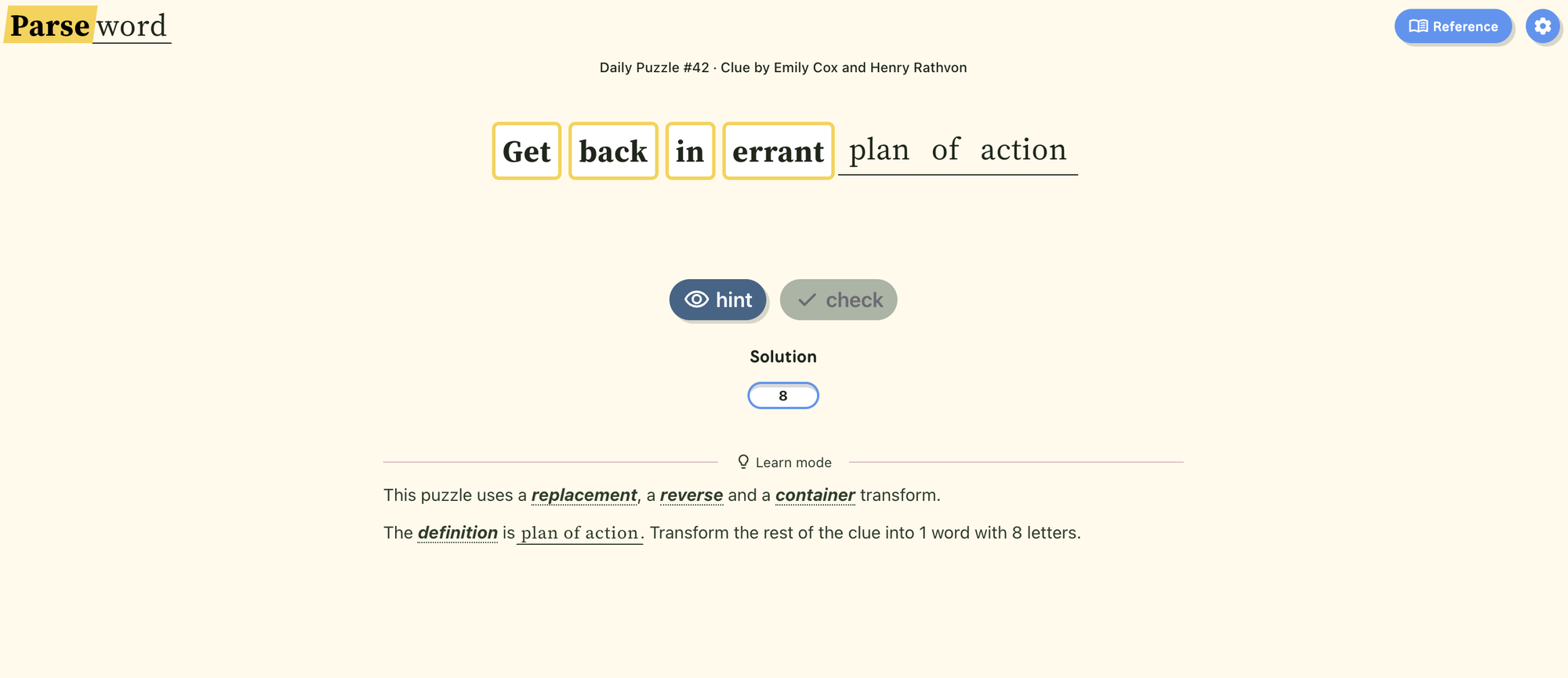
I’m not at all familiar with the genre of cryptic crosswords, so I can’t say how well the game pulls this off. It does do a good job putting all the information in front of you, meaning for me it became more a question of understanding the particular thought process of cryptics. This isn’t unlike the crosswords I’m more familiar with, where certain clues always point to certain words that you just pick up through playing, but it’s definitely a lot of new vocabulary and concepts to pick up as a beginner. The game feels good to play, with pleasantly clicky buttons and perky sound effects that kept it feeling light even when I stared at a screen for minutes at a time in bafflement. But it’s a hugely different experience than Wordle, which got its pleasure from spelling and vocabulary. Here, logic is the thing, both in terms of understanding the language of cryptic crosswords and in trying to get from here to there with the words provided.
Wardle told The New Yorker that he struggled after selling Wordle and found comfort in cryptic crosswords, despite their challenge. I can’t say I find Parseword comforting yet; it requires the kind of brainpower I’m not sure I have first thing in the morning, meaning it might not join my daily list of wake-up-with-coffee games. But it’s fun to have a new word game, and one that isn’t associated with transphobia and genocide. It’s introduced me to a kind of game I’ve never played before, and if you’re experienced with cryptics, I’d love to hear your opinions.


