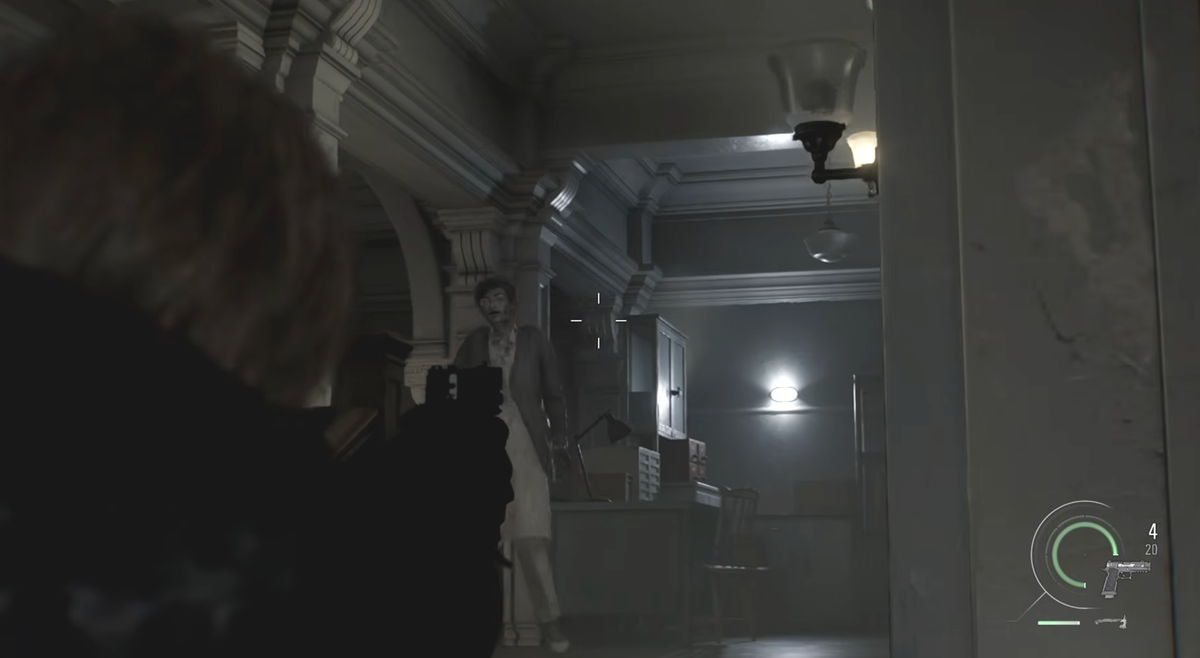
The Resident Evil series, historically, has been about a lot of things. Zombies, obviously, but also the global ravages of a feckless pharmaceutical company and, in its own often-campy way, the politics surrounding that. You might remember, for example, that time all of Raccoon City got obliterated by a nuclear bomb. Charged imagery, to be sure, but was Resident Evil 3 trying to say anything weighty or consequential with it back then? And what is Resident Evil Requiem, in returning to that setting, trying to say with it now? On the latest Aftermath Hours, we attempt to answer those questions.
This time around we’re joined by two critics who’ve played through Requiem and articulated their thoughts about it: freelancer and Aftermath columnist Joshua Rivera and Polygon editor-at-large Giovanni Colantonio, whose review of Requiem – which put the game in conversation with the atomic bombings of Hiroshima and Nagasaki – has drawn some pretty vocal criticism these past few days. We discuss whether or not the text of the game actually supports that kind of close thematic read.
We also discuss Resident Evil more broadly: where it’s coming from, where it’s going, and of course, where Requiem fits into all of that. The series has spent its past few installments promising a fresh start; does Requiem actually deliver, or is it lured astray by the siren’s call of Leon Kennedy-flavored nostalgia? And during an era that’s decidedly post-zombie, what makes this series, in particular, so enduring?
Finally, we come up with some truly diabolical remake ideas for old-school games and conclude that there’s actually no such thing as a long or short game. Who needs to stick around for 100 hours when you can make your own ending whenever you want to?
You can find this week's episode below and on Spotify, Apple, or wherever else you prefer to listen to podcasts. If you like what you hear, make sure to leave a review so that we can acquire the venerated Radical Rex license and leave it in the capable hands of Sam Eng, creator of Skate Story.
Here’s an excerpt from our conversation (edited for length and clarity):
Giovanni: It’s tough because there are specific moments – and this is the tough thing about a pre-release write up – I want to point to that are off limits for now, and there’s a question to be had about “Eh, maybe that should wait [until after release] to have the full scope of the thing.” I’ve always heard [Hiroshima and Nagasaki] referenced in terms of Resident Evil 3; I’ve heard people talk about that. I’ve never quite bought into it. I’ve always thought of it like the ‘90s and “Cool guys don’t look at explosions.” Everything blows up in these games. I never paid much mind to that.
There are a couple moments in Requiem that I do think kind of, to varying degrees of explicitness, at least reference it. Not saying it specifically, but there is one case where I think it does actually point to it in a way that’s surprising. But I started thinking about it [in terms of] “Is this a game that is looking back at what happened in Resident Evil 3 and looking at it through the lens of a greater tragedy?” I was doing research into that, and I found an old research paper from 2019 that was focused on [original Resident Evil director] Shinji Mikami’s work. It was a piece about unpacking a lot of that post-war feeling in his work. I don’t know that I even necessarily fully agree with that research paper. There were some parts of it where I was like “Dino Crisis fits into this? I don’t know. Seems like a stretch.”
But I think it got the wheels turning, and with some of the symbols and lines that are in Requiem, I got to thinking about if this is a game about Leon dealing with a trauma that is referencing the trauma [of nuclear devastation]? And are we supposed to take it as he’s experiencing this long aftermath of this trauma that’s coming from a real place of anxiety?
So that’s how I got onto that train of thought, and I do think there are things you can point to that are there. I think the question that arises, though, is: Even if that stuff is there, is Resident Evil equipped to talk about that in any way? I’ve been thinking about that a lot in the past couple days. This has always been a series that has political undertones in its lore. There’s an evil Big Pharma company, and it’s making bioweapons and trading those with the US government.
Nathan: Zombie president!
Giovanni: Yeah, there’s weird threads. They’ve always been kinda funny, but there’s also stuff in there that’s very strange and pointed. A distrust for authority is baked into all of Shinji Mikami’s work – even Dino Crisis. So the question that arises for me that I haven’t fully unpacked yet is, even if that’s what the reference is – and I think it’s fair to say “Eh, that’s probably a stretch” – is Resident Evil as a series, a goofy thing, equipped to deal with something like that? And is any triple-A game?
Josh, you wrote something that I really love; you say that even if games reference something like this, what do you do in the game? What does the gameplay come down to at the end of the day? Resident Evil Requiem, at the end of the day, is a big, fun shooting action game where you’re killing zombies, and zombies are the bodies of the dead. How do we feel about that [in this context]?
Josh, is there space for Resident Evil as you’ve talked about it, as a work of pure schlock, to talk about things and reference them, or should we take it as being a little too dumb to really say anything serious about this – and interpreting it that way is kind of a fool’s errand?
Joshua: I think it’s a fool’s errand. I also think the series is capable of [aspiring to something more serious] if they wanted to. My example in support of this is actually Resident Evil 7, which opens with a very clear Texas Chainsaw Massacre homage. There’s some hicksploitation going on there. And it has a scene at the very end where you link with the mold, which is the evil presence – it’s very silly – that’s made these people what they are. That neglect from this pharmaceutical company poisoned these people’s land and turned them into monsters. You get to speak with the real Jack Baker, a sympathetic, tragic figure.
I think the game means that. I think the people behind the game were interested in some type of pathos because that’s part of what they wanted to do with that game: ground you not just in Ethan Winters and the first-person [perspective], but also relating to these characters as you would in the first-person.
So I do think the games are capable of it; I don’t think this game is interested in that. I don’t think it’s crazy for someone to see what you saw, Gio, and to consider it in relation to the game. But I do think there is a matter of scope and justification. That’s a big check that you write – that anybody writes if they’re pulling from something outside of the text. The sticking point for me, then, is “How do I justify referencing a real historical tragedy and also a people in connection to that tragedy?”
The first thing I would go to is just a simple question of visual language. I think about 9/11; because of the generation we’re a part of, most people in the creative workforce are about our age or older. We have a visual language for how a city falls apart. We have a very specific image culturally for what that looks like. So if we are going to show a city falling apart, that is what we’re gonna think of and that is what we’re gonna replicate. Does it mean that the work in which we do that is about that? Not necessarily. Then again, this is also a matter of interpretation and intent. They could be totally separate things. This is what [the concept of] death of the author talks about.
For example, The Avengers. That’s very much a movie about “What if we could stop 9/11?” That’s not necessarily what the people who made that movie were thinking, but that’s kind of what’s in that movie. Or the new Superman movie – maybe less so. I think that movie has different aims.
You put even more of a burden of proof on yourself when you also invoke a people and a place and a culture in addition to the imagery of a historical event. That’s where I’ve got my guard up. I’m gonna call out something specifically, and it was not something that was in your review; this is something I saw in defense of your review from people who read it, and it really bugged me. People were like “It makes sense and it’s natural to think of Hiroshima in a work made by Japanese people featuring a bombed city.” It’s one of those “Listen to yourself” moments. Natural for you. That is your only frame of reference for this place, this people, this culture. You swap out any other atrocity with any other group of people, and fuck you, you know? “It’s natural for this Latino man to be evoking colonialism and the conquest of Borinquen.” Listen to yourself.
I think what’s interesting – and what I struggle with a little bit in your reading, Giovanni – is that you do evoke the Hibakusha [bombing survivors]. We know how Japanese culture evokes that imagery. They were a protected class. There is a very sober and sacred evocation of these people and what they went through. If we think this is something that is being referenced, I think we would also see that somber, careful treatment [in Requiem]. And I don’t think that’s there. So for me, that’s not where I would go.
Giovanni: Yeah, fair enough. I think that’s a really interesting way to read it, because yeah, I agree: If we are talking about survivors, this is a tough series to put that into! And again, I do think there are little references to it – there are things to my read that that’s coming from – but I don’t think that necessarily means that’s what the game is about.
I would actually argue, and I want to make this clear: I think the game, if we’re giving it an About, is very broadly about trauma. It’s about Grace experiencing it on this micro scale, dealing with the loss of her mother; it’s about Leon dealing with it on a larger scale of “All these people in this city that I was sworn to protect are gone.” It’s having two characters face that in very different ways – almost a fight or flight response between them. That’s what I would say the game is actually about, and that’s the wider point that I would point to if we were getting into that.
But yeah, I agree: If the intent is to invoke this [real-world tragedy], it’s certainly not terribly respectful. And I think that’s a good point, to be like “Well, you would think that they would be more respectful if that was the case.” I think that’s legitimate.
Recommended
 Riley MacLeod