

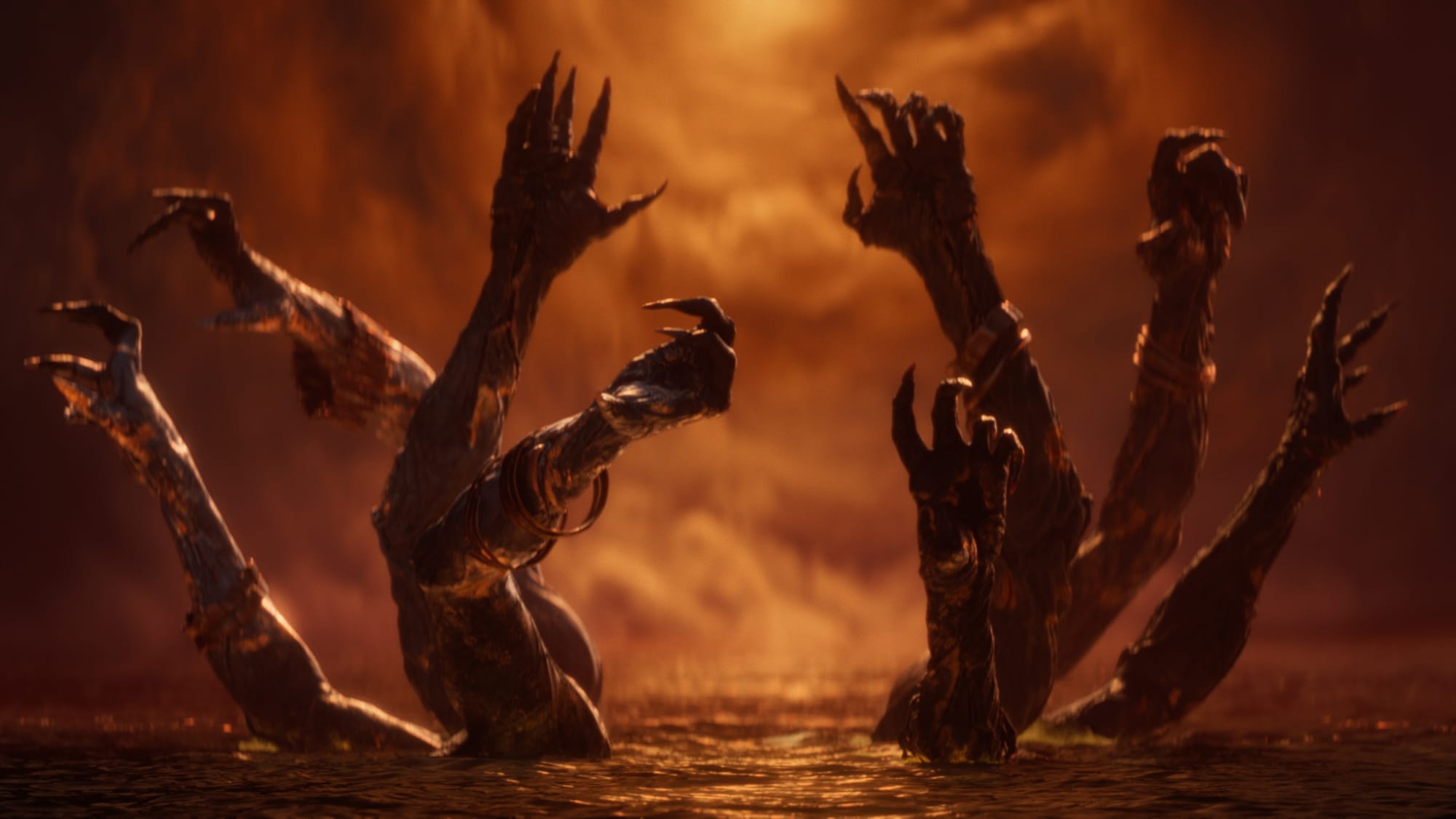
I was already fully bought into Saros by the time I got to the first of the “Eclipse” phases of the game. But when that first, bizarre, undulating alien hand opened itself up to me for the first time, I perked up in my seat even further.
Alongside that strangely gentle gesture, a series of extremely compelling and beguiling images flooded the screen. First, the eponymous eclipse but then a land on fire and an eye covered in gold. One final detail completed the picture and I was hooked: a series of echoing, ominous, distorted guitar chords. These seemed to extend the images’ effect well after they themselves receded from the screen.This passage confirmed a suspicion I had from minute one. This game was inspired by, and created in the oppressive light of, doom metal.
I’ve been playing video games and listening to metal for pretty much the same length of time, but I had never before seen a game as explicitly informed by doom metal. I was also struck by how weird that was. After all, there are many, many video games which use metal as an inspiration, an aesthetic, and as a literal soundtrack but none of them felt doom metal before. Doom (2016) is probably the example that’s currently the most famous; I’ve written about it myself as an example of using metal’s tonality to underscore a fast-paced action game. The examples continue from there, with varying degrees of game quality: Enter the Gungeon, Killing Floor, Metal Gear Rising: Revengeance, to name a few. The list is very long.
But what do I mean when I say that a game is metal or inspired by the genre? Some video games (and books and movies and so on) feel instinctively metal. “Metal” has even become a slang term to describe particularly gnarly pieces of fiction (as in “that’s so fucking metal!”). A definition isn’t always necessary to recognize this, partly because metal has been a part of mainstream culture for sixty or so years now and partly because that’s how aesthetics work—they are largely unmediated by language. But interrogating metal as aesthetics can be an incredibly fruitful exercise, especially in video games.
Games are inherently multi-media projects,by which I mean that they blend visual, literary, aural, and other art forms; they are especially reliant on a cohesive aesthetic. When players call a game “cool” or say it has “good worldbuilding,” they often mean that a game’s set of design, color scheme, writing, music, and mechanics all mesh well together, creating a work of art that is greater than the sum of its parts. That’s really hard to pull off and so game designers, writers, and composers often look towards outside influences for an initial palette, for a language to help tie things together. Sometimes that’s Welsh mythology, sometimes that’s cyberpunk, and sometimes it’s metal.
Saros is a really good example of some of the “primary colors”, or defining characteristics, of the metal “palette”, of metal as aesthetics. Metal’s number one defining character, beyond which no sub-genre, no matter how obscure, might be called metal, is excess. While the historical conditions which gave birth to metal are too complex to cover here, suffice it to say y that metal was born in opposition, as part of the general cultural rebellion of the 60’s and the 70’s. It has always defined itself by going faster and louder and by dealing with themes defined by society as taboo, like death, violence, self-harm. To be “fucking metal” is to be beyond, to laugh in the face of moderation and caution, to grab a subject by both hands and dive wholly into it, to commit fully and passionately.
Saros has this excess written all over it, from its story and all the way through to the mechanics of the game. When you reach some of the more advanced levels in the game and you are awash with the multi-colored lights of projectiles that Housemarque love so dearly and those projectiles are being shot at you by a dozen different enemy types and those enemies are organic, machine-made, and eldritch, all while you’re firing back with your powersuit mounted alien weaponry? There is very little left to say beyond: “that’s fucking metal."
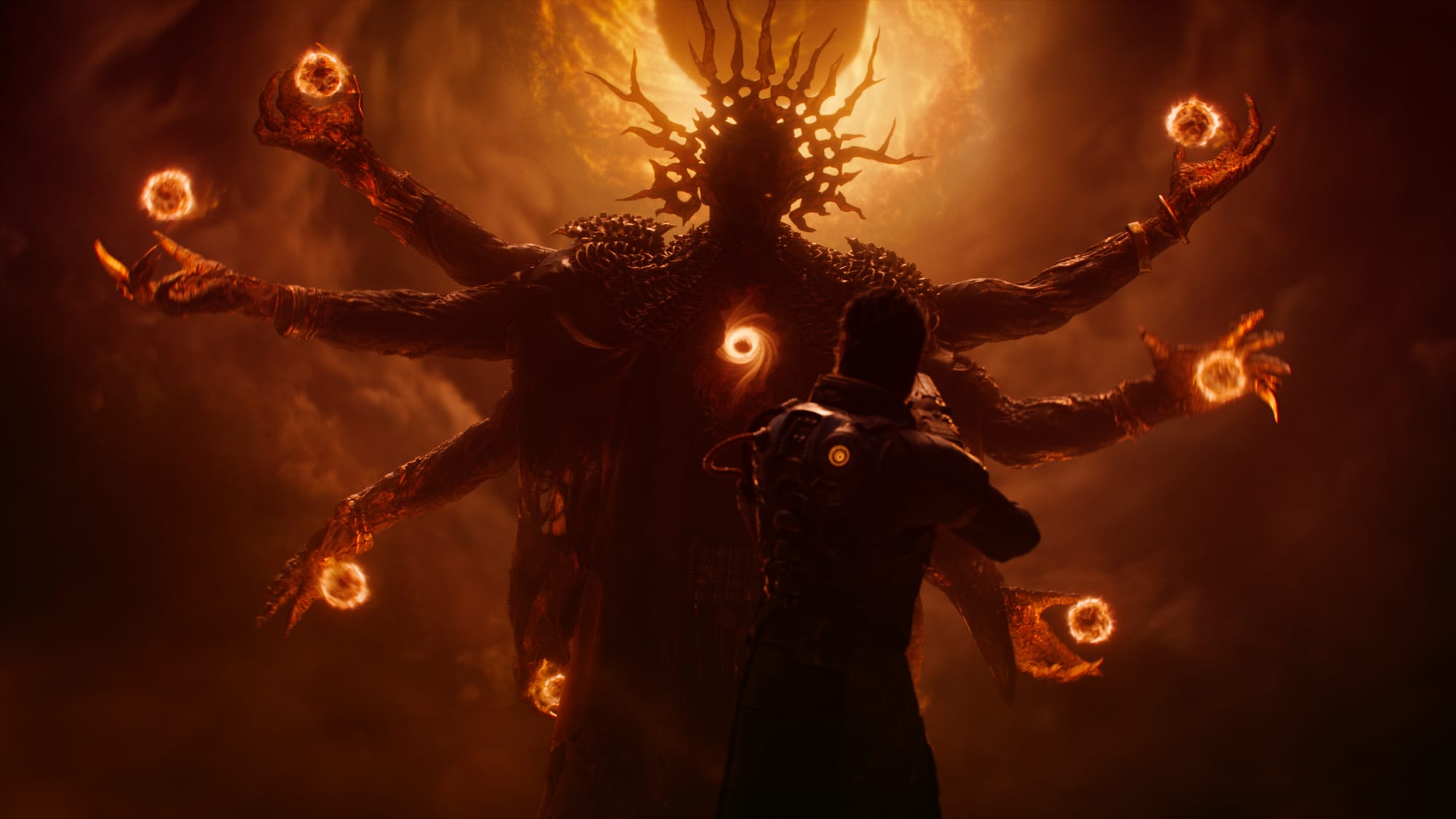
However, I am not here to make the point that Saros is “just” metal. I am here to make the point that Saros is doom metal. Doom metal is usually categorized by its type of excess: an excess of slowness. Another way to put that is to say that the way which doom metal generates “heaviness” is by appealing to a crushing, suffocating, and oppressive sort of aesthetic: massive suns and their alien heat, winding, eldritch labyrinths, distant mountain peaks and their grandeur. Doom metal’s aesthetic places emphasis on weight, on friction, on a molasses-like resistance that comes either from beyond or from inside of us.
Sonically, this emphasis tends to manifest in a few different ways. First, and most famously, in the outsized, overtone heavy, feedback-laden chord. For an example, check out Pallbearer’s “Foundations” from 2014’s Foundations of Burden. Feel how massive those chords are, especially when combined with the drums and the vocals, which seem hopeless and forlorn.
This is classic doom metal, which achieves its excess not by being faster or louder (though it can be very loud) but by being slower, to the point of sometimes ridiculous exaggeration. This first element of doom metal’s aesthetic is easy to connect with Saros. In fact, we already have. hTis is exactly how the chords which play in the background of Saros’s eclipse phase, feel: echoing, undulating, substantial. Slow in an ominous way. This also manifests in the scale of Saros’s world, full of giant flying monsters, massive machines that operate on a global scale, and world-ending weaponry all create that same feeling of slow, slouching, overwhelming size that lies at the core of doom metal.
Doom is also famous for repetition; when something is repeated again and again, we often associate it with a “digging” sensation, an excavation, a pressing down of weight. Chrome Ghost’s “The Diving Bell” is probably my favorite example of this. The main riff from the fourteen-minutes-and-change long track (we’re in doom metal country now, friends) does such a good job of making you feel the crushing weight of the ocean. It does this not just with size but also with repetition, enveloping you and pushing you under as it continues to pummel down that riff.
Feels familiar? It’s how Saros deploys its core mechanic, one which relies on what often feels like endless repetition. This mechanic, which lies at the base of the “rogue-lite” genres of games, utilizes repetition to upend the “traditional” trajectory of player progression. Instead of a linear, one way journey where the protagonist grows ever more powerful, rogue-lite games force players to return to the start of the journey. From there, often with very little in hand to show from the previous “run”, the player must try again, utilizing the knowledge and resources of previous runs to progress slightly further before, inevitably, being sent to the beginning once again.
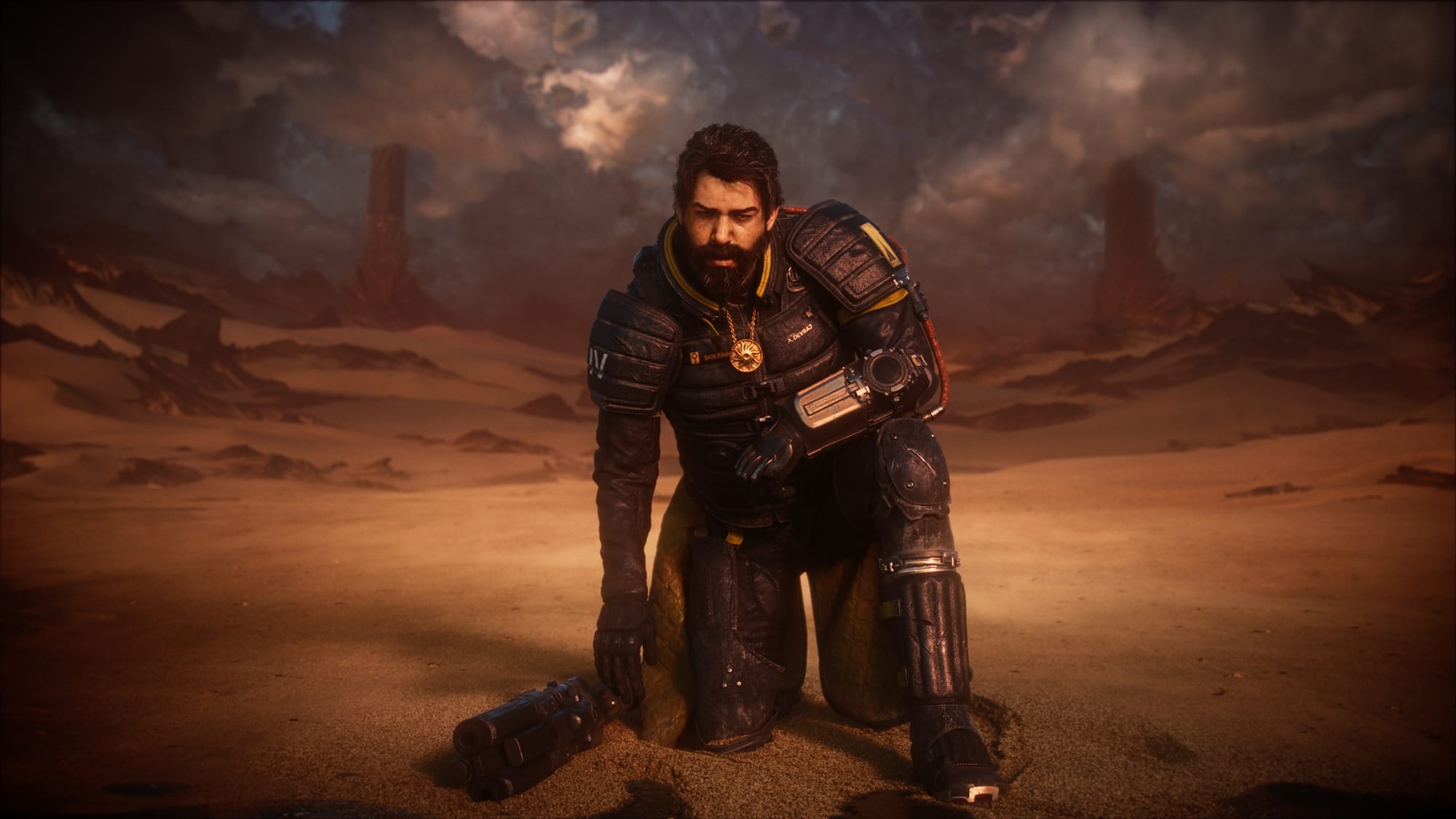
Some games approach the repetition inherent to this style of game in a lighthearted way (like in Cult of the Lamb for example) but not here. Saros uses the mechanic to double down on the feeling of limbo, purgatory, or suspended life it can evoke. As the game goes on, with Arjun spinning deeper and deeper into Carcosa’s core, each repetition feels more hopeless than the last rather than more elucidating or fulfilling. Are we really making progress between each run? Are we really learning more about what happened on this planet?
In some ways, yes. In others, no. Saros’s loop is a bit futile from a gaming perspective. This one is subjective, but I felt like Saros is a far less generous game than others of its kind in what progression gives us. I never felt like I hit a powerspike in Saros; each run felt desperate. I was stronger but so was the world around me, pushing back on the fantasy of Arjun as action hero and establishing Arjun as a desperate Sisyphus the more I progressed. Saros’s repetition is just like doom metal’s—reprieve is rare, resistance and friction are a constant.
As Arjun’s journey continues, knowledge itself begins to lose meaning, especially self-knowledge. Much of the game, in between its explosive beginning and its beguiling end, is spent in an oppressive excavation, a claustrophobic struggle against forces greater than anything in the protagonist’s toolkit or his capacity for understanding. What is more doom metal than staring at a golden, blazing sun and asking “wait, what exactly is even happening here?” The gameplay loop is used to obscure more than elucidate Saros’s lore, emphasizing the inherent folly in trying to “make sense” of things as complex as betrayal, love, purpose, belief, and desire.
This is the last facet of doom metal: the futility of the attempt to know oneself or, rather, an anxiety with the unraveling of identity which can lie at the core of such attempts. Doom metal has a propensity for extreme cynicism of self exploration, emphasizing how often the results of such introspection end up being the self, and the self’s body, moving further away from the self-explorer’s understanding. A good example of this is Latitudes’ “Body Within a Body”, from the masterful Old Sunlight. Its lyrics, with their corporeal, infinite corridors, distant and alien sunlight, and ominous, eroding oceans, might as well have been written by a member of Saros’s Echelons, lost on Carcosa and witnessing the dissolution of their humanity. Along the four minute mark of this track, you also hear echoing chords that sound like prototypes for Saros’s soundtrack to an eerie degree. In fact, the song played in my head again and again as I was playing Saros, especially when interacting with my favorite NPC: Stack.
Stack is a great example of how both Saros and doom metal view the intrepid self-explorer: he’s a lost diver, fumbling in a dark ocean of the subconscious, murky thoughts, biases, nefarious intent, and history. In the story of the game, Stack is the first to succumb to the urge to see the Yellow Shore. He attempts to visualize it, but ends up spiraling deeper and deeper into unintelligible madness and futility. The game and the style of music both are incredibly skeptical of our ability to solve the question of our own life and its meaning. Ultimately, in the music and in the game, these questions cannot be answered but only encountered and worked against.
Arjun’s journey and the player’s journey are replete with golden suns, formerly human monstrosities, unknowable deities, many unanswered questions and the unbearable weight of many, many, many enemies and their manifold weaponry. Like other games before it, Saros uses metal’s powerful and distinct palette to paint this vivid world. Housemarque reached for the fecund, blazing, undulating, and massive style of doom metal to create Saros.


