
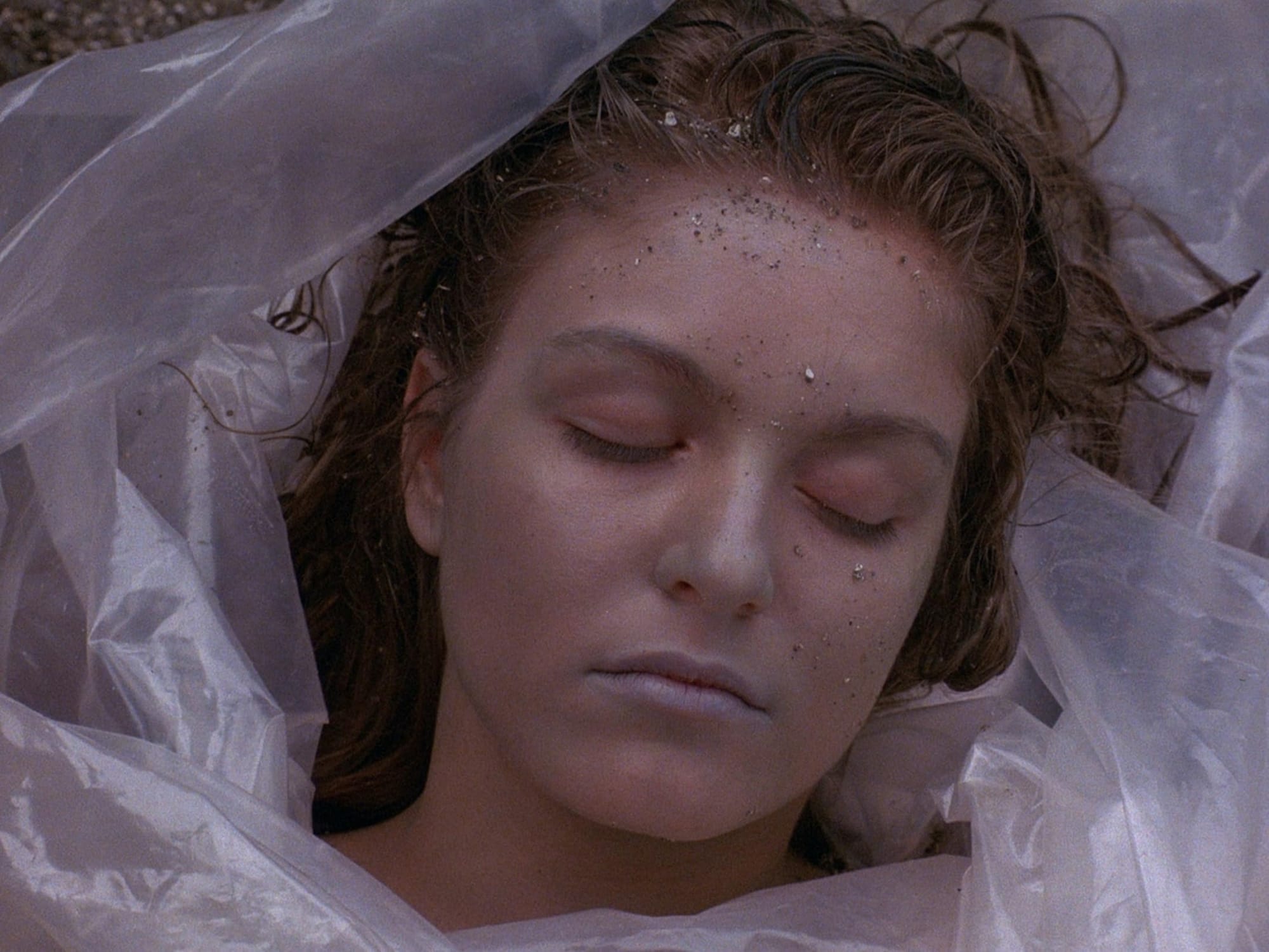
The bad guys won in Twin Peaks. That's not a spoiler – the show famously begins with the discovery of Laura Palmer's corpse, a young woman's life cut short by a horrible crime. As series protagonist FBI Agent Dale Cooper arrives to investigate, the series – stretching across the original two-season ABC drama and its legendary cliffhanger, a wrenching prequel film (Twin Peaks: Fire Walk With Me), and a shocking 2017 revival (Showtime's Twin Peaks: The Return) – chronicles the fallout from that crime, and the ways in which a community failed to recognize the evil living comfortably within it.
Twin Peaks isn't wall-to-wall grimness. It is still an uncommonly eccentric show, one that takes many digressions. The series is lauded for its boundary-pushing swerves into supernatural mythology, but none of that would land without its sincere effort to be a portrait of a quirky Pacific Northwestern town. This makes Twin Peaks a difficult show to pin down, one that is equally goofy, eerie, strange, melodramatic, and odd.
But all of it is haunted by a darkness its characters struggle to comprehend, one that stares you in the face and walks your streets, enters your homes. In its various forms across 27 years, Twin Peaks unflinchingly depicts what it means to try to live a normal life in the face of shocking, unknowable evil. How people push back against a darkness they might not even be aware of. How some survive the horror, and some do not.
This, of course, is just one way to view Twin Peaks, one I found increasingly compelling as ICE and CPB agents began their invasion of Minneapolis at the start of this year. Part of this was due to my friend and former colleague Scott Meslow, who nearly ten years ago was a fellow GQ contributor covering entertainment, and therefore 2017's Twin Peaks: The Return, with me. Scott, I learned, was an enormous Twin Peaks fan, who recently put his expertise to work in a new book, A Place Both Wonderful and Strange: The Extraordinary Untold History of Twin Peaks. The book is largely a production history, a comprehensive and compelling accounting of how one of the most singular works in U.S. television came to be. But throughout, Meslow takes the time to offer personal insight on this text, one informed by both the political reality of the show's final appearance in 2017 during U.S. President Donald Trump's first term, and what it was like to write much of the book during the early days of Trump's second.
As a Minneapolis native, Meslow has an unfortunate perspective on this, his early months of 2026 consumed with the work of coming together with his community to support one another and protect the vulnerable in the wake of ICE's Operation Metro Surge. I wanted to talk to Meslow about Twin Peaks in this light, as a show that juxtaposes arresting portrayals of evil against sleepy small-town mundanity, the parallels with having to carry on with your normal life raising kids and promoting a book under occupation, and how we grapple with loss and a world in which the bad guys have won – and then get back up again.
This interview has been edited and condensed for clarity.
Joshua Rivera, Aftermath: So I'm interested to hear how, in having this book, going on tour, and meeting people – how open have people been about what Twin Peaks means to them? What has it been like having those conversations?
Scott Meslow: I think anyone who's gonna eagerly sit down for like, you know, 90 minutes-plus of deep dives into Twin Peaks, that's gonna be someone who we already have a lot to talk about, because that's how I feel about Twin Peaks. People have just been great. I did an event in Minneapolis a couple nights ago, and a woman showed up as the Log Lady complete with Log. My favorite part is the audience Q&A, because I really don't know what people are going to ask. The show is big and broad enough that people come to it from a lot of different angles. Someone the other day was really trying to, you know, drill down exactly who found out who [Laura Palmer's] killer was and when, and that was like the thing that they really wanted to know.
And then shortly after that, someone just asked, "What do you make of the way Twin Peaks treats women?" And then for probably five minutes, I just worked through that out loud because it is a really interesting and complicated question. So some people really want more of that factual stuff, which fortunately I mostly have those answers. But some people just kind of wanna think it through together. I'm happy to do both.
And to that end: Twin Peaks does many things, but part of it is this study of ordinary people dealing with tremendous evil, right? But it starts with law enforcement – what are your thoughts on the show's exploration of law enforcement's limits?
The first thing I thought of were The Bookhouse Boys. The Bookhouse Boys is a weird, fascinating, secret society that has existed in Twin Peaks for generations. The way Sheriff Truman describes it to Agent Cooper is that there's something in the woods and it's the trade-off for Twin Peaks being such a special singular place: there's a darkness too [which the Bookhouse Boys investigate].
David Lynch in particular has that really kind of 1950s Jimmy Stewart, The FBI Story conception of law enforcement. It's really idealized: They all show up in their perfectly pressed suits in their pomaded hair and their trench coats and gold badges. It literally never existed, but it's your TV version of perfect law enforcement.
Sheriff Truman really seems to have an awareness in that moment when they introduce Cooper to the Bookhouse Boys that there is this evil, but then when BOB fully takes over Leland right before he dies, Truman is the one who has the most doubt about it. He's the guy who says, well, Leland was just crazy. It's the other characters who have to point out that people have independently reported seeing BOB. You cannot just explain this as a purely psychological phenomenon. So even in that moment, the highest law enforcement in the town, the self-appointed arbiter of "we're gonna take on the evil in the woods" can't even, when he is literally staring at it, can't face it.
I think so much of this is unintentional. Certainly when I talked to the writers on the show, I didn't have the sense that they were embedding these details on purpose. But I think that unintentional effect is actually kind of powerful. The idea that when something is really wrong – truly, truly wrong, and I think this is a thing that Twin Peaks: The Return very much picks up on – it's like staring at the sun. People fail you; they lose their nerve. They can't face it when it comes down to it. And Twin Peaks is, among other things, kind of a series of failures by these really lovable and morally upright characters.
There is also a woundedness when the show turns its attention to the next generation, its cast of high schoolers who knew Laura Palmer. It's so concerned about how they will survive all this ambient harm that their parents are engaged with. Even in mundane stuff! There's murder and a supernatural evil called BOB but there's also just, affairs and negligence.
I think season one has a great scene where it becomes clear how traumatized Audrey is [when] you just see her crying. When you finally see [her father] Ben Horne's very boring, human-sized evil – just greed and lust – is enough to really have changed her life in a hugely negative way. Ben Horne – his last major story in the show is the revelation that Donna is almost certainly his daughter, you know, from an illegitimate affair. There can be an instinct to focus on the more supernatural aspects of the show, 'cause they're a little more off the beaten path, but I think that teen soap stuff is actually really important to the overall effect of the show.
And even with all of this failure and heartbreak In Twin Peaks, there aren't grand moments of ordinary people standing up and saying enough, you know? But they do something more interesting – they try to persist in their decency in the light of these failures.
Another useful way to think about the show is that it is about guilt. Harley Payton won the Emmy for his script about Laura Palmer's funeral, which is a real key scene early in the show – when Bobby Briggs just starts yelling, you know, who killed Laura? We all did. "We all knew something was wrong," and they did! Truly. Laura Palmer interacted with everybody in that town, and they might not have known the details, but clearly something was wrong. And nobody did anything. I do think you have to look at the show as a portrait of good people turning a blind eye, a disturbingly common phenomenon.
We are certainly watching it play out in real time in this country in a lot of places – people who would self-identify as against bad things happening, and sincerely believe that, but when the bad things happen, maybe just not do anything about it, because it's easier not to. You certainly risk less.
You've written a bit about this – you live in Minneapolis, and at the start of this year had the terrible misfortune of seeing this sort of dynamic play out firsthand. You've written a bit about your community coming together to respond to the ICE occupation and the murders of Renee Good and Alex Pretti – before we bring this back to Twin Peaks, how are things there? Is there anything you'd like to say about that?
I wrote an article about this, and I would say that the headline of that article stands, which is that it's worse than people can tell from the outside. With the asterisk that now it's better here in my specific community. I live in South Minneapolis, where [ICE] seem to have declared mission accomplished – it was not, for the record, unless the mission was just to terrorize people. They didn't do anything useful to make anyone happier or safer. All they did was terrorize the community and people who didn't deserve it and destroy small businesses. They just kind of came in and wrecked everything and caused trauma and chaos.
Now they're largely out, as far as we can tell, but everyone continues to operate in a state of paranoia. Because there have absolutely been weird guerilla warfare tactics they've applied, in terms of disguising their cars a little better, being subtler. They've moved on from the shock and awe approach. The trade off to that is we know they're doing it elsewhere. There was just a big article in Rolling Stone about how bad things have been in Shakopee, which is not far from me. So they're not gone.
Then there comes the guilt of, I'm relieved they're not in my community because my day-to-day life has gotten easier. But I don't want them to go other places, especially places where, frankly, it might be harder to get organized.
Part of why Minneapolis was able to do so was because it has a relatively dense urban population, and a population that learned a lot of these tactics during the George Floyd response. Communities were ready to be activated when needed. That infrastructure does not exist in the same way in other places. So, in some ways, they couldn't have picked a worse target if they were trying to; if they were trying to make a statement in Minneapolis, I think that did not succeed, and I'm very proud of that, but it does make me worried for other places.
In thinking about this, and launching this book at this time where you've witnessed patent evil first hand –
Which is the word I would use, for the record. I think they've done evil things here.
Contending with that evil you've experienced and watched others experience, and then thinking through this book you've released on a work that also contends with great evil – I don't want to sound pat, but has it changed your reading of the show? Has it brought any clarity?
That is a hard thing that I think about a lot, because I have a strong sense of what I believe is right and wrong. There are countless incredibly wrong things happening right now, and it is a hard pill to swallow for me to say, for example, that I firmly believe Donald Trump got away with it and is going to get away with it. And would that I could reverse time and find a way to derail his first presidential election.
Often at book events what I'm reading is the final essay on the book, on Agent Cooper. I wanted to bookend it that way, where it starts with Laura Palmer and it ends with Cooper. Because those are the two characters in the show most essential to what it's ultimately about, which is why I think it keeps bringing them together, even though in life they could never have been. What I talk about in that essay is something I have thought a lot about, and it's part of why I love Twin Peaks: The Return so much. It is that no matter how much you wish a bad thing hadn't happened, it is hubris to think you can undo it. You can seek justice for it. You can, you can seek proper reparations for it. People deserve to be held accountable for the bad things they've done. But you can't cheat time.
Would that I could be Cooper and find a way that, you know, January 6th sticks, and [Trump’s] in prison right now where he should be. I can be prone to that sort of magical thinking where if I get really mad about something going on – and I'm mad all the time right now – I start to play out those what ifs. I think that kind of magical thinking is dangerous. I think it's ultimately not helpful. It keeps you mired and rooted in the past, for fights that have already been lost when there are still fights to be won.
That to me is a really powerful takeaway from what Twin Peaks: The Return is ultimately saying. It's something that I've really kind of tried to take to heart as I think about my community in Minneapolis, and that doesn't solve the country's problems, and it doesn't solve the world's problems either, but there are things I can do in my community that I know for a fact help specific people. And that's not nothing, and that's stuff that I had to be proactive about as it was unfolding. I could not be stuck in "I can't believe he got reelected!" I did my best to combat that too, and I did not win. So move on to the next thing. Don't try to undo the murder of Laura Palmer.
 Joshua Rivera