

For months after Tiny Bookshop was released on Nintendo Switch in August, the indie game remained on the platform's bestseller list, hovering around the likes of Hades 2 and Hollow Knight: Silksong. But in late November, Tiny Bookshop dropped off the list—and off the Nintendo Switch eShop entirely—due to a discrepancy between its digital age and content rating and the rating tied to its upcoming physical version. Tiny Bookshop originally had an "E" rating—for everyone—but was upgraded to a "T for teens" rating.
The reason for the ratings upgrade? One word: "Arsehole," said Neoludic Games.
Tiny Bookshop remained off the Nintendo Switch store in all regions for nearly two weeks, cutting into sales on what Neoludic Games says is its most prolific platform. "The impact was immediate and severe," Neoludic co-CEO and creative director David Zapfe-Wildemann told Aftermath.
"We noticed [the game wasn’t on the store] when people started reaching out via DM asking what was going on," he said. "Because there is a small delay between the Switch backend and the public web version, we didn't understand what was happening at first."
Neoludic Games wasn't notified that Tiny Bookshop was removed from the eShop until after it was taken down. "The process was completely opaque," Skystone Games (which published Tiny Bookshop) publishing head Dmitry Muratov said.
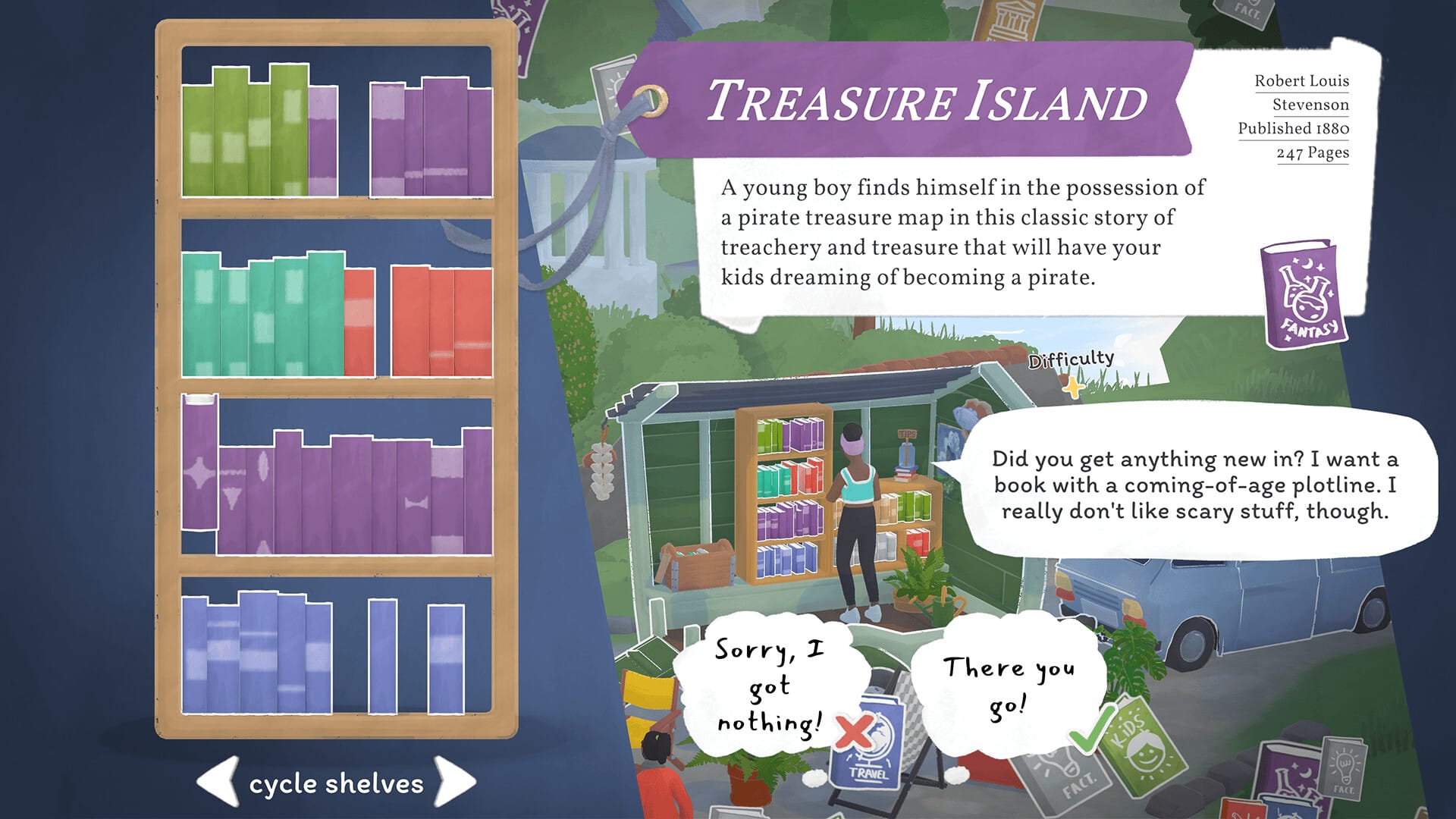
Tiny Bookshop is a management simulator set in a mobile bookshop by a beach. Acting as the bookseller, players design the little shop and then sell books to customers; the puzzles are in finding the right real-world and fictional books to recommend. Neoludic Games describes Tiny Bookshop as "cozy," and it certainly is. The quaint bookshop is the epitome of the word, and the low-stakes gameplay makes the game very chilled out.
Muratov called the ratings process that caused the eShop removal a "black box" that the studio and publisher got caught up in. Most games have a rating, but games that are sold physically have a more "official" rating than those that are only sold digitally. The digital ratings system is handled through an automated system with the International Age Rating Coalition (IARC), which works with the different ratings agencies, like the ESRB. Developers fill out a survey through the IARC system to self-evaluate their game, which spits out an automated rating based on the answers. Developers then provide a certification of that rating to storefronts to be able to sell digitally.
Zapfe-Wildemann said the digital certification through the IARC required very little detail and had "a lack of clear guidelines." Other developers who spoke to Aftermath about the IARC said the system can feel subjective—something that's especially relevant following the ratings debacle regarding Santa Ragione's Horses. Horses has been in the spotlight over the past several weeks after it was removed from the Epic Games Store for its rating; using the IARC process, Santa Ragione received a Mature rating. Epic Games filed its own IARC questionnaire and found the game to be ranked as Adults Only, therefore not publishable on its storefront. (Several developers and industry experts told Aftermath that they'd never heard of a platform filing for its own IARC rating.)
The IARC rating allows for games to display, for instance, an ESRB on a digital storefront. Crucially, it's a free-to-use tool that allows developers to get their games rated without much friction—and keeps rating bodies from being overwhelmed by having to have humans go through the hundreds of games released each month. IARC spits out a rating that's adaptable for the different regions a game is released in. One video game industry expert told Aftermath that rating bodies, like ESRB and PEGI, do run checks on IARC ratings to ensure accuracy, be it popular games or ones that get complaints.
Physical editions require a more detailed rating to be sold in stores, however, which made the ESRB and other countries' ratings processes necessary for Tiny Bookshop. That process is more robust and requires developers to submit footage, builds, and marketing materials, the expert said. The result is a formal rating from a thorough assessment of a game by a human.
"We started working together with a UK-based publisher for a physical release of Tiny Bookshop," Zapfe-Wildemann said. "That process mandated getting a detailed review by each target region's rating agency. In that re-review, the ESRB flagged the word 'Arsehole' in one of the 300+ book descriptions as severe enough to warrant a 'T' rating."
Neoludic Games only learned of the upgraded rating after Nintendo delisted the game and the process was completed. "It would have been five minutes of work to replace the word had we been informed, or had we had a way to track which swear word is considered severe in the IARC system," Zapfe-Wildemann said.
"A single word in more than 100,000 words of localization was caught and scrutinized without a chance for us to fix it pre-release," Muratov said. "It’s frustrating when you see massive AAA games with much more mature themes, while a cozy bookshop game gets pulled over a single instance of text."
The upgraded T rating triggered a "mandatory update to the digital store," Zapfe-Wildemann said, which resulted in the "immediate delisting" of Tiny Bookshop. On Oct. 17, which is the last date the best-sellers page was recorded by the Wayback Machine, Tiny Bookshop was in the ninth row of the U.S. bestsellers. (In September, it was listed 12th on the page, and in August, it was the second game. In the first month alone, Neoludic Games sold more than 300,000 copies of Tiny Bookshop. By December, that number surpassed 500,000.) Being removed from the Nintendo Switch eShop dropped Tiny Bookshop from the list, Neoludic Games said. Now, after being re-added in early December, it's much further down the page in the U.S. region. Neoludic Games estimated that it lost 10,000 sales due to the removal from the eShop and its subsequent absence from the bestsellers list.
"On Switch, the bestseller list is one of the most critical discoverability tools the platform has," Zapfe-Wildemann said. "Our release momentum was still carrying us in the charts of some regions when the incident happened. It is incredibly difficult to re-enter those charts once that momentum is broken."
Muratov said that getting back into the bestsellers list is "very hard or impossible," but that the studio managed to get back into the top 30 recently. "That couldn't have happened without an amazing worldwide community rallying behind us," he said.


