

You may have already seen this video today, in which Jeff Adams, experience director on the new Tomb Raider remake, is trying to answer a question from Game Informer about AI in the game before PR steps in and shuts the conversation down.
We asked the Crystal Dynamics team about its use of generative AI in developing Tomb Raider: Legacy of Atlantis. Here’s what Jeff Adams, experience director on the game, had to say.
— Game Informer (@gameinformer.com) June 12, 2026 at 12:37 AM
[image or embed]
It's kinda blown up, and a lot of talk online has centred on the conversation's focal point of AI, which I agree with of course, it sucks. But also whatever, this game is already dead to me, I simply could not care less how anyone involved in making or selling it is trying to weasel their way out of that.
 Luke Plunkett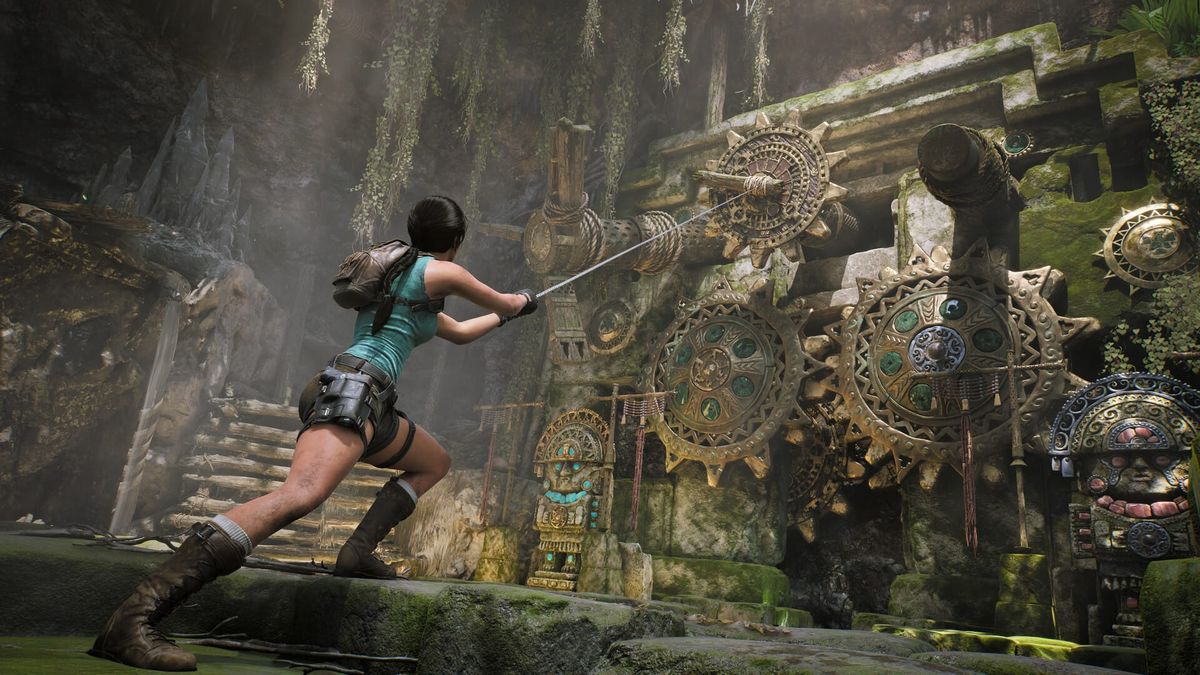
What I found really interesting about the video is that it captures, in real time, an aspect of games marketing and games media that is always there and has always been there, but which is very rarely seen by the general public: PR coming in hot.
The intrusion you see at the end of this video, where a normal man taking the time to find an answer to a question is completely cut off by the most low-calorie response imaginable, borders on coming off as rude and appears as something of a shock, but it also might help you better appreciate the shape and history of video games journalism to understand that this happens all the time.
Nearly every staged interview that takes place at an event like Summer Game Fest will have someone (or many people!) there overseeing things, ostensibly to help with media and influencer relations, but also to be on-hand for emergency situations like this. Meaning that every question that gets asked in their presence, and every answer printed as a result, has been asked under their gaze.
Sometimes those people work in PR, comms, media relations or whatever a company wants to call it (sometimes the same person is wearing multiple marketing hats, but I'll just call them 'PR' from here because that's probably the most popular shorthand). Sometimes they're internal; other times they work for third parties, which given their distance from the project can make for a bizarre game of bullet-point telephone that I used to run into a lot at local events here in Australia.
I've been at Assassin's Creed reveals at GamesCom where the most harmless questions for a producer are intercepted by PR and answered with a scripted non-response. I've sat through countless interviews with Japanese developers at the Tokyo Game Show where we've known that interview responses coming back through a translator are being filtered in real time. I once interviewed Hideo Kojima under the hilarious condition that in the room was not just a Konami translator, but someone else overseeing the translation as well!
And it's not just live events where this happens. If a games journalist ever wants to send questions to a developer via email, it's almost certain that those questions (and the subject's responses) are going to be agonised over by PR. I once had an incredible Kotaku feature lined up showcasing the graffiti work that had gone into a big PlayStation game; once I found out both the questions and answers would have to go through two sets of PR for two giant entertainment companies, I dropped the feature because I just couldn't be bothered with it. Even that harmless interview I did recently about Marathon's soundtrack had to go through Bungie.
I'm not saying any of this in the hope that it enlightens you; I'd expect that on some level you knew most of this already, because of course this stuff happens, this is entertainment journalism. But it's one thing to know at some abstract level how it works and another to see it on video. So if you got anything out of the end of that interview, I'd hope it's how ruthless the industry can be maintaining control over its messaging, and how absurd it actually looks when you see it in action.


