

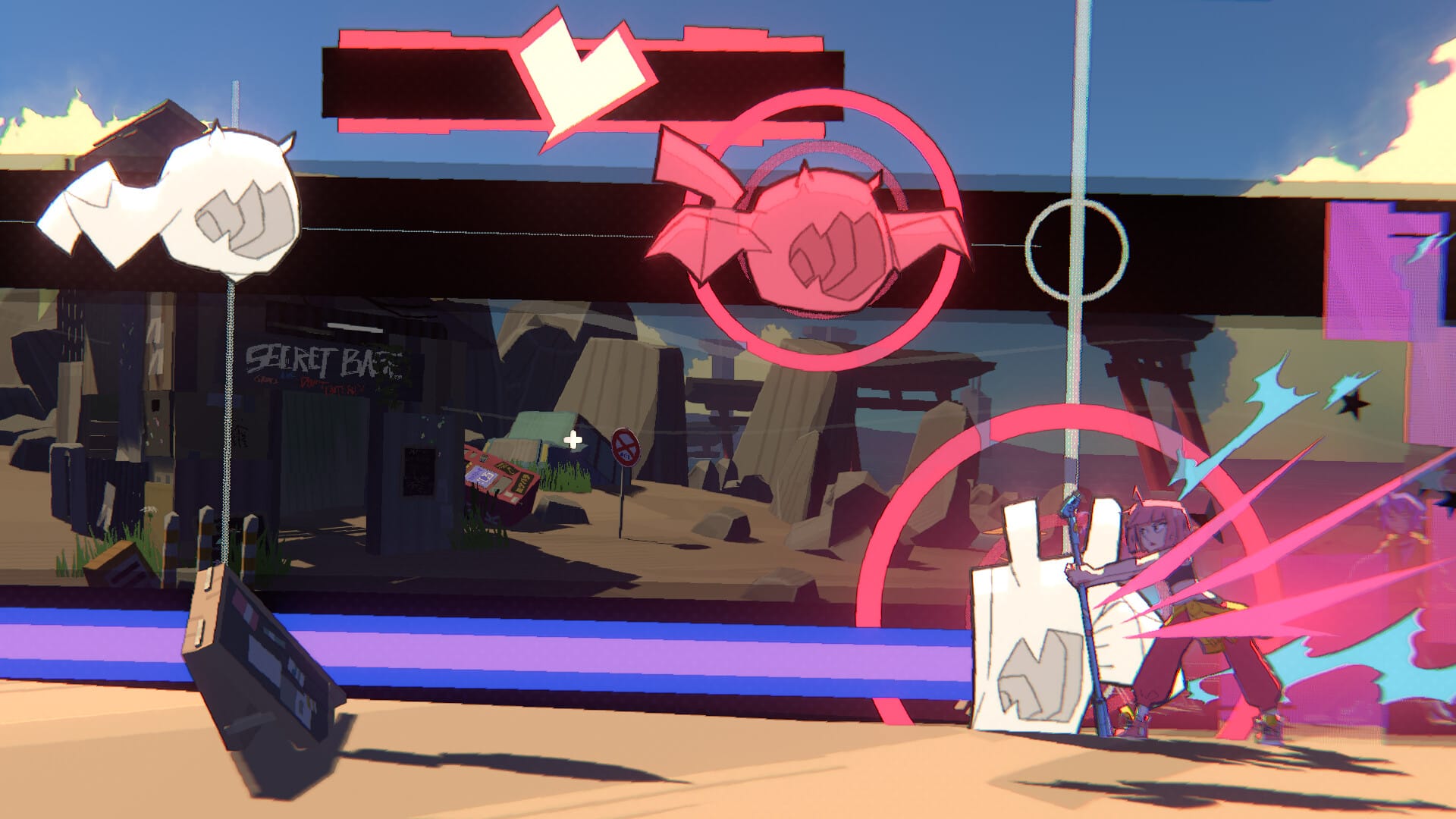
To steal a line from Unbeatable, I could feel the game's last chapter in the space between my eyes. It's the place where tension builds before you're about to cry—a unique feeling of feelings that manifests through pain. Played in episodes, the sixth of which is the culmination of it all, Unbeatable is set in a world where music is illegal. So illegal, in fact, that the world's become a fascist police state; musicians and music lovers still exist, but they’re pushed to the margins of society. Music is the key theme here both narratively and mechanically; the story is centered around it, tied to traditional rhythm-based gameplay where you push buttons to a beat.
Storywise, where Unbeatable lands is the idea that music and art are not only "amplifiers" of feelings, as Unbeatable's characters put it, but are feelings. The last chapter is where all of this becomes clear, and the game's rhythm gameplay, stylish animation, incredible music, and high-stakes story work together to reinforce that.
The problem is that it takes five episodes to get there. When Unbeatable is good, it's really good, but there's just too much time where it's not. Up until the last episode, I couldn't tell you why music is illegal, how the main character Beat was dropped into this world, or even who she really is. After the last episode, I still can't answer some of those questions, but it doesn't really matter. Unbeatable feels like the sort of game that's supposed to be a bit messy. This ending section of Unbeatable, though, is where the game gets to the heart of its characters, what drives it all—not the overly complicated story and slow pacing. For most of Unbeatable, the game gets in its own way.
Unbeatable is about music, but it's also about grief. It's about making mistakes, creating good and bad art, about feeling things. There's one scene, at the end, where the main character, Beat, is talking to her much younger companion, Quaver, about loss. The circumstances of their losses are different—from each others' and my own–but the feeling is universal. Just last night, I was talking about this: It's too painful to remember what I've lost. If I don't think about it, I don't feel it—that tension between my eyes. But in refusing to remember, I lose the overwhelming love that makes the loss much too painful. Beat and Quaver don't necessarily have the answers, and I don't either.
From this conversation, the screen cuts to white. Quaver starts to sing. The instruments come in, and I can start hitting stuff on beat—the perfect emotional release after the game's most poignant moment.
But the rest of the game, aside from several other moments here and there, move too slowly, with too many extraneous details, and way too much walking around. There's one section, early on, where the crew is trying to escape from prison. There's some rhythm elements, and it works as a sort of tutorial. There's a part where you get a prison job. A baseball minigame. A lot of walking around with bad camera work. It's so painfully slow, while also somehow moving way too fast—narratively, I have so many questions. Later, there's a random platforming part to restore power to an arcade that never comes back up in the story. The problem with these sections and several of the others is that the material within doesn't necessarily point towards the core of the story, what's at the center of the last chapter. Unbeatable is shrouded in a mystery that makes this feel intentional. I haven't mentioned this yet, but there's also a supernatural element: Cops are arrested musicians and music lovers, but there's also a big black hole that's threatening to engulf the whole world. You're kind of fighting both at the same time, but it's not until the last few chapters where Unbeatable reveals why. (I still don't entirely get it.)
There were a lot of times during Unbeatable when I wanted to quit the game's story mode. And right when I was thinking that, I hit one of the moments where the visuals, music, and writing really work. Those moments do a lot of work in forgiving the bad parts. It's easy to see the vision of developer D-Cell; the game drips both heart and an undeniable cool. But you can also see where the focus was—rightfully on these big, key moments—and where everything went off the rails.
Yet, by the end, I found myself shrugging off its failures. That's kind of the takeaway of Unbeatable, no? It's messy. Sometimes bad. And yet it still made me feel.


