

If there's been one depressing theme to a lot of popular culture news lately--beyond the obviously bad stuff like AI and labour conditions--it's been the increasingly dystopian way that rights holders have begun treating creative works as rentable assets and disposable tax breaks.
This story was originally published in December 2023. It has been updated in light of recent decisions made by PlayStation.
We've seen Warner Bros. cancel the release of Batgirl, a movie that was finished. In May 2023, Disney deleted Crater, a movie that had only been released seven weeks prior. It's now available to rent or buy from other, non-Disney platforms. More recently, WB also binned Coyote vs. Acme, allowing its creator to shop the film--as a Looney Tunes cartoon, one of the most Warner Bros. things imaginable--to rivals. It will finally be released theatrically in August 2026.
All three decisions were made because the projects were more valuable to Disney and Warner Bros. as tax breaks than they were as pieces of art. Meanwhile, other films and TV shows--like Westworld--across various streaming services have also been taken down, some for tax reasons, others so that companies don't have to pay licensing fees for them.
 Luke Plunkett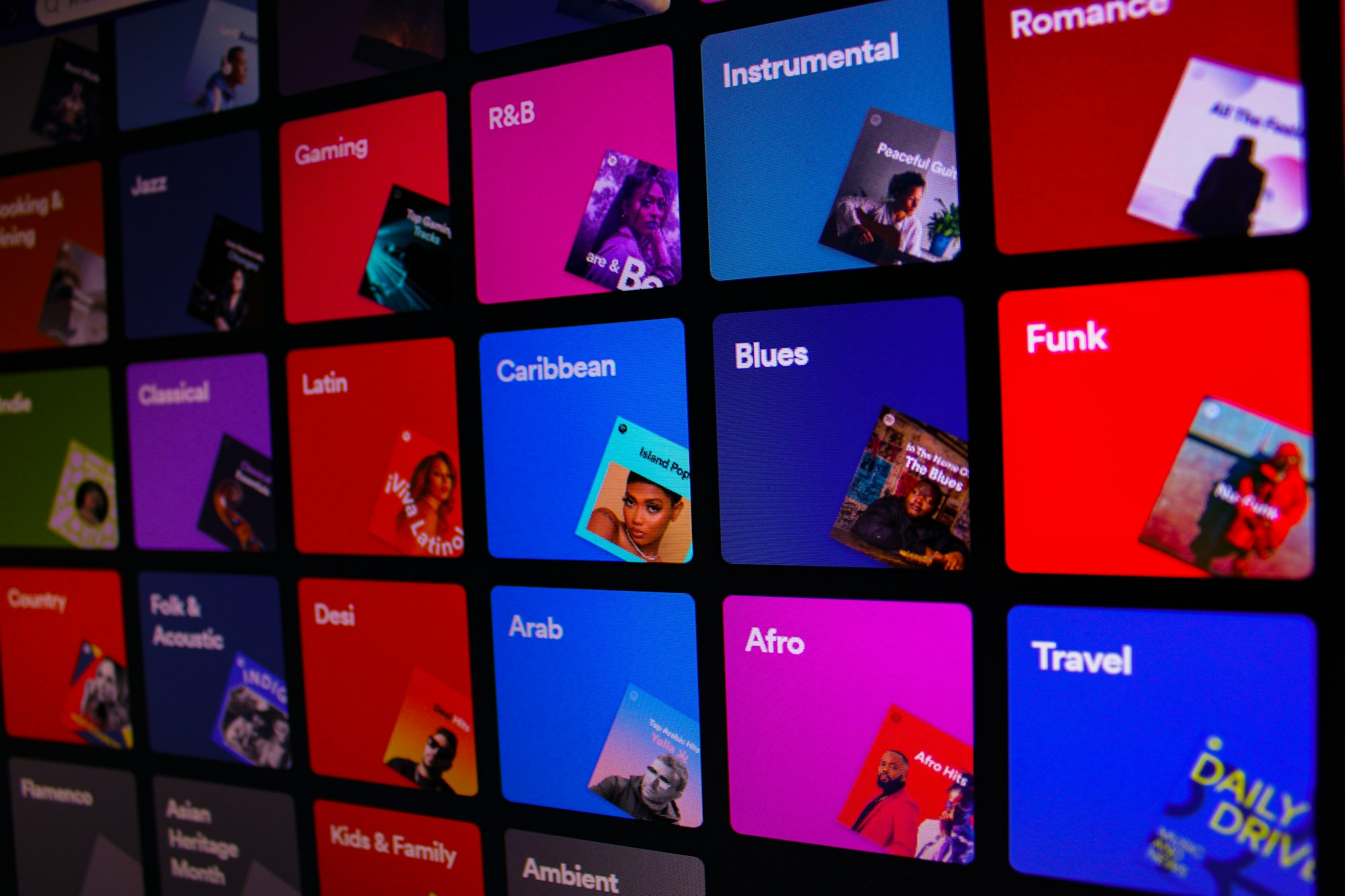
Spotify, meanwhile, pays artists a pittance--if it pays them at all--so that we can listen to all the music in the world instead of buying albums. In video games, Microsoft continues (despite setbacks and strategic disasters) its colossal Game Pass service at all costs, seeking to emulate Netflix's streaming success while simultaneously ignoring all the perils and pitfalls Netflix has run into over the past few years, while PlayStation has just made the decision to stop selling games on a disc altogether.
The dipshit executive class in charge of all these companies, and all these decisions, are all cut from the same executive cloth: they're doing this because they're far more interested in making short-term cash than they are in securing the long-term future of the companies they're in charge of, and the industries (and mediums!) they're a part of.
These moves all have something else in common, too: they're about stripping us of ownership. Instead of letting us buy discs, cartridges, records and box sets of DVDs that are ours to do with what we like, to keep forever, the push for streaming (where we're forever just borrowing) and digital purchases (which are licenses, not products) is turning us all into cultural tenants, forever on the hook to rights holders for access to our favourite things, and forever at the whims of the decision-making (and accounting) apparatus of profit-hungry corporations.
At any given time and for any given reason--though most times it'll simply be because there's money to be made or saved somewhere--movies, shows, games and albums can just disappear. It happens all the time. PlayStation has now done it multiple times with films and TV shows purchased on its digital shopfront. Even though people paid for them:
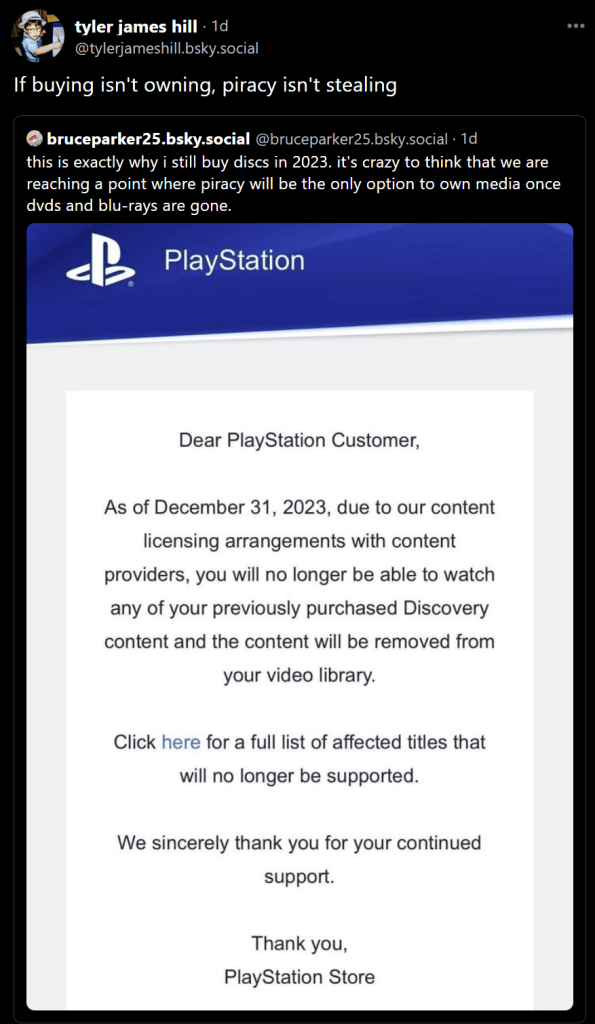
Tyler is onto something there! If the concept of ownership of modern media is changing, then so too should our treatment of its counterpart: piracy.
Piracy as we understand it is a crime. Modern media piracy as it has been established under law used to be pretty clear: if you illegally copied a DVD or a game disc or a cartridge or an album, or you downloaded a digital version of something normally purchased in a store in order to avoid paying for it, you were a pirate. That was theft.
As a legal concept, that made sense! The thing in question--a CD, a DVD, a game cartridge--existed in the marketplace, you could buy it and more importantly own it, so trying to get it for free was wrong. But what do we do now if in an increasing number of cases we can't really own the thing we're paying for? And even the ones we're borrowing--or, in the case of those PlayStation movies, we purchased!--disappear and can't be paid for at all?
Just as importantly, what do we do if the companies making and selling this stuff can't even be trusted to look after it? The whole point of streaming services (at our end, anyway) was that we'd have everything at our fingertips. We traded ownership for convenience. Now "content" is disappearing, and without CDs on our shelf or DVD boxsets under our TV it's at risk of disappearing forever.
Any hope that corporations would hold up their end of this convenience bargain was a fool's hope, especially when it comes to video games. As the Video Game History Foundation is getting tired of reminding us, often the only way to preserve important works of human expression is to...well, technically break the law and pirate them. And even when loopholes can be found to ensure this, video game industry groups like the ESA have lobbied to work against them, as the VGHF's Phil Salvador said earlier today:
There's understandably a lot of concern about the news that Sony is shutting down their legacy game storefronts and ending physical disc manufacturing. The truth is that museums and archives have been anticipating this for a while.
The preservation community has been exploring other options for preserving digital-only games for years. For example, our colleagues fought for and won an exemption in copyright law that allow archives to jailbreak their consoles in order to run legally acquired digital games, which is an important step.
The problem is that representatives of the US game industry have opposed these reforms that make it possible for us to do our jobs. The Entertainment Software Industry has repeatedly attempted to block minor, heavily regulated exemptions that would allow legitimate archival institutions to break copy protection in order to preserve and provide access to digital games. Over and over, the ESA has claimed that looser restrictions for archives would jeopardize the game industry, which obviously hasn't happened.
So, what alternative is the industry proposing? Are we supposed to just download a copy of GTA6 and hope that it's going to work in 50 years? If a game gets delisted before a museum acquires it, is it just gone forever?
If this is the future of gaming, then groups like the ESA (and their members) need to come to the table to work on meaningful proposals for how archival institutions can work with digital games.
If we can't own anything anymore, and everything created in the modern world is only made available at the privilege of a few greedy assholes, then downloading something and sharing it to keep it alive isn't piracy. It's all we've got left.


