

Kamome Shirihama's wonderful manga Witch Hat Atelier is a riff on the Harry Potter magical school novel. And it is also about the joys of pedagogy, of both teaching and learning a craft. What most attracts me to this story, though, is that it is about trying to do the right thing in a world that feels completely insane.
If you’d like to go into Witch Hat Atelier completely blind, you should probably stop reading here.
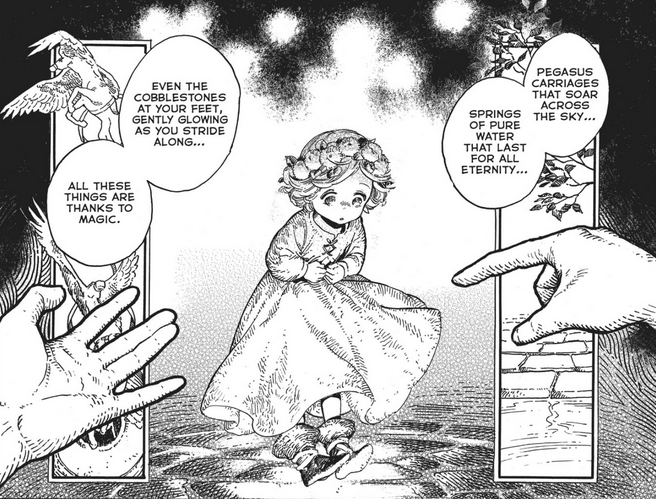
Coco, the young main character of Witch Hat Atelier, learns the secret of magic in a pretty traumatic way. Although the world believes that you can only use magic if you were born a witch, in actuality, all you need is a special ink to draw a series of magical sigils. Coco learns this by drawing a sigil that encases her mother and her home in crystal, only escaping because the witch Qifrey happens to be in the area.
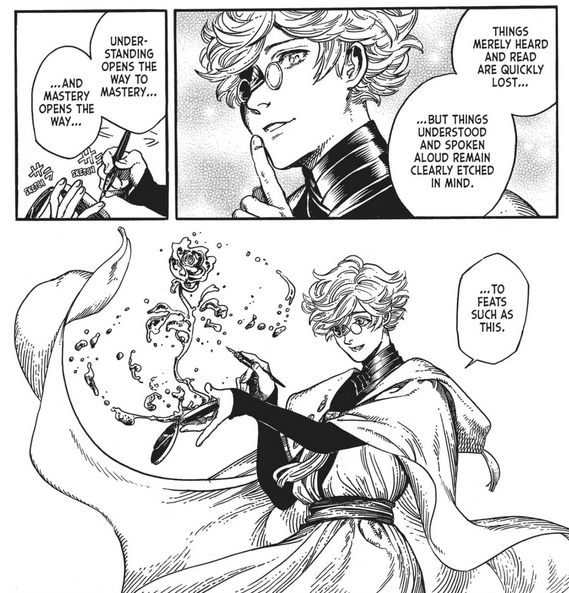
Coco joins Qifrey’s Atelier—his boarding school where he takes on apprentice witches—and learns how to draw magical symbols. As much as I love the narrative and characters, what deepens this story beyond just another post-Potter magical school narrative is the nature of the masquerade.
In Harry Potter, a terrible but immensely popular book series written by the human embodiment of pure evil, magical society lives in the shadows of normal society. Magical people know about non-magical people, but they don’t interact much. If a non-magical person sees magic being done, they have their memories of that moment erased. This all seems a little fucked up—and there are cases of the memory-erasing spell driving people insane—but it’s kind of accepted that this is just How Things Go and any alternative would be unthinkable. A lot of magical school novels have this general approach to the separation of societies. There’s a world behind this world, and never the twain shall meet.
For Coco in Witch Hat Atelier, every new thing she learns about how the secret of magic is kept from the world makes magic seem a little bit more terrifying. In this world, witches and non-magical people live in the same society, though everyone non-magical believes that you have to be born a witch to use magic. It’s a mostly harmonious world, in broad strokes. Witches, in fact, often help with natural disasters or repairing infrastructure, and Qifrey insists that all spells that have not been forbidden are ones used to make people happy.
The spells that have been forbidden are ones used as weapons, and specifically, all magic used to change the human body, including healing magic. In the past—and it’s ambiguous how long ago it was, which always sends a shiver down my spine—magic used to be used for war, and the world was constantly in a state of violence. The witches carried out a pact with the non-magical kingdoms of the world, one those kingdoms no longer remember, to erase the knowledge of how magic is used from everyone other than those who can be trusted not to use it for violence. The human kingdoms, in the present day of the story, covet magic but also now believe that magic can only be used by born witches.
Anyone who comes in contact with forbidden magic or the secret of how to do magic has their memories erased—not just memories of the magic used, but all of their memories. Pretty much every character acknowledges that this is a fate worse than death, that after memory erasure you cannot ever be the person you were before, that that person has effectively died. This is a punishment carried out for both the users of forbidden magic but also the victims of that magic. There is no trial or judgement—it’s a sentence immediately dispensed by the magical Knights Moralis, who act as judge, jury and memory obliviator.
Coco had been under threat of having all her memories erased for the crime of curiosity, and several characters make that very clear to her. She is grateful for the chance to learn magic and to make amends. But the world that they live in is fucking crazy. Coco, who can’t be much older than 12 or 13, is forced to reconcile two opposing truths in a way that clearly causes her emotional distress: that things are better than they used to be but also that the solution is far from perfect.
On the one hand, before the pact, the entire world was clearly in chaos. The few times the reader sees magic used to transform bodies it’s horrific. One character has their body transformed into a wolf, the sigils tattooed on his skin. Another simply explodes into chunks of meat mid sentence. On the other hand, given what magic can do, the witches are kind of holding a gun to the head of the entire world. As part of the pact, witches can’t learn medicine or about the science of the human body, but it’s clearly an uneven trade. These guys can fly, instantly purify water, and summon fire from nothing, but sure, if they get a cold they’re fucked.
Being an empathetic but naive child, Coco is most acutely distressed by the inability to use magic to heal, let alone use forbidden magic to save her mother. When she sees a character succumb to that temptation, she sits down on the ground and cries.
“Because none of this is your fault,” she says, wiping her tears and snot into her sleeve, “but you still have to suffer.”
By taking all the implications of its setting seriously, Witch Hat Atelier becomes a rich and layered story. It’s also one I cannot stop thinking about, given that my country is being steered into hell by an aspiring dictator with dementia. This week I sat for eight hours holding my breath, wondering whether or not the President actually meant it when he said he was going to destroy an entire civilization. I don’t know how many times I can do that before I have a heart attack. There’s gotta be a world after this madness, somehow. It makes me empathize with those old witches, who came to a deeply imperfect solution to stop the world from destroying itself.
And yet, Coco, our little witch, is still striving towards justice. She vows to save her mother, her friends, the entire world, but the right way, without using forbidden magic. That she even believes that’s possible is an inspiration for other characters, like her Master Qifrey, who have grown jaded after butting up against the margins of magical society. Maybe that’s the privilege afforded to the young, those who have not yet had their hearts broken by the world. I have found that it’s easy to slip into cynicism, especially when the world has been unfair to you.
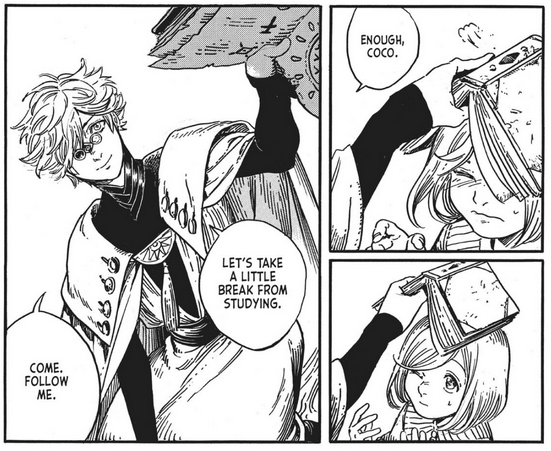
Qifrey was also a young victim of forbidden magic, set to have his memories erased and saved by the mercy of the witch who would become his teacher. He is deeply acquainted with the unfairness of the world and also knows it has tainted him—he carries a darkness inside himself that he doesn’t let the students see. Because the narrative is both a story about teaching and the harsh realities of adulthood all at once, you can see how Coco’s moral center, her strength against the world’s horrors, inspires Qifrey to be a better teacher. He wants to be worthy of the faith she puts in him.
When the two are in mortal peril, Qifrey pledges to protect Coco, whatever path she chooses, and it's her selflessness that surprises him.
“Of course she neither fled to safety, nor rushed ahead to her own goals. She flies for those who stand before her, those in urgent need,” Qifrey thinks to himself while watching her. “This is the kind of witch you are.”
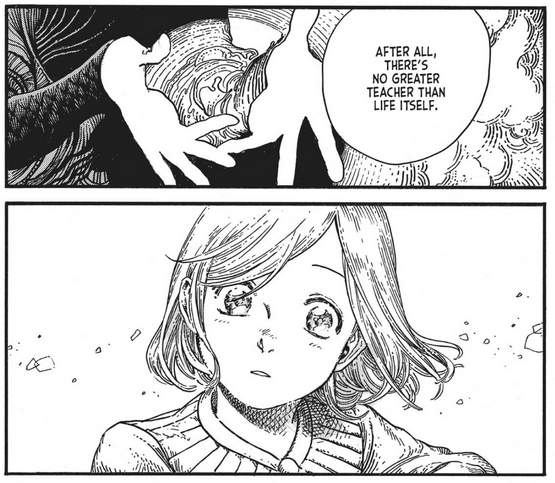
This is a magical school story that fully embeds in its narrative conceits. Its teachers are full people—some Masters are incredibly cruel, and even the good ones are flawed or biased towards their own ways of looking at the world. The world they are preparing their students for is hard, unfair in a way that will make them doubt the teachings of the adults around them, but they still try. The world of magic is just as fucked up as our normal, non-magical world. There is no solution for all the world’s ills that does not come with a price.
Still, we have to live in this world, and I think Witch Hat Atelier makes a good argument for not succumbing to cynicism. Sometimes, you get to discover things again through the eyes of people younger than you.


