

Xbox began widespread layoffs today, around which fears and rumors have swirled since CEO Asha Sharma and CCO Matt Booty announced a “reset” for the company in early June. In what Sharma calls "the most significant restructure in Xbox history" in a new memo, 1600 jobs have been cut today with more cuts planned, and some studios will transition to new ownership or become independent.
"After careful consideration, I’ve made the difficult decision to reduce our team by approximately 3,200 throughout FY27. This will include approximately 1,600 role eliminations today, and in addition, four studios will leave Xbox to new management," Sharma wrote in a memo titled "Resetting Xbox."
Studios Double Fine and Compulsion will become independent, with Sharma writing that they will "return to management and transition to independent studios with their IP, catalog, and runway for their next games." Compulsion confirmed on social media that it will retain the rights to its games. Double Fine wrote on social media that the move "preserves our history and culture, and returns ownership of our games to us."
Undead Labs and Ninja Theory "have entered terms to join new ownership with funding to complete and grow Senua and State of Decay 3." GameFile reports that the studios' new ownership will be announced later in the year.
At Arkane Lyon, where it was reported that Xbox was considering cancelling its in-development Blade game or closing the studio, Sharma wrote that "management is beginning required consultation with its Works Council to review potential strategic options." This is due to labor laws in France, and it's not clear yet what will happen to the studio. Microsoft closed Arkane's US arm, Arkane Austin, in 2024.
Game File's Stephen Totilo reports that these spinoffs affect around 350 employees of today's 1600, excluding Arkane.
"It is neither possible nor desirable to own every great independent studio," wrote Sharma, who runs a company that has gobbled up and spit out a huge number of studios over the years. "We have also learned that we are not the best home for every type of studio; in a typical year, we lost 64 cents for every dollar we invested."
Sharma wrote that there will also be "reductions across other units, and in some cases, shifting investment to focus on higher priority projects. These changes vary in size across Activision, Bethesda/ZeniMax, Blizzard, King, Mojang, and Xbox Game Studios. None of our first party publicly announced games or projects are being cancelled as part of these reductions."
Xbox will also see layoffs at the management level on the platform side, with Sharma writing that "Our platform teams are 40% larger than they were at the start of this generation, even as our player base and playtime have declined... We will reduce management layers to no more than 5, and where possible, 3." Helen Chiang, currently the corporate vice president of Minecraft, will become Xbox's first chief operating officer.
Sharma wrote that, "To grow, we bet on Game Pass, multi-platform, and a broader portfolio of content. While those businesses have created meaningful value, they did not grow at the pace we expected. As that happened, our core business weakened, and we added more teams, more investment, and more time, hoping for a better outcome. And now the industry is facing the most severe hardware crisis in its history. We must reset Xbox."
The wider Microsoft organization is also seeing layoffs today, primarily in commercial sales. These layoffs follow after recent voluntary buyouts for long-time employees.
The effects of today's layoffs were felt at Xbox before they even started, with employees of Compulsion openly looking for new work following Sharma's first "reset" memo, and word spreading that the studio, alongside other Double Fine, Ninja Theory, and others could face closure or a sell-off. Hitman and 007 First Light creator IO Interactive saw Xbox pull funding from an in-development project, leading to layoffs. Kotaku reported some contractors losing their jobs ahead of today’s cuts, and reports spread that some third-party Game Pass deals were on hold.
Microsoft made a similarly devastating round of layoffs at nearly exactly this same time last year, in which it laid off four percent of its 228,000 employees, or around 9,100 people. That included hundreds of workers across Microsoft's Xbox studios and projects, including King, Turn 10 Studios, Blizzard Entertainment, Sledgehammer Games, Halo Studios, and Compulsion Games. It shuttered The Initiative, which was working on a Perfect Dark game, and canceled Rare's Everwild. Microsoft never confirmed how many Xbox workers were impacted, but Game File reported that it was less than half of the 9,000 number.
Later that month, Microsoft announced in its yearly earnings report that its hardware revenue had decreased by 25 percent, but said that its games revenue was up 9 percent to $23.5 billion. It bragged, too, about being the "top publisher on both Xbox and PlayStation this quarter," per the report.
The company also saw layoffs in January 2024, a few months after completing its $68.7 billion acquisition of Activision Blizzard, in which nearly 2,000 people lost their jobs across Microsoft's games division. The company also had layoffs in May and September of that year.
The subsequent precarity for workers inspired a wave of unionizing at studios including Double Fine, Bethesda, ZeniMax, the World of Warcraft team, and id Software.
 Nathan Grayson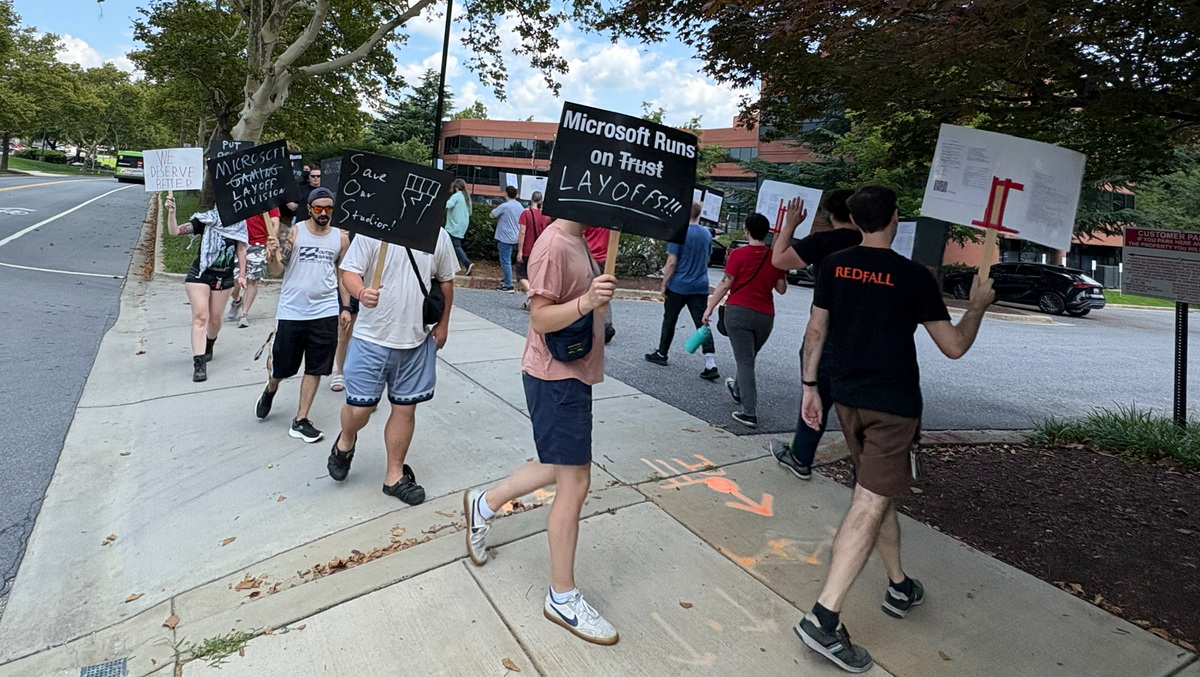
Xbox continued to try to find ways to increase profit and cut costs following the July 2025 layoffs. The company upped the price of Xbox Game Pass by $10 a month, or $120 a year—the second increase within just over a year. At this point in time, Microsoft was set on making everything an Xbox, turning focus from its expensive consoles to the ability to play Xbox games anywhere, including on its competitor's consoles, like the PlayStation 5. This did not go well; Xbox chief strategy officer Matthew Ball, who joined the company earlier this year, said the price hike decreased Game Pass’ subscriber count by millions "over a span of a few months."
Microsoft chief financial officer Amy Hood continued to push unrealistic profit margins—30%, according to Bloomberg, which is higher than other companies in the industry. Ultimately, Phil Spencer, who ran Microsoft Gaming from 2022 to 2026, stepped down from his role, and Sharma was put in his place.
Just 100 days into her new job, Sharma wrote in a message to staff that Xbox would undergo a "reset" in its next 100 days. The console maker and game publisher had spent $20 billion during the last five years (excluding the Activision purchase), but revenue declined by "nearly half a billion during that time,” she wrote. "Going forward, this cannot continue." The message seemed like a warning: Changes were coming at Xbox, and that would lead to layoffs as the company reassessed how it spends money. She wrote that Xbox needs to "move faster," leaving behind its "overly complex" systems that she called part of its “platform infrastructure.”
Sharma is certainly moving fast. Some of her decisions were relatively well-received; she lowered the price of Game Pass (albeit removing Call of Duty from its day-one release program), rebranded Microsoft Gaming as Xbox, and axed shoehorned-in AI features. Exclusives are back, too, despite the company's success on other platforms. While Sharma's insistence on speed has been popular with some fans, not all Xbox employees are convinced. The Game Business reported in early July that "numerous employees" said Sharma is listening too much to social media, as well as analysts and external consultants, and not the developers who are actually making Xbox's games.
Microsoft is working on its next generation Xbox console, which is codenamed Project Helix. With computer component prices so astronomically high, Project Helix will likely cost a ton. (Microsoft upped the price of its current generation Xbox consoles once again last month.) In an interview with Fortune, Sharma said Xbox needs to "think about other ways to think about the cost construction of a console."
She continued: "We must think about how we create different plans, so more people can participate in the console. We must think about partnerships that will allow us to have better distribution and reach."
This is a breaking story and will be updated.


