

I adore a garbage paperback. My younger years were spent reading the flimsy science fiction novels they dumped out constantly in the 70s with ancient covers that would disintegrate when you shoved them in a coat pocket. The books understood their purpose — to be cheap, tawdry and legible. The Xteink X4 is the beaten up paperback of eReaders. It is neither feature rich nor powerful; its UI is sometimes in Chinese by default, it has many basic drawbacks, and requires weird workarounds to become usable. But it’s about 50-70 dollars, magnetically snaps to your phone, is barely bigger than a credit card, and with a little tweaking does exactly what is required of it and many things a Kindle could never dream of.
The Xteink X4 is by far the smallest eReader I have ever used. It’s powered by an ESP32, the low power yet infinitely useful microcontrollers that appear in countless DIY and commercial smart devices. It is not a product that was meant for western audiences as-is, but one that found a home with a community of tinkerers and hackers who developed their own custom firmware dubbed “CrossPoint Reader.” In the few months since it has come out, it has become embraced by an ever-growing fan base of obsessed everyday carry nerds and readers, an entire subreddit of gleeful people posting photos of their tasteful custom lock screens.
CrossPoint Reader is a community effort but maintained by Dave Allie, a dev who originally got the X4 on a whim. “When it arrived, I was actually pretty disappointed in the reading experience,” Dave told me via chat. “The font options were extremely limited, custom fonts required monospaced only, and probably most critically for me, it couldn't render bold or italic text. I was planning to just try it out for a little and then put it down, likely to never pick it back up again.”
Eventually he found the subreddit and a small Discord for the device, and a few forks were being discussed. A community member named CidVonHighwind eventually got a working proof of concept rolling, and after many late nights of pulling his hair out, Dave got the first version of CrossPoint in a buggy but working state.
What it has and what it doesn’t
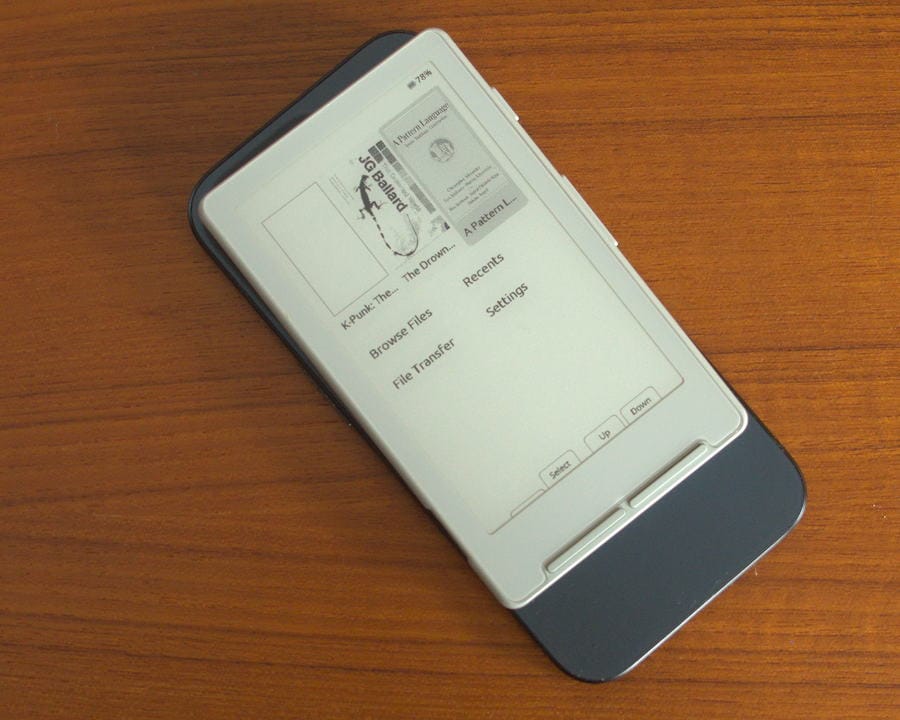
It is worth noting what features the X4 does not have. It lacks a touchscreen and backlighting, requiring either ambient lighting or an aftermarket clip-on light. It has difficulty with file formats, and some image formatting can be finicky, although that’s getting better daily. I have seen the word “flawed” used to describe it. As shipped and on a basic technical level this is true, but spiritually it is not. Because what the X4 lacks in technical power it makes up for in sheer utility, affordability and unbridled charm. Thanks to the community, it has blossomed into a device that, despite being spartan, is a truly cyberpunk one. It looks like technology from a 90s anime, unstuck in a different timeline and immediately exciting to everyone you show it to.
This conflict between functionality and implementation is perfectly epitomized in its MagSafe connector, which awkwardly does not fit squarely on my iPhone, the top bumping up against the camera hump. And yet despite the awkward fit, it works well enough (although I have seen phones it fits flush with) and serves the purpose of making it easier to remember your book. Even the Boox Palma, my favorite eReader, is big enough to make you consider leaving it at home.
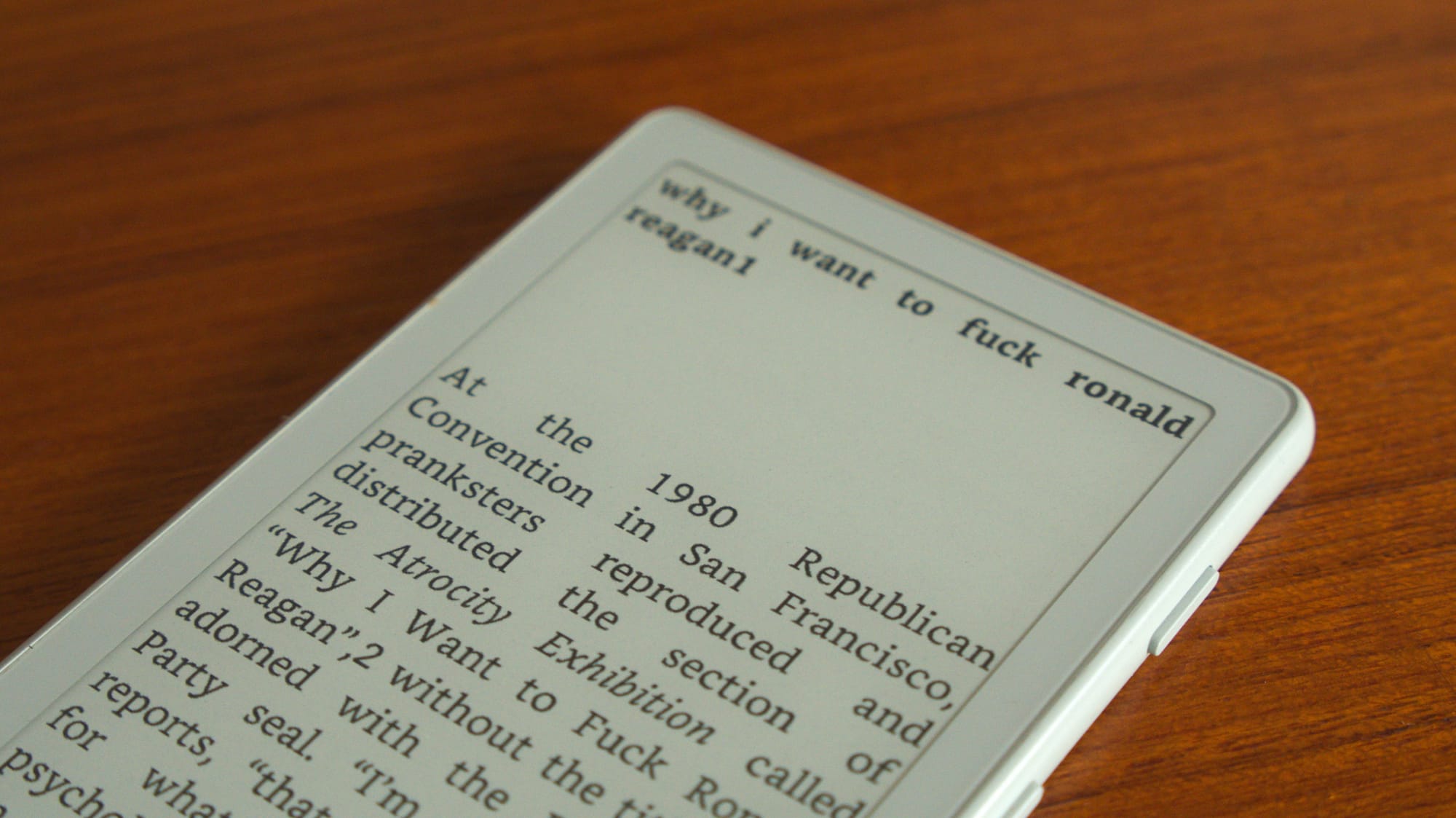
The Xteink X4 weighs practically nothing. It is lighter than a phone by a significant margin, non-fatiguing to hold, and lasts a long time on single charge. You can read it all day without your hand getting tired. You do not think of it except in the ways that it is invisible. The device also comes with adhesive metal rings, allowing you to be able to quickly snap it to anything, including a tiny Muji notebook. It is an eerily frictionless device to jump in and out of, and for a certain kind of easily distracted and fidgety person, there is no reading experience quite like it, because it is burdenless and always with you.
There are notable flaws with the device itself. I noticed the logo is not exactly color fast, at least not on mine. The white version of the X4 also had a problem where the IC is not UV shielded enough, causing the display to temporarily fade in sunlight. “The UV resistance of the white version is lower than the black,” Dave told me, “and so UV gets through the shell and disrupts the driver. If you have the white X4 and put it in direct sunlight, the screen will fade after a few seconds. It's not permanent, and changing screens resets it again. Some people have put a physical sticker on that spot to stop the UV once it was discovered that was the issue.”
Later, CrossPoint added an additional feature that shuts down the display between refreshes, fixing the device at the cost of a small amount of render time. But realistically, a hardware problem that is largely fixed by a sticker feels apropos to the nature of the device. The Xteink might not be perfect, but I can work with what it gives me, and clearly so can a lot of people.
FOSS Firmware
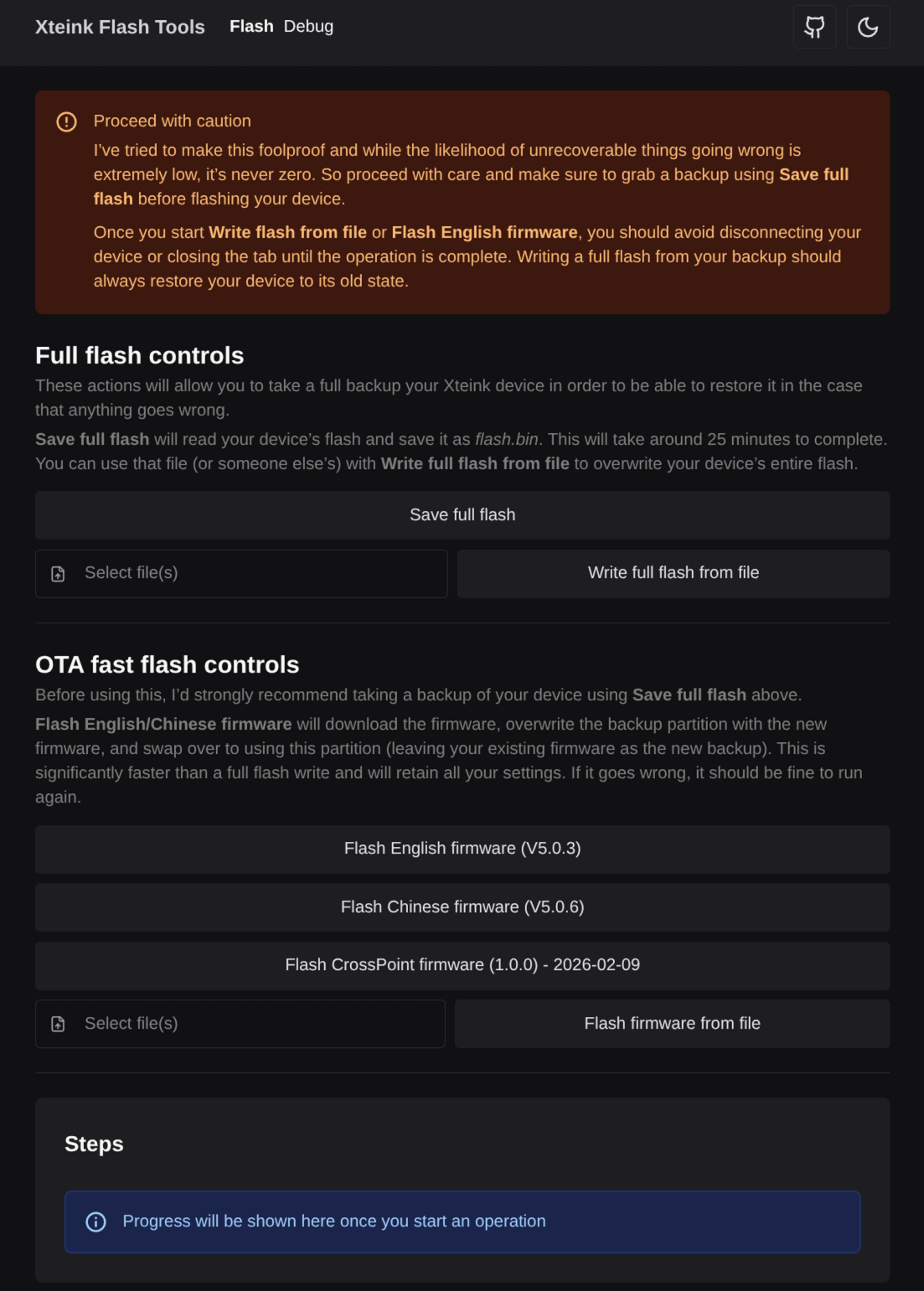
CrossPoint is simple and easy enough to flash on your device. As long as you have a computer that can run Chrome, the process takes less than 20 minutes. It can sync with Calibre, the go-to software for Kindle sideloading and library management for decades now. You can connect it to wifi and transfer your files via a browser window by typing in the device’s listed IP address. CrossPoint lets you transfer a custom sleep screen for your device by exporting it as a .bmp file named simply “sleep.bmp” in your local directory.
Once set up, I found the device to be an absolute joy to read with. There isn’t a lot on the page, mainly a few paragraphs at normal text size, but what’s there is clear and legible. What’s more, CrossPoint is releasing new updates with features often sourced from the community, and roughly 10 hours after I installed it the firmware went to version 1.0. It still isn’t a perfect experience –image formatting still needs a lot of work and custom fonts are in the works – but that’s currently close to being mainlined according to Dave.
Reddit is also full of happy customers, with tons of posts just showing off their X4 backgrounds. There’s Mac logos, the Lumon logo from Severance, and one that’s a fake phone call from your wife. A few wallpapers are clowning on the Kindle. There’s a wallpaper generator that will make a background for any Pokedex entry and another if you wanna have Spider-man read Naomi Klein’s The Shock Doctrine. I have seen multiple people claim it is their first eReader, and at least a few posting their X4s next to their FiiO DAPs (the same kind that Gita is a huge fan of).Dave hopes that one day CrossPoint will be unnecessary, and that the company will mainline the hard work the community has done. “I want Xteink to upstream all the good bits, open-source their firmware,” Dave said. “As much as I love hackability, my personal opinion is that they're dropping the ball, focusing on hardware alone, and just hoping for the best. I've seen plenty of sentiments that people would not have picked up a device without the availability of CrossPoint, I just wish that Xteink could combine some of the learnings with their own firmware to create something truly good for everyone.” Even still, one wonders what other hardware manufacturers are looking at the countless glowing reviews of the Xteink, with the availability of a community-run firmware, and hoping to get in on the action.
Even outside of CrossPoint, the simple nature of the device – an ESP32 with a battery, some buttons, and an eInk display – unlocks all sorts of possibilities. The people behind TRMNL, the ePaper calendar display that works on all sorts of devices from hacked Kindles, have already found a way to install their software on the device. The X4 plays Doom poorly and Gameboy games worse. There’s a roguelite for it. You can use it as a WiFi fridge magnet. I have seen people figure out fascinating workflows for reading manga on the device by splitting the page up into an overview and then three closeup segments. Honestly at that point you should just get a Kindle from Goodwill to hack or buy a Boox. But the point isn’t that it’s ideal, the point is that these are the capabilities that a cheap device fostered by an open community are able to quickly iterate on. “Honestly idk if I love it , but it's still nice to have it as an option,” reddit user Justpou posted.
Just Enough
A fundamental problem with how people look at eReaders is that they conceptualize them like a phone instead of a book. Phones constantly need new features to remain narratively interesting. They must be more powerful, do more stuff, be nicer and faster. These are not demands you would make of most books. A book must be legible and on your person. What’s more, we are in the moment when affordable, simple technology has never been more appealing. People are broke, the economy is twisted and K-shaped, and the majority of all western tech is aimed at an increasingly shrinking, wealthier segment of the population while everyone else gets their hand-me-downs.
“I think a lot of the world is decompiling what Jobs did with the launch of the iPhone,” Dave told me via chat. “The attention economy is everything at the moment, eyeballs are money, and with content/advertising generation getting AI supercharged, it's worse than ever. I think people feel a strong pull back to the 90s and 00s when tech was simple, distraction-free, and single-purpose.”
The idea of a cheaper device with fewer features has never been more appealing to a huge portion of people. From Digital Audio Players to suspiciously good wired headphones, there is a beauty in a device that is simple enough, excelling at one thing in a charming and novel way. Even with its limitations, everyone I have shown my X4 has said “man, I kinda want one.” People will always find ways to make the best out of the technology they have within the parameters of what they can afford. To the extent that devices can be liberating, it is often at the intersection of affordable and hackable, because together those qualities create a sound foundation you can build a community on.


