Barbie Rewind is both is dream house decorating simulator and an archival record of 16 different Barbie console games released from 1991 to 2007. A formative era of video games, to be sure, but this specific collection of games is not one that's been gauged much for its historical value. Barbie's signature pink stood out in toy and video game aisles, but the games were never much deemed to be valuable, despite the millions of children who played them. Barbie Rewind is the rare interrogation of Barbie's role in the video game industry.
It begins with Barbie, the 1991 Nintendo Entertainment System game, and leads into Barbie Super Sports, released in 1999 for the PlayStation. It also includes Barbie: Pet Rescue, released in 2001 for the Game Boy Color; Barbie Horse Adventures: Blue Ribbon Race, released in 2003 for the Game Boy Advance; and Barbie as the Island Princess, released in 2007 on the Game Boy Advance. Barbie Rewind includes an unreleased game intended for the Sega Genesis and Super Nintendo Entertainment System called Barbie: Vacation Adventure, in which Barbie visits several different states.
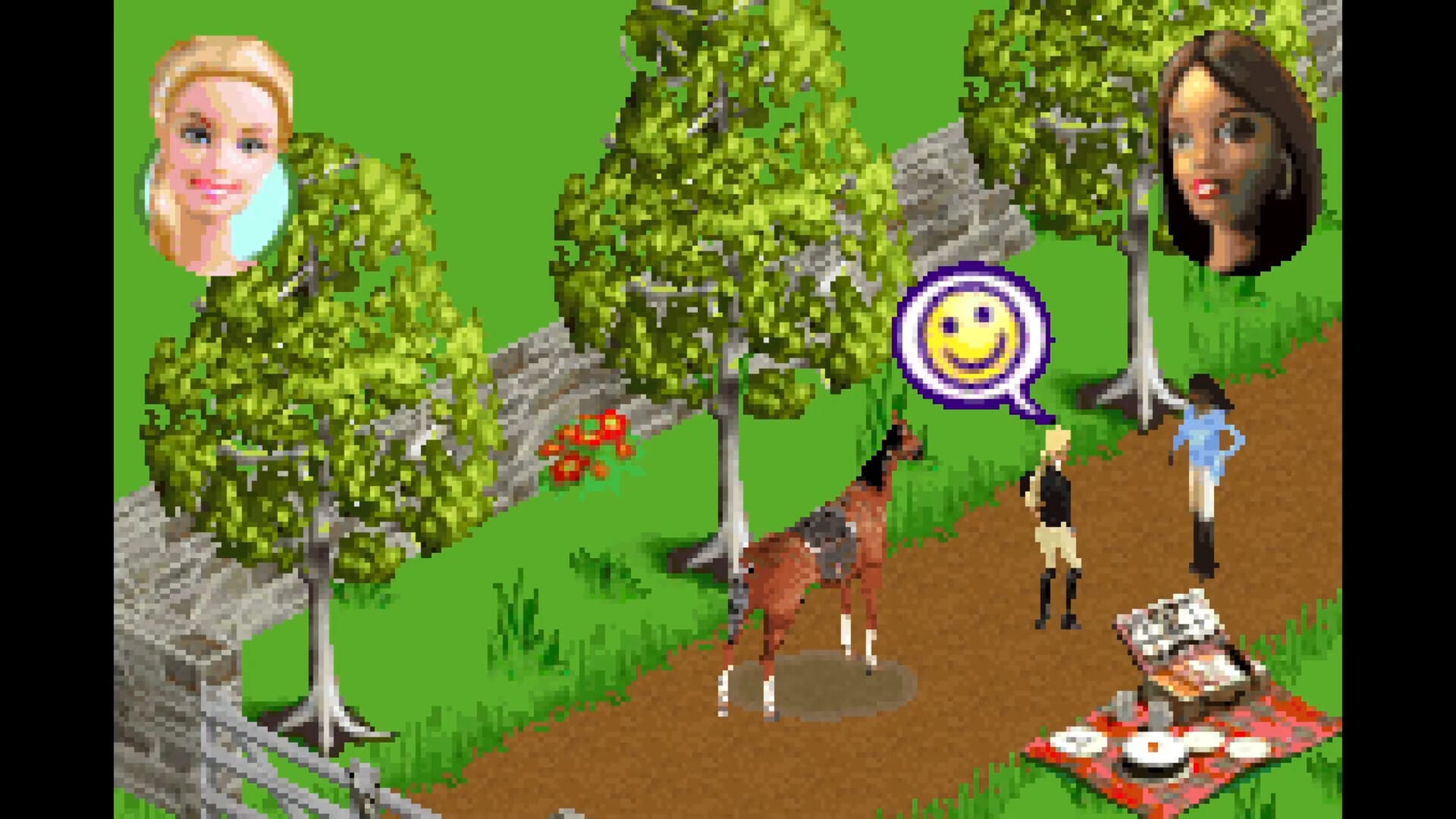
Many of the games are fine, limited by the constraints of whatever system they were originally released on. A few are awful; 1991’s Barbie is nearly unplayable, and movement feels so bad even in the simplest platforming that I do not have enough patience to even complete the first level. Barbie: Super Model, a SNES game from 1993, has charming, colorful pixel art in its arcade-like sidescrolling gameplay. (The first level is Barbie racing through Hollywood in her pink convertible.) Barbie Super Sports is an extreme sports simulator, where Barbie takes to the skate park and mountains to roller skate and snowboard.
Two personal favorites are Barbie: Race & Ride and Detective Barbie: The Mystery Cruise, both for PS1. My affection for these games is so obviously nostalgia-based, and replaying them is a real trip. Barbie: Race & Ride is a horse-riding simulator with little mini-games. You head out on a trail—environments rendered in ugly, wonderful PlayStation graphics—and occasionally stop to look at an animal or nature and play a mini-game tied to it. The mini-games are stuff like puzzles, memory games, and point-and-click stuff. Detective Barbie: The Mystery Cruise is a follow-up to my favorite Barbie video game, Detective Barbie in the Mystery of the Carnival Caper (released only on Windows PC) in which Ken goes missing and needs to be rescued at a carnival. The Mystery Cruise, where Barbie is investigating art theft on a cruise ship, is not quite as silly as the original Detective Barbie game, but worth playing nonetheless.
Determining whether these games are still good or still worth playing is the least interesting thing about Barbie Rewind. It's remarkable to see an archival record of these sorts of ‘games for girls,’ which so rarely get this sort of treatment. Bee Wertheimer wrote for Aftermath how girl games—and their histories—are "doomed by femininity." Games marketed toward girls in the 1990s and early 2000s are no less influential than other games of the period, but as Wertheimer wrote, they haven’t been "so much forgotten as [they] are buried." Part of that is because these games aren't seen as having innovative mechanics or ideas, Wertheimer wrote, and often because the brands attached, like Barbie, were the load-bearing parts rather than interesting gameplay or storytelling.
You can certainly see that attitude in the games released as part of Barbie Rewind. Mini-games within the games are often exceedingly simple, like point-and-click exploration or frictionless puzzles. What these games lacked in complexity or originality of mechanics, they made up for in subject matter: There simply weren't very many games that were explicit in targeting girls, and that alone made a lot of these games stand out at the time.

Barbie Rewind is not only a record of Barbie but of video games and the industry itself—a history of console gaming told through the lens of Barbie. You can see the ways in which the medium grew and changed, and how console limitations shifted and the tech advanced, the latter of which feels both slow and fast. You can see trends change through platformers, 3D graphics, and arcade- and smartphone-style games.
Developer Digital Eclipse also maps out pieces of this history within the game itself, showing Barbie's influence in her own technology and games. It's a simple museum to Barbie's legacy, but it takes the franchise and its players seriously. And that's something that's awfully rare. Digital Eclipse is known for this sort of thing, having pulled together classic game collections for Disney, Atari, Mortal Kombat, MegaMan, and others. And it's the first of these collections, as far as I've seen, to wrap the collection up inside a game of its own—the decorating game. The decorating piece is separate from the classic collection of games, and it's essentially Barbie asking the player to help decorate the new house. She'll get delivery boxes full of new stuff, but it's open-ended in how the player wants to interact with it. It's a really neat package to see this through, and another way to live through Barbie's eras with decor.
Update: This story has been updated with a correct release year for Barbie Super Sports.
Recommended
 Bee Wertheimer