

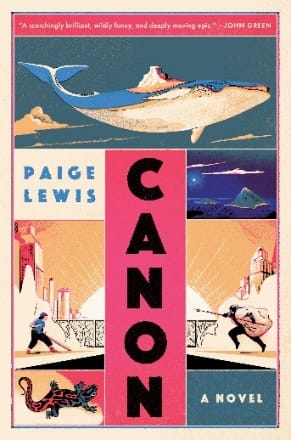
Welcome back to The Work, a column about resistance in fiction. This month: Canon, by Paige Lewis, and reimagining the epic.
There's a land rush on mythology. Tech CEOs are raiding Tolkien's rich vault of proper nouns for their evil ventures, culture warriors following the lead of terminal posters like Elon Musk espouse readings of mythology that are sympathetic to white supremacist ideals, and every jerk with a keyboard has some take on what a Proper Adaptation of The Odyssey ought to look like. Spurred on by Christopher Nolan's forthcoming film version of Homer's epic poem, ideas about what myths are and who they're for are being challenged with the dizzying cadence that modern discourse has normalized.
As many critics and historians have noted, an ahistorical romanticism towards ancient European history and art – one that rewrites them as whiter and simpler than the record shows – is a regular feature of fascism. The modern, extremely online far-right movement and the wealthy idealogues who fuel it are following a set pattern as they culture war over things like Christopher Nolan's casting of Lupita N'yongo as Helen of Troy.It's all opportunistic and quite cynical, more a vector for harassment and oppression than enlightenment.
Enlightenment, however, abounds in 21st century literature concerning the very same mythology. Some of the most familiar tales in classical literature are finding exciting new life in their translations – Emily Wilson's celebrated new renditions of Homer's epics The Iliad and The Odyssey; Marina Dahvana Headley's boldly rendered version of Beowulf. Novelist Madeline Miller has re-introduced a generation to Greek myth via deeply felt tales that take place between the verses of epic poems; Lev Grossman's The Bright Sword wrestles with what Arthurian myth means in a modern context; and Canon, the new novel by Paige Lewis, is an absurdist attempt to escape the gender binary in a mythological tradition for which it is essential.
Billed as "a nonbinary epic," Canon cheekily sets forth a problem for the novel to solve: The epic–at least in the Homeric sense, the sort that the Western literary canon is built around–is essentially all about gender, in that it is overwhelmingly, aggressively male. The Iliad and Odyssey are tales about men who valiantly act and fuck and scheme; women in these stories mostly just do one of those things, and are rarely celebrated for it. So what if you are neither? Is it still possible to have a stake in these grand power struggles? Maybe those are just another way to perform gender.
Yara, the novel's protagonist, is sent on a mission by God to kill Dominic, leader of the Bad Guys. Parallel to Yara is Adrena, a prophet who has fallen out of favor with God, yet believes she ought to be the one to slay Dominic, and persuades Harpo, the leader of the Good Guys, to assist her. Which God? Which Bad Guys? Which Good Guys? Canon shrugs in response, immediately signaling to the reader that if they care about such things to go read something else until they're ready to let go of these questions.
Canon is a gleefully irreverent work in a way that at times belies the seriousness with which it's engaging in its project of a nonbinary myth –the novel's ironic millennial voice is a touch too distant, Lewis' Patricia Lockwood-esque inflections too clever by half. But perhaps such levity is the necessary counterpoint to the severity with which gender is regarded in classical mythology, and the way those myths have been and continue to be used to impose a gendered vision of society. Lewis' background as a poet and their choice to structure the novel as a series of brief, wryly-titled scenes ("Where Is God? God Is Busy Judging a Men's Bodybuilding Competition") means that jokes and turns of phrase constructed to reveal character and amuse the reader come at a steady cadence, and if one doesn't work for you there are plenty more that follow.
“Canon” is a word with many complimentary definitions mostly related to legitimacy: which texts are accepted, what rules are agreed upon. Canon is a fence, ordering the world within from the wildness without. In calling their novel Canon, Lewis calls attention to those fences, the ways our oldest stories are used to construct them, and what it might look like to knock them down.
Lewis is most trenchant in this effort when their attention turns to violence, which is often symbolized by the touch of a man. Yara can't stand being touched by men – part of it is their obsessive-compulsive disorder, part of it is their personal history – and most things men touch in Canon turn to shit. Men wage wars and hack each other to bits to affirm their status as men, dividing the gender binary in a river of blood. (Canon has less to say about the ways women affirm and reinforce gender roles, but given the patriarchal concerns of the myths it riffs on, that seems fair enough.) In Lewis' mimicry of the fables of old, creation is the natural antithesis of such destruction, and as Yara embarks on a grand tour of a bizarre world crafted by a bafflingly masculine God, Yara is challenged to imagine something better. Or to confront why they can't.
It's a worthwhile consideration, especially at a moment when the United States government is engaged in an "unapologetic defense of Western civilization" – a diffuse theory of culture and governance that happens to have a lot in common with white supremacist ideals. Hence the spree to re-assert dominance over the mythologies of Classical Europe, through which the ideals of whiteness and patriarchal culture are laundered, and resistance to them ridiculed.
Canon shares this fixation on whiteness and the myths most central to it in a way that can grate. Yara's racial identity doesn't factor into Canon's story at all; their gender, and the way the world around them expresses and imposes gender, is all that matters here. This feels less like an oversight and more like a clarity of purpose: skewer what you know, and whiteness is almost as big a target as masculinity here. And so Lewis roasts all the hits: the minotaur's labyrinth is sort of here as a shopping mall, sirens are men who work the Nuts4Nuts kiosk, beguiling witches are Skin Care Consultants. (Canon is set in a strange funhouse version of the '90s in a world that resembles our own only when Lewis finds it convenient.)
Like the best Wes Anderson films, Lewis is wrestling with a deep melancholy beneath the whimsy of Canon's brisk, sweeping adventure, contemplating the aggressive way in which we are encouraged to fulfill or imagine ourselves in an archetypal role, or as part of a grand narrative, and how that diminishes our ability to connect with each other and ourselves. When we find a role, the role can take over, and the person can disappear.
Myths are power struggles. Textually, they chronicle the larger-than-life struggles of mortals to define themselves against immortal forces of nature. But they also travel with us through history, and become the means by which we argue for our place in it. Myths sew together nations, cultures, ideals. They are fluid and fickle, belonging to no one yet held closer than any prized possession. Who wouldn't want to control such a thing? Least of all the modern right-wing grievance machine, in search of stories to ennoble its crusade against the already-marginalized in the service of a crueler, whiter world.
Canon isn't an argument for dispensing with myth as much as it is for dispensing with the cruelty with which myths are wielded, violently shunting people into archetypal roles. Yara's journey in Canon is from assigned myth to authored myth, a story of ambivalence. Of self-determination but outside of the way that it's traditionally, perpetually defined through conflict.
There's one more definition of canon that's useful here. In music, it's a form of composition distinguished by the use of counterpoint, most famously in Pachelbel's Canon in D, with its trio of layered parts meeting as the piece progresses before they travel in unison. A canon of this sort gathers meaning in accumulation; its effect lies in the voices that join it. This Canon has joined in on the song, adding its sardonic yet ultimately sincere voice to the arrangement.


