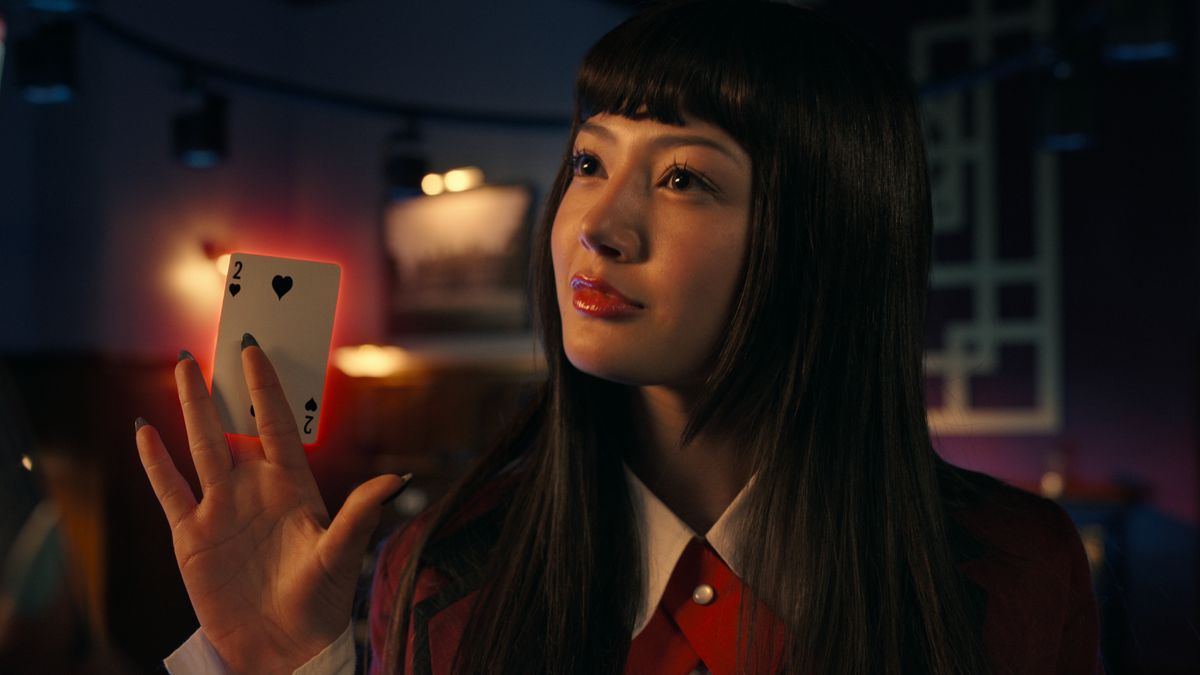
I recently saw Curry Barker’s excellent bad-romance horror movie, Obsession, and was left with a couple thoughts. Firstly, Inde Navarrette’s stonks are about to go through the roof, and better not land her straight in Marvel jury duty. Second, the central “romance” reminded me of how couples with matching Misa Amane and Light Yagami Death Note profile pics look absolutely wild to normal people. And, finally, we don’t talk enough about how the aftermath of Death Note is more messed up than the series itself.
Death Note is a series about an egomaniacal teenager named Light Yagami and a quirky detective named L, duking it out in a global morality play centered on a cursed notebook (with way too many rules) that kills anyone whose name is written in it. Though you probably already know that because its reputation precedes it—and rightly so. The early aughts series is spoken of in the same breath as Fullmetal Alchemist as a gateway anime for newcomers; it's gotten a couple of novelization spin-offs set before its story and an alternative tale set after its conclusion (both I highly recommend for fans of Naomi Misora and L Lawliet); it's even got an odd post-series one-shot that absolutely makes a mockery of Donald Trump getting his hands on the cursed notebook. It’s also crossed media into a musical for folks who’re into that sorta thing and introduced folks to Maximum The Hormone, who kicks all the ass.
But with its accolades also comes the counterbalance of unremitting smears to mangaka Toshiki Inoue and illustrator Takeshi Obata’s formative series. Key among them are ad nauseam discourse about its second half falling off, its Netflix live-action movie sucking (I enjoyed it), and the ever-present fear that the post-Stranger Things 5 Duffer Bros. plans for a new Netflix live-action series will emerge from production limbo and see the light of day.
But for all the things fans can readily say about Death Note—its cultural touchstones, its memes, its endlessly recycled discourse—what rarely gets talked about is what happens after it ends. And no, I’m not talking about the still-contested fan theories about Light Yagami’s fate (or his Easter egg cameo in another anime). I’m talking about the toll he leaves behind.
Spoilers, duh.
Light Yagami dies at the end of Death Note. Granted, the anime gives him a more romanticized end, but he still dies like a dog cornered with nowhere left to run, choking on his own desperate plea for help.
@juswhyheem ♬ original sound - WhyHeem
The shinigami Ryuk—having been amply entertained by watching Kira’s melodramatic rise and fall—writes Light’s name in his notebook and drifts back to his monotonous eternity. What’s haunting about the manga, though, is that even Light’s death is pyrrhic. His grandiose, self-righteous dream of creating a new world with himself as its judging god proceeds in spirit, despite failing to live long enough to see it through.
Lord Acton, a 19th-century British historian, famously wrote, “Power tends to corrupt, and absolute power corrupts absolutely.” While he wasn't the first person to articulate the idea, his phrasing perfectly captures Light’s arc. Light begins by killing criminals he believes have escaped the world’s debased sense of justice. But as the series progresses, the whiny, insecure boy he always was slowly surfaces. He’s no god; he’s the biggest hypocrite alive.
Like any dictator insisting his brutality is for the greater good, Light’s campaign boils down to control, which he’ll go to extreme lengths to uphold. He wipes his own memory in the most elaborate 5D chess move in anime. He kills innocents when cornered, and eliminates anyone who threatens his perfect self-image. He’s no super genius; The emperor has no clothes. Light is just an honor-roll kid who wants to be seen, feared, and, above all, worshiped, and makes it everyone’s problem in doing so.
Every person he (and, let’s be honest, L too) uses as a pawn ends up destroyed. Light’s police chief father dies because Light lets him just to gain an easy W over L. Meanwhile, he only has platitudes for his sister, whom he once doted upon, as she watches their family collapse under the weight of his own ambition. He even bestows his power (temporarily) to other deranged power-seeking people of status to get the heat off of him, including an old high school flame he uses as a meat shield. Key among these sacrificial lambs is his girlfriend in name only, Misa Amane, who, in addition to being one half of one of the top four worst anime couples of all time, he tasks with halving her lifespan (twice!) to help him win. According to the pedantically titled Death Note: How to Read guidebook, Misa dies a year after Light at 27 years old, on Valentine's Day of all days.
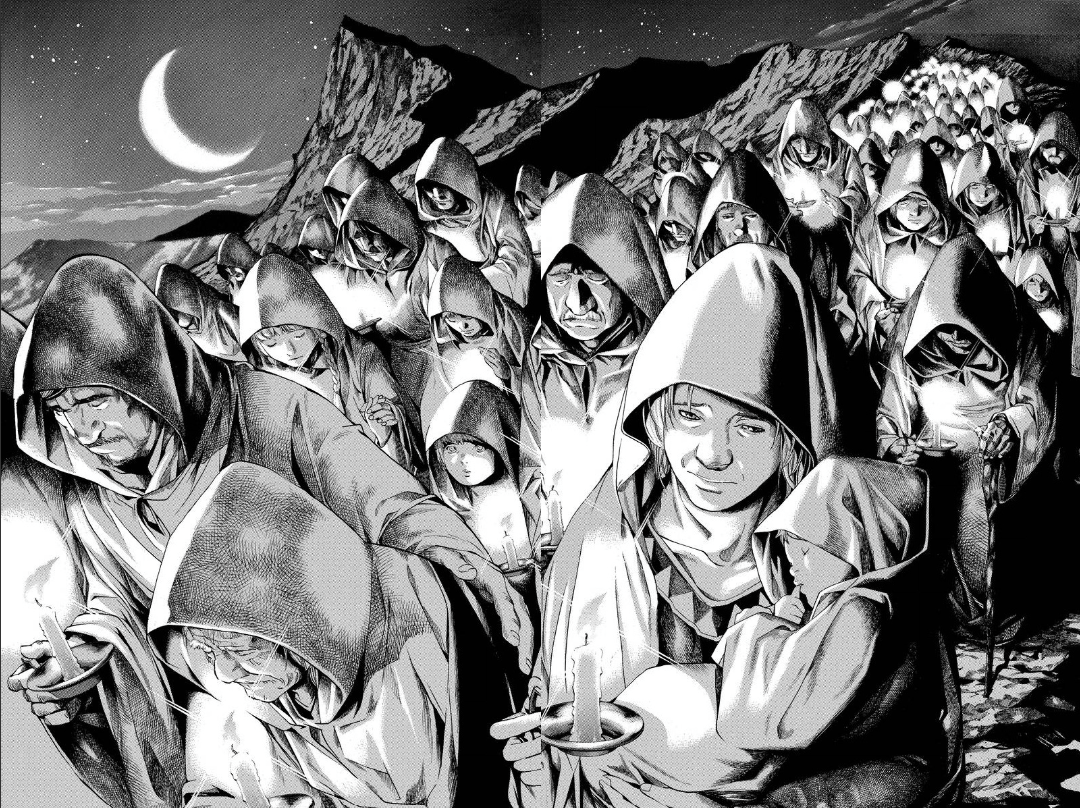
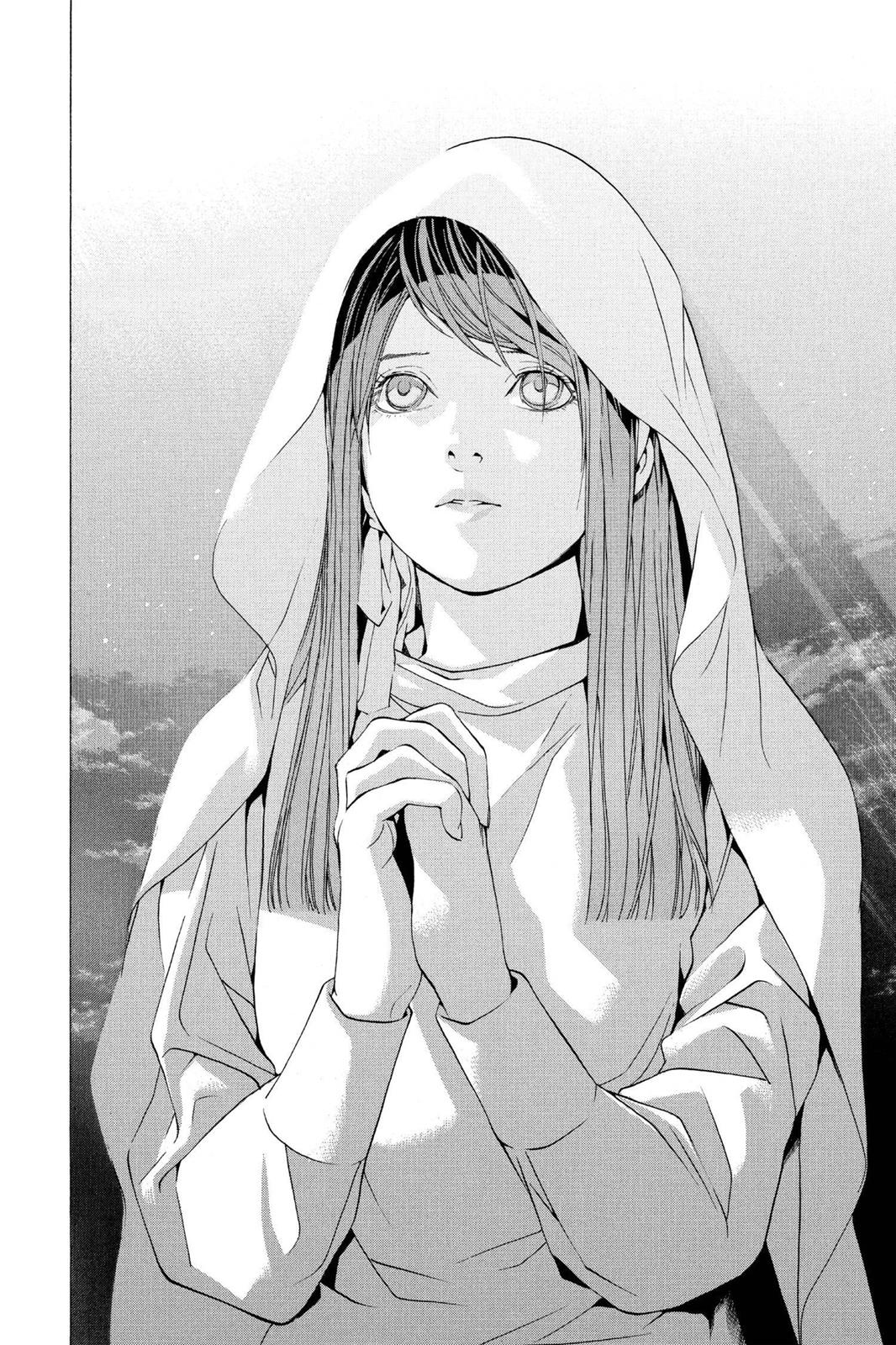
But the thought I return to most when I think about Death Note isn’t Light’s petrified expression when he dies, nor is it Ryuk’s apathy toward it all. It’s that Kira’s warped ideals endure. While the anime’s more upbeat finale ties a bow on this sentiment in its title, “New World,” the manga underscores that to an even chillier degree. The final pages of Death Note show a procession of Kira worshipers gathered on a cliffside, candles and prayer beads in hand and babies at their hips. The series then closes on a panel of an unnamed woman, hands clasped, praying to “Kira, our savior” as if to beckon his return, like he’s the second coming.
Thankfully, humanity gets Marxist king Minoru Tanaka, the post-series one-shot protagonist who surrenders the power of the Death Note instead. But the whole scope of it—the pyrrhic supernatural victory the L-led task force ekes out while Light still manages to reshape the world, poisoning everything he touches to the point that real-world leaders bid over a Death Note while using his same talking points—is haunting. Whenever people reminisce over Death Note, they do so as if it's only a murder mystery whose virtues and flaws begin and end at how entertaining its cat-and-mouse game is. Nearly 20 years later, I’m still stuck on it being a haunting, cautionary tale about an egomaniacal fraud who, in death, created a cult.
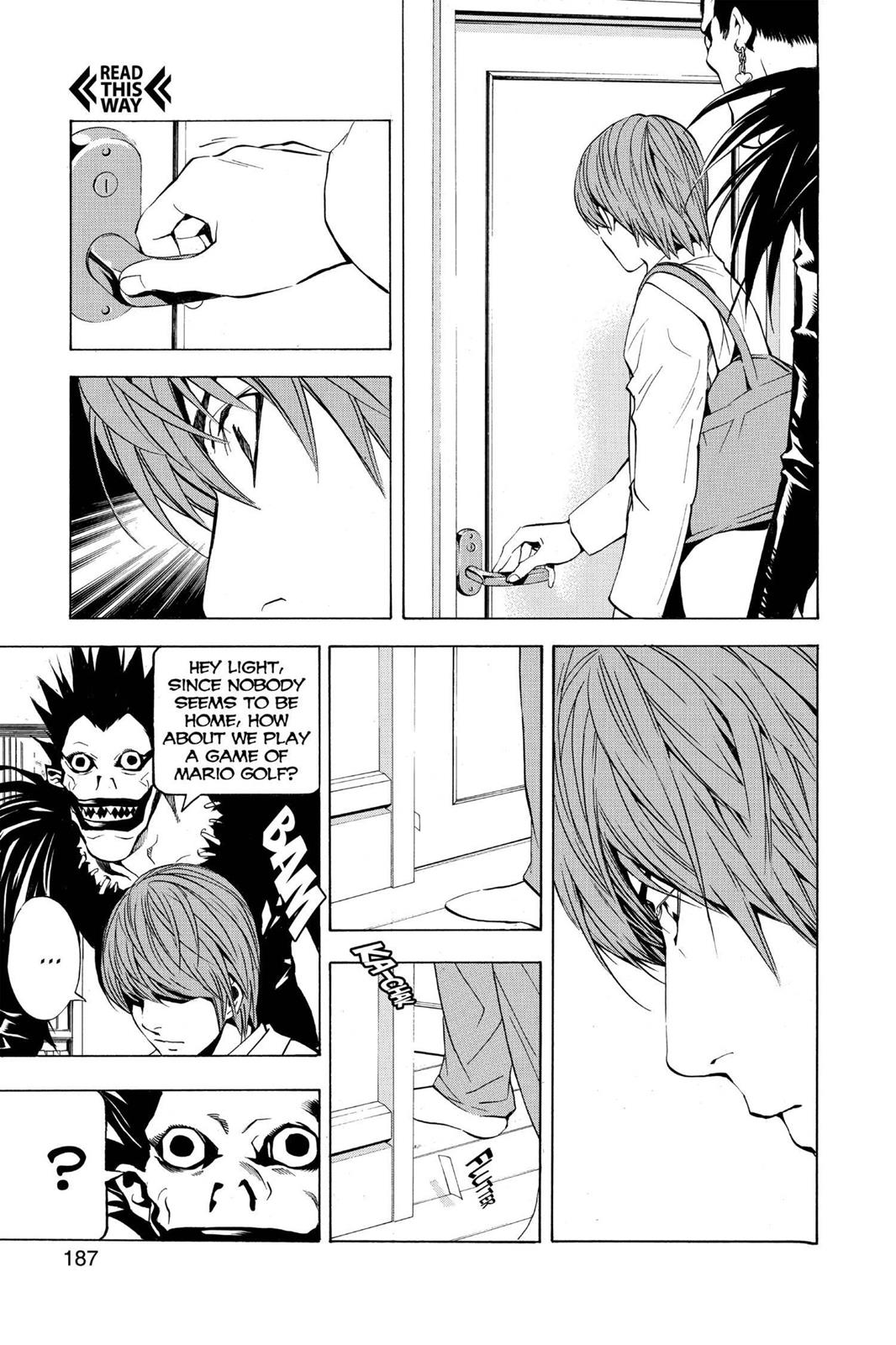
Toshiki Inoue/Takeshi Obata/Shonen Jump
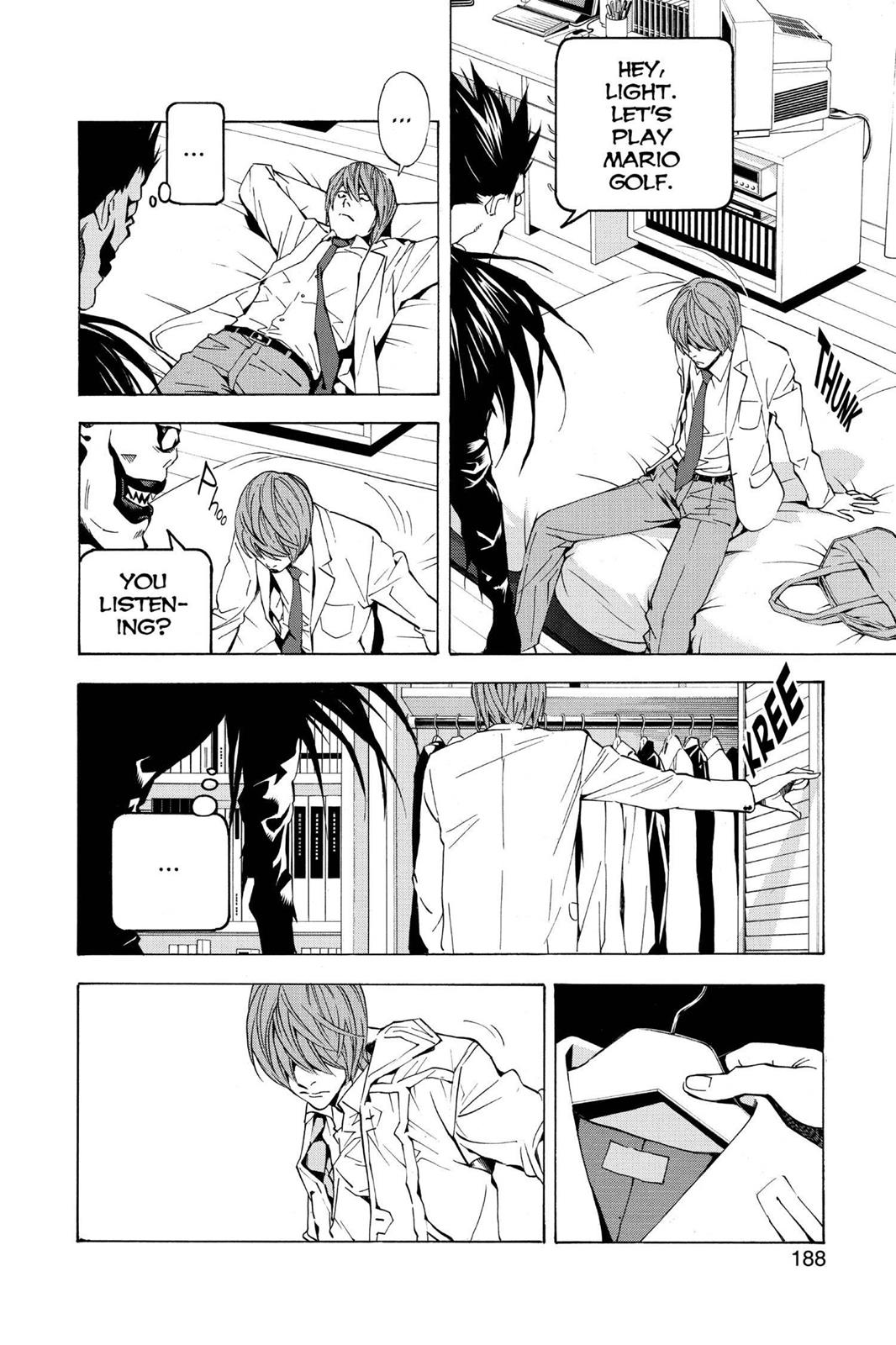
We can only hope the purgatory Light is wasting away in eventually lets him make good on Ryuk’s wish to play some Mario Golf to pass the time. It’s the least that asshole can do.
Recommended
 Isaiah Colbert