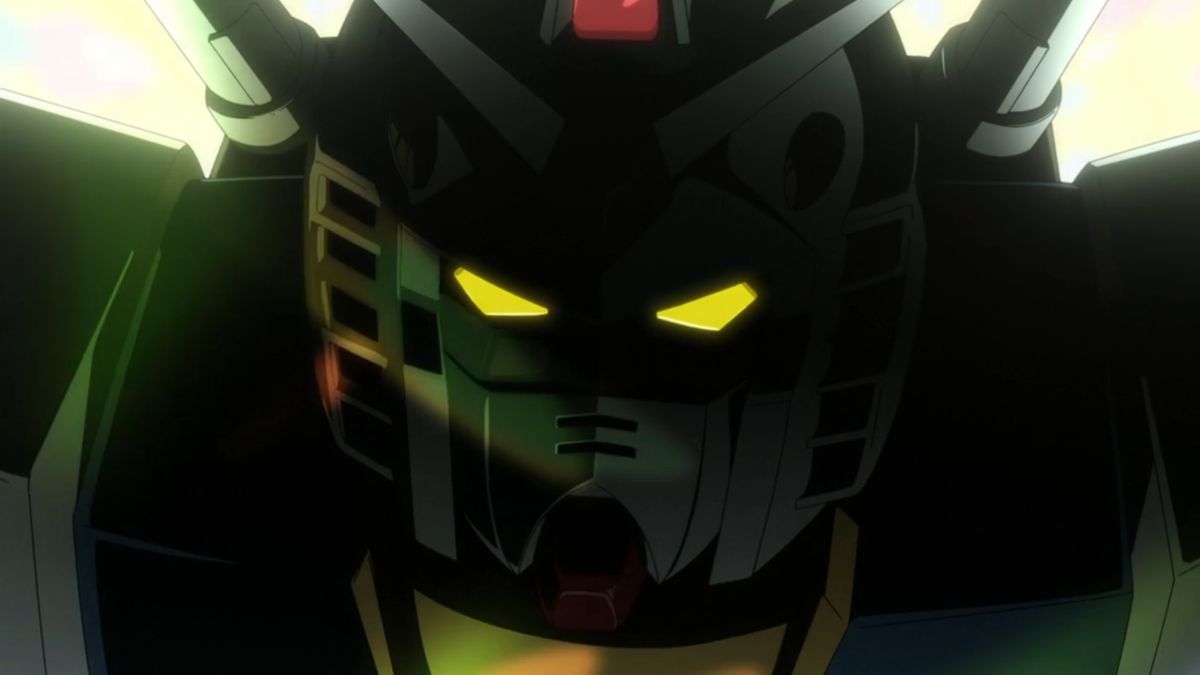
When I rolled credits on The Sorcery of Nymph Circe, I walked away thinking, “Yeah, that was a solid movie.” Not just because it was a solid entry in the ever-sprawling Mobile Suit Gundam zeitgeist, but because it became the antithesis of the media of the moment’s obsession with beautiful, sexless characters by making a mockery of its hero as a man who can’t outrun his own horniness.
Light spoilers throughout.
Mobile Suit Gundam Hathaway: The Sorcery of Nymph Circe is the second in a film trilogy of movies set in the Universal Century. Translation: there’s a lot of homework to do to comprehend the political circus that motivates its hero, Hathaway Noa, into becoming a terrorist. To be ever so brief, Noa is at the precipice of staging the greatest military resistance against the Earth Federation’s totalitarian mistreatment of space colonists as the undercover leader of Mafty. The only things complicating the matter are the odd love triangle between him, Federation Commander Kenneth Sleg, and Gigi Andalucia, a gorgeous escort caught up in her own mysterious Euphoria-esque subplot beyond her romantic entanglement with Noa and Kenneth.
To my delight, unlike in the first movie, where Noa stoically ignored the flirting and romance wafting his way from both Kenneth and Gigi, his cool-guy facade crumbled in the most embarrassing and spectacular way. Dude was getting his ass torn up, struggling to overcome his psychosexual urges. The way the film depicts his attempt to stay chaste in his mind palace, staying strong through his interactions with the women in his life, was worlds more interesting to me than the brilliant robot battles and political theater on display.
 Isaiah D. Colbert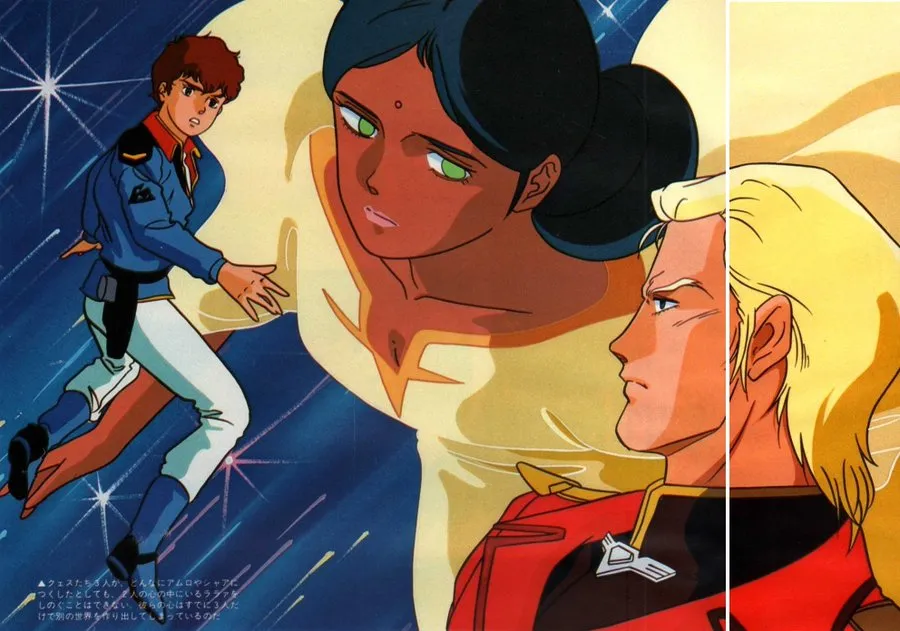
Romance isn’t anything new to Gundam. In fact, when I interviewed director Shūkō Murase about the film, he said it was a core part of the series' storytelling, the same way politics are, despite folks rubbernecking at the “whoa, cool robot” spectacle of it all. I’ve seen it in the Revolutionary Girl Utena-tinged sapphic romance between Miorine and Suletta in Witch From Mercury, the eternal love triangle between Char Aznable, Amuro Ray, and Lalah Sune, and it's especially present in the arguably messier love triangle between Noa, Gigi, and Kenneth.
But rather than embrace the romance of his entanglement, scored to absolute, precise perfection by SZA’s “Snooze”—a song about needing to fuck your paramour and going to extreme lengths to show your ride-or-die love for them—he admits his carnal desire to be with Gigi as a weakness. Being horny is Noa’s animus—a temptation distracting him from his mission. We are also witness to his failure to suppress his desires. Early on in the film, he chastises crewmate Julia Suga, telling her to “put something on to protect those ‘nice tits,’” while the camera treats viewers to one of the rare few point-of-view shots of Noa not breaking his glance at her, despite his making a show of looking away earlier.
This scene is emblematic of Hathaway’s arc in The Sorcery of Nymph Circe. He vilifies his own sexuality—twisting desire into something shameful, corrosive, and distracting. In his desperation to become the kind of sanitized, asexual hero that contemporary pop culture churns out (a pointed antithesis to the men who came before him), he does what all men are wont to do: he turns that self‑loathing outward. Throughout the film, Hathaway insists he’s above lust, longing, and the mess of human connection. But whenever the urges come, he routinely externalizes blame onto the women around him, treating them as the source of his turmoil rather than as its mirror. The result is a character who comes within punching distance of The Hunchback of Notre Dame’s Claude Frollo piloting a mech: a man convinced that his suffering is righteous, his repression is virtue, and his misogyny is moral clarity, when really it’s just the fallout of refusing to confront his own desires.
We see it in how he quietly quits his girlfriend, Kelia Dance, a matter made messier by her not being completely down with him being consumed by playing terrorist and by his obvious feelings for Gigi in the previous film, Hathaway’s Flash. The girl straight-up tells him not to forget to take his meds—a diss made even more poignant when, near the film’s halfway point, we see homeboy crying in the shower about how he’s supposed to have a “high-minded mission to shock the world into setting itself right," trying to convince himself that Gigi entered his life as some sort of test of his conviction after a near-death experience.
“There’s no way that I can ever be saved as long as I’m chained to these carnal and emotional desires,” Noa bellows.
His attraction to Gigi—which I originally read as nothing more than one-sided teasing on her part while Noa played the stoic, asexual brick wall I’d resigned myself to accepting as my bland hero—gets completely recontextualized in the sequel. The Sorcery of Nymph Circe dives straight into Noa’s tortured feelings and shows how down disastrous he’s been while trying to mold himself into the kind of desexualized protagonist that has become popular in a post-Marvel Cinematic Universe landscape. And he fails spectacularly.
responses to Hathaway 2 are a good litmus test for what someone watches Gundam for; ‘Wow, Cool Robot’ fans may be left wanting, but fans of Sensitive Young Man Psychosexual Torture Porn and people who enjoy muttering, ‘why did he say that?’ under their breath are in for a treat
— NAOMI 🐇 (@BUNNYEXPLODER) May 17, 2026
— 미깡 (@BURNTHEHOUS3) May 16, 2026
Mobile Suit Gundam Hathaway: The Sorcery of Nymph Circe (2026) pic.twitter.com/nETfzFOHCk
— ❁ Basil ❁ - HENSHIN!! (@Starshinefallng) May 16, 2026
In Everyone Is Beautiful And No One Is Horny, RS Benedict argues that despite pop culture being obsessed with beauty in the absolutely shredded actors we see in Marvel movies who’re contractually obligated to be shirtless at least once, it’s terrified of depicting any of them as horny.
Benedict writes, “Today’s stars are action figures, not action heroes. Those perfect bodies exist only for the purpose of inflicting violence upon others. To have fun is to become weak, to let your team down, and to give the enemy a chance to win, like Thor did when he got fat in Endgame.”
Benedict also prophesies a natural outgrowth of the desexualization of characters in movies, spotlighting Robert Pattinson’s The Batman as the hero we need. Granted, it pertained to Pattinson’s refusal to bulk up like so many superhero actors before him and to his admission that he has played roles asking him to masturbate. Still, Benedict’s words about the ethos behind the sexless portrayal of heroes are on the money when it comes to Noa’s own struggle in The Sorcery of Nymph Circe.
“Now, we are perfect islands of emotional self-reliance, and it is seen as embarrassing and co-dependent to want to be touched,” Benedict wrote. “We are doing this for ourselves, because we, apropos of nothing, desperately want to achieve a physical standard set by some invisible Other in an insurance office somewhere.”
Hathaway spends The Sorcery of Nymph Circe struggling not just to outmaneuver Kenneth, but to shape himself into an action hero who can surpass Char and Amuro, the mythical men whose shadows he can’t escape. He doesn’t want to be a “Char Clone,” as news chyrons insist he is, nor does he want to be read as an Amuro-type savior while leading Mafty as the son of a Federation war hero. And throughout the film, it’s obvious he believes the key to transcending them is to cut himself off from relationships and desire entirely, to be the one Gundam protagonist who’s above it all.
That’s why he’s such a humorless prude in the first movie—brushing off Gigi’s advances like a mosquito bite when she’s all but breaking out the runway lights for him to leave hickeys on her, and treating Kenneth’s teasing about “stealing her” as another irritation instead of him asking to be their third. Sorcery of Nymph Circe reveals what's really been simmering beneath Noa’s stoic act: he’s been stewing in the same repressed, self-righteous fury Eren Jaeger displayed at the end of Attack on Titan, raging at the idea of Mikasa moving on without him. When Noa finally cracked—screaming like Shinji Ikari in the fetal position after a “nightmare” of a naked Gigi walking toward him, then immediately trying to talk his way out of the feelings he just exposed—the movie leveled up from good, character-driven drama to a spectacular exploration of the natural outgrowth of the desexualization of characters in movies.
It was there that the trilogy stopped being another appendage that its Universal Century fans had to do their homework to appreciate and became a full-blown psychosexual mech tragedy. And I’ll wait as long as it takes to see how far Gundam deconstructs Noa’s libidinal Minovsky particles.
Recommended
 Isaiah Colbert