I’m visiting my parents in Cape Cod, where I arrived by bike last week just in time to be stuck indoors for days due to an early-season nor’easter. Despite being right on the coast, we were fine, with the exception of needing to find ways to entertain ourselves. At some point my sister rustled up a jigsaw puzzle from a basement closet, and god help me, I might be a jigsaw puzzle guy now.
I’ve never totally understood the allure of jigsaw puzzles. My sister is into them; her kids tease her about this, which is bad because it’s rude but good because it means that I don’t have to tease her about it. To me, jigsaw puzzles have always veered perilously close to being chores. I didn’t think they ask much in the way of skill or cognitive effort, and their main challenge seems to come from the pressure not to lose tiny, important things over an extended period of time.
None of that has ever seemed like much fun to me, so when my sister dumped a 1000-piece puzzle of old ice cream advertisements onto the kitchen table with aplomb on Friday night, my heart sank a bit. Her kids groaned and fled to other rooms, and the other adults retreated to the couch to drink wine and argue. As the last person in the vicinity, I helped tediously turn over pieces and start to look for the edges, the easiest pieces to identify. Studying the heap of cardboard, with so many pieces the same color, I despaired that we’d ever get anywhere.
But I changed my tune over the course of the weekend. There was something unexpectedly compelling about the whole process, as I’d wander past the table in my search for coffee or snacks and stop to try to connect a piece or two. Different strategies emerged: picking a specific area from the image of the completed puzzle on the box and hunting through the pile for possible pieces, trying to build inward from the outside or from a certain corner, zoning in on one specific uncompleted area and trying not to get distracted in an effort to complete it.
At one point my mom joked that she “wasn’t smart enough” for puzzles, which I found to be an interesting interpretation. There’s certainly an aspect of pattern recognition to it all, and a unique kind of concentration required in looking for a specific color or marking rather than bouncing from piece to piece, but it didn’t feel like it required any particular intelligence or aptitude. But rather than being boring, as I’d long suspected, completing the puzzle was just interesting enough to be something to do without demanding too much of me. I could walk away and come back at will, and there was always some progress to be made.
There was even a level of challenge I hadn’t presumed jigsaw puzzles had. This particular puzzle had several near-identical copies of the same image scattered throughout it, with differences in size or color being the only way to tell which was which. I definitely went down several dead ends of being sure I’d found all of one section only to be unable to fit the pieces together, finally realizing I was trying to combine disparate images. While this sometimes felt like a bit of a cheap way to add difficulty, it did make me think about what can make a puzzle “hard” beyond it just having a lot of pieces.
As the weekend progressed, the puzzle slowly occupied more and more of my sister’s and my time. On Sunday, up before everyone else, I started tinkering with it as I sat alone in the kitchen waiting for coffee to be ready. As we completed more and more of it, and as the storm passed and my sister’s departure date drew near, things both felt trickier and more urgent. Eventually, even the kids got in on the action, and as a big group we triumphantly put the last few pieces into place. It wasn’t all the pieces; some had been lost by people before us, so we couldn’t really complete the puzzle, but it was close enough: Every piece at our disposal had a home.
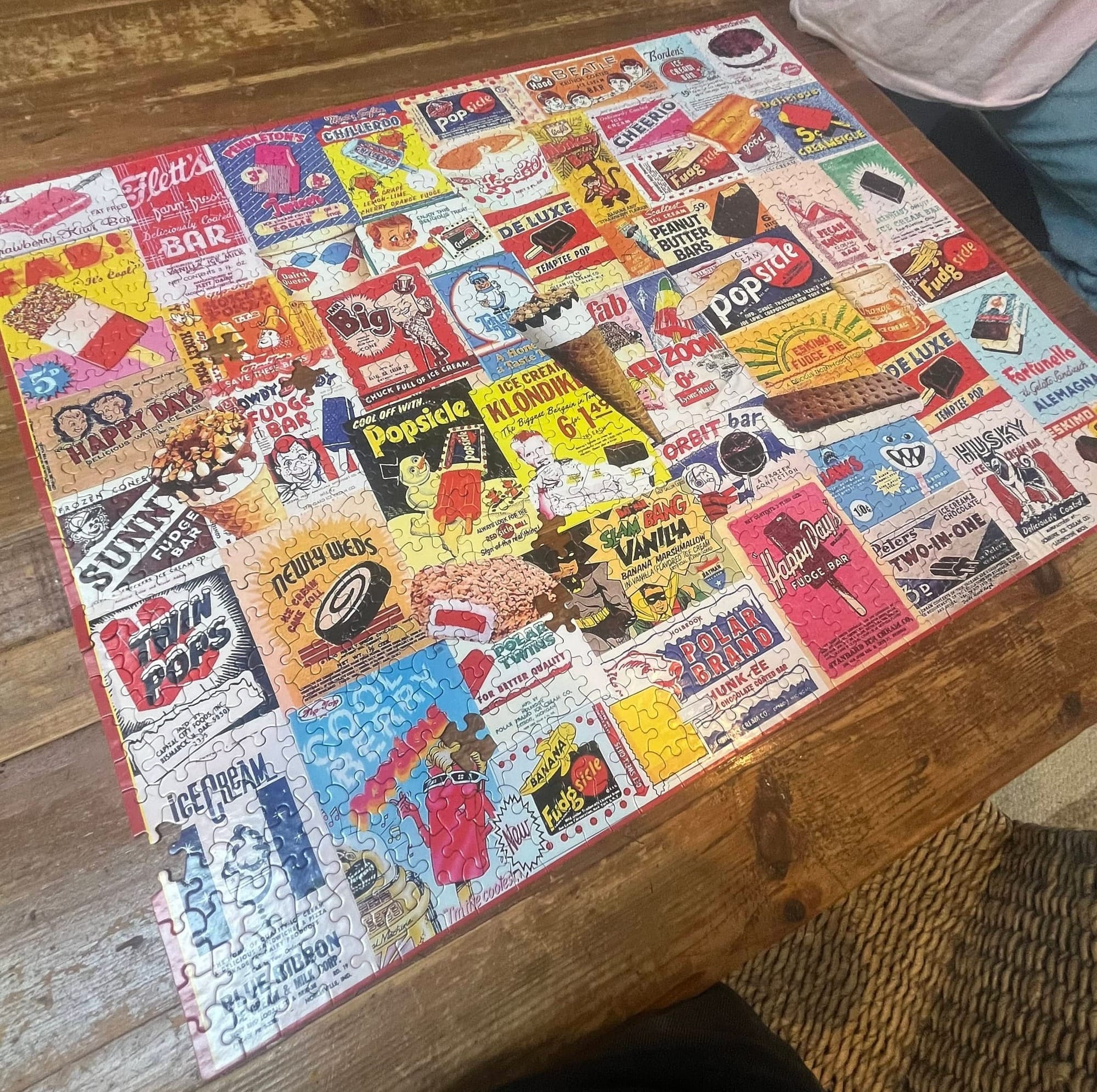
We left the puzzle sitting around completed for the day so we could admire our work, until we had to unceremoniously take it apart so we could put it away. I was surprised to find myself missing it; I’ve been eyeing another puzzle that’s downstairs, but I don’t think it would be quite as fun without my sister. But, in the wonderful way of being alive, it was cool to learn that I’d misjudged something, and to get to share in a hobby that someone else enjoyed.
Sorry I misjudged you, jigsaw puzzles. You’re actually super fun, and I would totally get into you if my tiny New York apartment could fit a surface larger than a side table.
 Nicole Carpenter