

After toying with polymer and air dry clay for a few months, I got a miniature pottery wheel and a microwave kiln. Why not take on an even more finicky, more painful version of the same hobby?
I've been taking lessons on making ceramics on a pottery wheel for a few months, and playing around with polymer and air dry clay. I've made a lot of polymer clay hockey skates since I wrote that last post in May, and I've gotten pretty efficient at it. I'm getting better at observation and creating a more accurate form. I've gotten better at throwing on the normal-sized pottery wheel, too! But what I have learned is that ceramics is an emotionally devastating hobby. I have ruined many pieces at all different stages—on the wheel while throwing, on the wheel while trimming, with a paintbrush while glazing.
So, of course, I made it harder by making everything smaller.
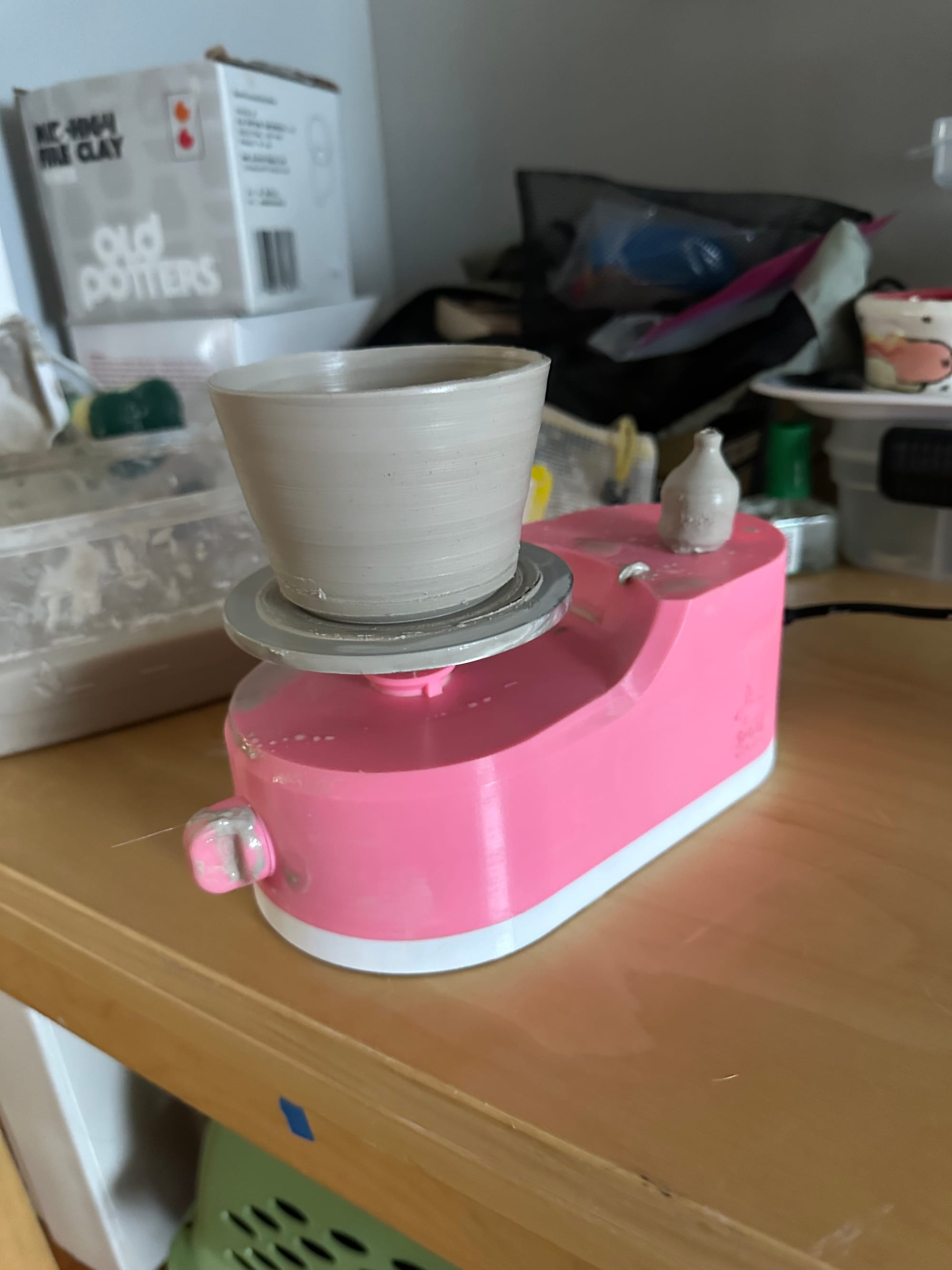
The miniature pottery wheel I got is from a company called Small Ceramics, which produces adorable, colorful 3D-printed pottery wheels. You can get less expensive miniature pottery wheels, and I'm sure they work fine. Except for the $5 toy pottery wheel from Five Below. I bought that, and it was a nightmare to use, which I shouldn't have been surprised at. But the Small Ceramics wheel is said to be more powerful; you can throw small, but you can also throw a regular-sized mug without issue.
Pottery is not as gentle as it may seem. There's a surprising amount of force necessary to force clay into different shapes, especially the setup of centering the clay on the wheel. This is the part that was impossible on the $5 toy wheel. Any time I'd cone the clay up (a move that sets the clay into a floppy, phallic shape) then back down (into a puck shape), the wheel would stop entirely. The Small Ceramics wheel has no issues at all, even with more than a pound of clay.
I got the wheel a few weeks ago, and I've made a whole bunch of different pieces using air dry clay. The problem with air dry clay on the wheel is that it's a lot drier than regular clay. You can do it, and I did a lot of it, but I think it also sort of messed me up on the regular wheel. (There was a gap between my classes, so I had a couple weeks of no regular wheel-throwing.) You have to use a ton of force on the air dry clay, and normal clay is a bit more delicate.
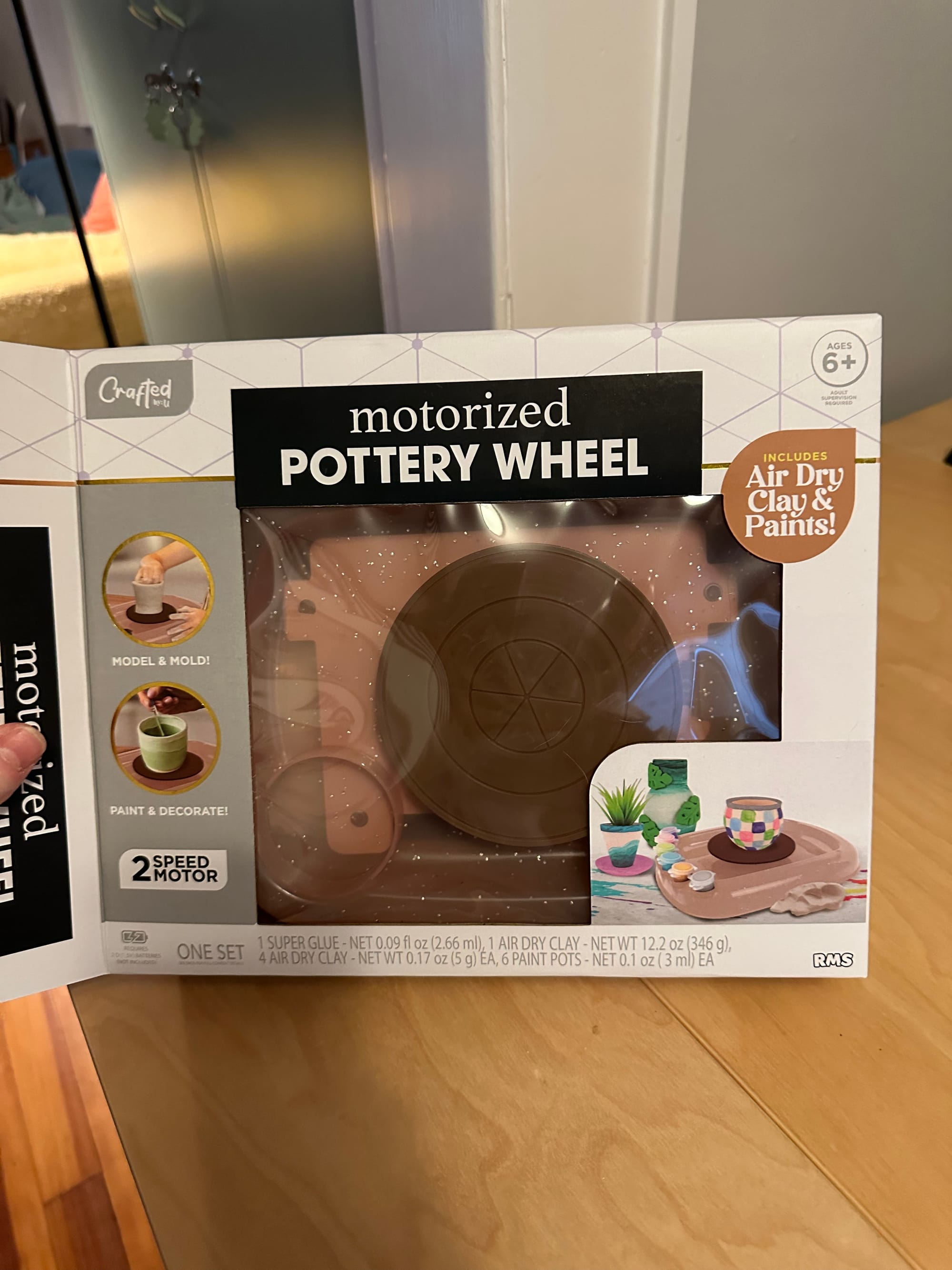
The other thing about air dry clay is that it, like polymer clay, doesn't make the satisfying clink of ceramics that are fired in a kiln. In a kiln, clay becomes vitrified—clay particles get fused together and then science happens and whatever you've made is no longer porous. And so it makes a satisfying sound when tapped. Polymer clay is plastic, and it sounds like it. Air dry clay can refer to clays made of a lot of different materials—but they don’t get vitrified in a kiln so (they may even burn up in the kiln), they don’t make that sound.
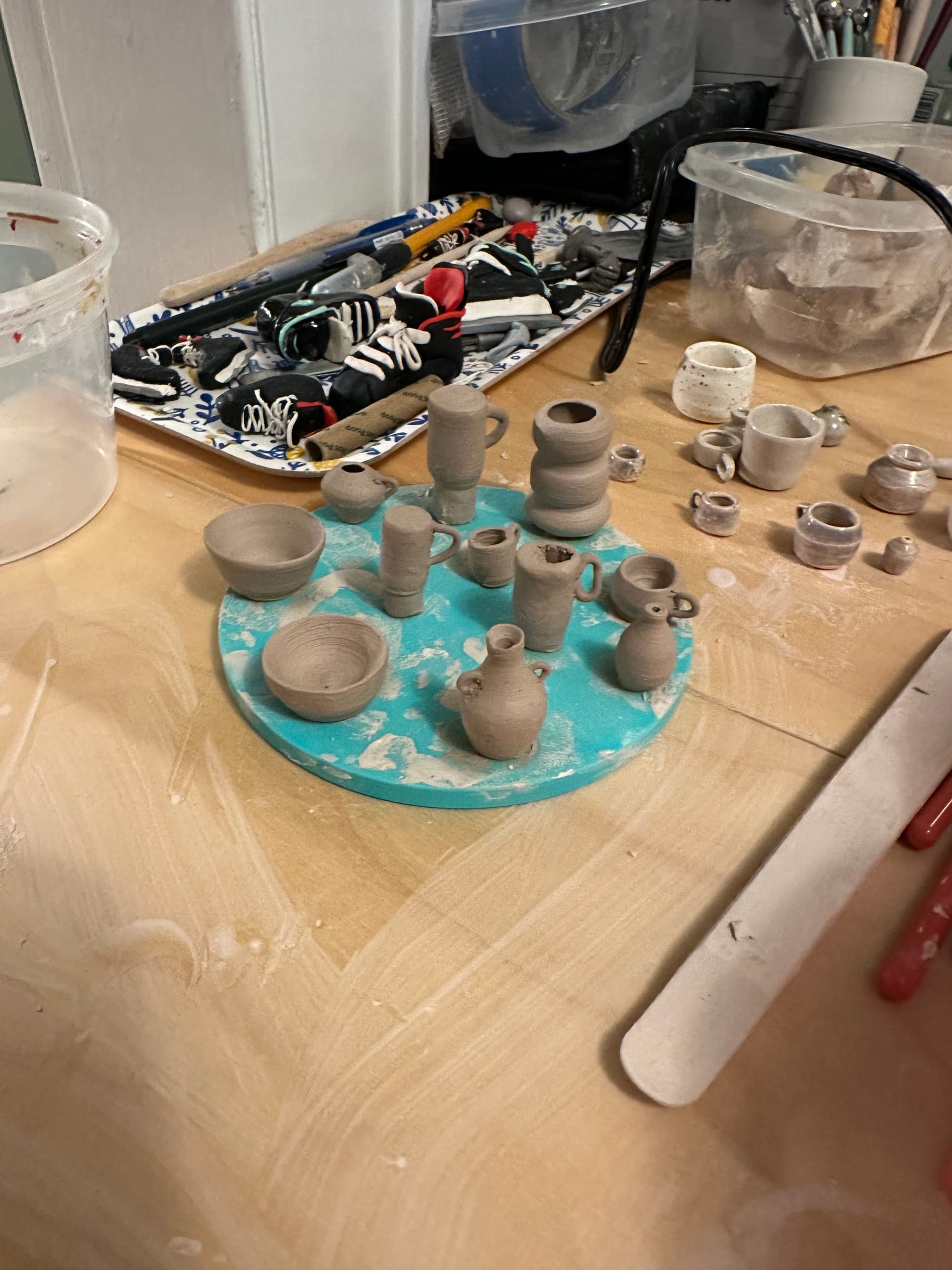
Before I got my microwave kiln, I started throwing with real clay on the miniature wheel, just to try it. The process is very similar to throwing on the normal-sized wheel—just at a much smaller scale. I used my fingers instead of my arms and hands. It's delicate, and sudden movements are devastating. The tools I'm using are especially small, too. Everything is so cute. It's been relatively successful, but for some time, I had no way to fire anything I made. Everything sat on my work desk in a state called "bone dry," and extremely fragile.
That's where the microwave kiln comes in. You need to fire clay in a kiln. It's too fragile in its bone dry state, and the tiny pots, cups, and vases I've been making break easily. I've lost several just from handling them at all. My regular-sized pottery, created in class, gets glazed and fired at the studio I'm taking lessons at. It's a weeks-long process to even get to the painting, then longer as they wait to get fired in the kiln. The microwave kiln makes the process something I can do at my house, in a much shorter amount of time.
The process, though, is much more chaotic and unpredictable by nature of the tool. You can't make food-safe ceramics in the microwave kiln, because it doesn't get hot enough to fully vitrify the clay. You also can't really choose what temperature you're firing it to. There are no settings like in a regular kiln. There are a lot of ways you can mess up: Heating it up too fast, taking the kiln out too early, leaving any trace of moisture in your pieces. Ask me how I've learned! Though I've watched a massive amount of YouTube videos and read a lot of instructions, you only really get a feel for it—your kiln, clay, and microwave—by trying.
My microwave kiln arrived over the weekend, and I wanted to try it immediately. Just to be clear, this is my experience and not necessarily instructions you should follow. I'm new at this!
I glazed some of the bone dry pieces I'd already made and immediately started heating up the kiln with no ceramics inside. Heating up the kiln itself, before adding the clay pieces, is necessary to make sure the thing itself doesn't heat up too fast. Rapid temperature changes can crack the kiln. So I heated it in 3 minute increments, increasing the microwave's power level each time. The kiln is very hot at this point, so you need heatproof gloves. I put the pieces in, put it back in the microwave, and started this process over, just at 5 minute increments. Everything immediately exploded inside the kiln. It sounded like popcorn popping. These little explosions stayed contained inside the kiln.
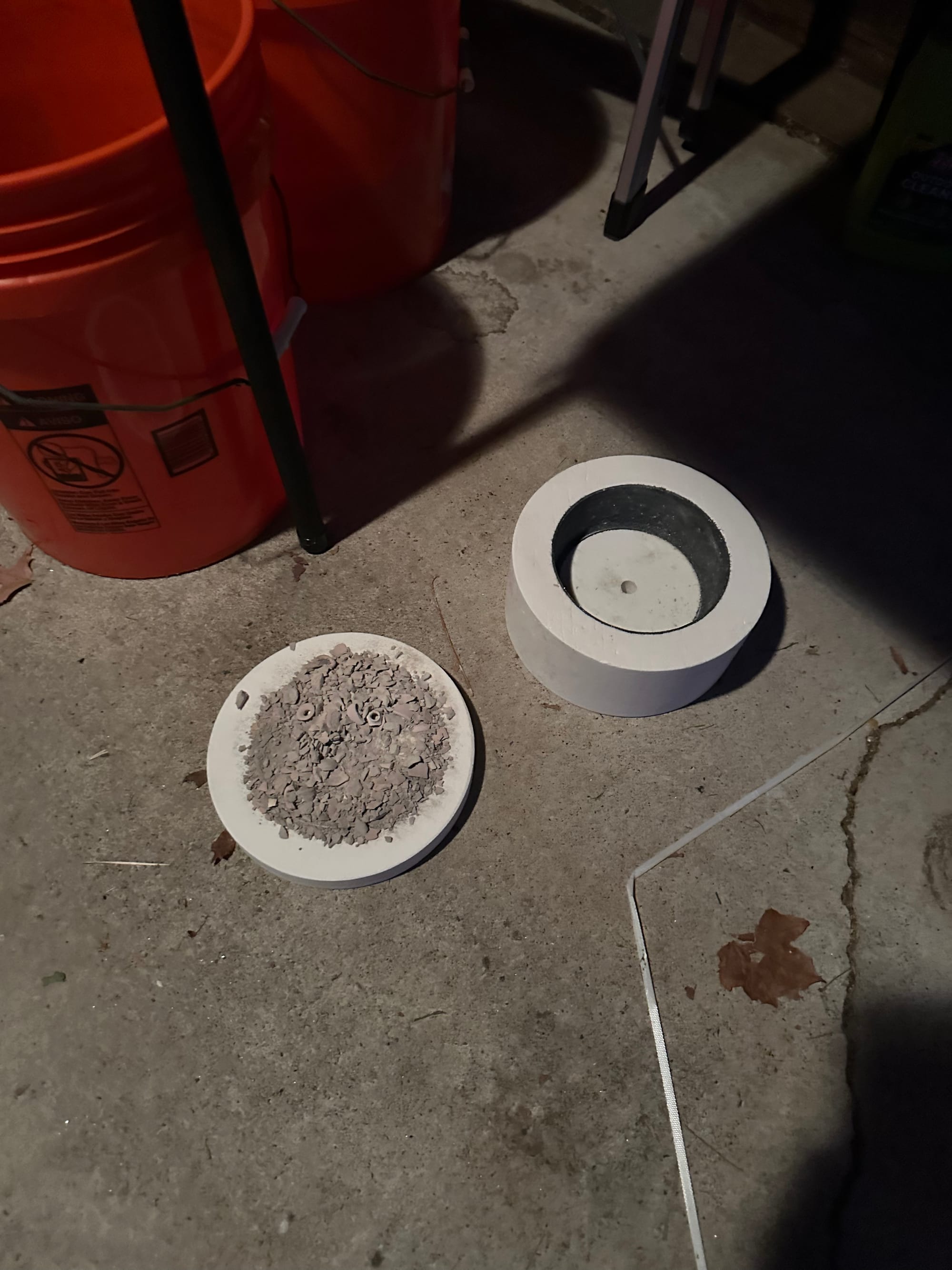
I didn't realize that—oh yeah!—the glazes add moisture. I also used water to clean the bottoms of the pieces so that they don't melt onto the kiln base. Unfortunately for me, I was so excited that I put all the best pieces in the microwave kiln first. To the seconds tomorrow!
The next day, I put the pottery pieces into the regular oven for an hour or so at its lowest heat, just to really dry them out, then brought them back outside to the microwave kiln. I heated the kiln up in the same way and popped the pieces back in. When I pulled out the microwave kiln immediately after the cycle was over, I lifted the lid with my fireproof gloves. They looked like lava! I let everything cool, though not as patiently as I should have, because the kiln cracked a little bit from thermal shock. (It's still usable.) I've learned I should leave the kiln in the microwave untouched for a half hour or so before even opening the microwave door.
The thing about the microwave kiln is that there are very real safety hazards. The fumes, for one, which is why you should do this outside and protective equipment, like a mask. It's also incredibly hot, so the fireproof gloves, fire extinguisher, and, again, protective equipment is essential. I don't know if it's dangerous, per se, but it's something you've got to be careful with. With that said, if this is something you're interested in trying, do your own research! I'm still figuring this out.
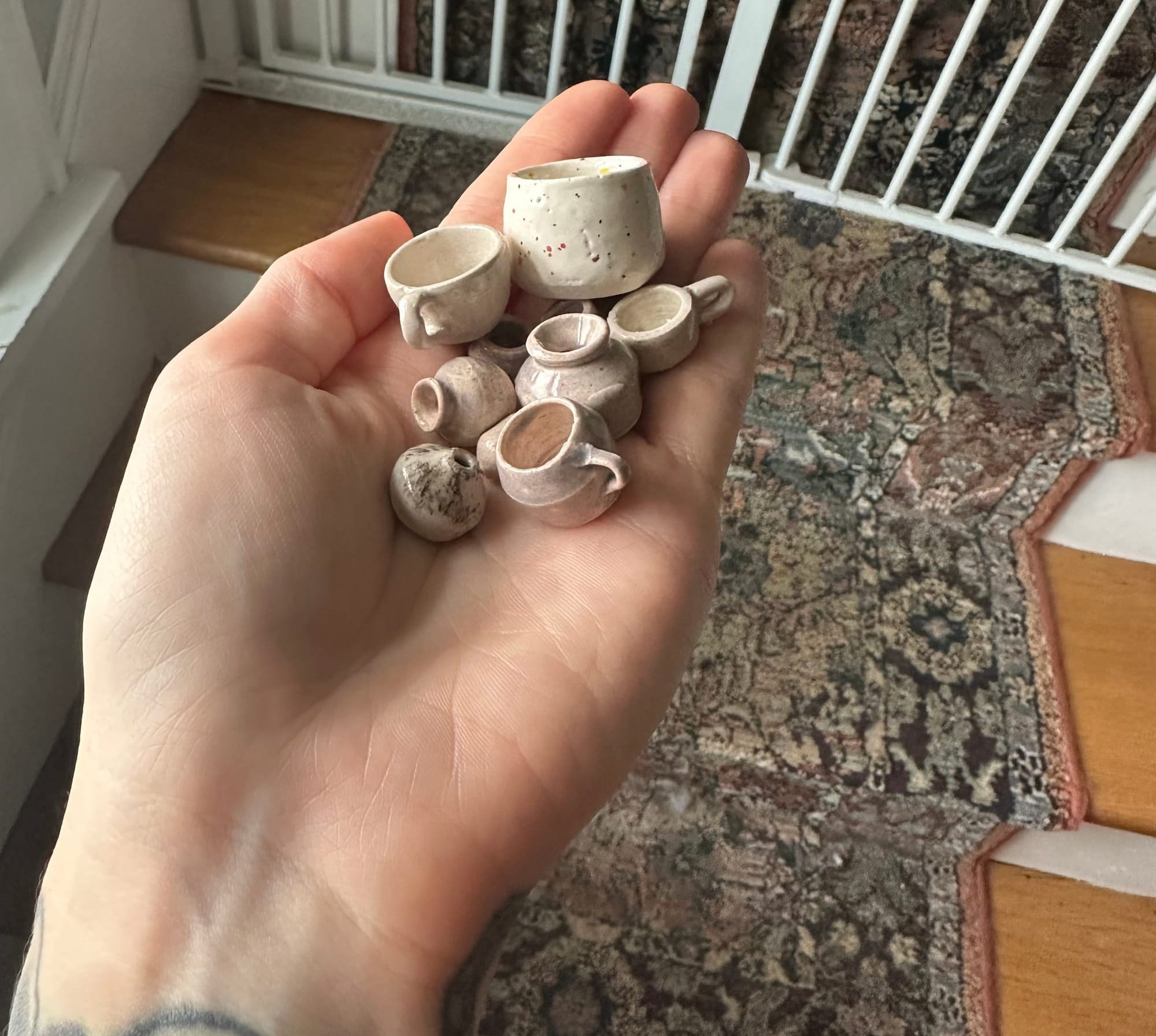
I've fired the kiln now several times, with different glazes, and gotten adorable results. There are lots of mess ups, broken pieces I drop before even reaching the kiln, and bad paint jobs. I'm having issues with underglaze and clear glaze—nothing comes out shiny. This is actually an issue in my regular-sized ceramics, too. If you know what I can do to fix these, please reach out!
It’s so satisfying to have these little pieces of pottery jingling around in my hand. I made those! I don't yet know what I'll do with the things I've made, which are now up to the dozens. For now, I've put them into my pockets to show friends—and anyone who will listen to me talk about it. My friends and family will certainly receive tiny gifts, too. The important thing to note though is that these really aren't functional in any way. I haven't tested them with water yet, but because they are fully vitrified, the water will eventually soak through the clay. You can't really even use them as vases because of that. Perhaps dry flowers, or as trinket dishes? Just trinkets themselves, even. I think it would be very cute to put a little stand outside my house and pass out tiny pottery to my neighbors, pay-what-you-can or free, especially since there's little to no function to these, except being cute.


