Unless you are a child, you probably don’t have hundreds of hours to comfortably invest in a game. That time, unfortunately, must be spent on work or curling up in a ditch and dying after work. This in mind, many yearn for games with a little less flab—something lean and mean that gets straight to the point. But games cost money, and in case you haven’t noticed, there isn’t exactly a ton of that going around these days. Thus, a dilemma: Do you buy a handful of shorter games, which you can experience in full, even though the cost might add up, or do you try to maximize bang for your buck with one? On the latest Aftermath Hours, we talk about that.
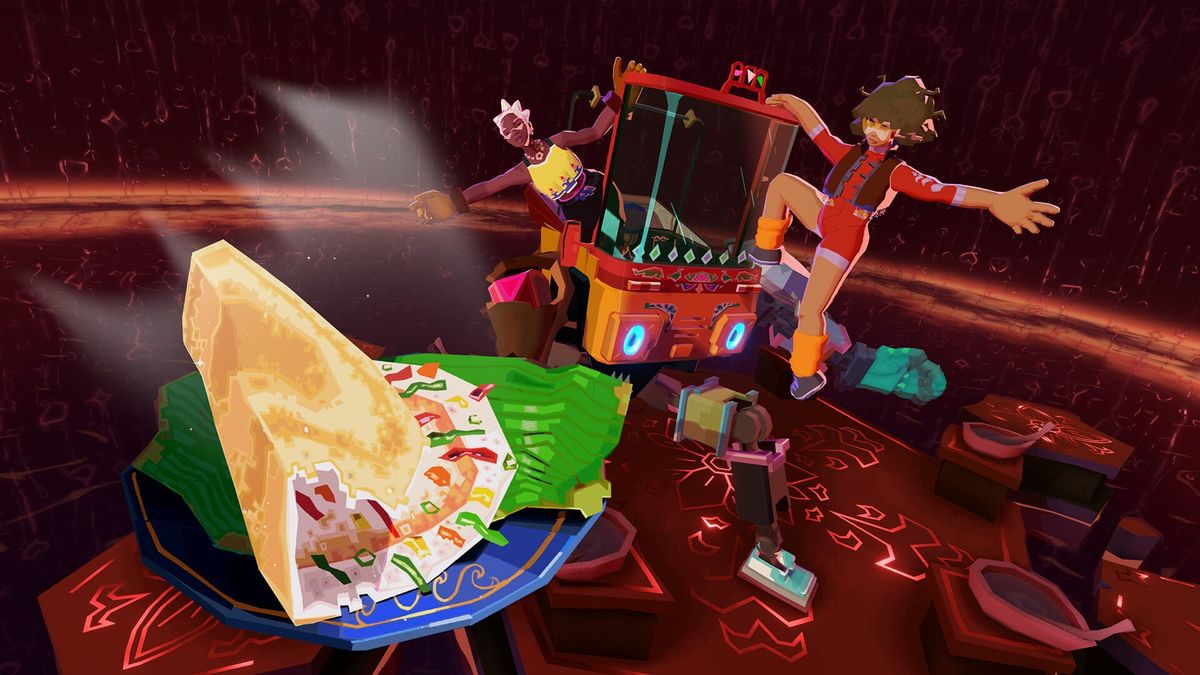
This time around, we’re joined by Chandana Ekanayake, director of Dosa Divas, a new turn-based RPG about cooking, culture, and reconciling with loved ones. Also, mechs. We discuss the game’s inspirations, as well as the way food and other elements of culture are often stripped of their original context and commodified—which allows for the dehumanization of the very people who made the food in the first place.
We also talk about what it takes for a small studio to keep the lights on as the video game industry sinks deeper and deeper into the swamps of tumult and how that experience—including, unfortunately, layoffs—surfaces in Dosa Divas as a theme. Lastly, we share our favorite dishes to serve friends and say what everyone else is thinking: The Pope was cooler before he went corporate.
You can find this week's episode below and on Spotify, Apple, or wherever else you prefer to listen to podcasts. If you like what you hear, make sure to leave a review so that we can go in and remove all the annoying parts from long games, thereby rendering them short.
Here’s an excerpt from our conversation (edited for length and clarity):
Chandana: We’re just competing against everything else—from social media to Netflix to streaming to whatever. There’s only so much time people have.
Nathan: With a game like Dosa Divas, how do you make that argument to people—that this is the thing you should be doing, over all those other things?
Chandana: We purposefully make short games. One of the reasons we’re making a Thirsty Suitors or a Dosa Divas is, I’ve never finished a Persona game. And I know they’re great, and I’ve tried, but 100 hours is not typically something I invest in a game. Elden Ring is a rare exception. I think I put 150 hours into it, because I was obsessed with that game nonstop for two months.
Gita: Yeah, it got its hooks into me as well, and I played that game for, like, two months. But not many games are as sticky in my brain as that one. Most of the time when I try a new game, I give it two days, and if you can’t latch onto me, it’s very easy for me to [move on and] pick up another game. I feel this way about books, too. The beginning of a game is so much fun, when you’re just discovering things. Everything is new, and the systems haven’t fully revealed themselves to you. You’re really excited for the possibilities. And then you might get to a place where it’s like, oh, these are the limits of what this game is going to be.
Nathan: Isn’t there a stat that’s, like, 95 percent of players don’t finish games or something? [Turns out, it’s 90].
Chandana: I’m sure that’s true, because it’s probably what my Steam library looks like. I’m ADHD brained, so I get scattered. I forget the show I started that I’m supposed to be watching or the game I started.
I like short experiences, so I think for us, we have a free demo on Steam. And we’re like “Hey, if you like this first hour and a half, [you’ll probably like the rest].” And you can continue from that save file onto the full game. We hope people finish it, but we also understand how time is the constraint. Also, things are expensive. There are a lot of free things out there that can take up your time.
Nathan: It’s interesting to see, because I think that a lot of people say they want shorter games, but then they are met with the fact that games cost money, and they’re like “I want to get the maximum amount of bang for my buck, so maybe I’m gonna save my money for something bigger because I’m worried that I’m not gonna have money in the future to spend on things like this.” It’s difficult, because there are so many great games I haven’t finished, and every time somebody says “This game lasts 10-12 or 10-15 hours,” I’m like “Thank god! The sweet spot.” Something Resident Evil 4-length, at maximum.
I wish that the world more catered to that, because I think that we would all be a little happier and saner if we weren’t making these decisions of “OK, am I gonna buy a shorter, smaller, more compact experience or a game that I need to play 100 hours of to justify the fact that I spent money on it?”
Chandana: Right. I think buying anything in general is emotional. If you get excited enough or enough of your friends are playing something, you don’t really think about the cost. You’re like “Oh, they’re playing it, and I just want to get it.” This happens to me with every GTA. I’m like “Fuck GTA. It’s just gonna be another one of these.” But then there’s so much coverage and share of experience that I feel like I’m missing out. So people complain about price, but I think that if there’s emotional hooks—or enough of your peer group or friend group is playing it—you don’t really think about the price so much.
Recommended
 Gita Jackson