

Four gamers are suing Sony Interactive Entertainment for allegedly breaking a California law that requires digital storefronts selling games to make it clear people are buying licenses, not actually owning the games. Sony Interactive Entertainment's PlayStation store uses language like "Buy Now" and "Confirm Purchase," lawyers wrote in a complaint filed on Thursday. It's a proposed class action complaint, meaning the group of four gamers is asking a judge to grant them class action status.
"In reality, consumers who 'purchase' digital games through PlayStation do not obtain ownership of those products," lawyers wrote. "Instead, PlayStation grants only a limited, revocable license to access the software, subject to multiple restrictions contained in a separate Software Product License Agreement."
It's the same reason that someone sued GameStop in January. That lawsuit has since been voluntarily dismissed.
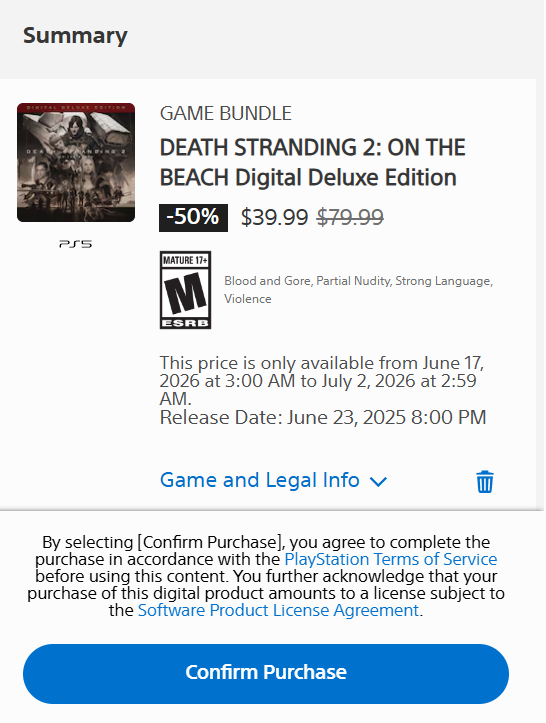
However, the PlayStation store does have a disclosure. Above the "Confirm Purchase" button, there's a note: "By selecting [Confirm Purchase], you agree to complete the purchase in accordance with the PlayStation Terms of Service before using this content. You further acknowledge that your purchase of this digital product amounts to a license subject to the Software Product License Agreement."
These four gamers aren't satisfied with that; they said in the complaint that it's too small, and that "a reasonable customer completing a purchase would not necessarily notice this disclosure."
At the crux of this lawsuit is California's digital goods transparency law, AB2426, which went into effect in 2025. It requires companies to explicitly tell customers buying digital goods, like games or music, that they're purchasing licenses to access that stuff, not outright buying it. Valve changed its checkout page in 2024 to include a disclaimer: "A purchase of a digital product grants a license for the product on Steam."
Lawyers for the four gamers said Sony Interactive Entertainment doesn't have enough of a disclosure on its checkout screens. "As a result, reasonable consumers are misled into believing that purchasing a digital game through PlayStation confers an unrestricted ownership interest, when in fact the transaction merely grants a limited license that may be restricted or revoked," lawyers said in the complaint.
The four gamers, according to the complaint, were not aware they'd been given a license to play the games and not buy them. The language, instead, mimics traditional, physical consumer experiences, like when you buy a pen from the office supply store; you buy it, and it's yours. The disclaimer about licensing, not selling games, is in the Software Product License Agreement most prominently. "The License Agreement expressly provides that the software is 'licensed to you, not sold,'" lawyers wrote.
The lawsuit walks through the checkout process. When someone checks out and hits the "Confirm Purchase" button, they don't have to check any button to acknowledge they have read the disclosure. According to the four gamers, that's misleading customers. They're asking a judge for a jury trial to determine restitution.
The GameStop lawsuit filed in January failed to move forward due to the voluntary dismissal, and it's unlikely that this one will see success: The PlayStation Store does, indeed, have a disclosure. But lawsuits like these continue to ask the big question around games—what should happen to games when they "die?" This is a conversation that's been happening in and around games (and other digital media) for a while, but came to a head in 2023 when Ubisoft announced it was shutting down access to its online-only racing game The Crew. Two Californian gamers sued the company for shutting the game down, therefore ripping access away from paying customers. That lawsuit was voluntarily dismissed in June 2025. Still, the surrounding situation kicked off California assemblymember Jacqui Irwin's campaign to get transparency around games and other digital goods signed into law. She specifically referenced the situation with The Crew as inspiration for AB2426.
While the California law deals with transparency, the Stop Killing Games movement is pushing for an alternative to just shutting a game off when a company no longer wishes to support it. The global organization has been lobbying for legislation in both the United States and Europe. The European Commission declined to do much about the issue in a new decision announced this week, but promised to meet with companies to come up with an optional code of conduct. However, the California State Assembly recently passed a bill to champion games preservation and the Stop Killing Games movement. That bill will move to the California State Senate, where a committee will debate the issue some time in June.


