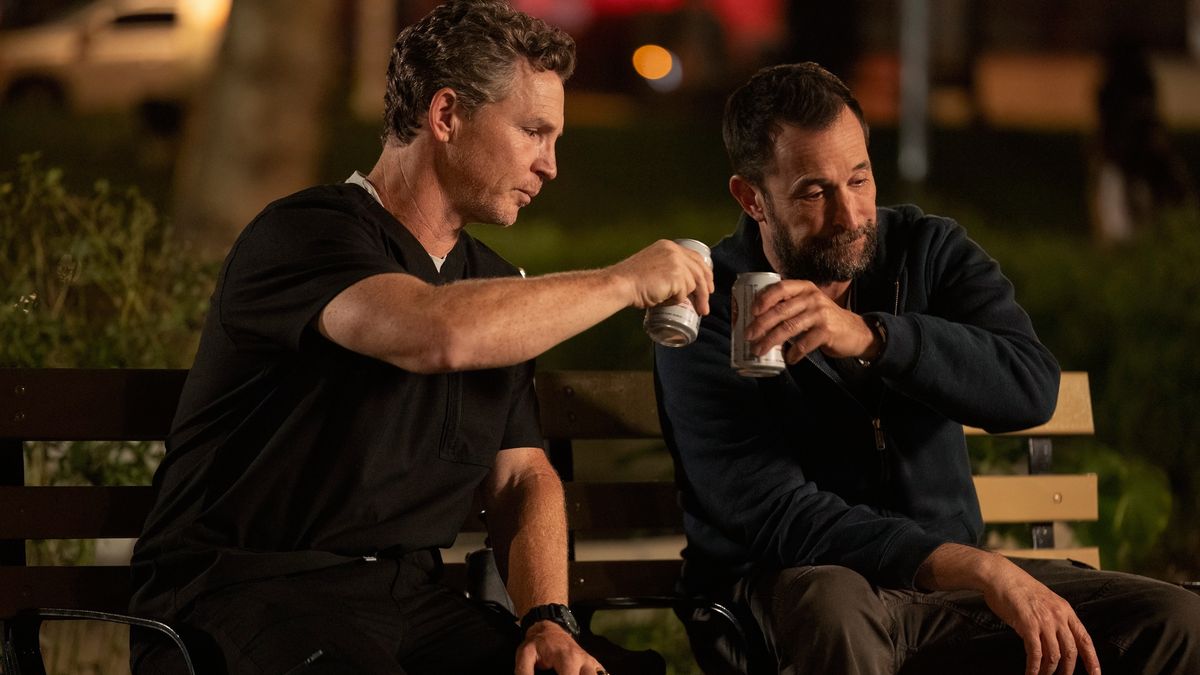
This weekend I finally got around to watching HBO’s medical drama The Pitt, a show everyone’s been raving about but which I avoided because I’m a squeamish baby. I’ve been enjoying it as long as I close my eyes for most of the medical stuff, binging a season and a half even though I meant not to. A quote from an interview with star Noah Wyle made the rounds when its second season ended recently, in which he calls the show “competence porn,” and I think that’s true not just as a workplace drama, but as a fantasy of a world where people get adequate medical care.
As everyone but me probably knows, The Pitt follows a single workday of the doctors, nurses, and medical students at a Pittsburgh emergency room. There’s interpersonal dramas big and small, and both seasons have featured some major disruption amidst the usual chaos. Each episode is one hour of the day, a really clever structure that allows for both continuity and the “patient of the week” format common in other medical shows. Most of what goes on in The Pitt is routine, in the unique way of emergency rooms: not necessarily rare diseases or medical mysteries, but regular people having the worst day of their lives, as we see the staff pivot from crisis to crisis with the dedication and professionalism that’s part of the show’s draw.
Wyle told GQ that the show
became almost a beacon of hope and humanity in an alternative universe. But in the midst of that, fifth point—this is essentially competence porn. You’re watching really smart, dedicated people do what only they know how to do at a level that you don’t know how to do it, and you’re so fucking glad that they’re there doing it, and compartmentalizing their own stuff to put your broken pieces back together. You’re so reassured by knowing that there are people out there that laugh and joke and have the ability to lock in like that.
This definitely struck me watching the show, on two levels. One is just watching very good actors be very good at pretending to be people who are very good at their jobs. The show is full of medical jargon that they deliver believably, and when you enter into the show’s fiction, the characters themselves move calmly through a day that would break the rest of us. A motorcycle accident or drug overdose might be out of the ordinary to the person experiencing it, but to The Pitt’s staff, it’s just another day at work. This doesn’t mean they aren’t affected by it all, but they remain committed to doing their jobs skillfully and with attention.
It’s aspirational as a workplace drama, whatever field you’re in: being a professional surrounded by other professionals, doing something that matters with other people who care about it as much as you do and who can do it at a high level. The show’s hospital is a teaching hospital, and throughout its drama we see its experienced doctors prioritizing mentoring the next generation. In our age of tenuous employment and AI boosters trying to deskill us all to line their own pockets (something The Pitt’s second season takes on), I found it affecting to imagine there could be such a workplace. The medical field is, of course, particular when it comes to skill in a way other fields aren’t, but the show’s emphasis on teamwork and professionalism felt like something that’s rapidly being destroyed in many workplaces in favor of cost-cutting and short-term efficiencies. This is also true in The Pitt, as we see its characters chafe against tone-deaf directives from on high, but at least from what I’ve watched so far, it feels like it never deeply threatens the core integrity of the workplace in the way that many of us have seen our own workplaces eroded.
The second thing that struck me about The Pitt’s competence is specific to the show as a medical drama: the fantasy, for many of us, of adequate medical care. The show doesn’t shy away from the ugly realities of emergency rooms–long wait times, understaffing, the financial burden of accessing care–but it also shows doctors taking patients seriously and endeavoring to help them despite these challenges, and even when those patients are rude or spout medical misinformation. It makes the emergency room seem like a place you could go to get help and actually receive it, even if it isn’t the most pleasant experience.
Content note: discussions of negative medical experiences follow.
As a trans person and someone who’s sought care while on public insurance, I haven’t had many positive medical experiences. I have no doubt most doctors and nurses are good, skilled people who try to do their job well, and I’ve always tried to be polite and compassionate when I’ve had to interact with them even when I’m frustrated or afraid, but most of my experiences, especially in emergency rooms, have been pretty upsetting. As a result, I’ve avoided seeking medical care when I’ve needed it, especially if I don’t know how a place might be about me being trans, or I’ve hidden my trans status from providers until it became unavoidable. The Pitt’s doctors begin by asking patients what medications they’re on, a routine question, and it reminded me how often I don’t tell doctors that I’m on testosterone, which I always know is a bad idea as I’m doing it.
The one time I did tell an ER doctor about being on T, we had a clumsy, upsetting conversation in which they tried to understand why, during which at some point I painstakingly said “I used to be a girl, but now I’m a boy, because of the testosterone.” They looked thoughtful for a while before asking “so it’s to develop your male sex organs?” and I said “yes” despite the absurdity of the question, simply to end the interaction and try to get what I’d actually gone to the ER for. (I like to tell this story because it's very funny to me now; it was a lesser kind of funny at the time, and I’d like to hope that ER's trans knowledge has improved since then.)
Even the places from which I regularly seek medical care often feel inadequate, not always able to handle my medical needs beyond hormones or sexual health. A long time ago now, a medical misdiagnosis thoroughly disrupted my life, as I and various providers spent a year convinced I had a rare, serious illness that eventually turned out to be a common skin condition, overlooked as a possibility in part because I’m trans. (This experience is where I learned the medical adage about looking for horses before zebras, which I nodded knowingly about when characters mentioned it in The Pitt.) This experience has made me even more unwilling to see doctors, a habit I know I need to work harder to overcome as I age. While despite the times we live in I don’t worry too much about my access to hormones, I do worry a lot about how I’ll receive care for other medical issues, and I worry how I’ll afford additional care if I need it now that so many of the systems that used to help me have been dismantled.
In my emergency room experiences, the things I always remember are brief moments of kindness from nurses who saw me struggling and tried to help me, offering me food or helping me get a room after hours spent waiting. It felt like these nurses came out of nowhere and then I never saw them again, and in my memory they alighted to Earth like angels. The Pitt doesn’t spend as much time on its nurses as its doctors, but it does show the important and often overlooked role they play. I found it moving to see the continuity in their days–that they are real people with real workdays and not just people it felt like I imagined in my crises.
Watching The Pitt gave me a more positive view of the emergency room than I have from my lived experiences. This feels like an important project the show is on in the aftermath of COVID, but it also has value for those of us who routinely have bad experiences with medical care for various reasons. While a provider's office staffed entirely by hot doctors might be an unattainable fantasy, and a workplace that actually cares about teaching new employees might be even more so, a world where everyone can get competent, high-level care shouldn't be.
 Isaiah Colbert