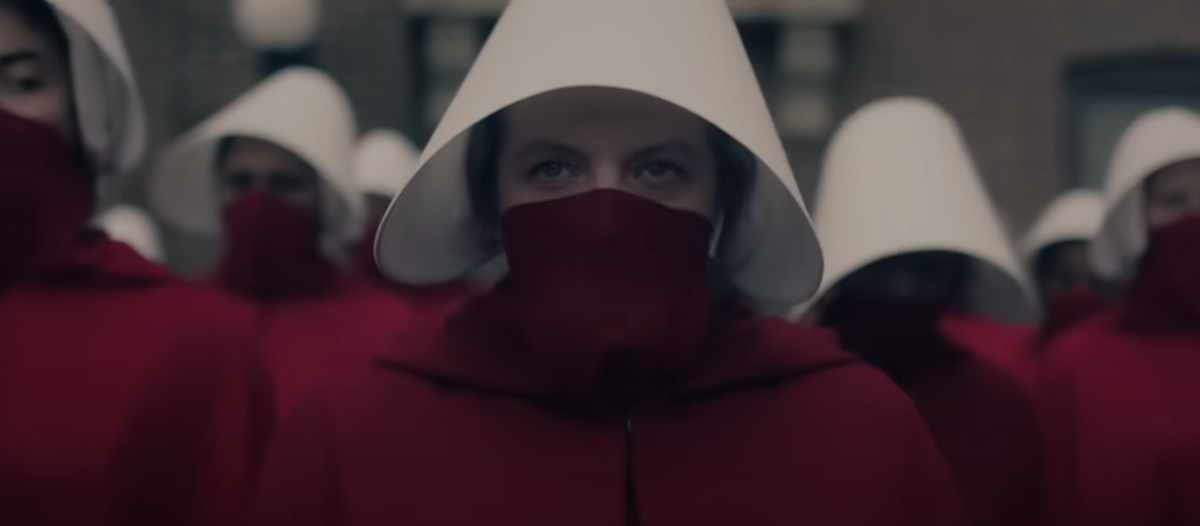
I am an avid hater of Hulu’s The Handmaid’s Tale. I am also a compulsive watcher of Hulu’s The Handmaid’s Tale, having stuck with the series from its first episode in 2017 through to its season six ending in 2025. Three episodes of its utterly unnecessary sequel The Testaments premiered last week, and I have watched each one of them, and god help me I’ll probably watch the whole damn series.
The Testaments show is based on Margaret Atwood’s 2019 book of the same name, which I read and thought was fine, if unmemorable. The show centers on Agnes MacKenzie, the adopted daughter of one of the repressive regime of Gilead’s powerful Commanders, as she comes of age in a fancy prep school that’s teaching her how to become a Wife. In the first episode, she’s paired up with a girl named Daisy, a convert to Gilead’s way of life from Toronto.
(Some spoilers for the first three episodes of The Testaments ahead.)
If you’re watching the show, or read the books, or watched the first show, I don’t think it’s a spoiler to say that Agnes is, of course, the daughter of June, the increasingly unlikeable star of The Handmaid’s Tale. Since I’m sure this will be dramatically revealed to Agnes at some point, the early episodes must instead get their mystery from what exactly Daisy’s deal is. It’s obvious from the jump that she didn’t come to Gilead out of true religious conviction, and we quickly get thrown into an intrigue plot. Alongside this, the episodes have low-simmering teen drama, and of course the background violence and repression of Gilead.
The Testaments hasn’t yet explained why, 15 years after the closing events of The Handmaid’s Tale, not much has changed on the surface of Gilead. We don’t see any handmaids in the first three episodes, but everyone is still color-coded–including the girls at school, separated by their proximity to getting their periods–and women are still forbidden to read or write. It’s a different environment, and a more established Gilead, than the original show’s Boston, though we do see rebellion and violence pop up. There feels like a stronger display of military might than in the first show, with more armed men and barbed wire, but it’s clear that Gilead has become firmly settled on the global stage.
While The Testaments still captures the unlikely grandeur of Gilead society, it’s not as visually gripping a setting as the original. The first show had uncomfortably beautiful kitchens and grocery stores, and it really felt like a new world being born from the ashes of the old. The Testaments, which I believe takes place in the DMV given that Agnes’ father is moved there from Colorado at the end of The Handmaid’s Tale, looks shiny and generic, the MacKenzies living in a house you might see in any TV show about rich people, and the girls school, even with its strange layout and intimidating statue of Aunt Lydia, feeling like the grounds of any TV school for rich kids. There’s an argument to be made that this reflects the bad taste of the Wives and by extension all of Gilead’s Christofascist leaders, but the compelling visual beauty of Gilead’s society against its horrors was one of the things that made The Handmaid’s Tale’s early seasons feel so provocative; without that, we’ve only got the show’s characters and plot to pull us through.
Those characters and plot, so far, are fine, if not a little dull. The Testaments is never going to be what the early seasons of The Handmaid’s Tale were, even though it’s premiering in a second Trump administration. Gilead and its cruelties aren’t new to the viewer, nor are the little rebellions people undertake within them or how they become indoctrinated into them, and all that familiarity takes the bite out of several dramatic moments. The show shoots it shot with a moment of violence a bit too early–we saw a much stronger, more shocking version of this in the first episode of the original series–and when it’s echoed again later among the girls it’s already lost its potency, even as it tries to spark things up with a ritual we first saw among the handmaids, in a not-so-subtle nod to how even the most powerful women in Gilead society are still second-class. But the ways women treat each other get a new tone when they’re set among young people–as Agnes says in voiceover at one point, “Teenage girls appreciate rage, in Gilead as elsewhere”--and this at least keeps the show from treading on ground it thoroughly exhausted in The Handmaid’s Tale’s too-long run. But it just can’t recapture what made the original’s first season so intense.
A big mystery of The Testaments’ pre-release was whether Elisabeth Moss would reprise her role as June, which the internet is milking every possible bit of SEO juice out of. It will never not drive me to the brink of insanity that June Osborne walks around like a regular person without being constantly recognized–Daisy mentions early on that they learned about Gilead and rebellion movement Mayday in school, a curriculum you imagine would include June. One of the big complaints I had about The Handmaid’s Tale was that it made June too powerful, and here we again see her immune from the logic of the world. June’s exploits were surely global news and, again, a school subject; I simply don’t believe she just walks around being normal, even as I get that her role in the show would be very different otherwise.
You’d think, after 900 words of complaining, I would have learned my lesson and would just not be watching this show, but here I am! I just can’t resist media about weird religions (I have rewatched Hulu’s The Path multiple times, and that show really jumps the shark, but also I love it), and, as a writer, I have a certain fascination with/ sympathy for where The Handmaid’s Tale has ended up. I want the writers to write their way out of their corners; there is so much to seize in a show about conflicting visions for religious and secular society and what that dystopia says about today, if only the show can get out of its own grooves to grab it.
The second Trump administration has brought us Pete Hegseth and Trump feuding with the Pope, a whole new avenue of what the first show criticized to explore. And how young people receive all this has never been more pressing, giving The Testaments the potential for a new kind of potency. There is plenty of powder to light here, if only the show can be bold enough to strike the match.
 Riley MacLeod