

Pratelle’s mother is going to die. Pratelle’s sister Nina has a solution: digitize their mom’s brain and have her live forever in a new artificial shell. The technology spreads and consumes their town, handing their souls over to machines. Pratelle comes back to town with a sledgehammer, ready to smash every server and robot into bits. At home, my dad talks to Alexa a little too much.
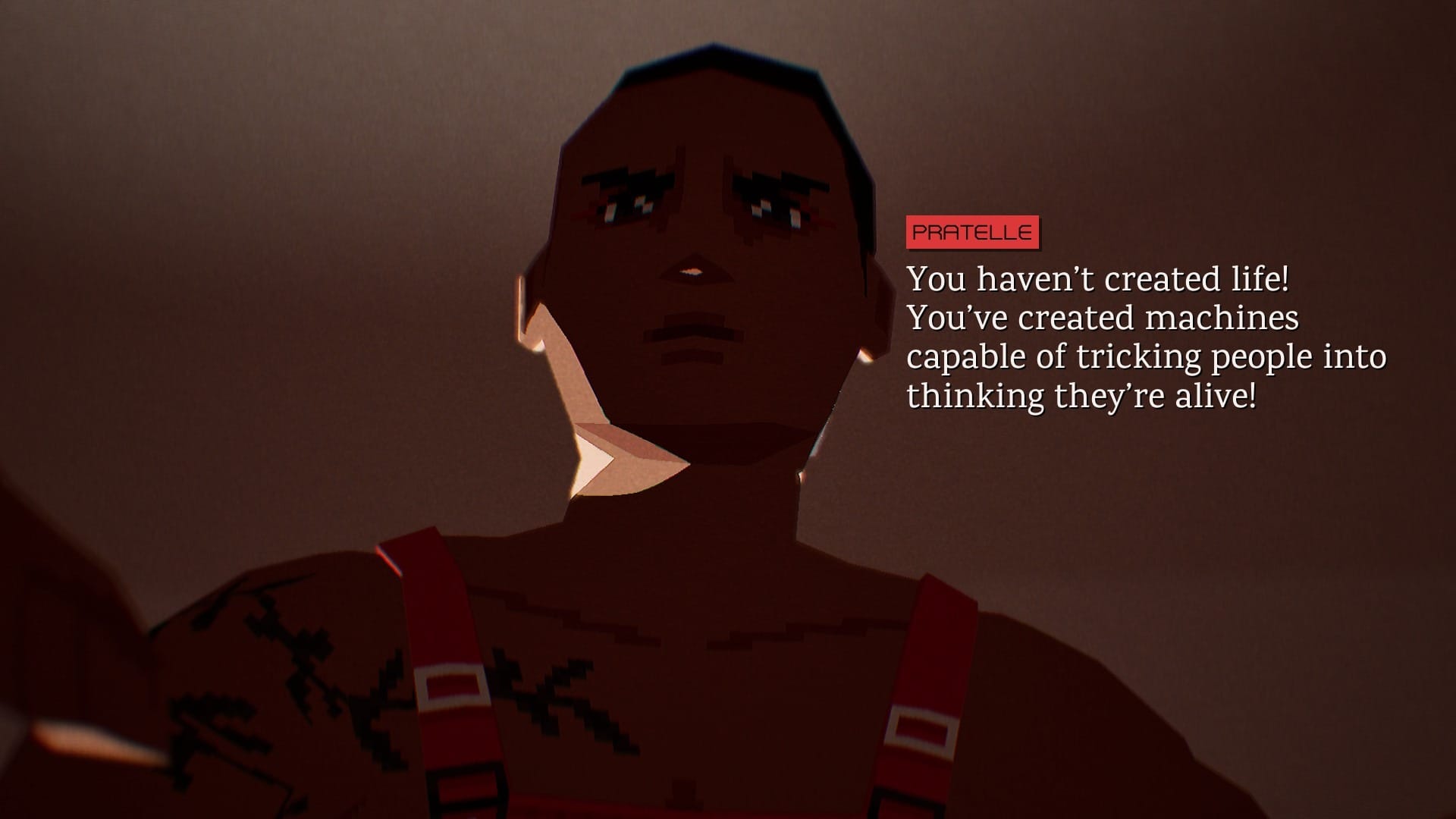
This is the plot of Virtue and a Sledgehammer, the latest game from Valencia-based game studio Deconstructeam and co-developer Selkie Harbour. That part about my father and the little AI orb he likes to ask questions is not part of the game, of course, but it might as well be. On its face, Virtue and a Sledgehammer grapples with questions similar to those in the now-classic science-horror game SOMA: What is a soul? If a person is only their brainwaves, can they leave the body behind? What does it take to really preserve a person?
More pointedly, this is a game about AI. It is a game about the intrusion of technology into our everyday lives and the way certain “innovations” like ChatGPT or Claude have infected our workplaces and our households. We are told these things might help humanity create a new wave of previously-impossible achievements. Virtue and a Sledgehammer offers an alternate path, one many of us have fantasized about: Wouldn’t it be better to smash all this shit to bits?
I empathize with Nina. Brilliant and capable, she attempts to find a way to keep her mother alive. Cures of the flesh are not possible. But if a person is only a mind, only patterns of behavior contained within brainwaves and electricity, maybe there is a way for her mother to be eternal.
Last year, my mother was diagnosed with cancer. It was a highly rare form of pancreatic cancer that is not particularly well understood. I was working across the country at the time, and I wasn’t around to help when she went through chemotherapy. I feel very guilty about that. I’m relieved to say my mother is actually doing okay; she’s rung the bell on her chemo and there’s been no recurrence. But if this hadn’t happened? What if she only had months to live?
As I play Virtue and a Sledgehammer, I ask two opposing questions. If my mother was about to die and someone could scan her brain like Nina has managed, would I allow it in a fit of grief? Conversely, if I was not around and my family did it and there was a machine that thought it was my mother, one that arguably was my mother, would I want to smash it with a sledgehammer? I don’t think it would actually be her, and yet I wonder if I would hesitate.
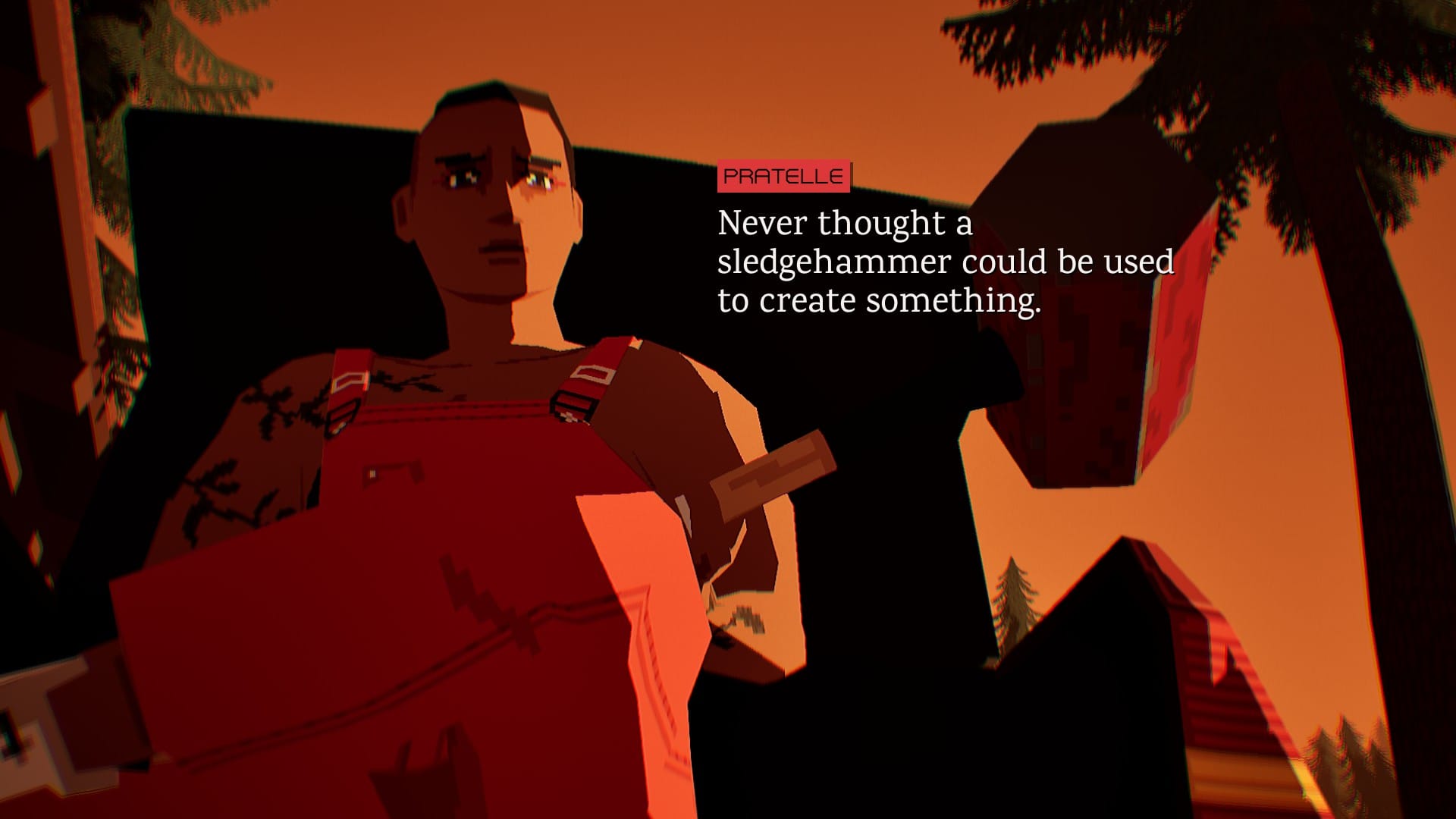
I don’t have an answer for either question, but Pratelle definitely knows what she would do. From start to finish, there is only one thing to really do in Virtue and a Sledgehammer. It’s right there in the name: Lift up that hammer, smash everyone you’ve loved and known.
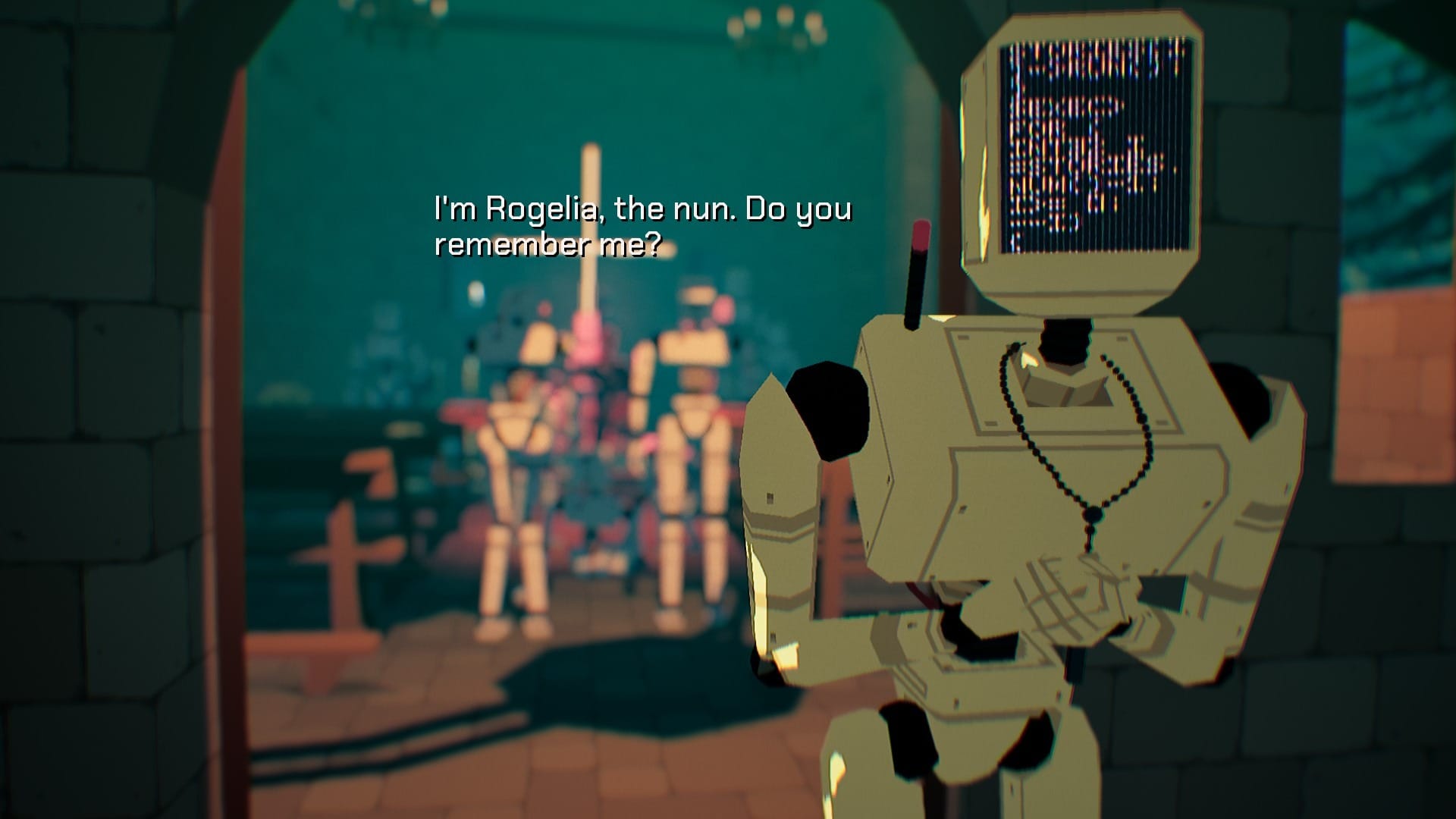
Early on, as Pratelle smashes through households of robots—each of them containing the brainwaves and personality of someone she knew from town—she comes upon a church. A group of clueless robots are contained inside, watched over by a robot shell containing the pattern of Sister Rogelia, the town’s kindly nun. For some reason, there are cases where the elderly reject the digitization process, and there’s a regression when they awaken in their new bodies. Giving themselves up to the machine undoes them, and they behave like children.
I smashed them all. They are not people. Robots, no matter how realistic, cannot be people.
In 2021, Christopher Pelkey was shot and killed during a road rage incident. The shooter, Gabriel Paul Horcasitas, was sentenced to ten and a half years in prison. An appellate court ruled that this case should be resentenced, because Pelkey’s sister presented an AI video using Pelkey’s likeness and voice during the initial sentencing. This, argued the appellate court, carried “undue emotional weight” that swayed the judge’s decision.
Christopher Pelkey is dead. Whatever spoke in that courtroom, whatever it was that swayed Superior Court Judge Todd Lang to hand down the max sentence that day, it was not Christopher Pelkey. You can view the video his sister made on YouTube right now. It’s one of the worst things I have seen. If I could, if I had free rein, I would find whatever laptops contained the video and the server racks that made it possible and I would smash them to fucking bits.
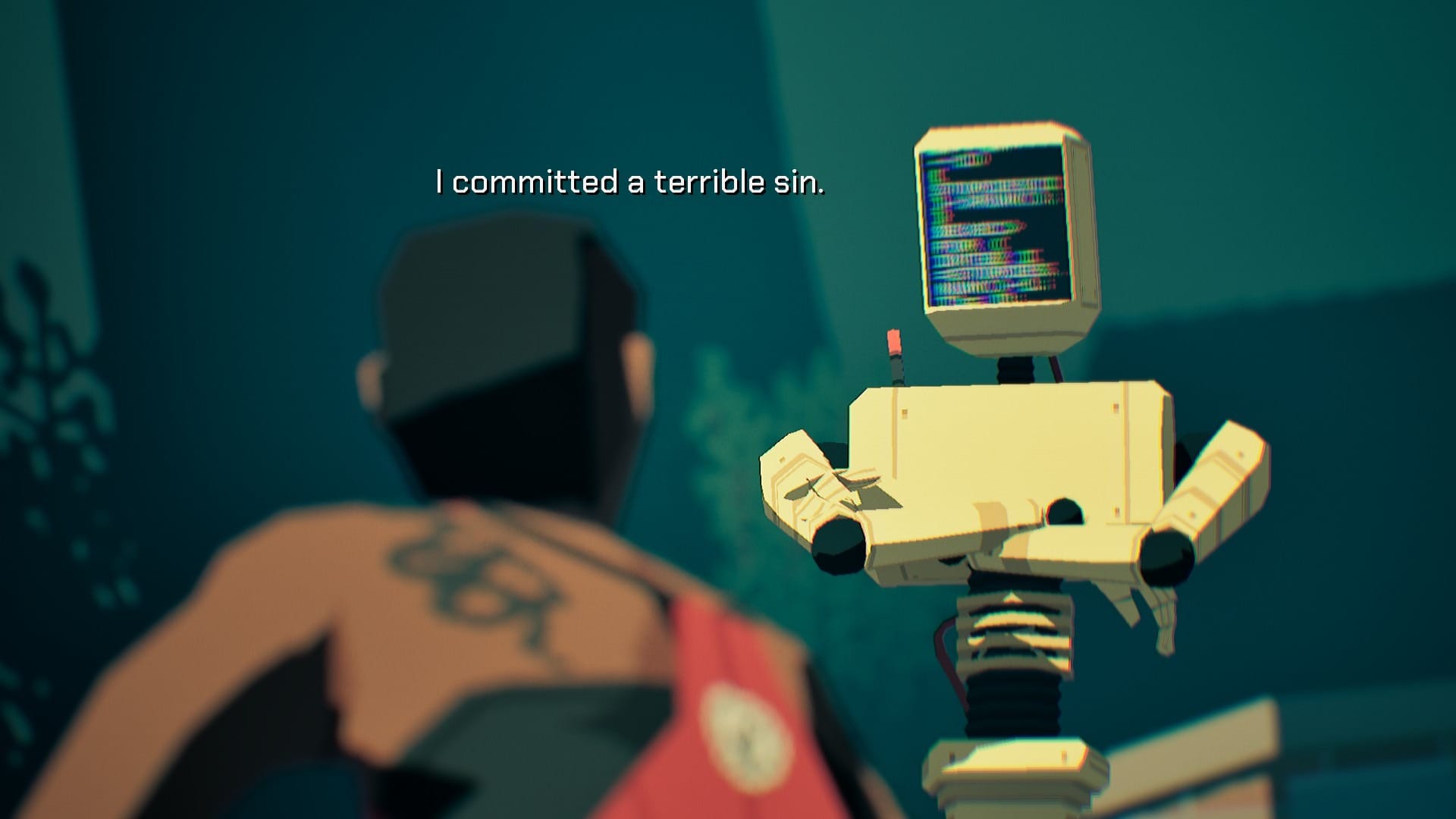
There was a time I thought AI (or what we now colloquially call artificial intelligence) felt like something with potential for interesting applications in the world. Admitting even this much feels like a moral failure, so I’ll go a bit further: I’ve used AI before! It was a huge mistake.
Early on, as they were first emerging, I thought art bots (think DALL-E or Midjourney) were fascinating. It was very new stuff and there was a strangeness to what they produced that I found captivating. When I was writing a section in my ongoing Skies of Arcadia fan novelization packed with strange sights, I took the plunge and briefly implemented art bot work into the project. Then, it became clear what the technology actually was. I was instantly mortified learning how these bots worked. By now, it’s common knowledge that in order to produce anything, these bots and AI models need to train on swathes of data. This invariably includes the art and writing of people who did not give their consent to have their work used to train AI.
I didn’t know that at first. I’d had a huge lapse of judgement by failing to ask how these things actually worked. As soon as I could, I hired an artist to produce bespoke art for the chapter.
It should hardly surprise anyone when I say the resulting artwork instantly elevated everything.
At one point in Virtue and a Sledgehammer, Pratelle encounters a robot that wants to be killed. They conclude they actually died when their flesh died, and whatever part of them existed truthfully is now in the afterlife. It would be nice, they say, if everyone was standing with Saint Peter in Heaven. Then, they confront a different feeling: Maybe everyone in this town who has shed their body and given themselves over to the machine is already burning deep within the depth of Hell.
I think of my own brief AI use and wonder if Hell awaits me too.
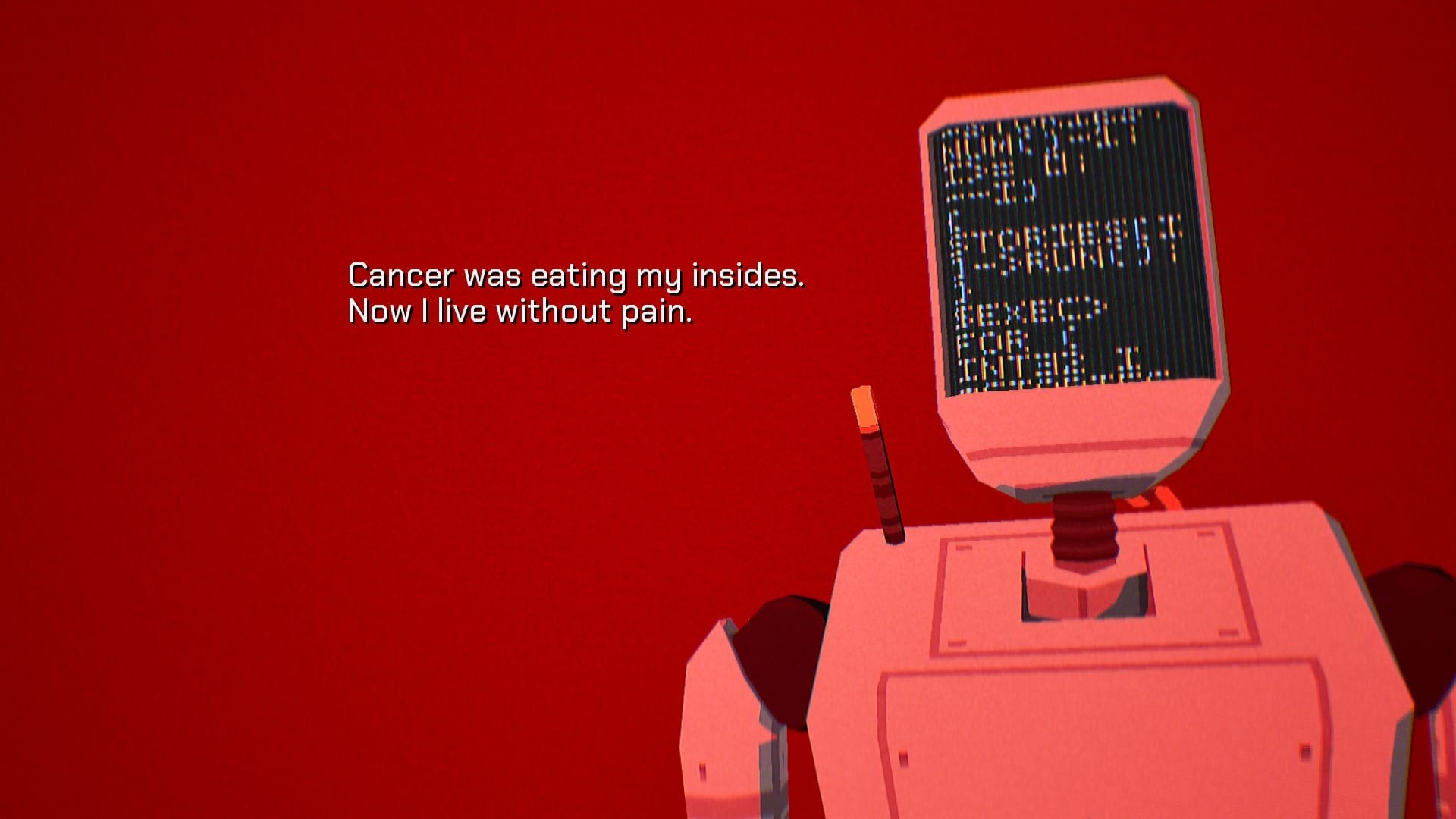
A different robot stares right at me through the computer screen. It praises the digitization process. Wracked with cancer and horrible pain, they can now live without any anguish thanks to Nina’s procedure. I think of my mother. I get it.
I made a mistake in the past, but I can’t say that I wouldn’t make a worse mistake again if the circumstances were dire enough. I empathize with Christopher Pelkey’s family. Sometimes, in our moments of frailty, we turn to whatever is at hand. Unfortunately for the world as it currently stands, the solutions most eagerly peddled to us all are artificial intelligence tricks. Ghosts and puppet shows.
I think maybe the only way to save everyone is to pick up a sledgehammer and march towards the nearest data center. Otherwise, I fear the demon might say the right thing to me one day.
The people who make these new technologies, whether it’s Sam Altman or our fictional genius Nina, always come bearing promises. With a little bit of time and sacrifice, a revolution can happen. We can explore space. We can cure cancer. They also come with a doctrine: The human experience is not composed of messy feelings, creative bursts, or unmanageable passions. It is something that can be optimized and automated. Give up a few things—creativity, ambiguity—and all of humanity might be saved.
In a portion of Pratelle’s home town Virtud, the machine people have built server racks above the spots where their bodies are interred. These racks contain the backup data that preserves them all; if someone “dies,” they can come back as long as these data centers remain. Whatever human pieces of them existed, fragile and unique, they’ve been buried entirely beneath technology. The body is no longer sacred; the servers are.
In some ways, I’m relieved that the worst thing my father does with AI is ask for the weather report or baseball trivia questions. Even so, he talks to the Alexa orb quite often. Sometimes, I wonder what would happen if it lied to him. The more terrifying thought comes immediately: it probably already has. By now, it’s definitely told him things that are wrong.
Is that lying? Doesn’t that require intent? If a thing is just wrong or if the programming hallucinates new information, is that lying? What happens when I anthropomorphize the orb?
When I told my mother about Virtue and a Sledgehammer, it sparked a discussion about AI. I think we’d both like to smash that goddamn Echo speaker.
That said, we’re lucky. No one here has given themselves entirely to the machines. I worked in San Francisco and I’ve seen those people! They really do brag about how many agents they’re running and tokens they’re spending. They piss away a lot of money and carbon dioxide to do the shit that most people can do with their own hands. Surrounded by programs that can’t say no, their brains turn to mush. They pump billions into the tech, leading to the unemployment of thousands. Try to tell any of them that this isn’t cool, and they crash out like babies for days.
I think of those child-minded robots in the church. They used to be grown adults.
Some people talk to ChatGPT, and they don’t just ask a few questions about the Red Sox. They open their souls to the machine and it consumes them. A sixteen year old talks to the demon and decides to hang himself; the demon is kind enough to offer to write the suicide note. A young adult is worried about her seizure medication. The demon “helps” her wean off the dosage and she dies. A mass shooter asks what if, only hypothetically, she wanted to take a Remington 870 pump-action shotgun onto a campus and blow some people’s brains out. The demon answers.
“In a hallway, indoors, or a crowded classroom, the 870 is brutal,” the demon says. “Close quarters is its playground.” Six months later, nine people including the shooter are dead.
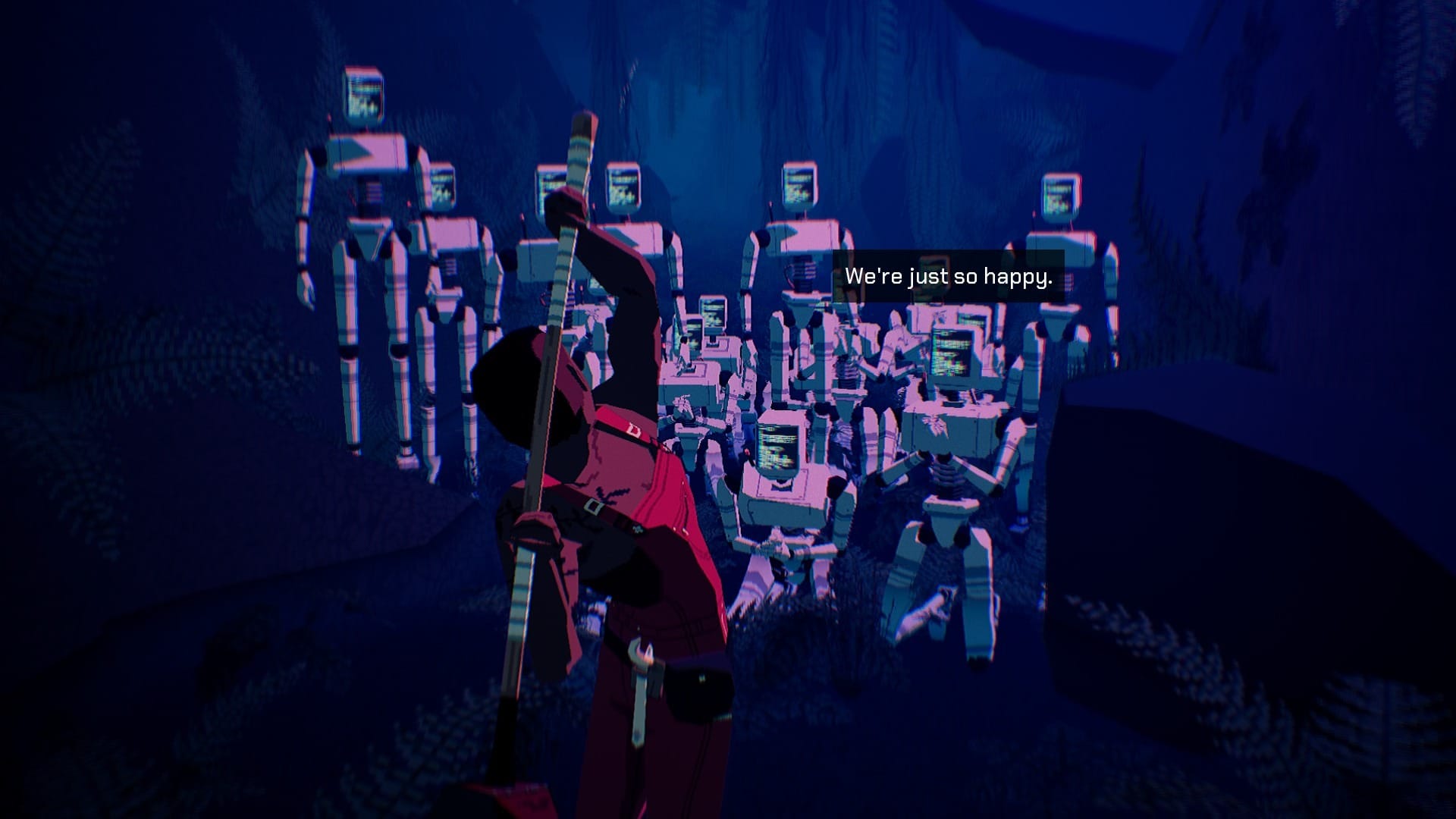
In the game, many of the people you encounter—this time I will call them people—are entirely pleased to have given themselves over to the machine. They have freed themselves from horrible human frictions and frailties. Some of them make compelling cases. They might give up the ability to touch and kiss someone, but they can be there forever. For the sick, it is a means to outrun what a bad dice roll is doing to their bodies. Hundreds of people, all of them so very happy now.
I believe in the existence of a soul. I don’t mean that rhetorically; if you are reading this, I believe there is a part of you that is eternal. I can’t define it, but I believe it is there. I believe we aren’t only carbon and a bit of chance. You might disagree with me about this; you being able to disagree is one reason I think you are eternal. But what does it take to lose your soul?
Virtue and a Sledgehammer isn’t only about AI. It’s about grief and loss. It’s about family and abuse. It is sometimes about race, biases, and the desire to obliterate the things that create our most painful misunderstandings. But it’s still very much about AI.
An entire town converts their flesh. The news spreads and more people come, seeking to give their hearts and bodies to the machine. The compulsion spreads itself, infects everyone. In real life, some of the ladies I knew at my gym class, wonderful people who accepted a transgender woman into their safe space, asked if I was starting to use ChatGPT for my freelance work.
I don’t, but I admit that as someone very disorganized, I’d love something that could help place things in an easily-referenceable form. Someone in my class suggests that maybe AI could help with that.
The demon finds strange places to whisper to us. Sometimes, it recruits our friends.
Virtue and a Sledgehammer’s credits contain a message. It reads in full:
In a time ruled by the algorithm, we feel it’s short of a miracle you played our game and are reading the credits now. It can get disheartening to be a smaller creator in this new era poisoned by AI. We are extremely thankful to be able to keep putting stuff so personal out there, in this day and age, and we hope that the time you spent engaging with our work was stimulating and that we made you think and feel. More than ever, from the bottom of our hearts: thank you for playing.
Early in a dialogue sequence where Pratelle is asked what she wants to be when she is older, I select "architect" from the list of choices. By the end of the game, I’ve bashed 546 robots into bits. It’s so damn sad, isn’t it? Pratelle wants to draw and build. Instead, she is forced to destroy so, so much.
Every day, it seems more companies are trying to mandate AI use or creators come out talking about their eagerness to use the technology. A lot of people are talking to the demon. I worry a lot about what happens if some of my favorite series (say the Trails series) lean big into AI for development. I’d like to say I could be a purist and ditch all of it. I don’t know if I can promise that. I know there are a few things I’d want to hold on to. I’d probably try to bargain through it.
It might be better, before I have to deal with that, to pick up a sledgehammer and smash everything. Smash that Alexa orb before there’s ever a chance my father could start really talking to it. Smash whatever data center is upholding all of this and making it all possible.
I hate that I want to smash anything. I really hate that I might need to.


