After over a decade of building to this moment, Warframe is finally headed to Tau, the solar system where its vast, endearingly strange narrative began. Tau isn’t just a quest or an area to roam; it is, like the Origin System that comprises much of Warframe to date, a series of planets that players will do missions across. Today at TennoCon in London, Ontario, Digital Extremes debuted the first region of that interconnected pocket of space, Fornax. It’s a truly momentous occasion—perhaps the game’s most ambitious addition yet.
But at the end of a TennoCon preview event earlier this week, creative director Rebb Ford let some relatable hesitation show through: "It's obviously a huge, scary time for us,” she said, “because the games industry is super stable right now, and it's awesome to show something that may or may not impact the future of the company."
Warframe, which began as a humble co-op space ninja shooter and evolved into a sprawling sci-fi epic with too many gameplay systems to count and one of the most dedicated communities in video games, has proven remarkably resilient in an era where live-service games drop like flies. Even Destiny 2—to which Warframe is often (if erroneously) compared—met what basically amounted to its untimely end earlier this year.
"Games as a service, it's a scary world. We've been doing it for 13 years, and we have no secret formula. We have no cheat code."
And of course, Microsoft’s latest round of layoffs remains all too fresh on everyone’s minds as hardware prices skyrocket and Sony adapts by killing physical discs. Change is afoot, with traditional triple-A games looking more and more like a potential casualty. No one is safe and nothing is sacred. Not even a seemingly unshakable pillar like Warframe.
“It’s fucking awful, what’s happening in this industry,” community director Megan Everett told Aftermath during a recent interview. “I feel very lucky to be working on this game and to have this dev team and the community that we’ve built, because I’m no stranger to the fact that it could all end tomorrow. Games as a service, it's a scary world. We've been doing it for 13 years, and we have no secret formula. We have no cheat code. We have just stayed in our little Canadian homebrew lane, put our heads down, and really tried to make this game what we want and what our community wants it to be.”
Digital Extremes
For developers at Digital Extremes, that has at various points meant eschewing trends and sticking to their many, many guns.
"I think back to when PUBG and Fortnite were popping off,” said Everett, “and everyone was making a battle royale game, and I remember internally we all looked at each other like 'We're not doing that.’"
“We’re not good at that!” Ford added.
"That's not what our expertise is, and we know where our strengths are,” Everett continued. “We know where we can stray a little bit and get wacky and weird, and so we do that. But it would be a disservice if we went so crazy that [we lost sight of Warframe's identity]. Like, we've tried the PvP thing; we've tried Conclave. It didn't work, and we know that's not what we're about, so we shifted to focusing on the story and the narrative. I think that has been a good thing for us in that we know where our strengths are."
The TennoCon Tau demo leaned into those narrative proclivities, with cinematic flourishes aplenty. An intro to the new solar system that—if you’re a longtime Warframe player—was frankly chill-inducing gave way to a perspective switch to an all-new Warfame, Brysko, a creation of Albrecht Entrati, the Void-harnessing scientist who set much of Warframe’s story into motion. Brysko’s whole thing is that he’s basically an old-timey noir detective in Warframe form. Lacking a mouth to call his own, he monologues about everything that happens to him in his head—which, of course, the player can hear, even though no one else can.
"The unknowable inner monologue of this character felt very extreme, but in my heart and soul, I feel like it works. And if it works for at least just me, then you know what? Happy early Christmas to me."
But why a noir detective to introduce a new solar system? Because there are mysteries afoot in both the cosmic and more immediate senses. And also because Ford really liked Law And Order as a kid (Brysko = Briscoe, by the way) and Blade Runner as an adult.
"I wanted [those inspirations] in Warframe,” said Ford. “It's kind of that juvenile, but I wanted Warframe to explore gangs, addiction, [and] lifespan of constructs. All of these things are super relevant to Sentients, who as a construct were created by man—no different than androids. So this was essential for the tone of Tau's first reveal."
The idea of a monologuing Warframe followed shortly after.
"Credit to Adrian, our lead writer, because we were trying to think of how to go noir and tell the world of Tau from a perspective that needs to feel new, and he really put his heart out on his sleeve and was like 'I really think we could get an inner monologue working for this,”' said Ford. “We proved it within a day. We were like 'That's it, that has to be it.' Because nothing else would work in the world with the pieces we put on the chessboard. It's too bleak, it's too dark, it's too weird, and the unknowable inner monologue of this character felt very extreme, but in my heart and soul, I feel like it works. And if it works for at least just me, then you know what? Happy early Christmas to me."
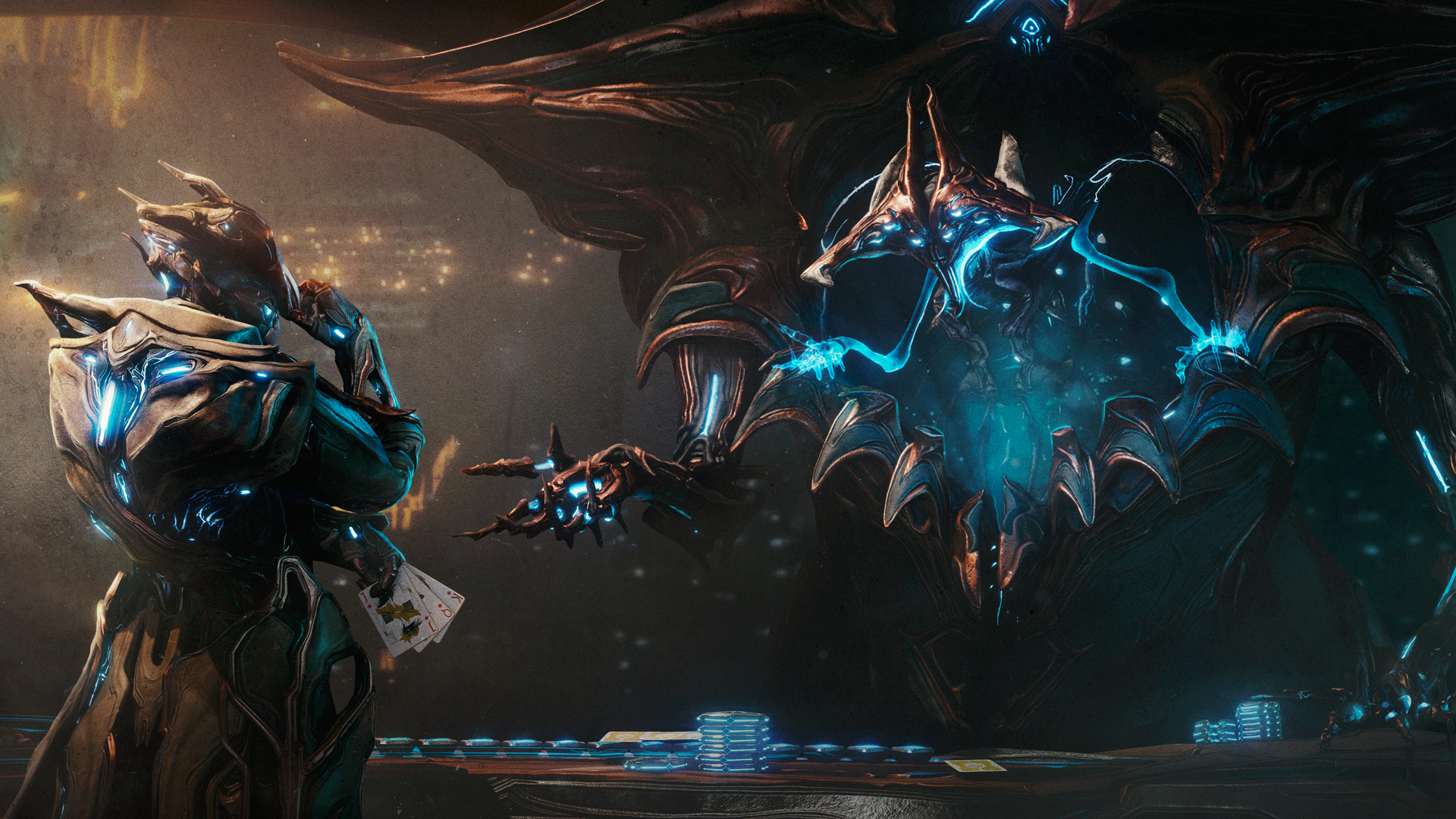
What ensued in the TennoCon demo was a stroll through a grimy, goopy noir slum—if H.R. Giger was in the business of imagining such places. Sentients, addicted to a drug called Bloom, writhed and in some cases attacked as Brysko waxed nihilistic about their dead-end lives in the universe’s rock bottom. “All dreaming or dead,” he said of the Sentients at one point. “Until the rains come.” But in his cheery estimation, things could always be worse: “At least I’m not out on one of the old battlefields,” he growled mid-combat, voiced by the inimitable Matt Mercer, who made the hammy dialogue a lot more convincing. “Warframes and Sentients lurching back to life, fighting old wars over and over again. Mindless. Heartless. Dead.”
It’s a far cry from some of Warframe’s more lighthearted endeavors, like the 1999 expansion that featured a dating sim and an in-universe boy band or even last year’s Old Peace quest, which—in setting up the journey to Tau—still contained a few moments of levity. Fornax won’t be all doom and gloom, either; the Tau update will also introduce an entire Sentient card game, Portau, to Warframe.
"That's the eternal struggle of Digital Extremes no matter what point we are at in history: You either set your sights too small and you disappoint, or you go too far in the other direction and you disappoint, because it was too ambitious and there were too many moving parts."
But Warframe’s great strength has always been its ability to bullet jump between tones and accommodate all manner of inspirations. It’s part of what makes the game so special to those who regularly play it but also gives it an imposing air to those who don’t. There is just so much, and there’s about to be a whole lot more.
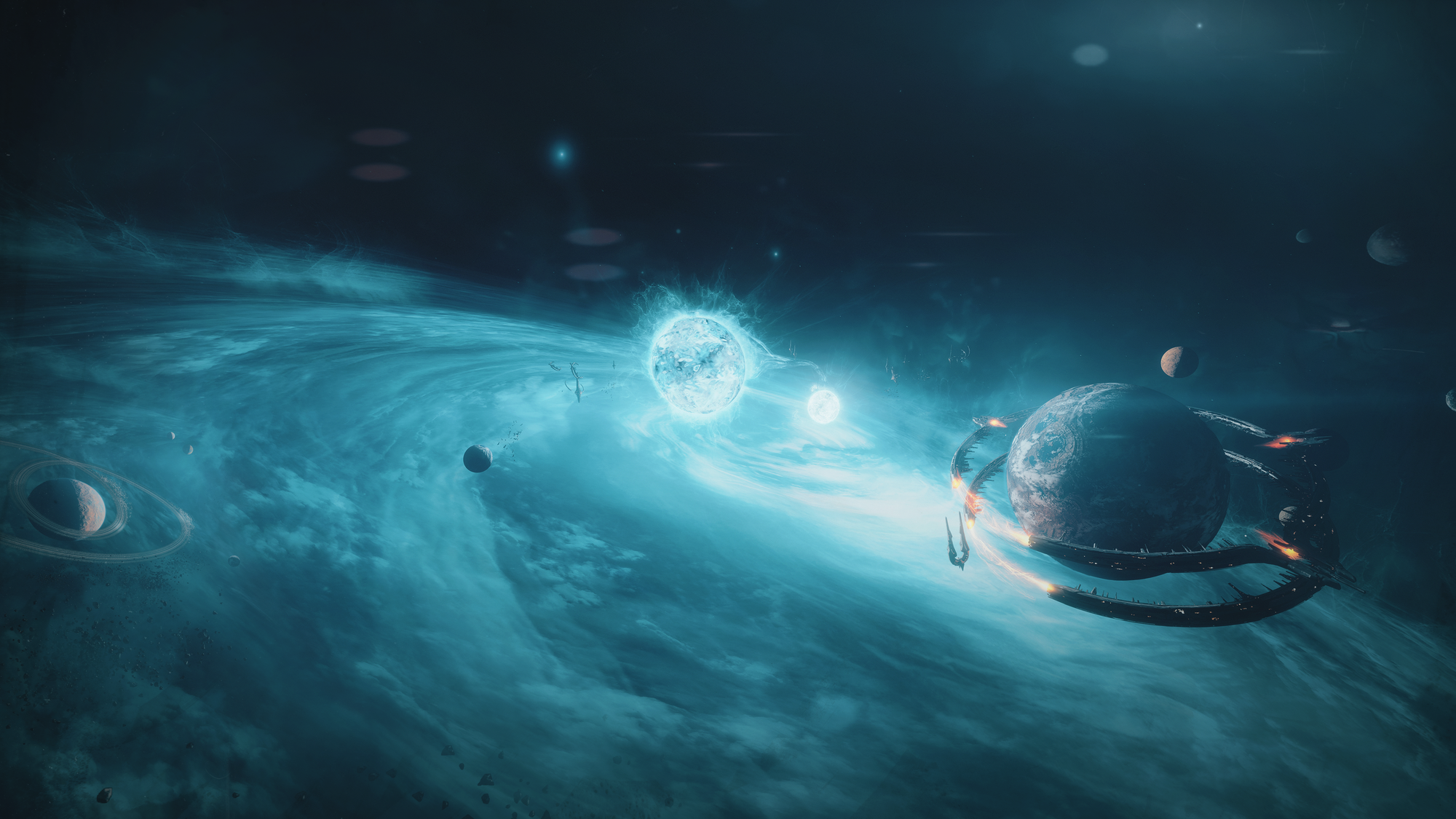
"The whole sequence of flying through Tau—that, I hope, is going to be a very big moment for our players,” said Everett. “Finally seeing Tau and understanding that it's not just another planet; it's a whole new solar system. That's touched upon in this demo and is something we'll get into more as we do future in-depth streams and stuff: making it very clear that this isn't just one little planet that you get to go to; it's a whole other solar system. ... Really trying to have players understand how big this is actually going to be."
After 13 years of existence, Warframe constantly has to cater to the demands of new and old players alike. For example, a recent update to Railjacks, giant ships you can fly with a crew of NPCs or other players, put those who’ve maxed theirs out at odds with those who’ve barely touched the system. It’s a constant balancing act, as is the ceaseless demand for new content that comes part and parcel with a live-service game. Case in point: the recent Jade Shadows quest, which was met by some players with concerns that Digital Extremes had rushed its release a bit.
"That's the eternal struggle of Digital Extremes no matter what point we are at in history: You either set your sights too small and you disappoint, or you go too far in the other direction and you disappoint, because it was too ambitious and there were too many moving parts,” said Ford. “In this case, there's no bad news for me; it's just better planning and knowing what we know about developing out characters like the Protoframes. We got the harder non-Tau things out of the way, and the way we've structured the rest of the year has been in response to the past three weeks in terms of 'How do we make sure Tau is undistracted? How much room can we give ourselves to have a more comfortable landing rather than undergo the turbulence that no one ever wants to feel?'"
With Tau, set to release near the end of the year, Ford and Everett have no plans to let themselves get pulled in multiple directions. This update is not for tourists.
"You've gotta earn it,” said Ford. “It's not gonna be an instant unlock. You need to get through the means of story to access Tau. That's the current philosophy."
In some cases—like with last year’s Old Peace quest—Digital Extremes has made new content more immediately accessible to new players. But in so doing, the Warframe team has found mixed success, and Tau is different.
"I would say that's a crisis-level decision every update, because anyone with an opinion is like 'New players, new players' and then you're like 'Well, what do we do?'" said Ford.
"You weigh that: Would you rather have a player play it but be confused, or ask them to have that commitment and not be confused,” said Everett. “That's something that we toil over all the time. But our players have waited 13 years to go to Tau. It would be a little wrong to be like 'It's at the beginning now!' ... You make a player really earn that Tau experience, and I think it's way more impactful if you understand the Lotus lines that are being fed to you and see all those planets you've played through."
Ultimately, for now, in the absence of data that suggests any particular method is unilaterally better than another, Digital Extremes has settled on a back-to-the-basics approach: Make something good, and players will show up.
"We've tried everything at this point: Give [new content] to new players right away, give them an instant unlock, and nothing has proven better than actually making a good game that gets people in,” said Ford. “There's no cheat sheet for engagement. It's the biggest curse in running a long game—putting content at the end of the railroad. But if you can make a game that's good enough to play, you can make a game that's good enough to continue."
"It's the biggest curse in running a long game—putting content at the end of the railroad."
Can that approach keep Warframe going indefinitely, though? Ford is aware that we’re seeing a generational schism in terms of how games are made and what a video game even is to people. Warframe might be a free-to-play online game, but its roots are intertwined deeply with cinematic triple-A traditions. As time and changing tastes—alongside greed and mismanagement—wash away what we currently call the video game industry, how will Warframe stay afloat?
In some ways, especially business-model wise, Warframe is already ahead of the curve, but Ford believes it’s crucial to stay on top of an ever-shifting landscape.
"I'm not afraid of TikTok and Fortnite,” she said. “I engage with those all the time, and I enjoy that type of game. I think you just need to be able to see where the marketplace is shifting, right? This is the CD-to-MP3 era for a lot of video games, which is a nightmare on its own, but even if you look at things like games only being digital in the future, we're already that. What does that mean for everything we hold dear about being physical media collectors? ... But Warframe isn't physical, and it's given me everything I have in life. So how do you reconcile [all of that]?"
During TennoCon, Digital Extremes announced a Warframe collaboration with Fortnite, which has been met with mixed reactions from fans.
@rebbford WAKEY up
♬ original sound - Rebbford
That doesn’t mean Ford is cheering for the end of the more traditional video game industry, though.
"The mobile games and the gacha games and the people who make games the fastest and most accessible to the next generation of gamers are the ones who are not worried right now,” she said. “That is a terrifying reality, because the $70-$80 game title—where are those and what are those and who's playing them? It's wild."
"If the Steam charts go down, as a YouTuber would like to point out, we're still going to be here."
Nor does it mean that Warframe is suddenly going to get Roblox-ified, though Ford doesn’t hate everything that game—which is actually more of a platform—is doing.
"I actually like user-generated content a lot. I think we kind of have it with Dojos and clan obstacle courses, but I would like to do more of that, to be honest,” she said, noting with a grin that somebody created a Warframe ripoff in Roblox, which she has played and enjoyed. “So who knows. But no, [we probably won't make a Roblox-style user-generated content platform].”
For now, Ford and Everett are sticking to the path they, themselves, helped map out.
“We've had our schedule of what we want to do planned years in advance,” said Everett. “We just maintain the course and really try to put our community first and make sure that they know we're here, we're behind them, and we'll keep making this game. If the Steam charts go down, as a YouTuber would like to point out, we're still going to be here, and we're still going to be trying. Hopefully [players] want to try with us."
Recommended
 Nathan Grayson