

At their core, city builders represent an easy to understand fantasy: What if you were given ultimate power to control the place you and all of your loved ones live in? Can you do a better job than the people currently running your city? The best games in the genre challenge that fantasy further, asking tough questions about trade offs, priorities, the natural world, and more.
Like in urban planning, the tension between chaos, control, and the city is very much present in city builders. These games are also far from the only genre of gaming to include cities; just in recent decades, games like Control, Prototype and Infamous have all asked us to rethink our relationship with architecture and the city system. But city builders are, for obvious reasons, the genre of games that most concerns itself with ideas of how cities are run. While real world urban planning and city building has evolved to accept the role of friction and conflict in city life, very few city builders view these ideas as positives.
The conflict and friction inherent to city life can often be seen as intimidating or even downright terrifying for non-city dwellers. But for those of us who have lived in these cities for all of our lives, they’re the point. There’s potential in cities because they force us to encounter other ways of life, differences of language, cuisine, fashion, and more. This is supported by theory and research as well. In his foundational (get it) book The Uses of Disorder, renowned city planner and urbanist Richard Sennet wrote that “the jungle of the city, its vastness and loneliness, has a positive human value. Indeed, I think certain kinds of disorder need to be increased in city life.” According to Sennet, disorder, chaos, and friction in city life are net positives; cities encourage freedom because they reduce control, encouraging people to encounter different ways of life and accept others.
Sennet comes from a major school in urban planning, one which contradicted more traditional approaches and sought to foster friction and emergent systems instead of controlling and repressing them. This school of thought rose to prominence in the 1960s. One of its most famous and popular examples is The Death and Life of Great American Cities by Jane Jacobs, published in 1961. To summarize what is a very long (and interesting) work, Jacobs argued for organized complexity: Cities function like living ecosystems rather than simple machines, meaning planners must study how people actually use spaces from the ground up and build cities around this complexity and even for this complexity.
Like living ecosystems, cities are healthier when borders and limits are fluid, two-way, and loosely defined, allowing people to be challenged and to explore. This is in stark contrast to the earlier, modernist approaches to urban planning that view a city as an unruly arrangement of objects that require top-down planning and control. In that view, citizen movement must be funneled into easy to see and close routes, zoning must limit interaction between the classes, and “undesirables” must be relegated to city boundaries (the most famous example of this is Baron Haussmann’s devastating and brutal reforms of Paris and its banlieues, which influence that harsh and beautiful city to this day).
Both approaches to urban design can be seen in city builders, but the earlier, modernist approach is far more dominant. Perhaps the best example of how city builders adopt this top-down approach into their gameplay is the most famous city builder of all time: Sim City. As Noah Caldwell-Gervais shows, Sim City belonged to an early genre of computer games that tried to appeal to the people who already owned personal computers: businessmen. These were people for whom balancing ledgers of numbers was fun (I say snidely while hiding my Victoria 3 save files). Thus, the game was focused on management, on the shepherding of resources for growth. This, naturally, creates a city whose entire purpose is to grow, to generate various sources of income, and do so well. In short, the goal of Sim City is to create a well ordered city, a city which runs smoothly and efficiently.
Chaos has nothing to do with such a city and certainly has no positive role to play. This is why when later iterations of the game, which tried to have broader consumer appeal, introduced chaos in the form of natural and less natural disasters (like alien abductions), they did so as a sort of joke. Summoning tornadoes and aliens to destroy the cities I toiled over is one of my favorite memories from my early days of gaming, but it wasn’t anything serious. Chaos was external to the city: destructive, arbitrary, cruel, and funny.
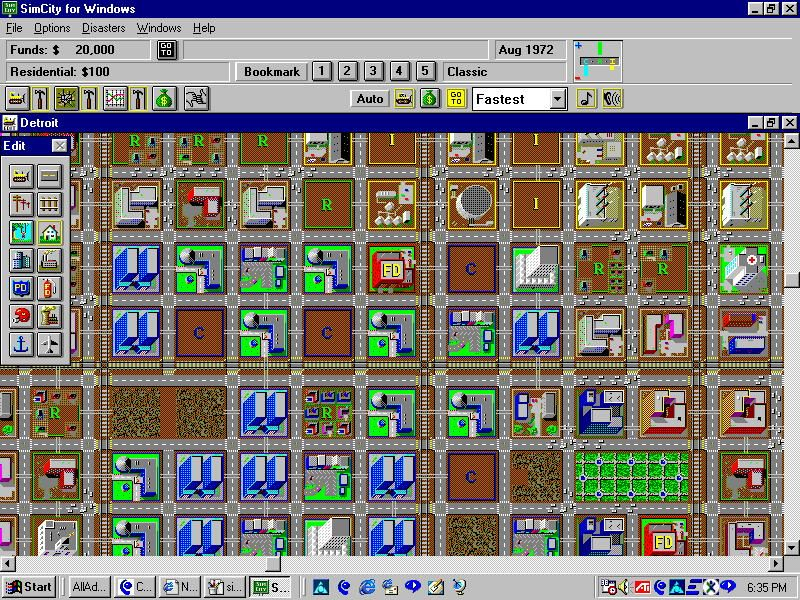
In many ways, city builders mostly function with these same modernist and rather outdated assumptions at their core today. The basic gameplay goal of the genre is still to create an ordered, functioning, efficient city, where chaos, friction, and happenstance are minimized. Some of the most successful city builders currently on Steam–Cities: Skylines (both titles), Planet Zoo, The Farthest Frontier, Timberborn, and Factorio–all require the player to strive to build ordered, efficient, and well-functioning cities or production systems. Some of them allow for chaos and disorder; Cities: Skylines, in its attempt to model “real” cities, definitely allows you to build sprawling, chaotic cities. But this is not encouraged: Cities such as that are allowed but are penalized by the game using its traffic, abandonment, and service reach systems. Cities which the game deems “inefficient” will end up with stranded garbage truck drivers and whole parts of the city abandoned.
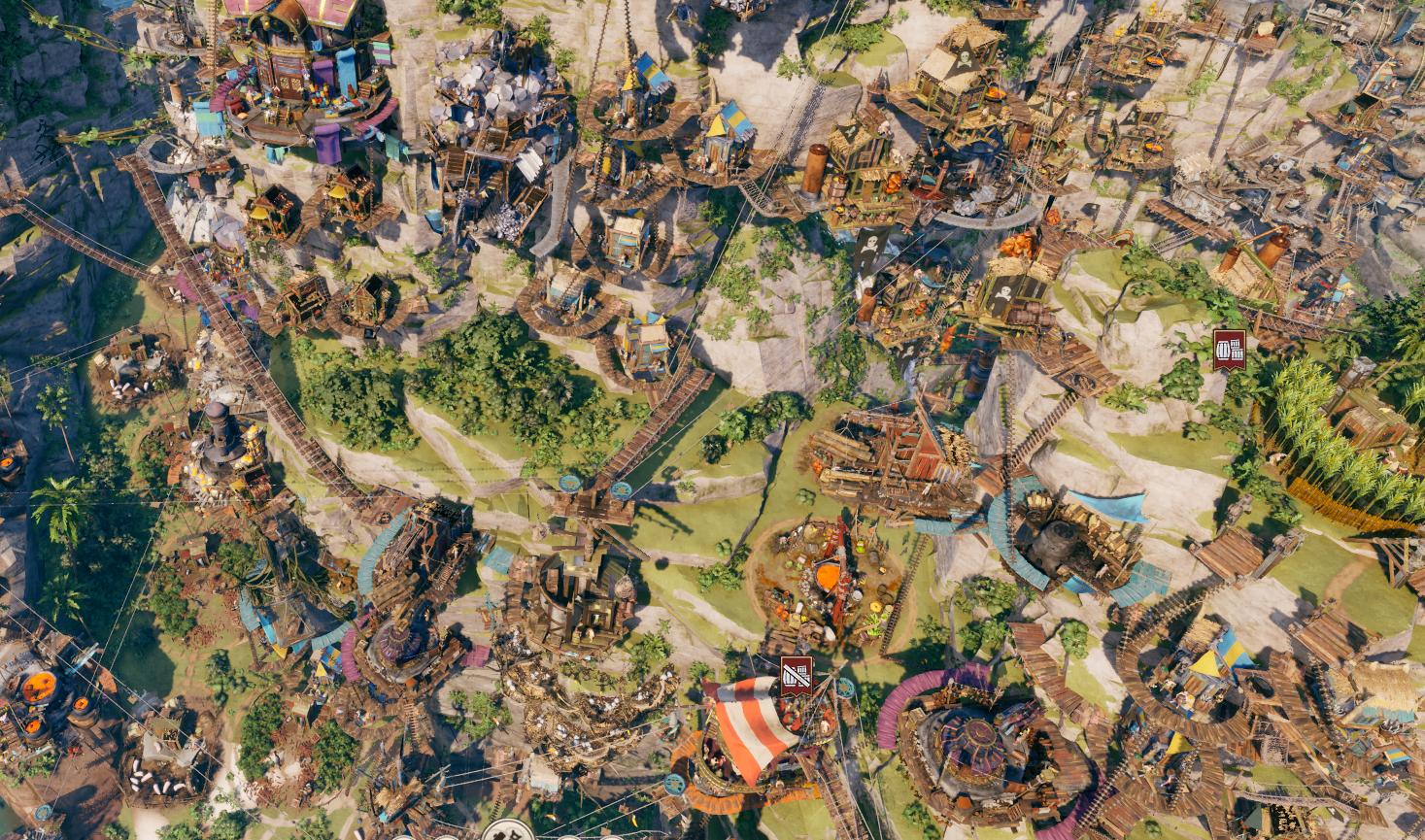
Two counter examples will serve to describe what city builders look like when they incorporate the other, more fluid school of thought in urban planning: Corsair Cove (2026) and Foundation (2025). In Corsair Cove, the player leads a crew of grizzled pirates as they build a secret cove away from the prying eyes of the Spanish navy. Half of the game is centered around building said cove, with production chains becoming ever more complex as you want to build more and more elaborate and capable ships. The other half involves sending those ships out on more and more dangerous and lucrative quests. But here’s the secret sauce that makes Corsair Cove stand out: The game adds a vertical axis to its map. Because you are in a cove, land is scarce and so you must build up. To connect your buildings you must build a system of elevators, pulleys, foot bridges, and stairs, wrapping around haphazardly-placed foundries, galleys, housing, and factories. Of course the game intentionally gets in your way, dispersing resources in all three directions, forcing you to make compromises and build a truly convoluted and chaotic settlement.
While you are somewhat penalized for building structures far away from each other or for placing structures in a disorderly fashion, there is no choice but to do so. Plus, the game lets you remove those penalties pretty easily, by developing the game’s tech tree and adding better ropes, pulleys, and advanced elevators. Corsair Cove’s core assumption is that the end result of your building will be a mess; there is no other way to build the settlement. Even if you, for some ungodly reason, strove to build an organized and efficient cove, it would fall apart in your hands as you realized that oh crap, the turtles you need for your turtle soup (the resource which most beguiled me during my playthrough) are all the way over there and you need15 bridges just to get close to them.
Chaos is not some external force that happens to your settlement; it is an inherent part of how the city has to be constructed, and trying to fight it is pure delusion. And what’s more, it sort of works in the end. God knows how; by the time my playthrough of Corsair Cove ended, I was hard pressed to explain all of the production chains and how they worked. But they worked, even if I didn’t have a precise, incisive, and controlling diagram to show it.
Foundation is much more subtle. Centered around building a bustling medieval town, Foundation makes you relinquish control of a very basic mechanic in city builders: You do not get to put down roads. Roads in city builders are perhaps the most baffling attempt to enforce order on a city. I doubt that anyone reading this thinks that the roads leading to and from their city or the roads inside of their city make any sort of sense. Roads are one of the most organic, chaotic, and hard to control elements of cities, notoriously easy to bungle, painful and costly to rebuild, and stubbornly conforming to some demonic set of rules. And yet, most city builders begin with the player paving an ordered grid, dissecting a virginal piece of land into neat plots that can then be used for distinct and orderly production, connected by efficient transportation. When has any city been built that way? Never, says Foundation, and introduces a much more chaotic, and therefore pleasing and realistic alternative where people put down roads where they need them.
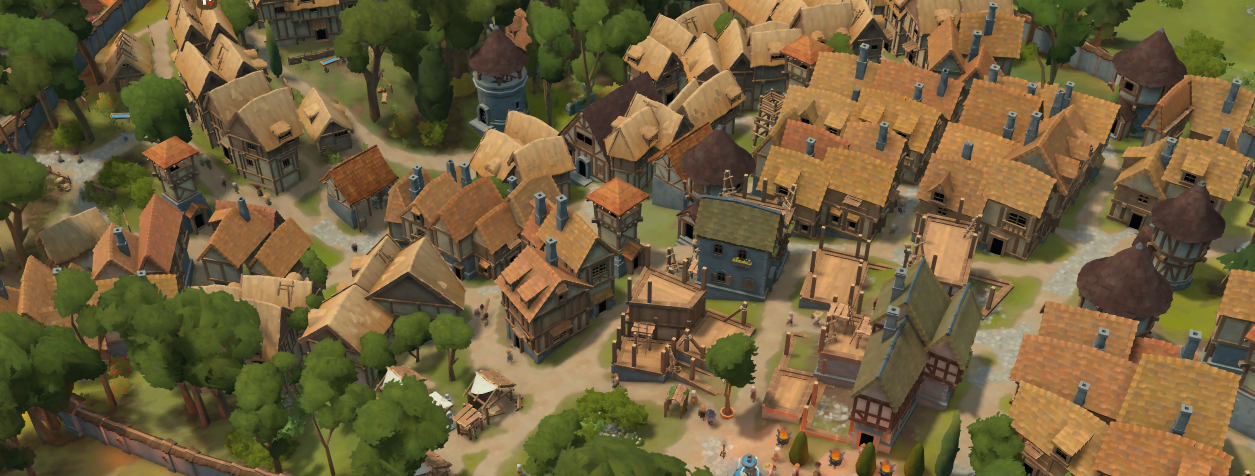
The result is something a lot less intense than Corsair Cove, which some might even call “cozy.” Foundation feels good to play because the city grows around your actions rather than from your actions, which resonates much better with how we experience the cities we actually live in.
Beyond creating better and more realistic images of how cities actually are, both games benefit from their inclusion of chaos on a gameplay level. They feel less frustrating than the old school games and their limited imagination, and even smoother: By letting friction in, by embracing it as something that is inevitable, they struggle less against it. Like the willow that bends before the storm, Foundation and Corsair Cove spend so much less energy than other city builders on planning, saving and loading, making mistakes, getting frustrated, and obscure systems. Instead, they invite the player to let loose and build freely, within well-defined confines but without limiting their hand too much. This resonates deeply with the player and feels right, making the games more fun to play.
After all, when was the last time anyone showed up to direct anything in your city? When have you ever laid eyes on a perfectly-behaving grid? And, on the flipside, how many times have you seen new paths or uses for public space spring forth from the needs of the people who live around you? This is the major failure of the modernist approach to urban planning: Real cities have just never behaved this way.
Chaos and friction are generative forces in how cities grow, live, and prosper. We can see it and feel it for ourselves, without reading any book. Fostering and enabling these energies in our real-life cities is hard enough, a multi-generational struggle against capital and the forces of “order” who would like to put the urban in neat, exploitable little boxes. We shouldn’t have to fight the same war in games. Instead, city builders should embrace their potential to create new future imaginaries, new visions for cities and let a little (or a lot) of chaos back into them.


