

Mixtape is an exploration of adolescent love and friendship, how that survives the transition into adulthood and what it means to come of age in a place you don't want to stay in. Because of this, and because it's set in the 1990s, you can't play or even read about Mixtape without encountering the word "nostalgia".
I get why! It's set in the 90s, it follows the format of a teen movie (an inherently nostalgic genre) and both its name and its entire narrative structure are built around a collection of old music. Having just finished it, though, and as what must be one of the people most specifically targeted by its setting--a white middle class games critic whose entire teenage years took place within the 90s and who was a little too into music--I'm struggling to see just who, exactly, this game is trying to speak to.
As a time capsule of the 1990s, it feels off. Like a courtroom sketch of the decade made by an artist sitting behind its head, or an AI-generated summary produced from stories written about the 90s by people born in 2002. From the fashion to the language used to the way characters interact with technology, none of it manages to evoke the spirit or the feeling of the 90s in the kind of direct way that I, someone who was the same age as these kids at the same time, would feel nostalgic for.
As a musical expedition through a teenager's feelings--every chapter of the game is centred around a licensed song, from Mondo Rock to Silverchair to, uh, Stan Bush– it's also weird. Nobody in the 1990s would have had a music collection like that of main character Stacey, because she has the music collection of someone who could only have been made this insufferable with the help of the internet. And while I'm not expecting a game played from the perspective of a 90s teenager to simply play the hits, I would also expect a game played from the perspective of a 90s teenager to at least remotely resemble what some kind, any kind of 90s teenager would have listened to. Stacey feels less like a 90s teenager and more like the product of a team of white guys making a video game about a 90s teenager in 2026.
Mixtape's ambiguity--it never says exactly when it's set, and the town it takes place in is fictional--ends up doing its swing at nostalgia a disservice, because without a time and place to nail itself to the whole story floats around, unable to ever really speak to a feeling or a purpose present in the era in which it’s set. As Cameron Kunzelman says:
It’s like someone telling you how it was “back in the day” or gesturing to an “Victorian attitude” — it is convenient cultural shorthand for us to collapse all of time and space into an aesthetic package so that we can name it, corral it, and put it on the open market.
That’s what we call genre under capitalism. That’s the thing we’re buying and selling these days.
While a lot of the discussion around Mixtape has compared its stab at nostalgia with other teen classics like Ferris Bueller, the one comparison I couldn't stop making was with Richard Linklater's classic Dazed & Confused. That film, released in 1993 but set in 1976, is much like Mixtape in that it focuses heavily on the minutiae of teenage party preparations, and has an era-specific musical spine carrying many of its most memorable moments. It's a movie that has since resonated with successive generations of adults because, even if the fashion and tech have changed, the social archetypes it presented and the feelings of being a kid have not. I was -4 years old in 1976, but I can watch the film and instantly recognise whole swathes of my teenage social circles in its characters and "we're gonna get wasted don't let our parents catch us" storylines, because despite all the flares and K.I.S.S. references the writing presents a cast of deeply relatable teenagers. It makes me feel nostalgic for a time I wasn't even born, because it makes me feel nostalgic for good times spent with friends.
Mixtape's overwrought writing makes everyone sound like they're from a skateboarding episode of Dawson's Creek, or a Broadway production of Daria. Like I've said, I should be right in Mixtape's crosshairs. I was 18 in 1998, an insufferable white kid with annoying opinions about music, raised in a city I couldn't wait to get out of, just like the three principal characters here. But Stacey, and many of the game's other main cast, are so exaggerated there is little to relate to. None of these kids are coming of age, because most of these characters don't sound like kids in the first place. That's not to say I don't like them–the school's principal is a blast and I would die for Slater–it's just that for a game that on one hand is trying so hard to just be a story about some kids, most of the kids don't come across as kids. And if I'm not getting nostalgic for the 90s playing this game, and I'm not getting nostalgic for the experience of being a teenager playing this game, what exactly am I supposed to be feeling here?
Mixtape takes place in California but was made by Australians. It's about the 90s but also isn't really. It's full of music but with a soundtrack that's all over the place in ways that don't reflect well on the main character, the time or events of the game. It's pandering to the past while simultaneously unable to grasp it, and its cast feel more like adults playing as teens than teens. So, uh, what's left here?
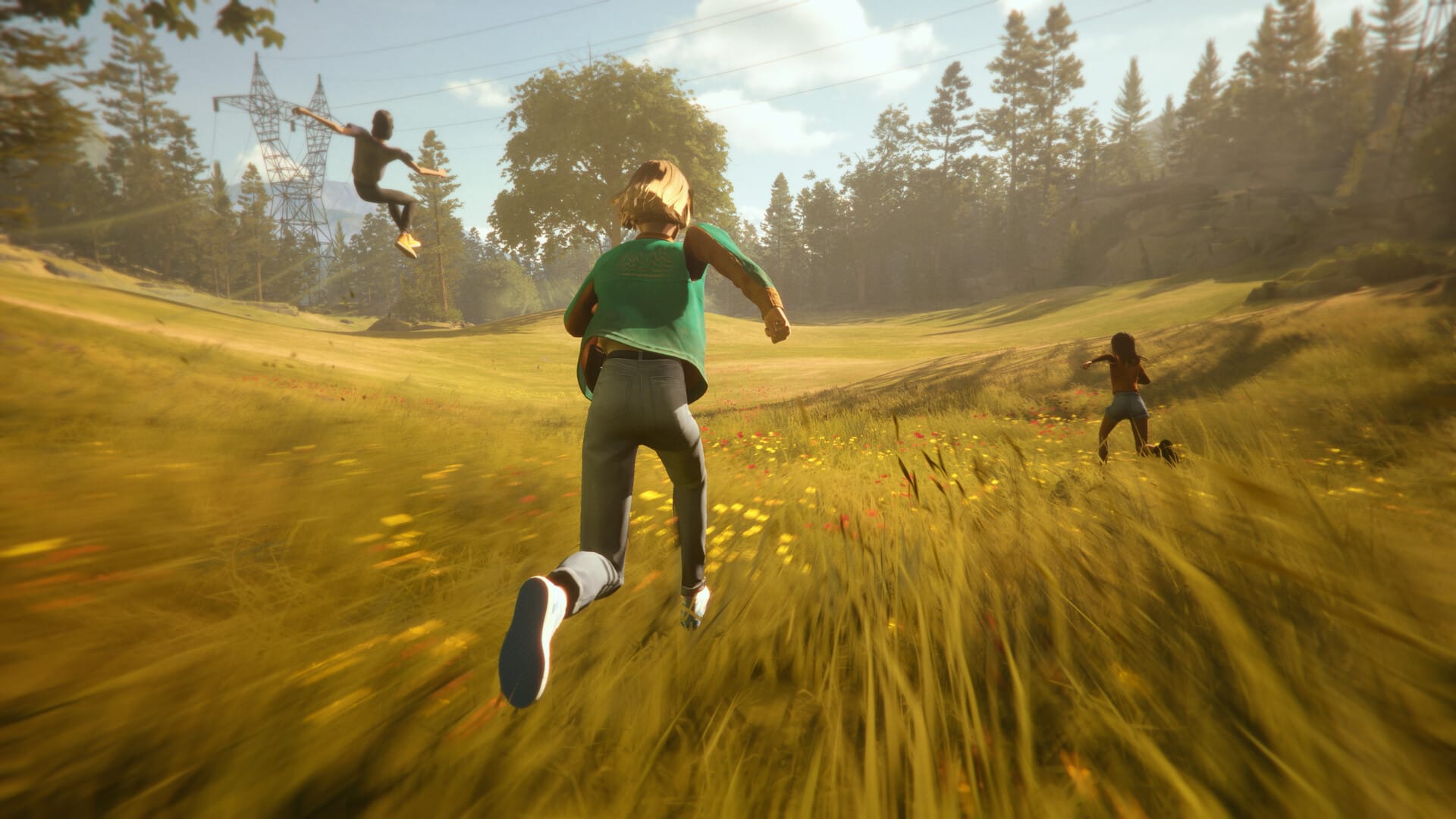
Turns out that despite all that there's still a lovely little video game here. Mixtape's inability to land its nostalgic haymaker is constantly annoying, but as tedious as the writing in pivotal moments can be, the game's strength lies in the way it breathes creative, only-in-video-games magic into those scenes.
A flashback to Stacey's first kiss isn't a black and white cutscene, it's a tongue wrestling minigame so gross and funny it had me nearly falling off my chair. Another scene featuring two kids getting slushees turns into a memorable, physics-based exercise in pouring video game liquids. A heartfelt chat down by the river features a stone-skipping game I could play a whole six hours built around. Mixtape's trip to the video store is not only the game's creative and interactive highlight, it's also perhaps the only moment I truly found something nostalgic I could relate to.
It feels reductive to dismiss so much of what Mixtape is trying to do by saying I just enjoyed it as Wario Ware For Teens, but that's the truth of where I got the most out of this game. I really appreciated just how much of a video game it was, how it was able to approach such a crowded genre dominated by so many famous movies and novels and, while failing to contribute much to that genre narratively, was able to nonetheless make its mark by transforming so many tender moments into bizarrely playable skating and shooting games.
So much of the discussion around this game--and I've fallen for it here with the opening half of this post--has focused on Mixtape's nostalgia, but I think to focus solely on that does the game a bit of a disservice. Sure, it doesn't speak to me, and I'm having trouble seeing who it does speak to, but I'm also a 46-year-old white man; who am I to assume what other people are getting out of and enjoy in a video game? The one thing I hope more of us can agree on with Mixtape is that more games with such an overt narrative focus should also involve slingshot simulators and skateboarding scenes where you crash through a deserted mall and can make cars explode with a click of your fingers.


