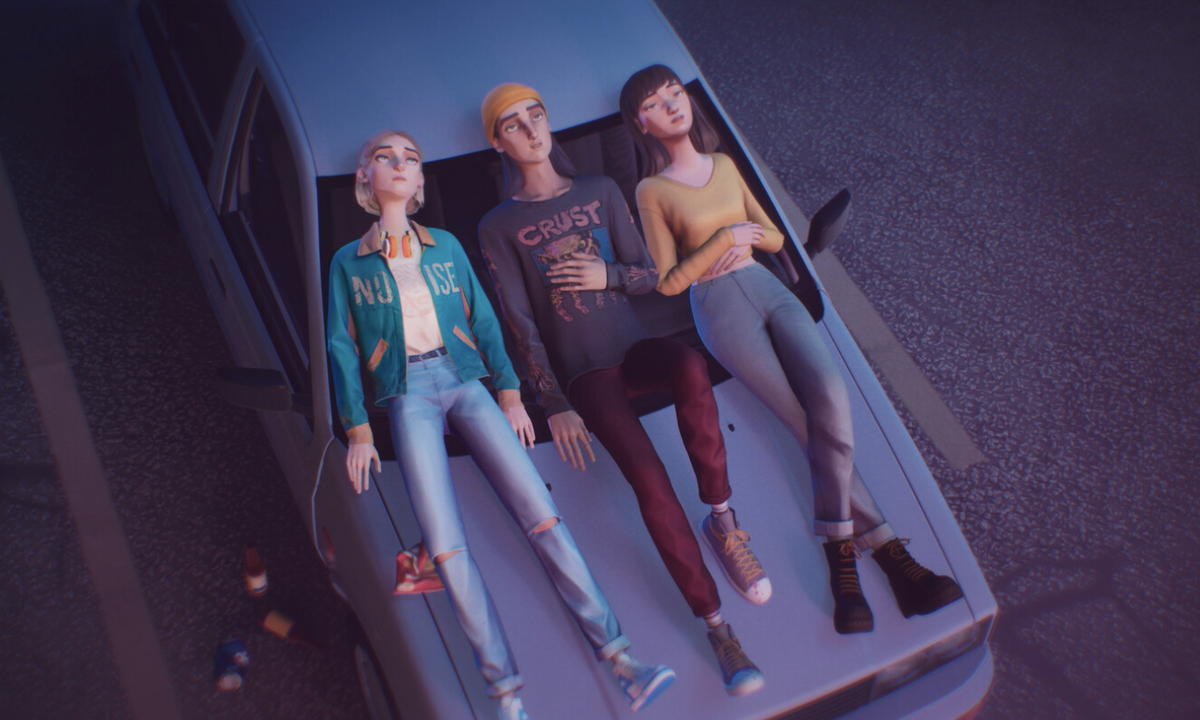
Everyone is talking about Mixtape, an ode to the idea of nostalgia that nonetheless feels rooted in a very specific kind of white guy’s teenage experience. To many, this discourse seems like it came out of nowhere, but in truth, it’s a continuation of several interminable cycles that, by being in the wrong place at the wrong time, this game just happened to serve as a lightning rod for.
There are multiple separate but overlapping Mixtape discourses unfolding, but at the risk of flattening the broader landscape, they break down more or less as follows:
- Glowing reviews of the game and its Gen X-friendly soundtrack on traditional websites like IGN and GameSpot.
- In reaction to those reviews, a series of wildly divorced-from-reality conspiracy theories on Twitter and YouTube about how Mixtape is an “industry plant” that sprang from the scheming hands of Megan Ellison, daughter of hyper-conservative multibillionaire tech and media magnate Larry Ellison.
- Game critics and game developers debating the game’s merits via blogs and Bluesky, often with a focus on the role of games criticism and Mixtape’s universalization of what largely turns out to be the wistful sights and sounds of a specific race/class background.
- Players of Mixtape reviewing it on platforms like Steam, where 89 percent of user reviews are currently positive despite all the noise surrounding it.
Drive-by arguments around the game and the ills it supposedly represents have given rise to posts and videos with millions of views. Mixtape is, against all odds—given that it’s an indie-coded game that aspires more to vibes than groundbreaking mechanics or any sort of genre-redefining experience—the talk of the town. But today’s internet is more fragmented than ever, so the Mixtape discourse is really more like dozens of towns, each with their own dialects steeped in unspoken histories, screaming past each other in an attempt to finally pin down Where It All Went Wrong. In other words, it’s another week in the video game industry.
The basic facts go a long way toward dispelling the cloud of hysteria that this game has unintentionally attracted, so let’s start there: Mixtape is published by Annapurna Interactive, the indie games imprint of Annapurna Pictures—which was founded, yes, by Megan Ellison. This makes things, at the very least, complicated. In the past, Annapurna Pictures has taken money from Larry Ellison, a staunch supporter of Trump and Israel. While Annapurna’s output and a few public stances suggest that Megan Ellison’s views don’t entirely align with those of her father, she’s reportedly proven to be a temperamental if hands-off boss, and when she intervened at Annapurna Interactive a couple years ago, 25 people ended up resigning. She also executive produced an Israeli documentary around a decade ago, though that is obviously not the same as being one of the largest private funders of the Israeli Defense Force—which Larry Ellison is. Still, for some, this is at least an understandable point of contention.
That said, Annapurna Interactive has published countless indie hits over the past decade, including What Remains of Edith Finch, Donut County, Outer Wilds, Sayonara Wild Hearts, Wattam, Telling Lies, Kentucky Route Zero, Neon White, Stray, Skin Deep, and Mixtape developer Beethoven & Dinosaur’s previous game, The Artful Escape. Nobody accused any of those games of being industry plants. So what changed?
Foremost, the Gamergate 2.0 conspiracy engine is now a well-oiled machine, and it requires a fresh helping of grievance-flavored fuel every week. Mixtape, which prior to release popped up in showcases here and there but largely flew under the radar compared to triple-A behemoths, landed last week to rave reviews, which the usual suspects on Twitter and YouTube immediately seized upon.
This, they suggested, was evidence of paid reviews and large-scale collusion. After all, Mixtape barely even contains gameplay in a traditional sense. How could it be picking up 10/10s where more deserving games, like massively mid role-playing game Crimson Desert, faltered? This is a talking point as old as time, born of legitimate confusion from gamers about how websites work—the perception that publications are monoliths rather than assemblages of individuals with their own distinct opinions—and now amplified by content creators and mobs when it suits their needs.
And of course, Mixtape looks like the fare Gamergate-adjacent types and right-wing sloptubers have been painting as bogeymen for years: visuals that evoke queer-friendly hits like Life Is Strange, a central cast that’s not entirely made up of white men, and on-rails linearity that prioritizes feelings over challenge.
The rest is post-hoc justification: Annapurna was founded by an Ellison, so it must be evil, and Mixtape is trading in stolen valor by masquerading as an indie while commanding the resources to license a formidable soundtrack of ‘80s and ‘90s hits. Never mind that indies come in all shapes and sizes these days, to the point that the label is very nearly meaningless, and, if we’re taking that designation away from Mixtape, then we must also remove it from some of the most highly-regarded indies of all time, which Annapurna published.
Further, never mind that Annapurna is a publisher, not a developer, meaning that Megan Ellison did not personally create Mixtape or devise nebulously maniacal plots around it; Annapurna’s role on the game, in all likelihood, was limited to funding and marketing. Also, Larry Ellison and his son, David, are in charge of TikTok, Paramount, CBS, MTV, Comedy Central, and potentially soon Warner Bros. Many of those ringing alarm bells about Mixtape’s supposed industry plant status have not, historically, been vocally critical of that larger empire (or Israel), and some are posting about Mixtape on TikTok, specifically. When a single family is working tirelessly to monopolize media, this is, to an extent, understandable; there is no ethical consumption under capitalism, and especially under this late-stage version of capitalism where a small handful of people own everything. You do what you can to divest from the worst offenders, but it’s not always an immediate option. That said, the specific target these content creators have picked—an indie game with relatively tenuous connections to the Ellisons—is telling.
The real question at the nexus of the toilet vortex swirling around this game is one of who gets what. Central to Twitter users and YouTubers’ complaints is the notion that traditional games media’s shriveled remains—with IGN at the vanguard—serve as unjust gatekeepers and kingmakers. Mixtape, they argue, is being elevated to a position of acclaim it did not earn by multiple embodiments of The Man, their conniving tendrils interlocked in a lattice of collusion.
But the truth is that relatively few people care about written game reviews these days, especially with even heavy hitters hollowed out by layoffs and the ravages of Google’s ever-changing algorithm. The very content creators who accuse IGN and other sites of misusing their influence are the real tastemakers of the modern era; they shape the conversation around new games—often via misinformation and ragebait, which more reliably drives engagement on social media than discussing games on their own terms. They’re once again demonstrating as much with Mixtape. If you search Mixtape on platforms like YouTube, you often see their opinions first. When people on Reddit ask why everyone’s talking about Mixtape, you hear about the controversy surrounding review scores—not the game itself or even, in many cases, what the reviews specifically praised.
However, for these content creators to admit that their influence, at least in aggregate, now far outstrips that of websites would be to give up the game. This type of rhetoric requires some kind of faceless, all-powerful enemy to rage against. Three imposing letters—I, G, and N—make for a perfect foil in this age of attention-seeking faces and names, despite the dwindling number of underpaid, overworked freelancers who do the actual work of propping up those letters.
This is where arguments among longer-standing critics and developers on Bluesky and blogs come into play. They are all, to some degree, feeling the squeeze. Critics no longer have reliable homes for their work. Developers can’t find funding to save their studios’ lives. And so, while YouTubers point to Mixtape as evidence that wokeness is ruining video games, those who’ve actually put the game under the microscope have come to a different conclusion: In a time of dwindling resources, money and attention have once again been devoted to developers with an older, decidedly whiter envisioning of bygone days.
This is not evidence of collusion, but instead systemic imbalance. Mixtape, rather than other games with similar themes, received financial and promotional backing, and many of the reviewers who showered it with praise were right within its target demographic—because, well, there aren’t many reviewers left outside it. They’ve all been pushed out by the economic realities of a shrinking industry and a crumbling society. Mixtape has come to represent both what gets made in a system defined by growing precarity and who gets the largest platform to talk about it.
As No Escape’s Kaile Hultner wrote:
There’s no way around this: Mixtape uses nostalgia as a bludgeon to beat players to death with. There is a specific Type Of Guy whose presence is overrepresented in games media for whom this game is basically catnip. It is meant to trigger emotions so powerful in that specific Type Of Guy that when they write or talk about it, they frame the bill of goods that Mixtape is selling as the universal growing up and coming-of-age experience, that it is so authentic and classic and true-to-life that surely everyone who has ever lived has experienced, or wanted to experience it.
Critic Cameron Kunzelman, meanwhile, dug deeper into how capitalism gives rise to Mixtape’s vague, vibes-y milieu:
My frustration, maybe, is that I’ve seen it done in more interesting ways, and I thought Mixtape might go there. It plays in irony as much as it does sincerity, and those are the best parts of the game. Stumbling drunk through the movie rental spot is good, playing off something real feeling but also blown out of proportion into heroic contexts. The magical parts of the game work just as well—running, flying, sitting in a beautiful car conducting fireworks—these are well executed and notable. While there are games that I think are doing the “teen feelings and how it impacts the self” better than this one, there’s not another game precisely like this, and certainly not one with the kind of money behind it.
What feeling is here to return to when the vague feeling of music lifted from all context, and winnowed down to flatter me, is available by creating an algorithmic Spotify playlist? I had this thought about halfway through the game, since it repeatedly kept hitting me with the smooth guitar music that one of our most evil platforms somehow keeps autoplaying for me when my playlists of metal and post-punk end. No one’s history attempting to drag us all into a given median, a space for no one, new coffee shop in the mixed use development-core.
These are conversations worth having, but it can be difficult to do so over the din of view-hungry content creators purposefully mischaracterizing how game development works. In the face of that, many feel an inherent desire to defend Mixtape and other Mixtape-shaped games rather than engage in substantive criticism of them.
“There has been an overarching ‘If you don't have anything nice to say, don't say anything at all’ attitude around writing critically about indie games (partly cuz the most common haters are bad faith reactionaries) that's really hobbled the space for a long time,” musician, writer, and game developer Liz Ryerson said on Bluesky. “It's part of the reason why indie games often feel like a Cause people are advocating for—that rhetoric that has proliferated really ever since indie games blew up commercially. There are some exceptions to this, like obviously problematic creators/games. But generally it's stayed that way.”
But all of this belies what Mixtape actually is: A several-hour-long interactive playlist. It is not particularly profound or ambitious. So many cool, interesting games come out every day now that those picking its bones clean for content could have safely ignored it; Wax Heads, another arguably more ambitious game about the intersection of life and musical taste, also came out last week. Numerous intriguing music games dot this year’s release calendar. In an ideal world, they would all be backed by Mixtape’s formidable-for-an-indie budget and resources. That’s not the world we live in, and clearly, no one is happy about it.
By getting punched well above its weight, Mixtape shows that this can happen to any game—and, indeed, that engagement-hungry platforms and content creators demand it. Next week or the week after, there will almost certainly be another One Of These. What can be done to ease tensions and stem the tide? Or even just to keep things in context? Vague tweets from Xbox clearly aren’t cutting it. In other countries, companies and governments have tried anti-misinformation lawsuits and campaigns to curb review bombing. So long as platforms continue to feast on anger and insecurity, though, even targeted interventions will only be able to achieve so much. Everyone wishing for a better internet faces an uphill battle, but while it’s tempting to declare all of this beyond saving, we have to keep trying. As Mixtape demonstrates, it can be comforting to indulge in nostalgia for simpler times. But the present is all we have.
Recommended
 Luke Plunkett