

Every morning, Hibari Ōzora arrives at school and opens her locker to find a fresh deluge of love letters. She’s the prettiest and most popular girl at Tokyo’s Wakaba Academy, where she’s top of her class, excels at sports, sings lead vocals in a band, and is generally loved as a legendary local diva.
She also happens to be assigned male at birth, a fact that is unknown to everyone at school except her sisters and her hapless new cis guy roommate. Hibari is someone amateur gender scholars would describe as “serving sickening fish.” Effortlessly passing, she sashays down the hallways like a plate of freshly-caught tuna tartare, greeting her classmates and throngs of admirers who can not imagine her as anything other than a girl.
Hibari is the eponymous main character of Stop!! Hibari-kun, a 1981 comic and anime series by famed manga artist Hisashi Eguchi that’s getting its first official English translation this year. Hibari-kun is a gag manga, but unlike virtually every other depiction of trans people from that period, the gag is not the fact that Hibari is trans—it’s other characters’ cartoonish inability to chill out and be normal about it.
The story begins when Kōsaku Sakamoto, a high-strung but well-meaning high school boy the same age as Hibari, is adopted into Hibari’s household per the dying wish of his beloved mother. Kōsaku quickly discovers two shocking bits of information: that Hibari’s father is a notorious yakuza boss, and that Hibari is ‘actually a boy’—the heir apparent to the Ōzora crime family. What follows is four volumes of comedic shenanigans where Hibari’s natural charm and impish flirtation constantly clash with Kōsaku’s inability to accept his feelings for her, making his life a living hell. The biggest joke is, of course, that it’s largely a hell of his own making.
In fact, much of the humor in Stop!! Hibari-kun comes from characters being tormented and humiliated as a direct result of their inability to accept Hibari for who she is. Her ruthless crime boss father, Ibari Ōzora, is rendered powerless against her time and again, flying into wild temper tantrums and panic attacks that cause him to see imaginary white alligators. In the second chapter, Ibari recruits the scariest and most dangerous yakuza thug he knows to help him force Hibari to “man up,” only to have said thug sent home battered and crying—yet another victim of Hibari’s unflinching feminine power.
Hibari is not meant to be a realistic trans character. It’s better to think of her as the ultimate foil. Anyone who tries to make her change (or “Stop!!,” as it were) is in for a bad time. She is the trans woman-as-mirror: Those who call her a “pervert” end up looking like actual perverts. Those who try to expose her “big secret” are exposed themselves.
When Kōsaku frantically tries to stop Hibari from using the women’s bath during a school trip, he blunders in classic anime fashion, looking like a peeping tom in front of the whole class. When a group of jealous girls at school begin to suspect Hibari and hatch a plan to expose her, she switches places with her sister Tsubame on the day of a school-wide medical exam, making her haters look like massive creeps. All the while, Hibari rarely loses her cool, getting the upper hand each time using her natural wits, charisma, and penchant for mischief-making (and occasionally her comedically uncanny fighting prowess).
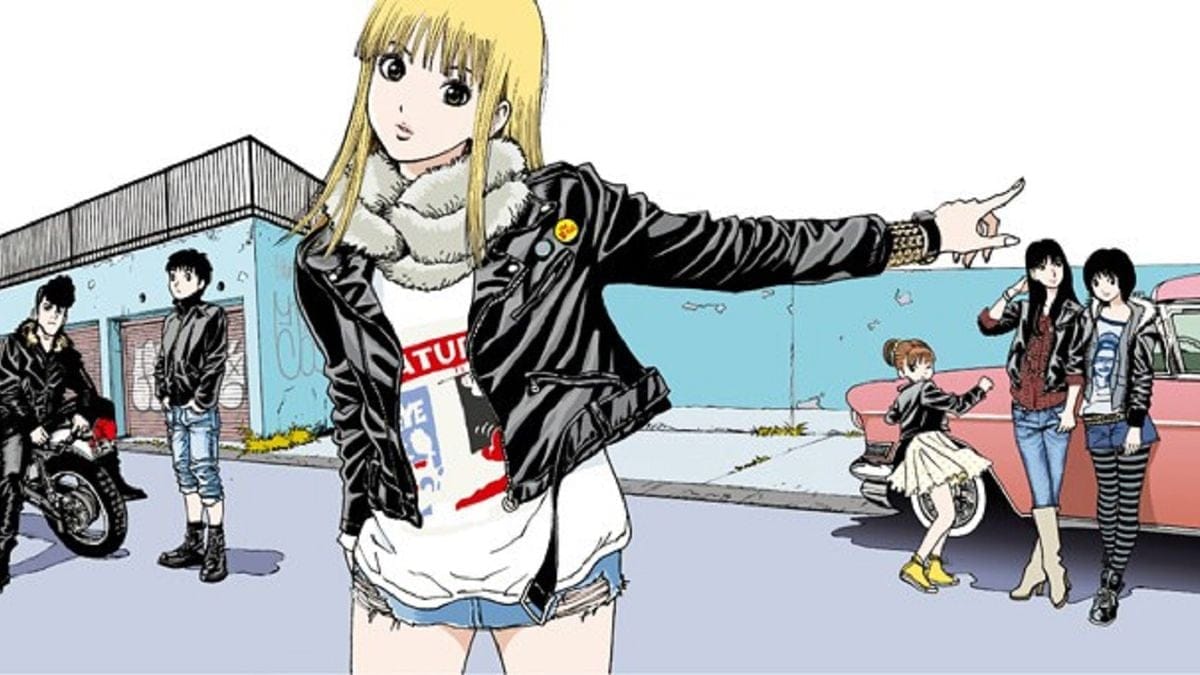
One could argue that in 2026, at a time when trans people face unprecedented violence and existential threats from the highest levels of government, Hibari represents the ultimate trans power fantasy: being able to control your own narrative and live a normal life. Even when that life is still at times fantastical and extraordinary.
It’s easy to see why Hibari is still stealing readers’ hearts more than 40 years since she first graced the printed page. She is a subversion of the “man in a dress” stereotype that has reduced trans people to dead bodies and pop culture punchlines for decades. She is not a tragic character and never asks for your sympathy, instead winning over her admirers naturally by being charming and loveable. And it’s easy to see the cartoon antics of Hibari’s haters in the various politicians, D-list celebs, and internet grifters who spend their days having public meltdowns while obsessively trying to make trans peoples’ lives more miserable than their own.
Hibari is a positive trans character not because she is a realistic depiction of a trans woman (she isn’t), but because she refuses to allow her identity and narrative to be controlled by others
One might be tempted to categorize Hibari as an early example of the “trap” archetype popularized on incel-dominated forums like 4chan—the trans woman as a deceitful manipulator who lures men astray into a world of homosexual perversion. But in my reading, she defies even this stereotype. Hibari is an agent of chaos, yes, but Eguchi never depicts her in a way that feels mean-spirited. She doesn’t get her kicks from “revealing” herself to others, and the one character who always feels deceived by her—Kōsaku—is in reality deceiving himself.
While ahead of its time in some respects, Stop!! Hibari-kun is still very much a gag manga written in the 1980s by a cis man. It’s undeniably problematic, featuring crude racism and other tired stereotypes that were offensive even at the time the series came out. There are countless scenes where Hibari is threatened with violence and rape, and the fact that it’s played up as a joke doesn’t change the fact that real, actual trans women are routinely murdered by men who use their surprise at those women being trans as a legal defense.
Hibari’s unclockable tea also brings up the issue of “passing privilege,” the fact that passing as cisgender is highly racialized and contextual, and that many trans people simply don’t want to pass at all. Like many anime and manga characters, Hibari is eternally 15 years old, meaning she will never have to deal with the inevitable onset of male puberty that makes passing more difficult without medical interventions like hormone replacement therapy (HRT).
Some fans of the series have also brought up the question of whether Hibari is really “trans” or simply a mischievous cross-dressing boy. This kind of thing comes up often when viewing Japanese media like Stop!! Hibari-kun through a Western queer lens, which doesn’t always align with the realities of non-Western queer identities at the time it was made. While more common today, terms like “transgender” and “non-binary” were completely unknown within Japan when Hibari-kun was first published. Over the years, terms like “X-gender” and “Otokonoko” have been used by gender-expansive people in Japan, the latter being adopted directly from an anime and manga trope describing young characters who are assigned male at birth and present as female.
I describe Hibari as “trans” not prescriptively, but as a broad placeholder that maps messily onto a range of gender experiences and lived realities that vary widely across race and culture. Even then, the question of “is Hibari really trans” is, to me, extremely boring. It also completely misses the point.
It’s very unlikely that Eguchi intended Stop!! Hibari-kun to be trans-positive in the ways I’ve described. Hibari is a positive trans character not because she is a realistic depiction of a trans woman (she isn’t), but because she refuses to allow her identity and narrative to be controlled by others. Her lived reality and experience of the world is that of a woman, a fact recognized both by her fictional classmates and non-fictional readers. In a fan letter section at the end of the Japanese manga’s first volume, published in 1982, a 14 year old student wrote to Eguchi: “I can’t see Hibari as anything other than a girl!”
In a way, that’s sort of the whole point. A world where everyone moves through life performing the gender they were assigned at birth has never existed, and never will. As Eguchi demonstrates, it would also just be really, really boring. In the last episode of the Stop!! Hibari-kun anime, the series ends abruptly with a direct message to fans from Hibari herself: “Don’t worry! The world of perversion will probably continue forever.”
Hibari will never “Stop!!” Nor should she. Nor should anyone.


