In early 2022, Rebecca Ford, formerly Warframe’s director of community and live ops, took over as creative director, marking the beginning of a new era for the then-nearly-decade-old massively multiplayer space ninja fashion simulator. Taking the reins on such an established game would’ve been a daunting prospect for anyone, even someone as intimately familiar with it as Ford. But she and her cohort came armed with a plan.
The thing about game development, though, is that it’s fraught with unforeseen wobbles and stumbles, which can presage full-on faceplants. Even the best-laid plans rarely emerge from the process unaltered. Add to that the crucial fact that Warframe is a live-service game with its own daily, weekly, and monthly wants and needs; you can never entirely predict how its sometimes-obsessively dedicated player base will react to change.
"You have to take big swings, or you join the statistic of the percent of live-service games that fail in a given year.”
So how can developers possibly lay down track to carry the game forward for five years while still leaving wiggle room to swerve? It’s an art, a science, and a math problem all rolled into one. Now, at the tail end of her first five years at the helm, Ford can reflect with clear eyes on what panned out, as well as what didn’t.
"You have to take big swings, or you join the statistic of the percent of live-service games that fail in a given year,” Ford told Aftermath. “One live-service game failing is a tragedy; one hundred a year is a statistic, and you must strive to radiate your DNA."
War(frame) Always Changes
Warframe has long been prone to unexpected shifts in tone, subject matter, and even genre, with the past half-decade’s expansions taking players everywhere from a demented fantasyland, to the year 1999, to World War 1-inspired trenches. But much of what’s happening in the game today—namely, a long-awaited journey to the star system that set the game’s whole story in motion, Tau—existed on a white board in Digital Extremes’ offices back in 2022.
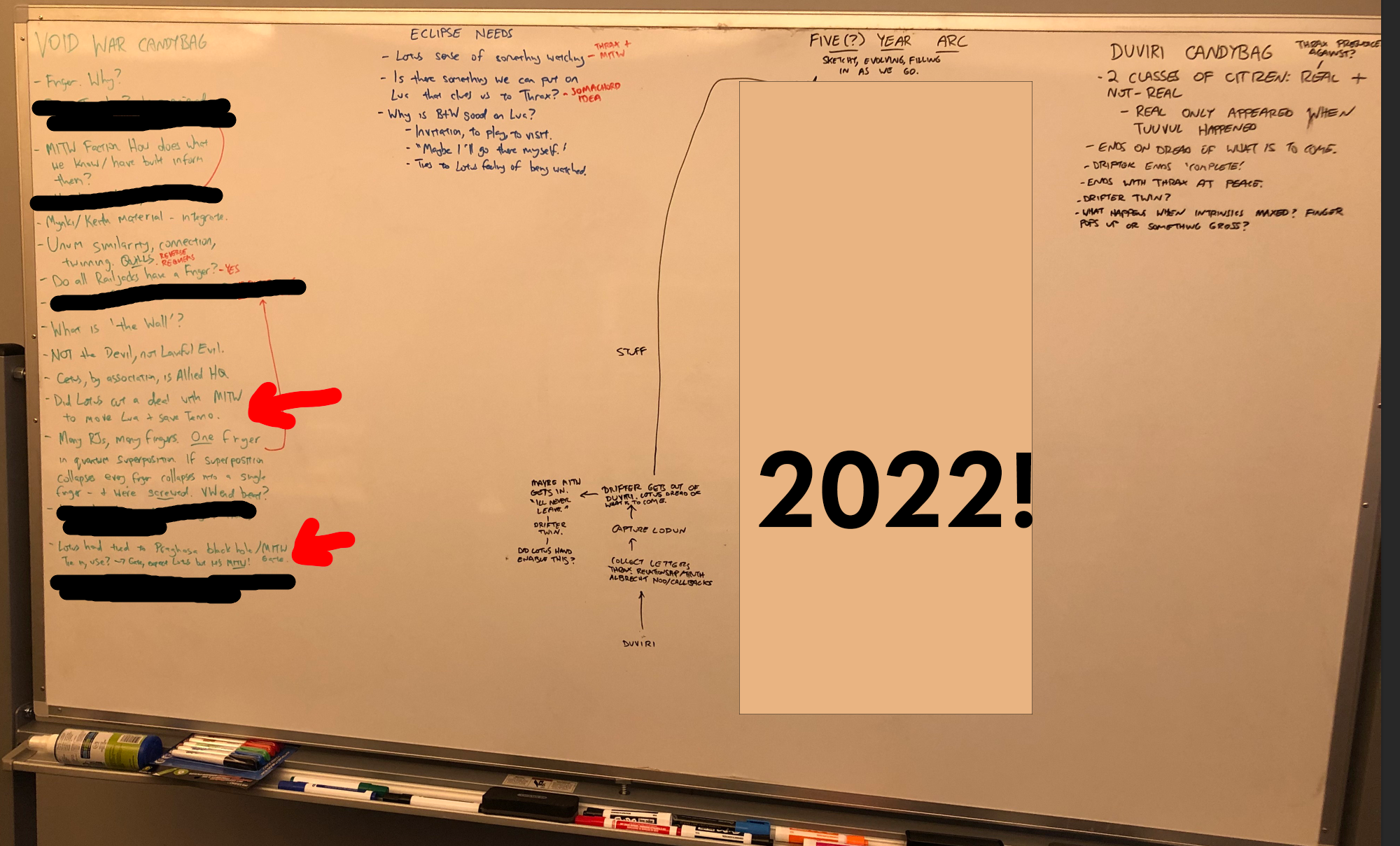
During our interview, Ford walked me through it, pointing to recently revealed story beats like [SPOILERS] Lotus, the player character’s beloved space mom, cutting a deal with an Eldritch space horror known as The Man In The Wall to save all the child soldiers who pilot Warframes, as well as a more prominent role for Praghasa, Lotus’ mom who is also a spaceship [END SPOILERS].
“We really had the fundamental questions that felt relevant for Warframe—which [are] ‘What is The Man In The Wall? … Did Lotus cut a deal with The Man In The Wall? And then Praghasa, what’s going on with her?’—[mapped out],” said Ford. “Some of these will be very deeply explored in the quest that you're going to play at the end of the year with Tau. You can see the process from 2022 and us continuing to refine the timeline and what we think is important.”
By 2023, the team had already sketched out the intro to Tau, which finally debuted at this year’s TennoCon in London, Ontario and featured a noir detective-inspired Warframe, Brysko, skulking through the slums of a goopy, glistening city full of drug-addicted automatons.
“We knew [back in 2023] that Tau was going to be our addict arc, where it's like a Sentient-fentanyl parallel,” said Ford. “So all roads lead to Tau, and for three years we've been working in that direction, year over year.”
Another white board from 2023 featured a full chronological timeline of key moments throughout Warframe’s centuries-spanning saga.
“For staging everything, white boards and analog are still so much how we work,” Ford said.
Ford also uses software to create a visual plan for every year, quarter by quarter, that outlines “all the big swings,” including the themes underpinning individual Warframes that will be released. This, however, is one place where Digital Extremes has decided to zig when it was planning to zag during Ford’s tenure as creative director.
“I like to think I'm really rigid, but secretly there's some flexibility for the plans to just make it work."
Originally, a detective Waframe, Brysko, was going to be introduced in 2025, with his mini-story serving as the player’s first strides into Tau’s seedy underbelly. But then the team decided to move all of the Tau update to 2026, necessitating a new frame for that slot in 2025. Why? Because Warframe’s ex-stewards, who’d since moved over to alpha-stage fantasy sister game Soulframe, had a great idea for an update that would serve as a lead-in to Tau: a leap back into the distant past known as The Old Peace. This would better establish the history between players’ faction, the Tenno, and the aforementioned Sentients, enemies turned allies (tragically) turned enemies again who are now the main occupants of Tau.
“We shipped a playable Old War,” said Ford, “which was a creative moment that the old team, Steve [Sinclair] and Geoff [Crookes], were like ‘You should really do this,’ and we were like, ‘Oh, you're so right. We'll add that to the plan to make Tau more impactful.’ So [Tau and Brysko] got pushed back a year so we could make room for this.”
As a result, Uriel, an infernal demon frame, took Brysko’s place on the 2025 calendar.
"That is one of the cases where you'd rather be lucky than organized any day,” said Ford. “Uriel represented an archetype we wanted for a long, long time. And the second we started going through the themes of [World War 1-inspired] Old War technology and knowing that we were going to do a bayonet [weapon], he fit so well that we tailored all of these moments around him. If you've played the Old Peace quest, you know it doesn't work without Uriel, especially in a specific scene. So we made it work. We had him in an earlier update that year, just on paper, and then when we moved out the detective frame, he went right in. And we just embraced it fully. That is being an agent of change for good and making everything better as a result of flexibility.
“I like to think I'm really rigid,” Ford added, “but secretly there's some flexibility for the plans to just make it work."
Bullet Jumping With The Punches
Warframe tends to release several major updates each year, with TennoCon occurring in the summer and showing off what the year’s final, biggest update will be. This year that was Tau, last year it was The Old Peace, the year before that it was 1999, and so on. This structure is important because it helps keep the team, well, sane.
“At this point in the year, we already have next year's TennoCon, the shape of it for the types of things that take a really, really long time to make, [figured out],” said Ford. “Giving teams lead time is the most responsible thing we, as all the leads on Warframe, can do as people that run a game-as-service. At this point, the games industry is like a meat grinder, right? So you need to have some responsibility for lead time.”
Not every update includes a new Warframe, but they are, ultimately, the backbone of the game. Some frames, Ford said, take months to bring from ideation to completion. Others take years. The key, again, is to be rigid about scheduling so that something monumental makes it into the game at a regular clip, but flexible enough that the team can roll with the punches if need be.
"At this point, the games industry is like a meat grinder, right? So you need to have some responsibility for lead time.”
Case in point: Citrine, a crystalline Warframe released back in early 2023 not long after Ford took over. She came together in two months because, as a result of growing pains, The Duviri Paradox—originally planned to be 2022’s big update—was delayed into 2023.
“We realized [Duviri wasn’t] going to make it in time for December [2022] shipping, so we invented two updates to fit in between, which were the Voruna update and the Citrine update,” said Ford. “We just were like ‘OK, what themes can we do to get those in?’ The skill to adapt but still deliver a ‘complete’ package is essential. … So Citrine was less than two months, and that at this point is unrealistic. We could still do it if we had to delay something, but it's not the norm.”
Meanwhile, due to more recent extenuating circumstances, Brysko lies at the opposite end of the development time spectrum: “Some Warframes take two years because other projects come up along the way,” said Ford. “The detective frame is a really good example of that. That guy's been either in the works on paper or art-wise and such [for two years]—two years of gaps between his development.”
Warframe’s community is uncommonly forgiving as far as these things go—at times bordering on parasocial thanks to Ford and co’s efforts to constantly keep them in the loop via weekly dev streams and regular in-person events—but that doesn’t mean players have infinite patience.
"When player sentiment changes, how do you adapt so that you don't imprison yourself in a bad plan?” said Ford. “The good and bad thing about being decisive is that no one has a 100% batting average, and among [design director] Pablo [Alonso] and I's deep soul-searching heart-to-heart community sentiment stuff, we generally feel like we can move on with enough inspiration if we're batting eight out of ten, sometimes seven out of ten for an update. We aspire for a home run every time. Aspirationally, we want every update to feel like it made Warframe better than before the update was in the game. When we start missing our swings, and when we start getting into the sentiment traps and issues, we really take it very seriously, and that is a survival skill."
If community grumbling around an update reaches a fever pitch, the next step is to figure out what kind of problem the team is dealing with: a technical stability issue or something arising from the game’s creative direction?
“If it's a stability problem, you don't call a firefighter for what's clearly an ambulance scenario, right?” said Ford. “We have our first responders, which is our community team, and then diagnostics, and all of these things allow us to [identify and address a problem quickly]. And like sometimes it's both [a creative and stability issue], to be clear. So it's never something that doesn't take all hands.”
"You don't have the capacity, ability, or skill to do everything at the same time."
Ford pointed to two separate updates released this year as examples: On one end of the spectrum, there was Icebind, an experimental new six-player mode that forces players to work together in new ways and also puts greater strain on Warframe’s underlying tech. Despite concerns that the whole thing could melt into an unsatisfying puddle on exposure to the outside world, Icebind’s launch went off more or less without a hitch, and players enjoyed it. “We were super pleasantly surprised by how smooth the six-player stuff was,” Ford said. “That has been a huge technical ‘what if’ for a long time.”
Players were less enthralled with an ambitious new Warframe that released earlier this year, that, due to multi-dimensional shenanigans, is actually two frames in one: Sirius and Orion. While many were excited by the idea, they ultimately felt like the execution was underbaked and quickly made their feelings known.
“Two new Protoframes enter, and people want more,” Ford said of the update. “So we absolutely made it forbidden for us to release true Protoframes until we flesh [Sirius and Orion] out more, and then we can consider going back. ... Fundamentally, that changed one of our big plans for the year. That is the biggest challenge because you don't have the capacity, ability, or skill to do everything at the same time, so we try to target Warframe reworks most acutely with a plan and a level of attention that the players have been receptive to.”
The Best-Laid Plans Of Mice And Tenno
In general, 2026 has been a bit of a bumpy year for Warframe, at least in terms of player sentiment. The aforementioned Sirius and Orion update, as well as more recent ones like Iceblade of Narin and tweaks to systems like big ships known as Railjacks, have been met with mixed reception, leading some players to fear that Tau might also not live up to expectations. On that front, Ford—who spent much of this year dealing with medical issues and had to miss TennoCon for a much-needed surgical procedure—said there are some things you just can’t plan for.
"I think a lot of my advice is: Don't get diagnosed with a benign tumor and miss TennoCon and go into surgery recovery for three months, and you might have a better year,” said Ford. “Don't go through clinical torture and have the worst medical year of your life and try to bat 100.”
“If it was easy, everyone would be having amazing years all the time with their games,” she added. “I'm incredibly proud of the team and their ability to deliver on anything. Sometimes you wish you had a perfect batting record, but that's not reality. I think the version of us that has to deal with sentiment ebbs and flows. If you're like me and have worked on Warframe for 14 years of your life, you've seen it all. You've seen the worst. You've seen the best. You've seen everything. You cannot let it stop you from trying your absolute hardest on every update."
"I think a lot of my advice is: Don't get diagnosed with a benign tumor and miss TennoCon and go into surgery recovery for three months, and you might have a better year.”
Medical difficulties aside, Warframe also faces a more practical problem where player sentiment is concerned, one arguably faced by every video game: The engagement- and rage-bait-powered, algorithmically-driven internet has grown into a virulently negative place, and with each passing year, it becomes more difficult to separate signal from noise.
“I think just existing on the internet as any entity is really hard year over year, and it does feel like [that problem] just keeps growing,” Warframe director of community and live ops Megan Everett told Aftermath. “As a team, trying to sift through sentiment and parse through what is constructive and what is just people being passionate, that's where the line usually gets a little muddy. Is someone being extremely inappropriate or just really passionate about something that we've touched or changed? And it's up to us [to decide]. … One thing we've definitely learned is that there's a time and a place to have knee jerk reactions, and that time and place isn't always prevalent. You kind of have to let people really absorb and digest a little bit. If their feedback is the same three days later, then we can have a discussion.”
Ford, Everett, and co also constantly have to keep in mind that no matter how available you make yourself to the community, you’ll never please everyone. Case in point: Warframe players regularly complain about how some of the game’s mindboggling number of systems, introduced years ago, now gather dust. The development team could go back and give them a fresh coat of paint, but after a certain point, you have to know when to move on.
Necramechs, player-controlled walking tanks added to the game in 2020, are a good example.
"Every player was capable of thinking of how cool [Necramechs] would be, more so than they ever actually would be, because we only ever released two,” said Ford. “That was six years ago. They are beautifully presented and cool, but maybe two was enough, and the feature is done. Is that not possible? It seems impossible because that is not how you operate a live-service game. You don't finish a feature. So when we express that something is finished, it seems like opposite world. There's still so much potential. They could be so much better. But when you look at the reality of the way they're treated, it would effectively be one of the biggest nerfs we could do in the game; the Voidrig Necramech is just so broken. ... It's just not a priority. Our priority is making another system better."
If there’s one thing Ford has learned after nearly five years directing Warframe—and especially after this one—it’s that you can never be too careful about calibrating players’ expectations.
“I think that's been the biggest sentiment lesson: player expectations,” said Ford. “It is a very dangerous [line to walk]. It's an exciting thing to be excited about your game, but if you're too excited, players will always be disappointed.”
"It seems impossible because that is not how you operate a live-service game. You don't finish a feature. So when we express that something is finished, it seems like opposite world."
Tau is an especially difficult instance of this dilemma. It is in many ways Warframe’s biggest update ever—Ford said that player speculation about it demanding most of Digital Extremes’ resources in a year where other updates didn’t quite stick the landing “isn’t inaccurate”—but it’s not going to spring into existence with the same amount of content as a solar system that’s been around for over a decade.
“Tau is an indicator of everything in Warframe we've made so far,” said Ford. “I think what I want to convey is that we are adding a second solar system, and in that regard, it's unlike anything we've done, and it's huge. Obviously, there's a ‘but’ there, which is: but it's the first part of Tau. Don't go there expecting 17 planets on launch.”
Still, Ford is proud of what the team has accomplished this year despite ups and downs. It’s an imperfect conclusion to her five-year plan, but it sets the stage for even more ambitious plans to come.
“[I’ve learned] just how hard it is to outdo yourself and your greatest years, but the recovery process needed to happen. I maybe rushed things a little too much at some point, but we had a plan and we did our best, and we will continue to,” said Ford. “Will [Tau] feel like a competitor to GTA VI? Let’s not go that far, Tenno. Comparison is the thief of joy. So Warframe's updates will live in a gallery amongst our updates, past, present, [and] future.”
Recommended
 Nathan Grayson