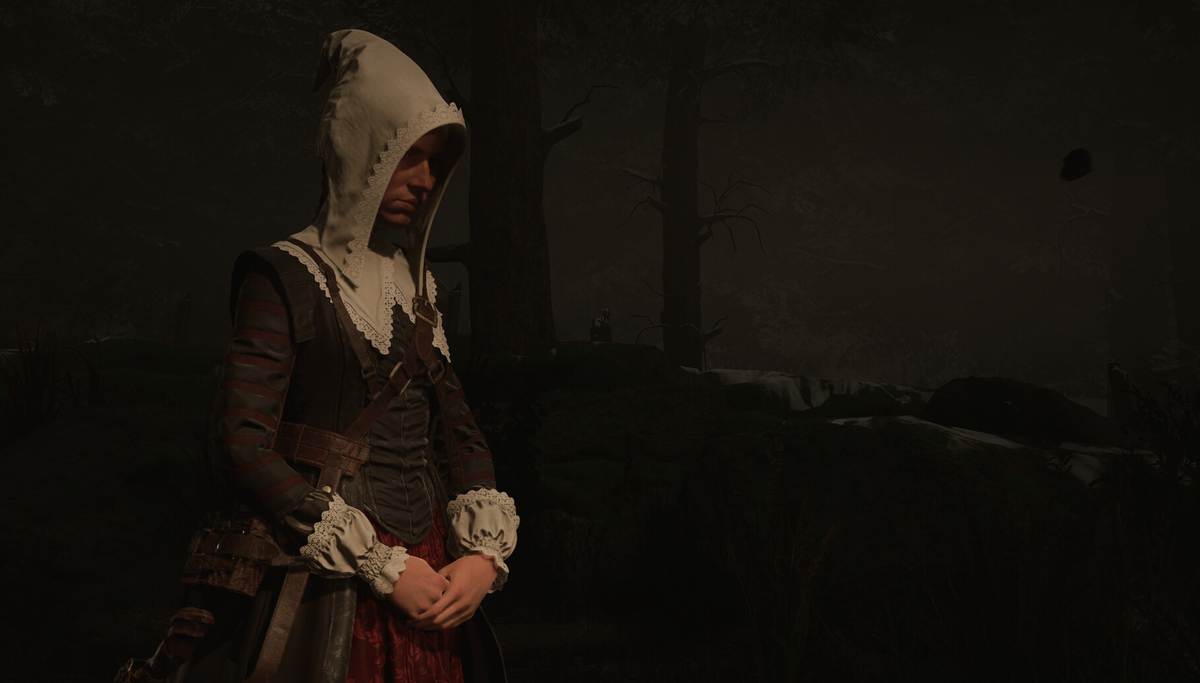
1666: Amsterdam, best known as the brainchild of Assassin's Creed co-creator Patrice Désilets before its reveal was marred by some impressively terrible AI art, has as of recent times “totally” moved on from AI. That’s according to Désilets, who, speaking with GamesRadar, claimed that his company had fired up the plagiarism machine “mostly at the beginning … in conception and pre-production.” Now, though, AI’s out of the pipeline. Hm, where have we heard this kind of thing before?
Oh, right, earlier this year from the developers of Blood of Dawnwalker, the vampire-flavored skulk ‘n’ stab from former Witcher devs that comes out this week. And also from the studios behind Tomb Raider: Legacy of Atlantis, the Steam page for which discloses that “AI-assisted tools” were used to support “some early exploration and temporary development content,” but that “any AI-assisted assets were either replaced or refined by humans in order to maintain the creative and artistic vision of the development team.” Oh, and from Larian CEO Swen Vincke at the very beginning of the year, who—while facing sustained blowback following an admission during an interview last year that his studio had been experimenting with AI—clarified that developers used the tech to “explore things” but that “there is not going to be any GenAI art in Divinity.”
At this point, a meta has calcified: Use AI, get caught and/or admit it, and then walk it back by saying that no AI-generated assets will appear in the final game, you’re done with AI for the time being and, actually, you never used it all that much to begin with, so really, what’s the big deal? Then the bad press dissipates, and you can move on with your life.
This should not be allowed to function as a get-out-of-AI-jail-free card, both because it’s a plainly disingenuous reaction to criticism, and because it doesn't hold up to scrutiny. Creativity is a process, one that begins with ideation and conception. Indeed, these are some of the most enjoyable parts of creating something; writers get to envision whole new worlds, artists get to sketch out their most deranged fever dreams, designers get to invent new genres and mechanics. It feels almost banal to say at this point, but that’s the last place where we want AI intruding. Unbridled human imagination does not need a pair of clumsy, cold hands leading it to water.
And even if the words, images, and designs AI produces don’t make it into the final game, its fingerprints still wind up all over the thing. Those are still AI’s malformed hallucinations being painted over by people. That is still AI effectively helping steer the ship, if its contributions really are constrained to a project’s early goings. It’s the video game development version of humans being trained not in any specific skillset, but rather in how to prompt AI to do it for them. After a certain point, that becomes almost worse than using AI to whip up an ugly in-game painting or two. Instead, it’s filling in perceived cracks in the foundation. It’s becoming the base on which everything else rests. I don’t care what studio heads say about individual assets; AI is absolutely in a game made that way.
This is a bait and switch, and it can’t become the accepted default. AI suffuses these games even if it’s not literally staring you in the face moment to moment. Execs and studio heads will keep trying to talk out of both sides of their mouth here. Don’t let them. Words need to mean something, or else AI will have truly won.
Recommended
 Luke Plunkett