

Not too long ago I took the plunge and finally bought a 3D printer and, against certain reservations, I decided on the newly released Bambu Lab X2D. Bambu has been killing it over the last few years since releasing the X1 Carbon, making no-nonsense printers for cutthroat prices. If there is an Apple or Unifi of 3D printing it is Bambu Lab, in more ways than one. But unfortunately in the last few weeks Bambu Lab threatened a cease and desist notice on an obscure Github repo. Now some people are pissed, and despite how internecine much of this sounds, their reasons are valid.
Much of the current 3D printing landscape is built on open source software, specifically the AGPL license. The AGPLv3 is a strong copyleft license designed to get around a problem with open source software. It ensures that any subsequent code developed under the license that runs as a network service also remains open source. Modern 3D printers require what is known as a “slicer,” a piece of software that takes the 3D object the user has created and turns it into a set of instructions that the printer can understand.
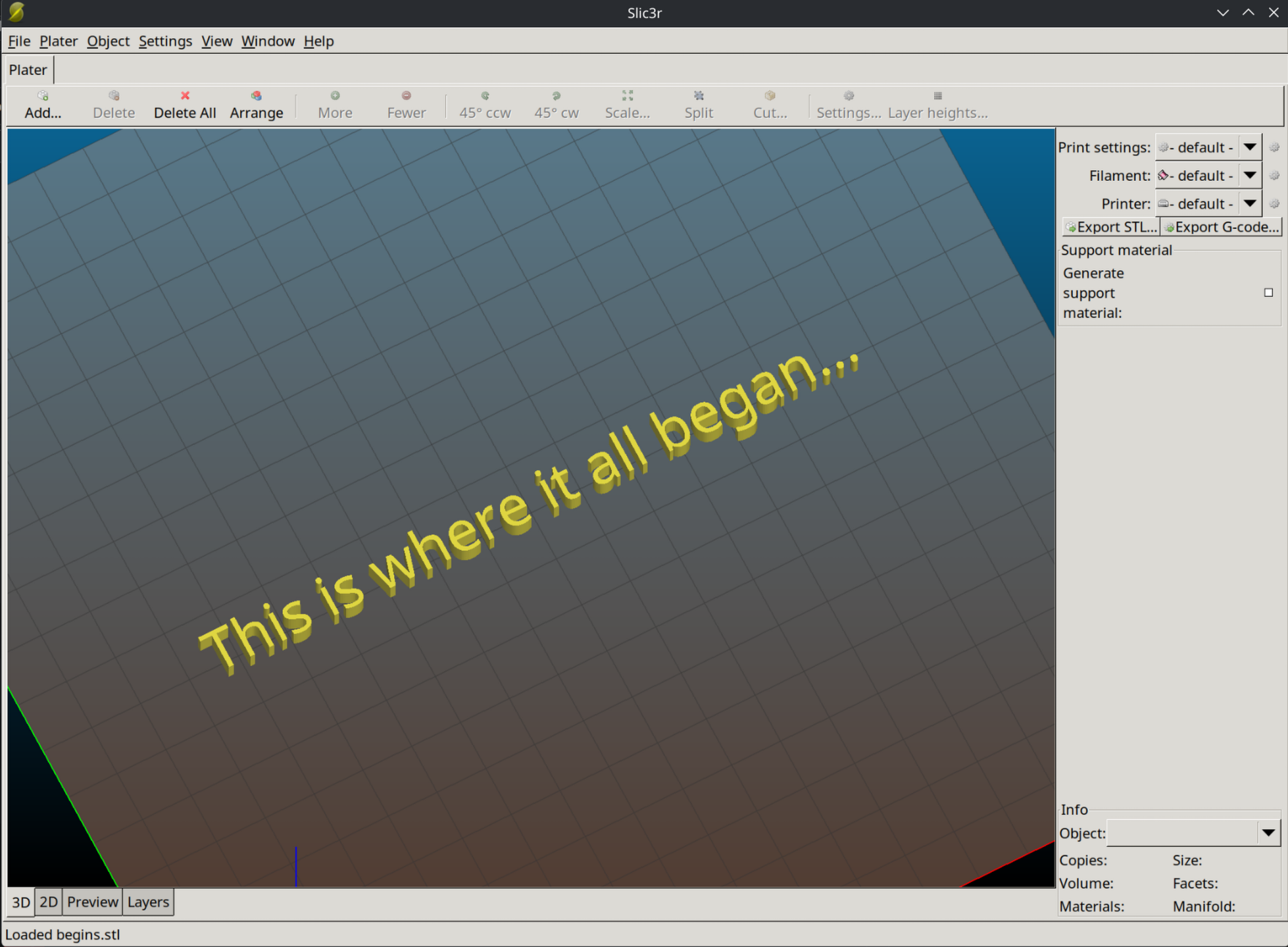
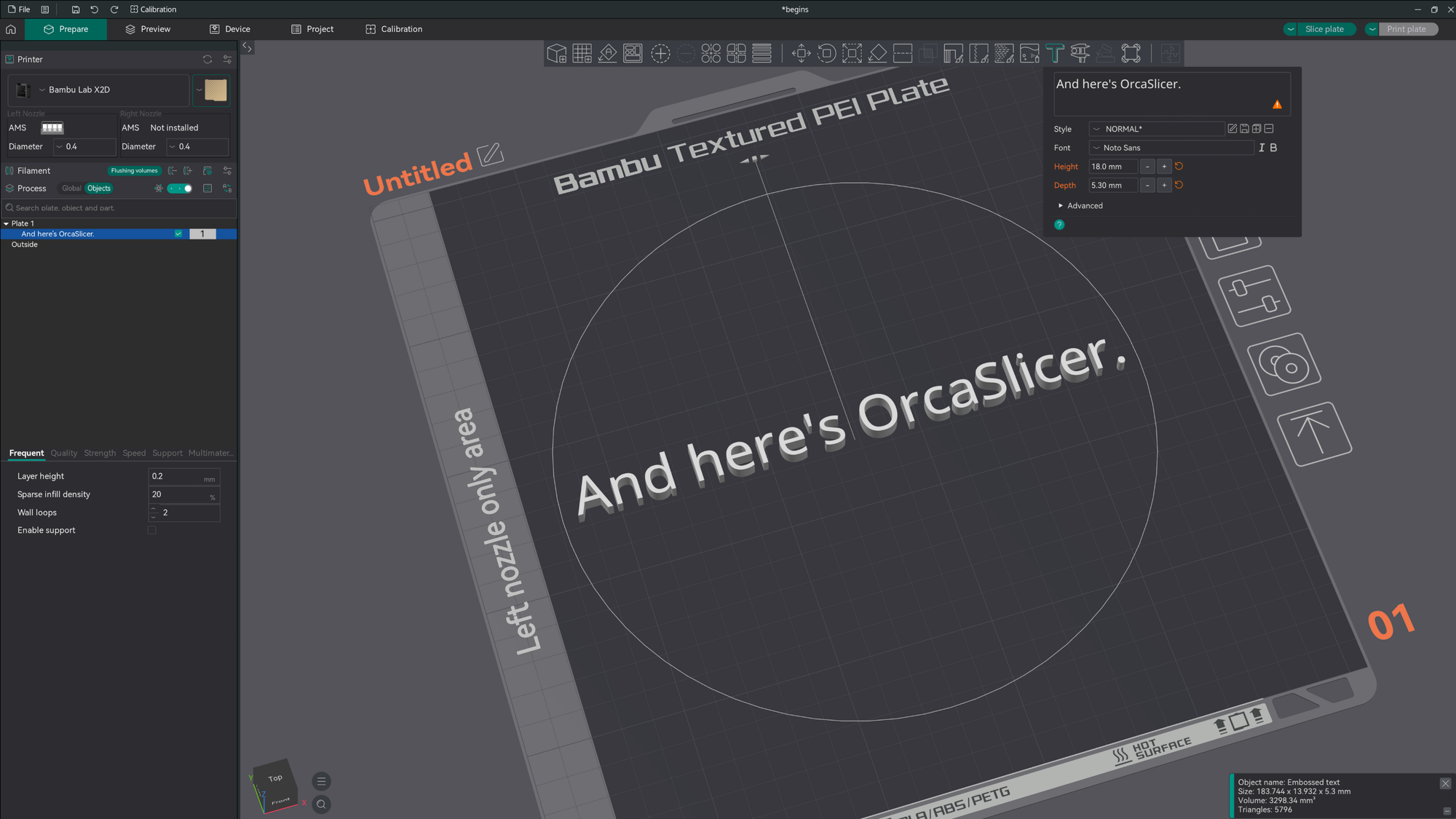
Years ago a piece of software called “Slic3r” was developed, which then was forked into PrusaSlicer by the brand Prusa, a printer brand known for its openness and commitment to repairability. Bambu Lab took PrusaSlicer and forked it into their own Bambu Studio, and users have subsequently taken that and modified it into OrcaSlicer. All of this is possible thanks to Slic3r originally being licensed under AGPLv3, thus ensuring that everything in the software chain remains open source.
A history of enclosure
In January of 2025, Bambu Lab poked the hornet’s nest by introducing an update that removed the API path that third party software like OrcaSlicer used to communicate via the cloud, replacing it with Bambu Connect. This would force users to go through their servers in order to use several core functions of their printer. Presented as a security update, this initially broke the functionality of certain parts of OrcaSlicer and third party hardware, including printing over LAN with Orca. People justifiably got pissed off at Bambu, including YouTubers like Louis Rossmann and Jeff Geerling, because this tethered their existing printers to Bambu’s servers, and seemed to hint at a more closed vision for the future of the brand. Bambu eventually caved slightly by introducing optional Developer and LAN-only modes for users who want them, but remote access still requires you to go through Bambu’s servers or to use an optional plugin called Bambu Connect (which OrcaSlicer developers refused to implement). This is in addition to the fact that you have to download a separate closed source networking plug-in for OrcaSlicer and Bambu Studio in order to get the full functionality out of your printer, despite Bambu Studio itself being open source.
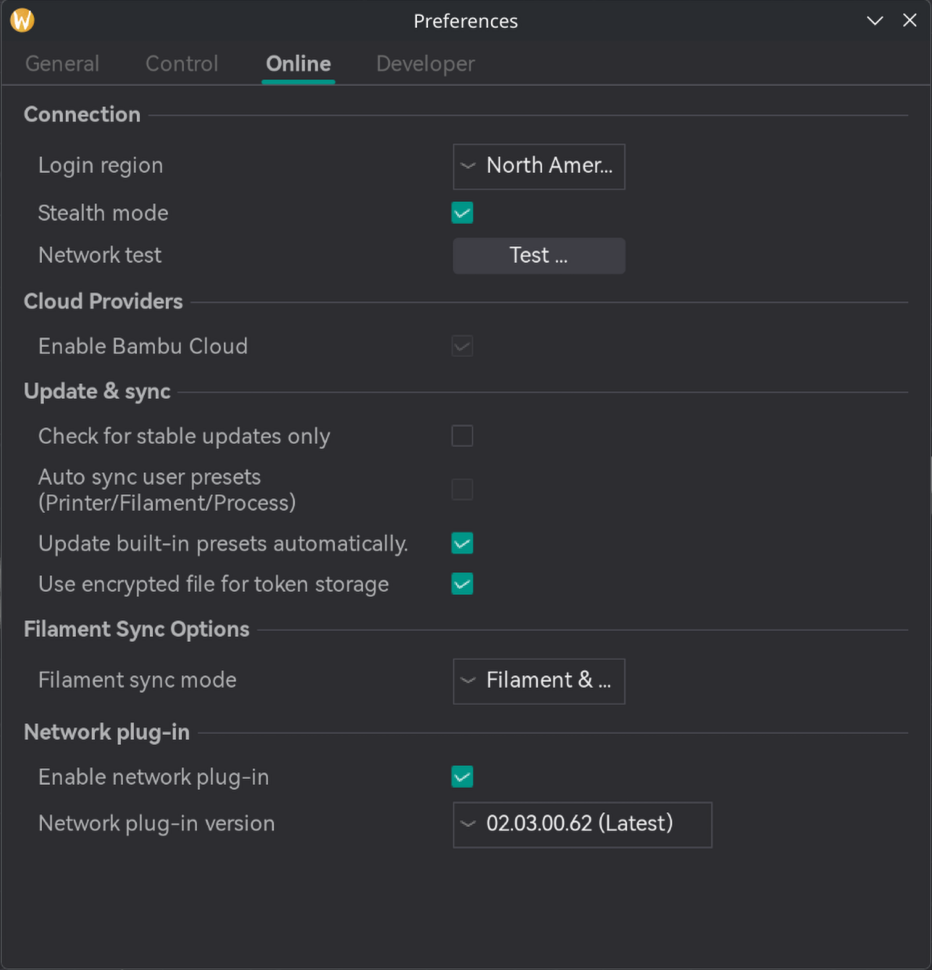
Many people are fine with only connecting to their printer over a local area network (I try to keep many devices in my home local out of general habit), although the ability to check on your prints remotely is quite handy. Others might also not be bothered by being forced to go through Bambu’s servers, and to install their optional plugin. For my own part, I prefer using OrcaSlicer just from a functional standpoint, and Orca recently added support for the X2D in their pre-release builds. But some people wanted to restore that basic functionality that was in the printer when they bought it without having to go through Bambu’s servers. In particular, one developer named Paweł Jarczak attempted to bring this functionality back.
Jarczak created a fork of OrcaSlicer that would restore the basic network functionality back to the printers called OrcaSlicer-bambulab. And a few weeks back, Bambu Lab demanded he take the project down. According to the developer, his project “impersonated Bambu Studio,” “bypassed their authorization controls,” “violated their Terms of Use,” involved “reverse engineering,” and “could allow modified forks to send arbitrary commands to printers.” Jarczak denies all of these accusations, but says he voluntarily decided to take the release down because he did not wish to maintain an ongoing dispute against Bambu Studios. I’m kinda sympathetic here.
YouTuber Leonard French was the first major YouTuber to offer support.
The backlash
It did not take long for people to catch wind of what happened. Several forks of the project immediately sprang up, and many people, including legal YouTuber Leonard French, encouraged him to fight. Gamers Nexus is hosting a version of the plugin on their website. Louis Rossmann, a YouTuber who has fought Apple and John Deere over Right To Repair, openly challenged Bambu Lab on the merits of their case and forked the plugin on Github. Jeff Geerling publicly doubled down on his commitment to not buying another Bambu printer.
Bambu attempted to alleviate concerns in a blog post called “Setting the record straight on Cloud Access and Community.” This is the third blog from Bambu Lab that features the term “Setting the record straight” in either the headline or subhed. In it, they only obliquely addressed their behavior towards the dev, instead insisting that they are committed to AGPLv3, while claiming their rationale is that Jarczak’s software impersonates an instance of Bambu Studios to their servers.
“This is not only bypassing a technical limitation,” Bambu wrote in a company blog, “but also impersonating another entity in communication with a server. And that is precisely the problem that requires us to respond.”
Bambu Lab did not respond to Aftermath’s request for comment in time for publication.
Jarczak rejects this characterization. In an update to his Github repo, he highlights the bit of code that Bambu Studio objected to in their blog post.
“User-Agent is not authentication,” Jarczak wrote. “It is only self-declared client metadata. Any program can set any User-Agent.”
What's more, Jarczak claims that the User-Agent construction was derived from Bambu Lab’s own code, which is publicly available under the AGPLv3. In essence, Jarczak is claiming that Bambu Lab pressured him to take down code derived from their own irrevocably open source code. Instead of fixing how printers identify themselves to their servers, they blamed a random developer. Louis Rossmann, ever the YouTuber, openly reproduced the code and dared Bambu Lab to sue him.
Louis Rossmann loves starting a legal battle over right to repair, it's kind of his whole deal.
“If Bambu Lab believes there is a serious security issue in a path that still exists in their own software, then that should be fixed on their side,” Jarczak told ALL3DP. “Putting legal pressure on an individual open-source contributor does not seem like the right way to handle it.”
Original Sin
This entire situation exists in the context of an even larger issue with the specific way that Bambu Lab implemented its slicer. While Bambu Studio is itself open source, the networking plugin that they used to connect the slicer to the printer is closed source; it is downloaded as a separate package and loaded at runtime. Bambu Lab itself defended this in 2022, stating that they are legally in compliance with the AGPLv3 license because the networking plug-in is a separate piece of software. But multiple people have disputed how separate it actually is time and time again, including developer Roy Sigurd, who analyzed the plugin and stated that it is loading and linking to a shared library, thus effectively breaking AGPL. The argument specifically centers around if the code itself is an essential part of Bambu Studio and the idea known as "Corresponding Source” that is explicitly defined in the AGPL.
On Friday, Josef Prusa of Prusa Slicer weighed in on X, accusing Bambu of violating AGPL years ago with its networking plugin.
“[Bambu Studio] cannot do its primary job without the plugin. The plugin cannot do anything without [Bambu Studio].” Prusa said. “They are not two products that happen to talk to each other, they are one product split across two files for PR license-laundering convenience.” And while Prusa is their competitor and thus has a vested interest in the matter, it’s also true that the foundation of Bambu entire empire is software built by his company and others before him. On the same day, Jarczak updated his GitHub repo to include a detailed audit of bambu_networking, enumerating a list of points with links to Bambu’s own code where he believes Bambu is violating the AGPL.
“I am not claiming that the AGPL automatically forces Bambu to allow every modified client into their private cloud,” Jarczak stated. “I am claiming something different: if Bambu distributes an AGPL program that is designed to load and use a closed runtime component through a strict ABI, then that component may fall within the program's ‘Corresponding Source’. This is a distribution compliance problem under the AGPL, not a simple dispute over cloud terms of service.”
“AGPL v3 requires Corresponding Source for such components if the program is specifically designed to require them through intimate data communication or control flow. Therefore, in my opinion, distributing Bambu Studio as AGPL together with the closed bambu_networking without providing its complete Corresponding Source under AGPL-compatible terms violates the AGPL.”
After this audit went live, the Software Freedom Conservancy stepped into the fray. You may know the SFC as the non-profit that has been suing TV manufacturer Vizio for the corresponding source code of its TVs so that it can build an open-source alternative that does not spy on its customers. They have since published two blogs related to the Bambu situation; the first was “Dealing with Incomplete Copyleft Source That Doesn't Correspond” by Bradley M. Kühn.

Kühn is a policy fellow at the SFC and is responsible for the Affero clause, the “A” in the same AGPL license at the heart of the matter. In addition to this, they also laid out a comprehensive response to Bambu’s AGPLv3 violations, and launched the baltobu project, or “Bringing Affero Licensed Things to Bambu Users.”
“Bambu has behaved badly for years and made multiple, provably false public statements regarding the AGPLv3 and its requirements,” the SFC stated in its blog. “The recent aggressive behavior toward Paweł Jarczak was a last straw for us: we have decided to launch a multi-pronged effort that will assist consumers and users in the short-term, and also work toward a long-term strategy to improve the software right to repair for all 3D printer consumers.”
“AGPLv3 was specifically designed to to provide *maximal* copyleft: moreso than any license before it,” Kühn told Aftermath via email.
“I know because I invented the original Affero clause and co-drafted AGPLv3. Bambu is currently engaged in the most egregious AGPLv3 violation that I have ever seen,” he continued. “As SFC explains in our announcement, Bambu keeping their dynamically loaded library proprietary contradicts specific, clear text in AGPLv3 that prohibits such behavior. Bambu did *not* write most of their slicer themselves. Bambu built their business on the years of hard work of other contributors who gladly follow the rules in the AGPLv3, and now refuses to follow those same rules. Bambu's business wouldn't even exist if the contributors before them had done these bad behaviors that Bambu now does. I've spoken over the last week to many contributors to the codebase that made Bambu's product possible. These contributors — who themselves followed the AGPLv3 carefully — are outraged.”
“The AGPLv3 only functions properly if everyone — commercial entities and volunteers alike — follow its terms, and share the software as required by the license,” he said. “Given Bambu's large percentage of market share in 3D printing, their bad behavior has the ability to seriously harm the entire 3D printing ecosystem irreparably. SFC *must* act now to prevent Bambu from inflicting permanent damage on the 3D printing ecosystem through Bambu's AGPLv3 violations. “
What happens now
Bambu Lab clearly wants to be the Apple of 3D printing: less open, more proprietary and locked down. But aside from the fact that they built their entire brand around one of the most aggressive open source licenses out there, which they comply with when they are compelled to, this is simply the wrong community to pull this kinda shit in. The venn diagram of people who 3D print things and people who care about the right to repair is almost a circle. The essential nature of both the devices and the community that fostered them trends towards openness. Attempting to enclose the commons will not work; Bambu Lab chose the wrong hobby. Despite their aggressive push towards undercutting the competition (literally everyone will grant that they are a good value), what they do is not unique except in terms of cost and completeness of features. Brands like Prusa, Creality and Snapmaker offer alternatives, and Qidi is gunning for them on the budget end (Qidi Studio is forked from Bambu Studio and Qidi’s firmware uses code from Klipper and Moonraker).



As good a deal as Bambu Lab's printers are, they are not so special that others could not theoretically unseat them. The Snapmaker U1 for example, excels at multi material printing with far less waste. Credit: Snapmaker, Prusa Research a.s., Qiditech
This is not to say that they will not be successful, but rather that they are burning hard-earned good will in the service of a nebulous, if not pernicious, goal that is bound to fail. This is the wrong hill to die on. If this saga seems niche and granular, a subset of a subset of an argument about an open source license, I assure you it isn’t. This is about what people have the right to do with the devices they own and if companies are allowed to use the free work of countless people in the service of digital enclosure. What happens with edge cases like these matters for the future of devices even beyond the incredibly granular world of 3D printing.

And the worst part of all of this is that they ultimately do not need to do this. The printers are good and this is a solved issue. I was really enjoying my X2D (now with Developer mode and LAN mode turned on) before all this stuff went down. Now, unless this is all sorted, I’m having second thoughts about ever recommending one to anybody ever again. Or maybe the community will drag Bambu Lab kicking and screaming into the open, force them to provide the corresponding source code, and take back what was rightfully theirs all along.


