

When I wasn't digging around the game's kitchens, one of the most striking things about playing through 007 First Light was just how reflective the game is. There are mirrors everywhere, and in 2026 that was such a jarring experience in a AAA video game that I wanted to learn more.
If you're wondering why I got so excited about mirrors of all things, allow me to explain. For the longest time, video games didn't have working mirrors–that was absurd, how would an 8-bit console even do that? But by the mid-90s, games like Duke Nukem 3D had pioneered actual, functioning video game mirrors. You could walk in front of one and it would reflect the world back at you. It was sorcery, one of the most "next-gen" moments in the history of the medium, and for a while there it felt like something you could just get used to seeing in big, AAA video games forever.
We'll come back to this explanation as to why mirrors are rare in video games in a minute...
Or not. It turns out that, even back in 1996, developers knew that if you wanted a proper mirror in your game the performance cost would be immense, and usually not worth the effort. So by the time the 2010s rolled around we started to see fewer and fewer player characters staring back at us through bathroom mirrors.
This decline culminated in the reception to Cyberpunk 2077, a game that featured a mirror as its central viewpoint for character customisation, but which--despite having other reflections present in the game if you crank the settings up, like in puddles--didn't actually let the player look at themselves outside a specific scripted editor, a frankly astounding decision considering customisation seemed such an important part of the story. People got so worked up about it that they built mods to get mirrors working and tried to explain it away using MS Paint.
One series that has maintained working mirrors throughout recent years, though, is Hitman, so it shouldn't have been such a surprise to see them feature in 007 as well. But there aren't just mirrors in First Light; there are enough of them to compel me to write a blog this long about them. There's an abundance of them, and just some absolutely over-the-top placement, from club bathrooms featuring enormous triple-pane vistas to expensive apartments featuring floor-to-ceiling mirrors to cracked mirrors that reflect multiple, cracked versions of Bond back at you. Other people have noticed this, and they are excited.
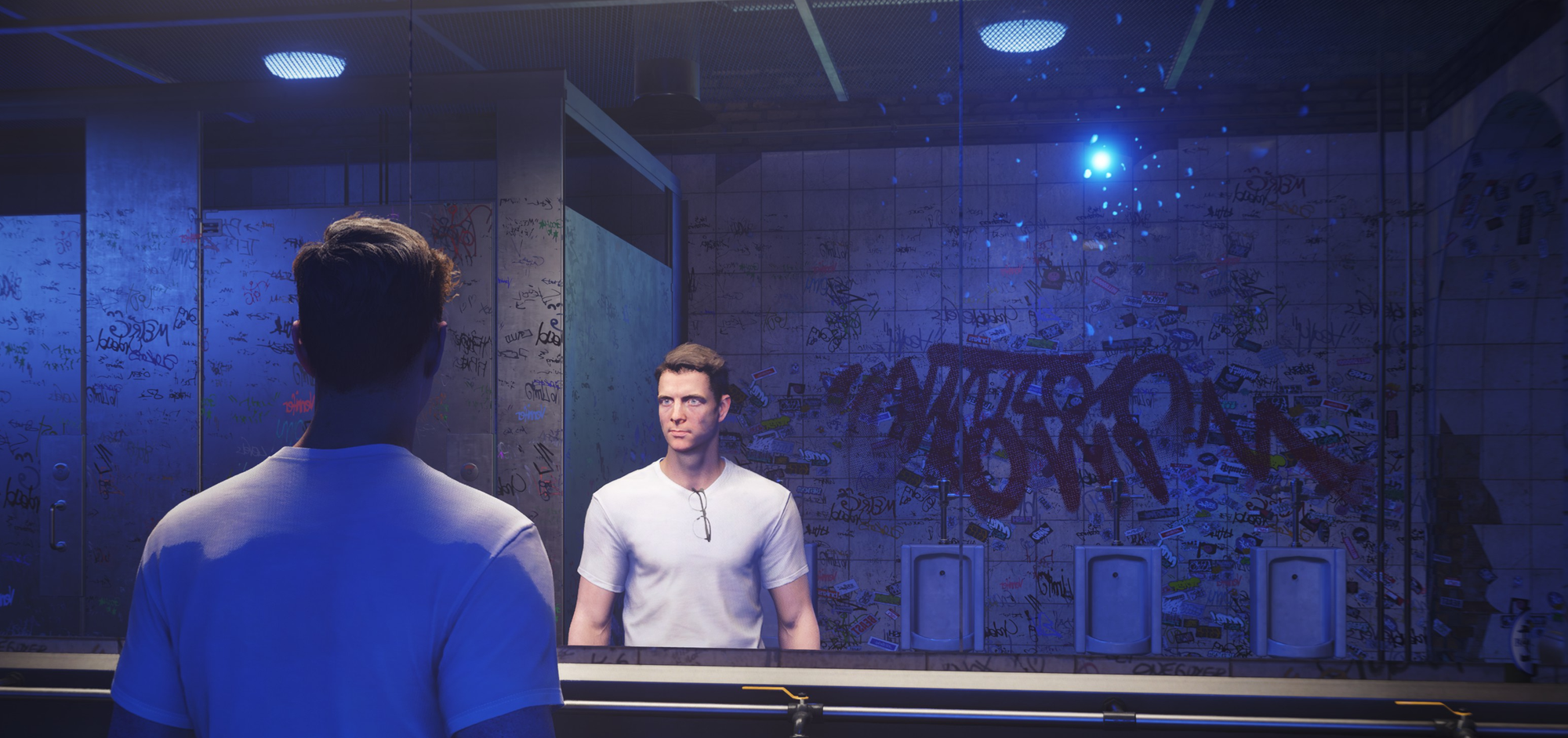
To learn more about this game--which really could have been called 007 Mirrorverse--I spoke with Dag Bjärum Bengtsson, Senior Technical Artist at developers IO Interactive. If one person could answer my deeply specific questions about the workings and placement of a bunch of mirrors in a single video game, it'd be Bjärum.
My first question was a historical one: why don't we see mirrors anymore in big video games? "Supporting functioning, good-looking mirror reflections in more modern games has become increasingly difficult with the ever-growing number of advanced rendering techniques/features which generally don’t scale or work well with having extra cameras rendering the whole world multiple times in a convincing manner", he tells me.
"If a game wants mirrors it has to be prepared to make quite a big technical commitment, and there is a performance cost to them that has to be accounted for and balanced all the way from the technology side to the art implementation side."
Bjärum says “many modern games”--I name-dropped Cyberpunk specifically when chatting with him--have not wanted to pay this cost, saying they'd rather prioritise other features, or that mirrors are rarely accounted for when scheduling for the development time needed to implement them.
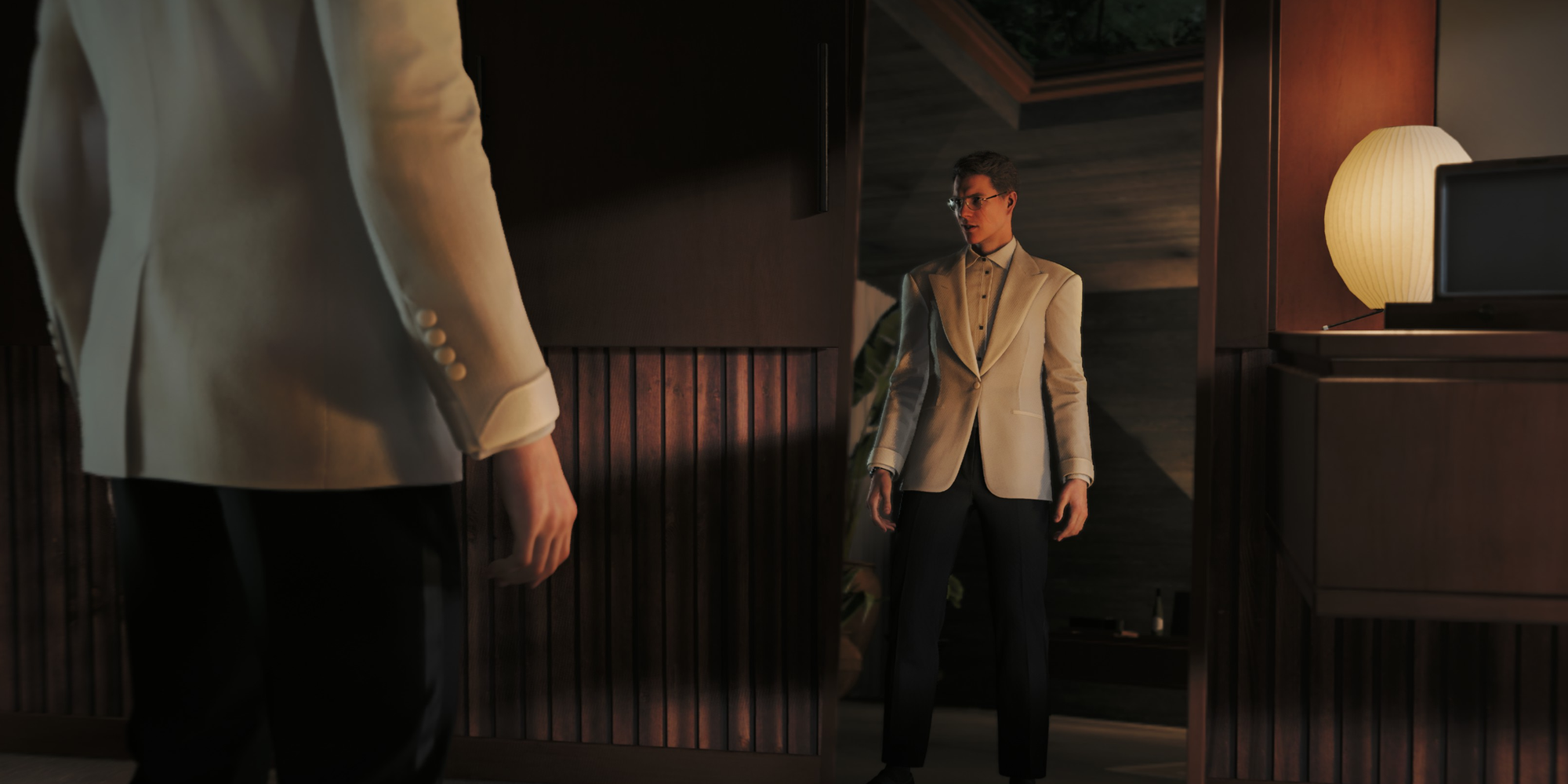
The reason First Light is able to throw so many of them at the player is a fairly simple one: like I've already mentioned above, the Glacier engine--which powers First Light but also the last few Hitman games--has simply never stopped doing it, so IO has never had to worry about changing their processes or adjust their resource allocation.
Which led me to my next question: just how do those mirrors work, exactly? "For mostly flat surfaces we have the possibility to configure a plane which describes the desired reflective object’s surface", Bjärum says. "Using the position, size and angle of this plane together with the position of the player camera, we have a secondary camera which renders the world using these parameters. The rendered image is then sampled by the material of any surface which we want the reflection to appear on."
"On the technical side, a lot of the heavy optimisation work done for Hitman carried over to 007 First Light, and in First Light we further enhanced them, with motion vector support so antialiasing techniques can better resolve the image, global illumination support, and more", Bjärum adds. "We also have many scalability settings to maintain stable performance across platforms.”
Which answers how they work, but what I really wanted to know is why there are so many big mirrors in this game. By the time I was one or two hours into First Light I was appreciating the working mirrors, but by the time I was five to six hours in I was thinking "man, there sure are a lot of mirrors in this game". By the time there's a cutscene that directly involves Bond trying on a pair of sunglasses in a bedroom mirror, I was convinced the developers knew what they'd accomplished and were taking the piss. So I asked Bjärum: were there so many mirrors because the concept artists just imagined the world that way, or was this an enormous flex from the technical artists because the mirrors worked so well?
"It came from both sides", he says. "The technical team’s confidence in the mirrors gave the artists the freedom to go big, and the artists going big pushed the technical team to keep optimising. Our artists really love the visuals of mirrors and embrace them to a very large extent, and we also have some special moments in 007 First Light (without spoiling anything) that could not really be achieved in alignment with the vision set out by our directors without them".


