

For a while now I’ve been trying to learn the Irish language, one of the big challenges of which is that, as an American, I just don’t encounter it much in my daily life. Putting any video game I can in the language has been one way, but I also watch a lot of TV on the Irish language channel TG4. TG4 recently added an Irish language game show, An Deis, and I am as obsessed with the idea of a game show in Irish as I am with what the hell it’s doing as a game.
An Deis (meaning “the chance” or “the opportunity”) is based on a Welsh language show (Y Deis) of the same format. Three teams compete in trivia rounds, but the twist is that major portions of the gameplay are controlled by two oversized dice that roll in a machine placed center stage. In the first round, the dice decide how much progress a question is worth toward moving on to round two. In round two, the color of each die triangulates a position on a board that dictates how much money a question is worth. In the final round, players themselves get to roll the dice to determine the size of the jackpot (in Irish, delightfully, “pota óir,” or “pot of gold”) they’re playing for.
A game show has actually been a great way to work on my Irish, which I didn’t expect. For one, the written questions show up on the screen, helping me try to understand them better. Sometimes I’ll pause the show to try to parse out the questions, and other times I’ll use the answers to try to help me get the gist. The game show format also helps because the host repeats the same rules and catch phrases every episode, so there’s a couple phrases I’ve managed to pick up that, while they probably won’t prove useful in real life, are at least helping me make some middling improvement to my absolutely abysmal listening comprehension skills.
Since you are probably not learning Irish and so don’t care about any of that, I am utterly fascinated by what this game is as a game. I don’t watch a lot of game shows, but the ones I have seen are strictly American. So it’s utterly baffling to watch a game show from a different country, where the cultural mores and what is considered game show-appropriate knowledge are totally different.
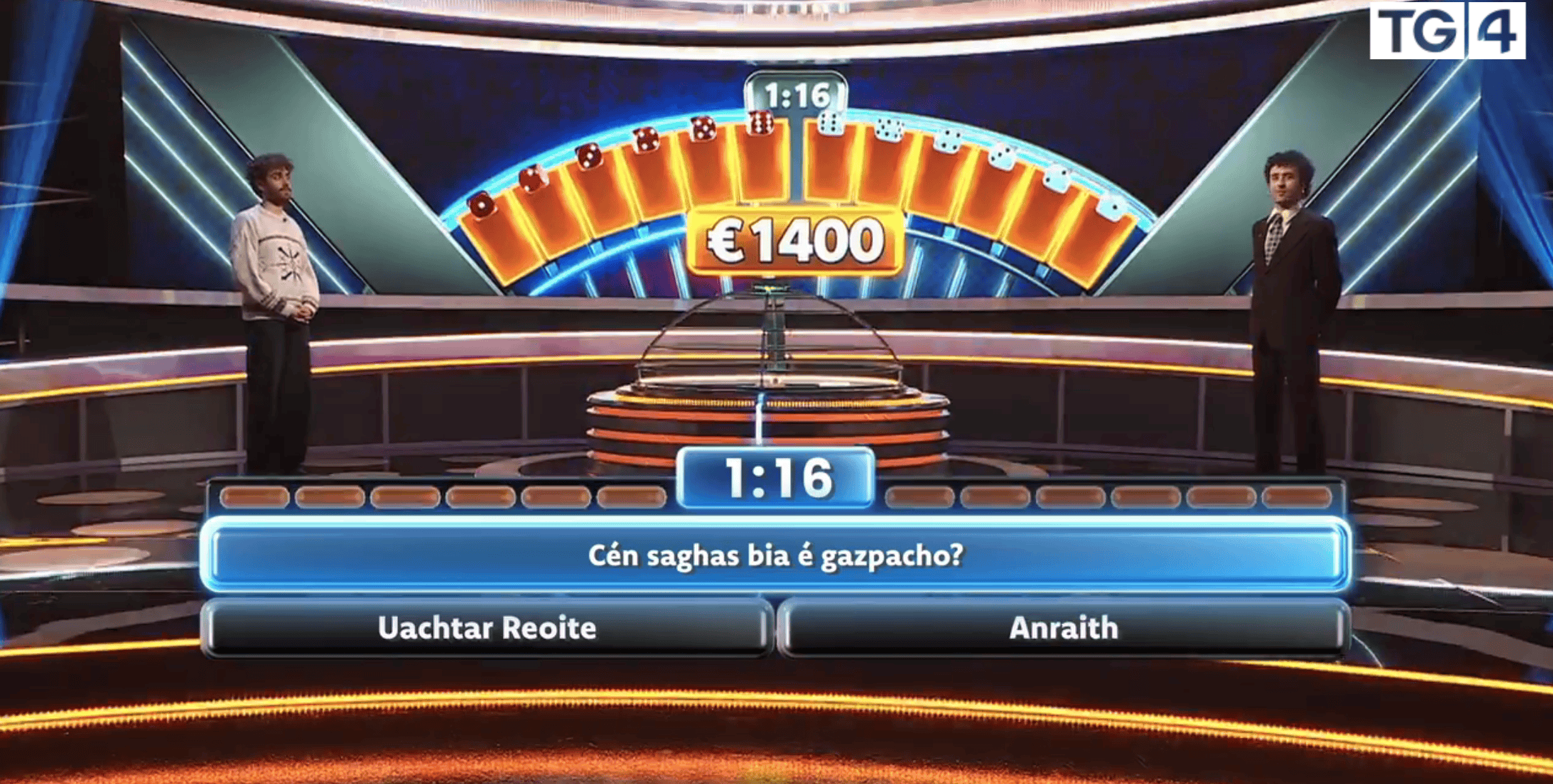
To me, the range of questions is absolutely nuts. In one episode, one team was asked who starred in the movie Barbie, while the next team was asked which crop Jean Nicot introduced to France in the 16th century. One team can be asked whether a ciabatta is a soup or a sandwich, while another can get a question about a specific word from South Africa or how old Tatum O’Neal was when she won her first Oscar. There are a lot of questions about Irish geography, mythology, and literature (fair enough), as well as a ton of what I feel like are very specific questions about Irish sports like rugby and hurling, like how old a certain player is or how many points they’ve scored over their lifetime. (I was delighted, in one episode, by a team of two Irish language TikTokers debating knowledgeably and at length about the question “Who led the Connacht army in Táin Bó Cualinge?” They ultimately got it wrong, though.) In the final round, a team is split in half and has to answer questions by themselves, and it was sometimes head-spinning to watch one person get questions about pop culture while the other was asked about science or international airport codes or the total sum of all the slots on a roulette wheel.
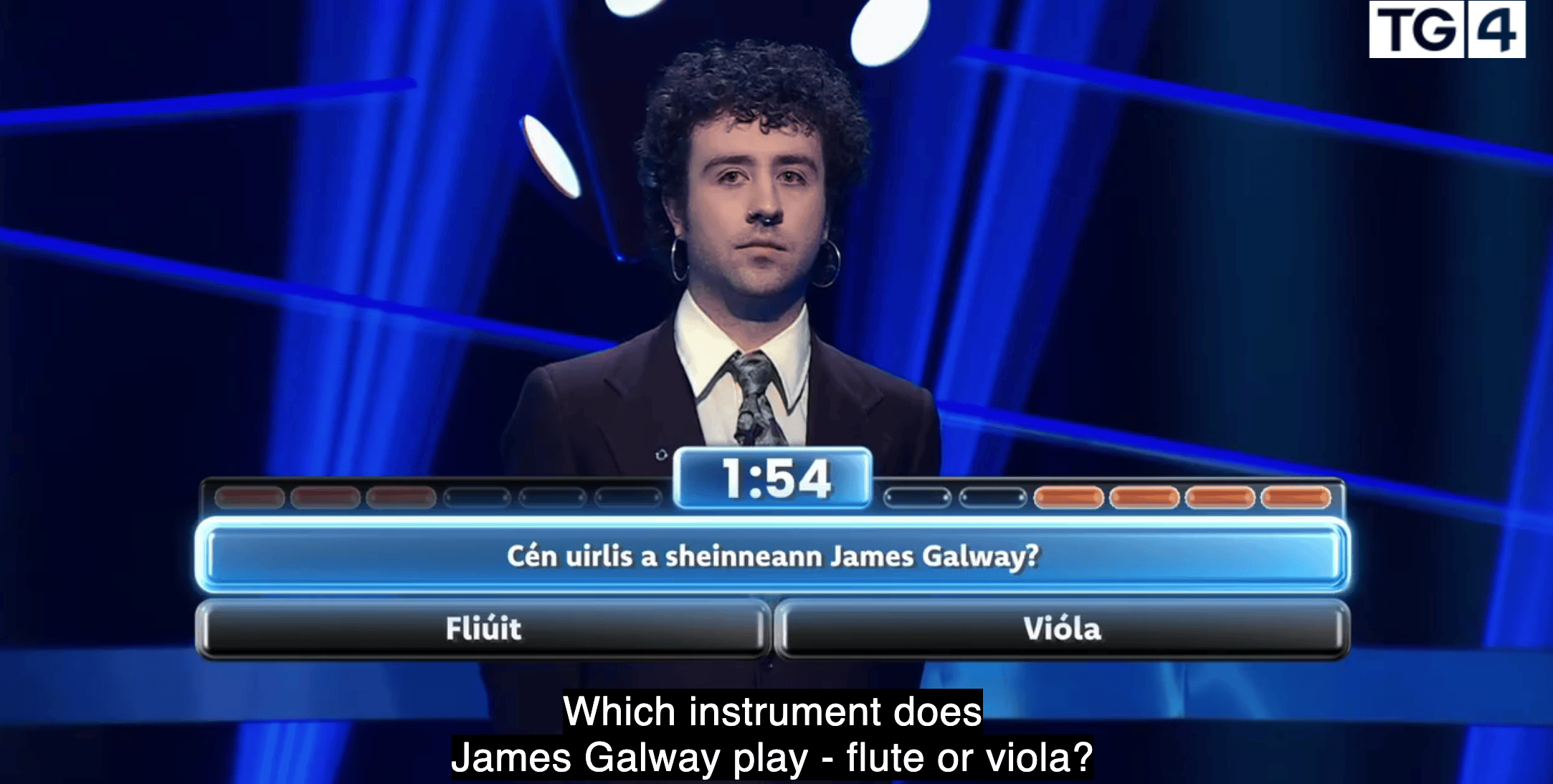
I wondered if some of the very Irish questions were a result of who one would assume would be on an Irish language game show. There were several teams of Irish language influencers or people who worked at Irish language organizations, and an early episode featured a man who’d translated the board games Monopoly and Scrabble into Irish. But there were just as many sort of random folks, including one guy who’d moved over from America and had only been learning Irish for a couple years. (He told the host that he can understand Irish but can’t read or write it, which as someone who can only do the opposite made me both jealous and a little shocked.)
My favorite team was a couple of glam rock-looking boys who kept winning largely due to the show’s dice structure, which is the other fascinating thing about this game. I get the concept of the dice, and they do add an interesting level of chance. In the first round, a team can answer less questions than the others correctly but still proceed, because they get higher rolls and thus more steps toward passing than teams that get less lucky. The second round honestly took me a couple of episodes to wrap my head around, though this isn’t strictly the fault of the dice: in addition to the two dice determining which square players land on, they also lose all their money if they land on certain squares, or if they land on other squares, they can steal half the other team’s money. It’s just a lot going on, and the host sometimes had to clarify it in the middle of the game.
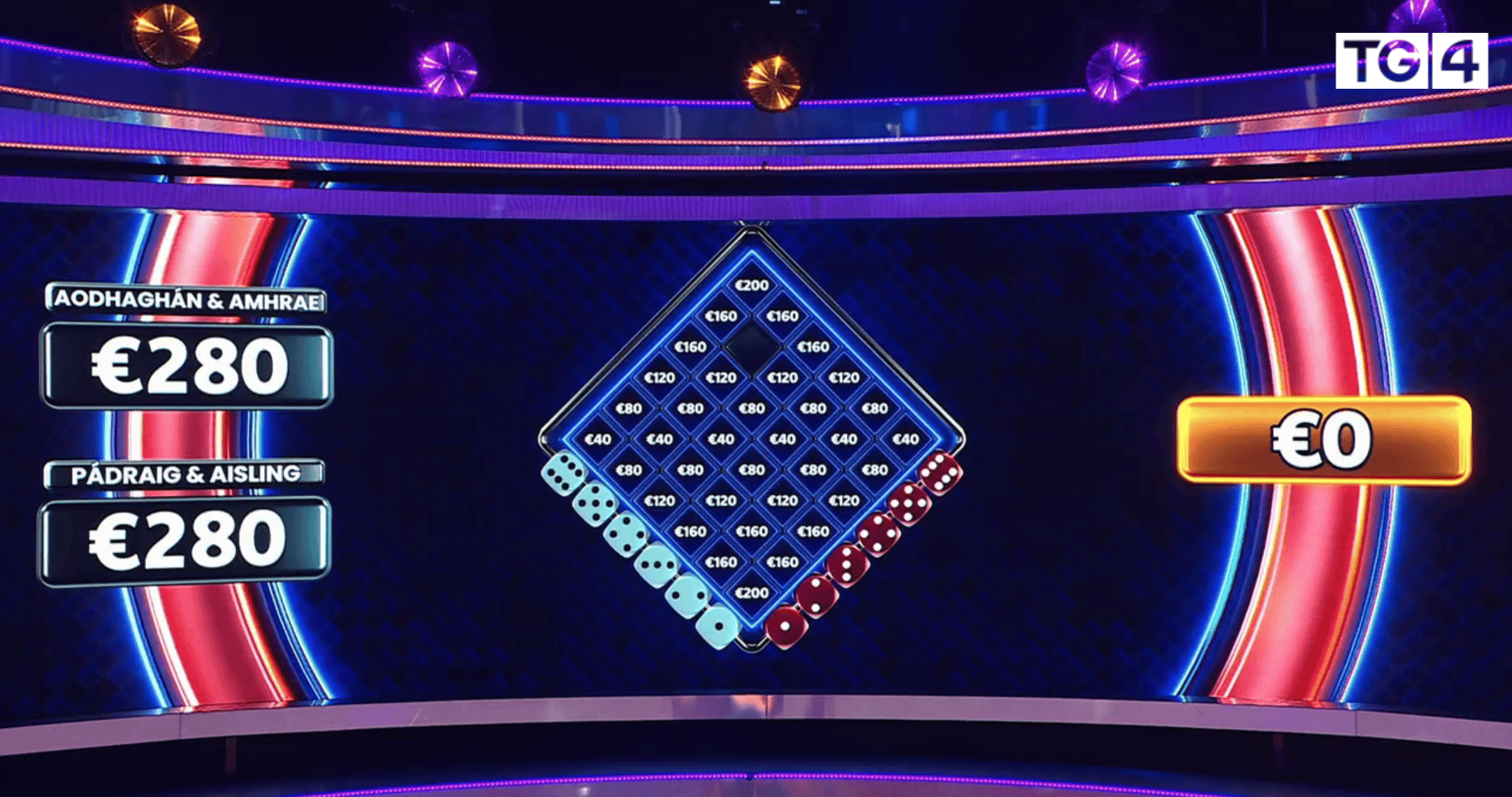
The dice don’t matter much in the third round, outside of rolling for the size of the jackpot. This is another thing I find charming about this game, as teams were often competing for something around 1500 euro, far smaller than the kinds of jackpots you see in American game shows. I can’t imagine the show has much money to throw around, but it was still sort of hilarious to see players taking home a few hundred euro for a successful run.
My biggest complaint is that while the concept of the dice plays a big role in the show, the actual rolling isn’t all that important, so it’s unfortunate that the dice roll around in their machine simply forever. A few episodes in I’d started fast forwarding through the rolls because they take so goddamn long. I started assuming it was the nature of the machine, that it needed to build up a certain speed in order to fling the dice; the time adds to the drama of how the dice will affect players’ fates, but it’s far more gripping to watch players answer questions. The show definitely knows what vibe it’s going for, but because of how long the dice roll, the focus feels like it’s set on just the wrong place often enough to make things feel a little weird instead of dramatic.
My biggest takeaway from An Deis is a renewed appreciation for how culturally specific game shows are, which I had never considered much before. A lot of American game shows feel like they’re played for life-changing sums of money and lean in on people’s stories, how they overcame hardship to learn trivia or how they’re desperate for a new mini-van or washing machine. By contrast, everything here felt very modest, with no tearful or heated moments; at one point, a father-daughter team could have stolen another team's money and won, but declined and lost instead. I don’t know how much of the show's particular vibe was the niche of the show being on the Irish language TV channel, or just the nature of game shows in other countries where people have to rely less on big breaks in order to simply live, but it definitely made me think more about how gross so many American game shows are at their core.
You can watch the whole thing for free on TG4’s website if you’re curious. My biggest takeaways, beyond now badly wanting to read a book about the role of game shows in our shared cultural imagination (recommendations, please; this must exist), is so many questions about what makes a “good” or “bad” game show; there’s a non-zero chance one of you reading this is a game show designer, in which case, please get at me. An Deis has also made me more confident with the Irish words for “right” and “wrong,” something I imagine will serve me well as I progress in my studies and keep getting everything wrong.


