

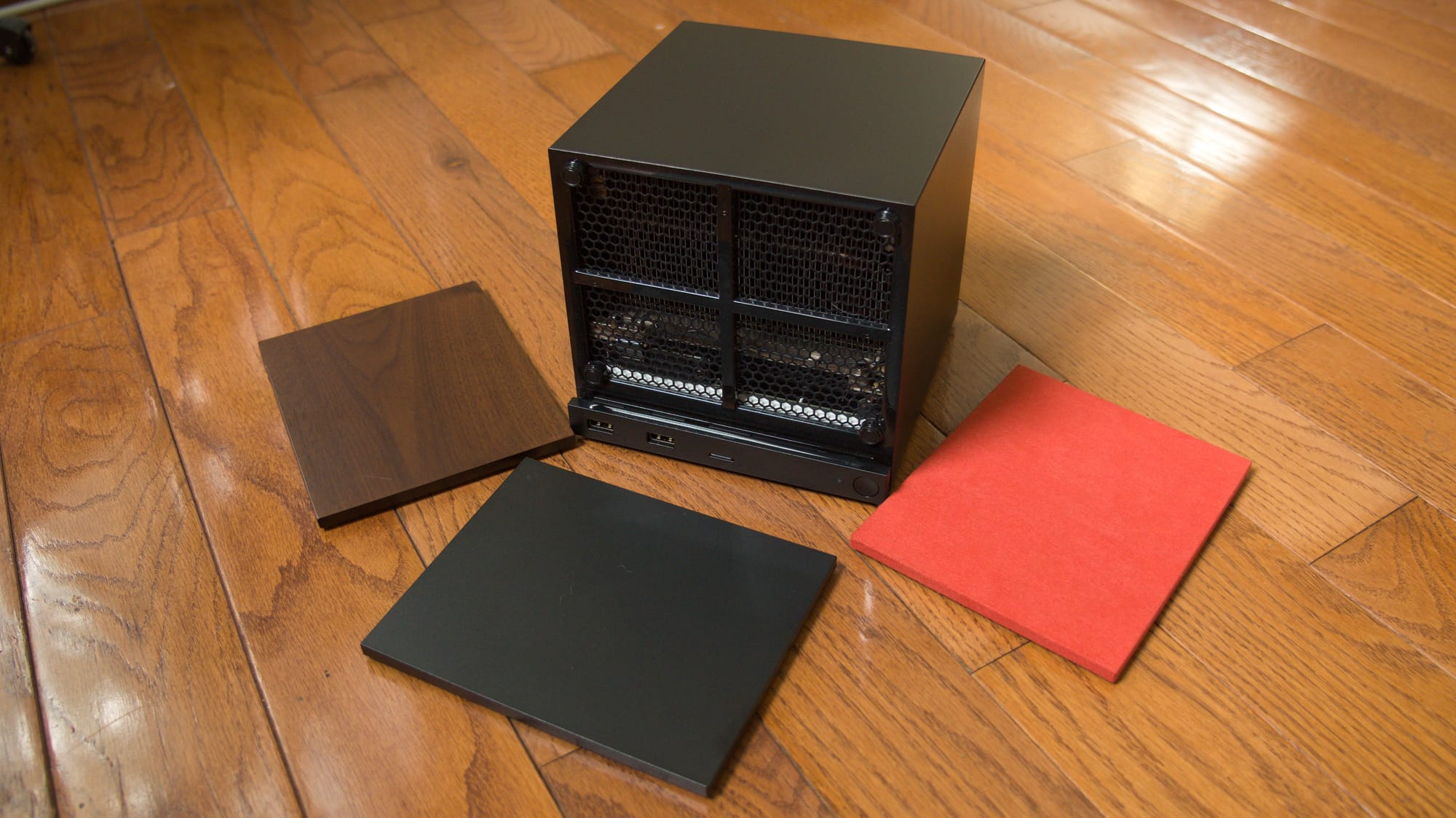
It’s difficult to talk about the Steam Machine in the abstract versus the Steam Machine that is in my hands right now. The one in my hands is intuitive and easy to use like a console, sets up fast and, for many PC games, it just works. It is one of the most unintrusive and charming pieces of console hardware ever to grace the living room, a tiny industrial cube that allows you to swap the front plates if you want. Design-wise it is in league with the Series X, the Sharp X68000 or Sony’s offerings in the PS2 era. It is also one of most mass market releases of a desktop computer to ship with Linux in history.
But it is also a computer released in 2026, when a bunch of useless jackasses have made the computer expensive. It costs more than the PlayStation 5 Pro for the entry level model without a controller, and is roughly what a prebuilt computer with as much RAM and memory costs. The math is much more charitable when you realize that the Steam Machine is an adult computer you can install your own software on, instead of a weird playpen like the PS5 Pro that charges you $79.99 a year to play games you already own online.
On a long enough timeline, the cost might not matter. What would normally be a debilitating launch for a console is sub-optimal but not ruinous for the concept of the Steam Machine. You can build a Steam Machine yourself, and I know because at present I have three Steam Machine-shaped devices sitting next to each other in my living room, all running Linux. The Steam Machine is meant for an alternate present but, barring that, it could lay the groundwork for a more interesting future.
Sticker shock
It’s worth letting the air out of the room about what the Steam Machine costs before talking about what it does: $1,049 for the base model with a 512GB SSD, and $1,128 for the same model with a Steam Controller. Bump the SSD up to 2 TB and that goes up to $1,349 and $1,428 with the Steam Controller. Bundling the Steam Controller separately is smart because customers may have already bought a Steam Controller. The most expensive bundle comes with additional face plates in red and walnut.
The sticker shock will be met with a chorus of “oof”s and “yeahhhh”s, but as someone who has doggedly watched PC component prices creep up every single day, I’m not remotely surprised. This is straight up what computers cost now. The PS5 Pro costs $900, and Apple discontinued its $599 256GB base Mac Mini recently, which makes sense because a bunch of dullards kept buying them to run OpenClaw instead of doing anything remotely useful with their lives. You know things are bleak when Tim Cook, Mr. Supply Chain himself, says “Unfortunately, price increases are unavoidable.” Try finding a comparable Chinese mini PC in stock or price out a similar build to the Steam Machine, and while you might be able to hit a similar price if you get lucky, it is unlikely that it will be in anything approaching the same form factor. If you had the foresight to build a good PC before AI and memory companies threw us all under the bus, try inputting those components into PCPartpicker now. I did: My computer now costs around $5,500 without a case.
 Chris Person
Valve has stated outright that this price point was never their plan. “Our original goal for the price of Steam Machine is no longer viable,” Valve wrote in a blog post prior to release. “So the prices we're sharing today reflect the state of the world for manufacturing; or, more accurately, it reflects the price [of] the components as we've secured them over the past 6 months.” This has not only impacted how much the units cost, but also how many units Valve is able to ship based on the components they could secure. Valve also wrote that they do not wish to subsidize the hardware, stating that it runs counter to their idea of the PC as an open platform. “When companies sell their hardware under cost for competitive advantage, or buy exclusive content for it, they're doing that to build a more closed system, one where you don't get to choose what software you want to use.”
Valve arranged an interview with engineer Pierre-Loup Griffais and designer Lawrence Yang, and when I asked what they had originally targeted for their price, they said they could not specify, although they did suggest that the price increase the Steam Deck OLED recently underwent should give you a ballpark estimate of how much the Steam Machine’s target had moved. But at this point, counterfactuals are cold comfort.
It’s hard to fault any console or PC maker for raising their prices in an environment this rancid, but I am still bummed out. The Steam Machine was supposed to do something very important for PC gaming generally and Linux computing specifically: provide a stable and affordable goal for others to build on, and to continue the work in the living room that the Steam Deck did with handhelds. If Sam Altman and his cadre of chicken-necked freak friends hadn’t decided to gobble up the global memory and RAM supply, it could have been a slam dunk. For now, it’s a wonderful if modest little computer for those who can afford it, that is doing important work for what comes after.
Disclosure: Valve provided Aftermath a Steam Machine for this review.
The setup
The experience of setting up the Steam Machine is seamless. You input the basic parameters of language and internet credentials and the Steam Machine goes through its little setup process where it shows you in big IKEA-like pictograms on how to set the controller and audio up. After that you’re off to the races. At most, you are installing the latest patch and updating your controller’s firmware. If you have an existing Steam account and the mobile app, linking the device with a QR code takes about two seconds. Navigating the Machine’s menu with the Steam Controller is a joy, and I’ve gotten so used to using it at this point that even after a few days I didn’t bother to move my keyboard’s dongle six inches to switch it from my living room PC for a few days.
Not all PC games are compatible with the Steam Machine–some for reasons outside of Valve’s control–but the work done on Proton (the compatibility layer that allows Windows games to run in Linux) has made the need to check ProtonDB and fiddle with settings less necessary every day. Steam is fairly good at visually indicating which games run on the Machine, although to a newcomer the idea of being able to buy a game that you can’t play on your console might sound alien. By default the Machine boots into Steam Big Picture Mode, although you always have the option to go to a desktop environment.
Since the Machine I used is pre-release, Valve says they are still working out the kinks and making new improvements to how it performs. I tried playing 007 First Light and the game humorously defaulted to the native resolution of the Steam Deck. Valve assured me that this is a byproduct of the machine operating in Steam Deck mode and that this will be addressed as new SDKs are released. Valve shipped multiple patches to address issues like VRAM optimization and ray tracing performance in the week I’ve had the Machine. For the most part games ran well natively at 1080p and 1440p depending on the title and settings, although I did end up hitting the ceiling of the 8 gigs of VRAM often if I got too ambitious with settings.
Dialing in
The machine sang when FSR or XeSS, AMD and Intel’s AI upscaling technologies, were applied, and I get the sense that this is going to be the default for many high end titles. I was surprised that I was able to pull a respectable, native 1440p at 30 fps out of Crimson Desert with fairly high settings. I don’t have the means to benchmark the Machine as rigorously as an outlet like Digital Foundry, in part because the performance of the Machine would change from day to day. If the Steam Deck is any indication, the machine will only be better optimized over the years. But I did run it through both Black Myth Wukong and Cyberpunk’s benchmarking tests with FSR and 4K, and both ran well enough.
Since the Steam Machine uses a custom RDNA 3 GPU, Valve told me it will soon be getting the same FSR 4.1 improvements that AMD recently announced it was extending backwards to previous generations of its hardware. This is good news because FSR 3.1 looks like ruddy toilet water and FSR 4.1 is a significant improvement over previous versions of the upscaling tech that approaches Nvidia’s DLSS in performance. A version of FSR 4.1 that ran in earlier hardware actually leaked in the last year, and so it’s trivial to install that even on a Steam Deck, but an official release is imminent and I’m excited to see it officially ship.
Some console players used to preset settings like “quality” and “performance” might find the granular nature of PC display settings disorienting, but I have always found tweaking display parameters soothing. It is the sign of real PC gaming, and as easy as the Steam Machine has made the gaming experience, it’s an adult PC. Like the Steam Deck did for handhelds, the Steam Machine finally offers an accessible living room entry point to countless freaky little PC games that have historically never made it to consoles. It is a machine suited for both AAA games as well as early access oddities like Psycho Patrol R and Goblin America (a real and grotesque looking game which I did briefly play). The Steam Machine does not give a shit if you throw emulators on it, and projects like EmuDeck have streamlined the entire process. The Heroic Games Launcher lets you seamlessly add titles you may own from the Epic Game store and GOG as well. You can throw whatever mods you want on there, provided you have a compatible way to manage them. At this point, the Steam Machine is probably a better place to play Bloodborne than the PS5 if you’re crafty.
SteamOS is a fairly straightforward and newbie-friendly variant of Arch Linux. The Discover app functions like a standard app store but for Linux. If you’re new to Linux, imagine if the Microsoft store was mostly full of useful free software, uncluttered, and not miserable to use. Neophytes may also be pleasantly surprised to learn how seamless it is to update every program on your computer at once with a single command. And unlike a Windows PC (and even Mac recently with the atrocious Liquid Glass update), you’ll eventually learn to love and trust your computer updating instead of disconnecting it from the internet and pointing a gun at it every time it tries to perform a system update.
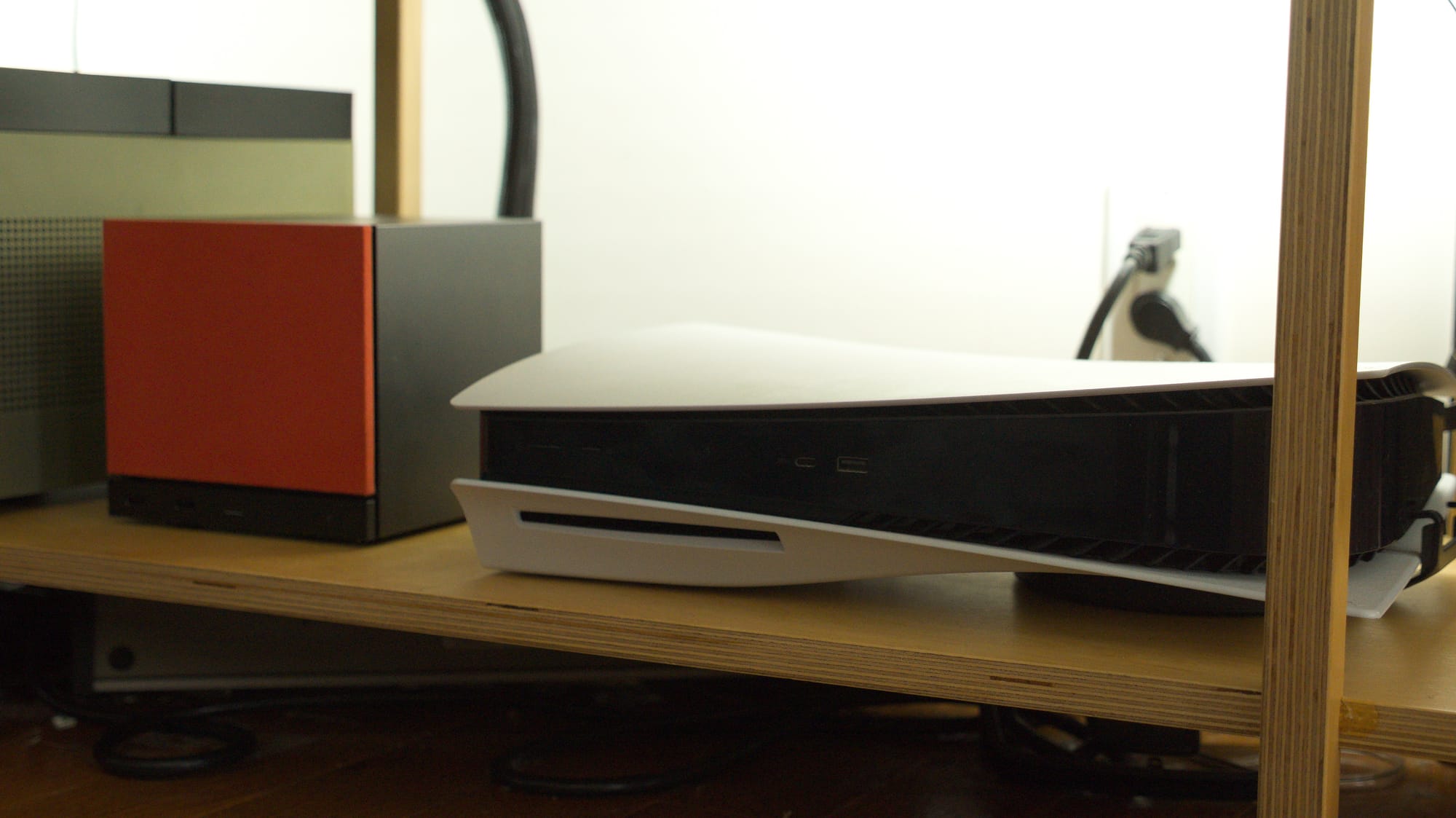
The Steam Machine has a lot of pleasant little tweaks that make interacting with it a joy. It contains an internal variant of the puck that comes with the Steam Controller, which helps you to shift the Controller back and forth between computers if you so choose. There’s a tiny LED strip at the bottom of the front of the Machine, which is most useful as a progress bar when you’re downloading huge games from Steam. Like the PS5 there’s a swappable shell component in the form of the front magnetic face plate, and Valve plans on releasing the STL so that anybody can make face plates on their own (versus Sony, who eventually got lawyers involved when someone did that). Valve also put an SD slot on the front, which makes transferring files or sharing games between the Steam Deck and Steam Machine seamless. Given how bad the market for drives is currently, any flexibility in storage is potentially a godsend.
The lonely life of the living room PC
As I wrote in my review of the Steam Controller, I have long been a “full ass gaming PC in my living room” guy. It has not been an easy lifestyle historically, as it’s often been hard to find a PC case that isn’t embarrassing let alone build a small form factor PC that runs quiet. Even consoles have become embarrassing eyesores half the time, with both the PS3 (minus the slim) and PS5 existing as grotesque carbuncles that live under your TV. Couple that with the awkward experience of running a desktop on a 65” OLED or projector and it’s understandable why this lifestyle has not caught on yet.
The Steam Machine is the most proactively pleasant PC I've ever used in a living room setting. I cannot stress how quiet and unobtrusive it is, a quality I did not realize mattered to me until I’d spent a week with it. I had to put my ear next to it to hear that it was on. As someone who has built a small form factor PC I cannot stress how easy it is to make something this tiny accidentally sound like a jet engine every time it needs to do a moderately complicated task. To design a small form factor PC is to fight nature and physics and often lose.
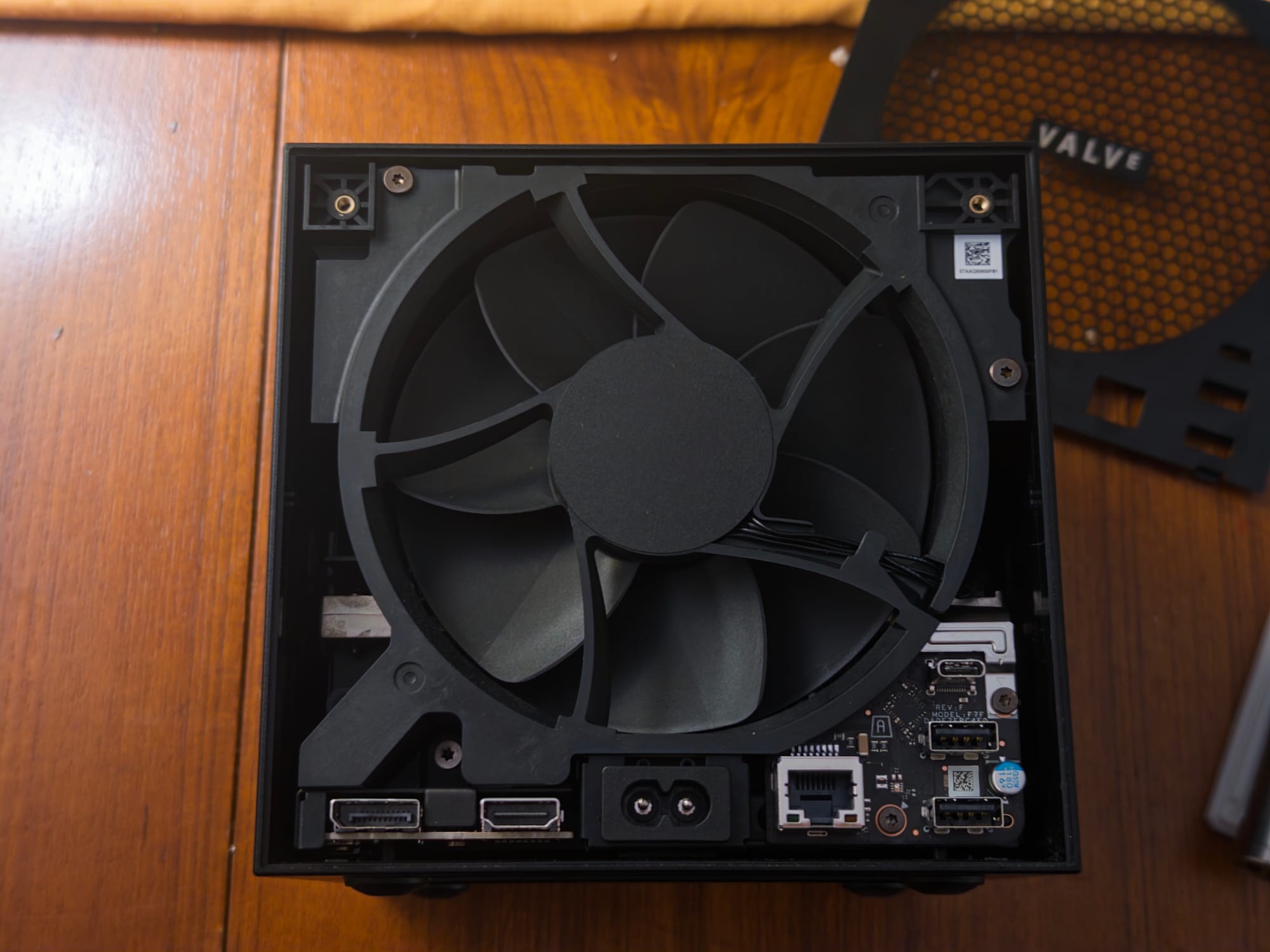
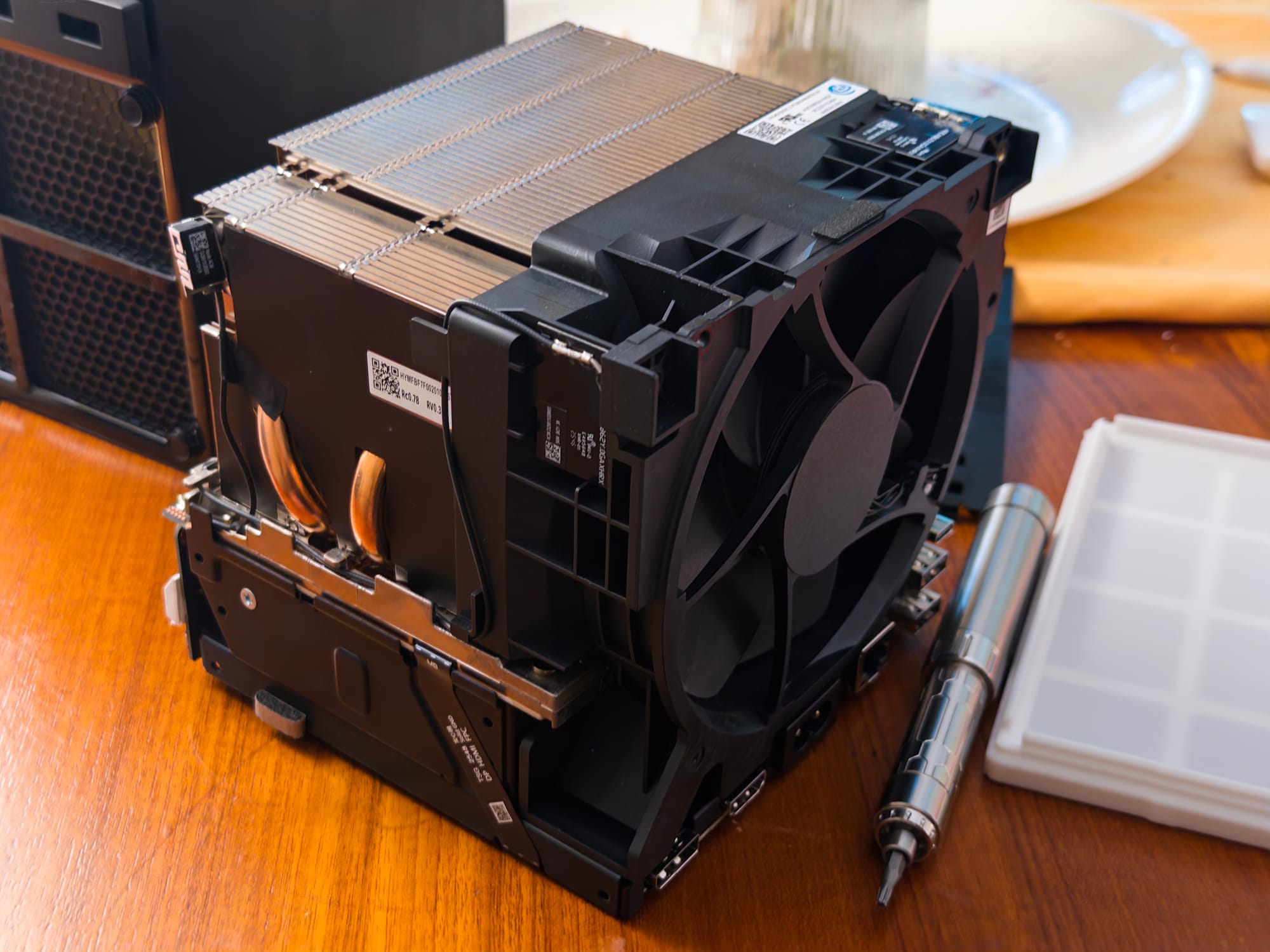
The internals of the Steam Machine.
The inside of the Steam Machine is frankly beautiful, and I do not say that lightly. The majority of the Steam Machine’s guts is just one big cooler connected to a custom plastic shroud and attached to a single, funky looking 120x25mm fan. “The whole thing is basically a thermal module with a slice of compute attached to it,” Yang told me, and both Yang and Griffais beamed when they talked about the thermal design. The back is connected with two torx security screws embedded in the rear so you don’t lose them and comes off on a hinge. The top and side shell is connected via the four rubberized feet that are also torx screws. You do not need to remove the cooler to replace the SSD, as there’s just a breakout board on the bottom of the thing that is easy to access. The Steam Machine has the exact same design ethos as the Steam Deck and Steam Controller, the spiritual midpoint between repairability and optimizing for a specific goal. You can tell this machine is loved deeply by the people who designed it.
Valve has also done a lot of work getting features normally found in HDMI 2.1 to work in HDMI 2.0. This involves getting VRR (Variable Refresh Rate) and HDMI-CEC to work seamlessly across multiple TVs. “In general, integration with the living room is tricky to get right. There's a lot of different TVs. They all support CEC differently. The ecosystem has a lot of interoperability issues,” Griffais said. Though by no means unique to the Steam Machine, it still feels bizarre to be able to navigate Steam and PC games in menus with an LG remote. Audio is seamless with my Denon AVR. The ability to get full 4k120 is currently being worked out (you can currently do that by means of Chroma Sub-Sampling or by using a DisplayPort to HDMI dongle, but it’s not perfect), and Valve told me HDMI 2.1 FRL (Fixed Rate Link) support is in the works, which allows for higher bandwidth modes.
The work Valve is doing to solve these issues for the Steam Machine will often benefit other Linux computers, which is the nature of open platforms. When your work is done in the open, everything gets better on the whole. And that’s good, because I don’t have just one Steam Machine, I have at least three.
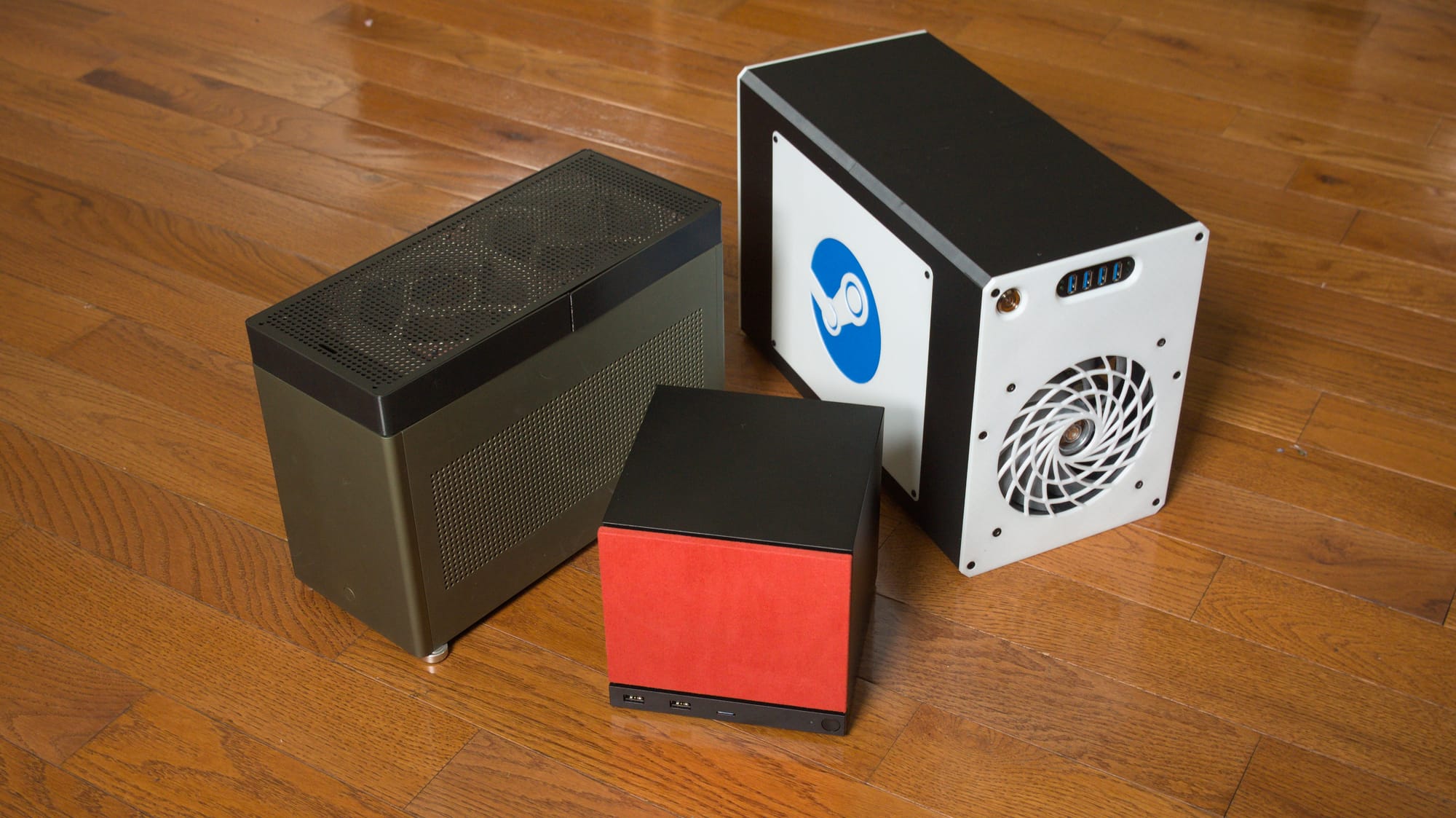
Unlike Xbox, anything really can be a Steam Machine
Linux has gotten good, to the point where even non-Linux people have been admitting it. There are many roadblocks to adoption that have to be blasted through, but for the most part gaming has never been better. There are some notable exceptions to this – games like Marathon that feature kernel level anticheat often lack a workable Linux implementation. In my interview with the hardware team, Griffais said Valve is “very aware” of this issue and are attempting to make progress on it, although that progress might be long term. “We definitely are very aware of the tradeoff between security and openness,” Griffais told me. “We don’t want to end up in a situation where we do a bunch of short term work that goes too far in one direction.” But for the most part, this issue is limited to a handful of mostly multiplayer games. Often, most games simply work.
Six months ago, I decided to give living with Linux full time a shot. I started by installing Bazzite, a gaming-oriented version of Fedora Atomic similar to SteamOS, on my older living room PC. Like SteamOS, Bazzite is meant to be no-nonsense, instantly parsable by gamers, and easy to run without breaking something randomly. While the experience has had its bumps, in no small part due to uneven GPU support for Nvidia compared to AMD, the day-to-day console experience was superior. I then moved on to my main workstation, installing Bazzite on to my secondary drive to dual boot.
Though I am slowly isolating and migrating the tasks I rely on Windows for with my workstation, those are fewer and fewer every day, and the experience is constantly improving. The living room PC is powerful enough to lift its weight playing most indie titles and some slightly older AAA games. For everything else I’m able to stream from my workstation via Moonlight or Steam’s own internal streaming. My relationship to the Steam Machine is almost identical in most functional respects to my living room PC, although the Steam Machine is far better optimized, quieter, and purpose-built for the task.
A few months ago, I also became aware of another project for people who cannot afford Steam Machines: the BC250. A crypto mining card built on a stripped down version of a PlayStation 5, the BC250 started to appear on the secondhand market a while back for around one hundred dollars. It features 16GB of unified GDDR6 RAM that is soldered right onto the board, and features an air cooler oriented to be run in server racks. Eventually, people figured out that you can install Linux – usually Debian, Bazzite or CachyOS – right onto it. The People had turned e-waste into Steam Machines. And though it requires a lot of elaborate work just to get it to run and comes with some serious tradeoffs, the cost of the RAM on it is far more than the price of the board itself even after the word got out and caused the price to spike by 50 bucks.
Because I am vocationally addicted to projects, I slowly began a BC250 build that has taken well over a month in my spare time, researching cooling solutions and 3D printing cases. I had to talk for hours on Discord with a helpful stranger named Gadget about his case, and figure out a way to get a discontinued cooler to fit. Since I started, the community has figured out ways to unlock the sectioned compute units on the card, bumping them up from 24 to up to 40 depending on how lucky you are with the silicon lottery. Though still early, the performance boost is so significant it’s absurd. An entire community has sprung up around this wonky-looking bit of hardware with an active Discord and wiki, and people are constantly innovating with different form factors and cooling solutions. I do not intend to keep this machine in my house; I have far too many. But I will write about it in depth, and I fully expect it to live on in the living room of a friend who cannot afford a Steam Machine.
The BC250 is a distorted mirror of the Steam Machine. While the Steam Machine is pricier than a console traditionally, it’s ludicrously easy to use for a Linux PC and works beautifully even in beta. The BC250 is a low cost and high effort project, or at least it was for me because I decided to make the most absurd and elaborate air-cooled build possible. But those machines, as well as my converted living room PC, all now exist within the continuity of Valve’s idea for the Steam Machine. All of them benefit from work being done in the open, a rising tide raising all boats. In the same way that the Steam Deck directly improved similar but more powerful products by companies like MSI, Lenovo and ASUS, I can easily see the Steam Machine’s form factor and simplicity of use being applied to the countless mini PCs out there if the market ever settles down.
The Steam Machine is not a console in the traditional sense; the economy is increasingly hostile to that idea. It is working towards something that both Valve and the community itself are building on. This makes even more sense when you look at FEX, a Valve project to have X86 programs run on ARM chips like smart phones and portable devices, and the explosion of support for PC games on devices like the AYN Thor. But Valve’s hardware team also indicated that a part of the Steam Machine’s launch is the extension of SteamOS proper to as many devices as possible, with a goal of improving compatibility with Nvidia and Intel GPUs. The more hardware they can reach, the better.
A goal
When Valve tried the Steam Machine the first time around, it did not have its shit together. The basic underpinnings that make their current ecosystem work wasn’t simply not there yet. Instead of leading with their own hardware, Valve had loose relationships with third party vendors, each offering a boutique product. The idea was half baked, and ultimately fizzled out.
This time around, the situation could not be more different. Both Windows and Xbox are in the worst state in Microsoft’s entire history, and the very existence of the latter as a platform is legitimately in question. The Steam Deck, while still relatively niche compared to Nintendo’s offerings, is beloved by people who use it. The next few years are going to be chaotic, as hardware pricing hits this entire industry like a cement truck, and the difficulty in buying components causes many hardware manufacturers to fold. In this environment, predicting how anything will shake out save for Nintendo puttering along is impossible. But it is very likely that people are going to have to get creative with whatever they have around if we want this hobby to stay alive. E-waste, freak handhelds and older computers – people are and will get increasingly creative.
The Steam Machine is not landing where its creators planned it price wise but the core vision has been realized and is something I agree with ideologically. It is a platform in the true sense of the word, a foundation to build on. Like the Steam Deck, it provides a reasonable target for game developers to aim for, a reasonable optimization baseline that can handle basically every indie game and a huge portion of big titles. It is the rare console that does not treat the user like a child, and I have no doubt that it will improve with age. And like Valve’s original vision for the Steam Machine and the reality of the Steam Deck, it is a template that any other manufacturer could easily build a much more performant product on, with an operating system that is, in multiple meanings of the word, free.
When I asked the team about the dire context of their launch, Griffais reminded me that the Steam Deck was developed following the supply chain disruptions around COVID. “We’re looking forward to being able to launch hardware in times that are a little bit more quiet,” he told me.
Yang agreed, “Less interesting times.”


