

Teenage Sex And Death At Camp Miasma is the latest film by Jane Schoenbrun, the director of We're All Going To The World's Fair and I Saw The TV Glow. Like those movies, it's all about queerness and media, and, like those movies, all my (Riley's) friends can't stop talking about it. Chris and I both saw it recently, and now we're here to talk about it.
This post contains spoilers for Teenage Sex And Death At Camp Miasma.
Riley: Hello, Chris! I saw Teenage Sex And Death at Camp Miasma over the weekend, after reading the Wikipedia summary enough times to convince myself it wouldn't be too scary for me. (I'm a horror wuss.) And you saw it too! What did you think?
Chris: Man, I wish I liked it! I wanted to like it! I, unfortunately, did not like it.
Riley: I also did not quite like it. I came home after seeing it and read some reviews, and one was like "this movie is so nuanced and layered" and the other was like "this movie was so obvious I wanted to chew my arm off." I found that dichotomy very funny.
Chris: I am in the latter category unfortunately, and to quote the film critic Peter Griffin, it insists upon itself.
Riley: Yeah, I think it's... very clear about what it's talking about, even under its layers of meta-narrative and surrealism: media and queer desire and in particular the eroticism of slasher films. But I wasn't always sure what it wanted to say about those things. It felt like the big dramatic moment was "slasher films are about sex" and I was like... well, yeah.
Chris: The thing is the movie contains many things I enjoy. Jane Schoenbrun casts a lot of people I like! Hannah Einbinder, Gillian Anderson, Zach Cherry, Kevin McDonald, Sarah Squirm, Louise Weard, Patrick Fischler. It's a stacked cast. And there's a handful of jokes in there that I thought were quite good. But I found it to be tedious and academic while also chastising that impulse!
But maybe we should get into the plot of the film first.
Riley: Right. So the short version is that filmmaker Kris Williams (Hannah Einbinder) has been commissioned to reboot and reinvent a slasher film series called Camp Miasma, which was once very popular until it played itself out. The film series is about a summer camp stalked by a killer called Little Death (get it?... sigh), whose backstory is now seen as transphobic and retrograde. Kris is trying to cast the woman who played the original film's final girl, Billy Presley (played absolutely wonderfully by Gillian Anderson), who lives alone in the abandoned summer camp that served as the set for the films. Kris stays with Billy at the summer camp, and things get... sexy and meta.
They're both great characters, and they work really well together--they're so different, but they have this great chemistry, and I think watching them on screen together made the movie less tedious than it could otherwise have been when it started feeling a little too film school for my tastes.
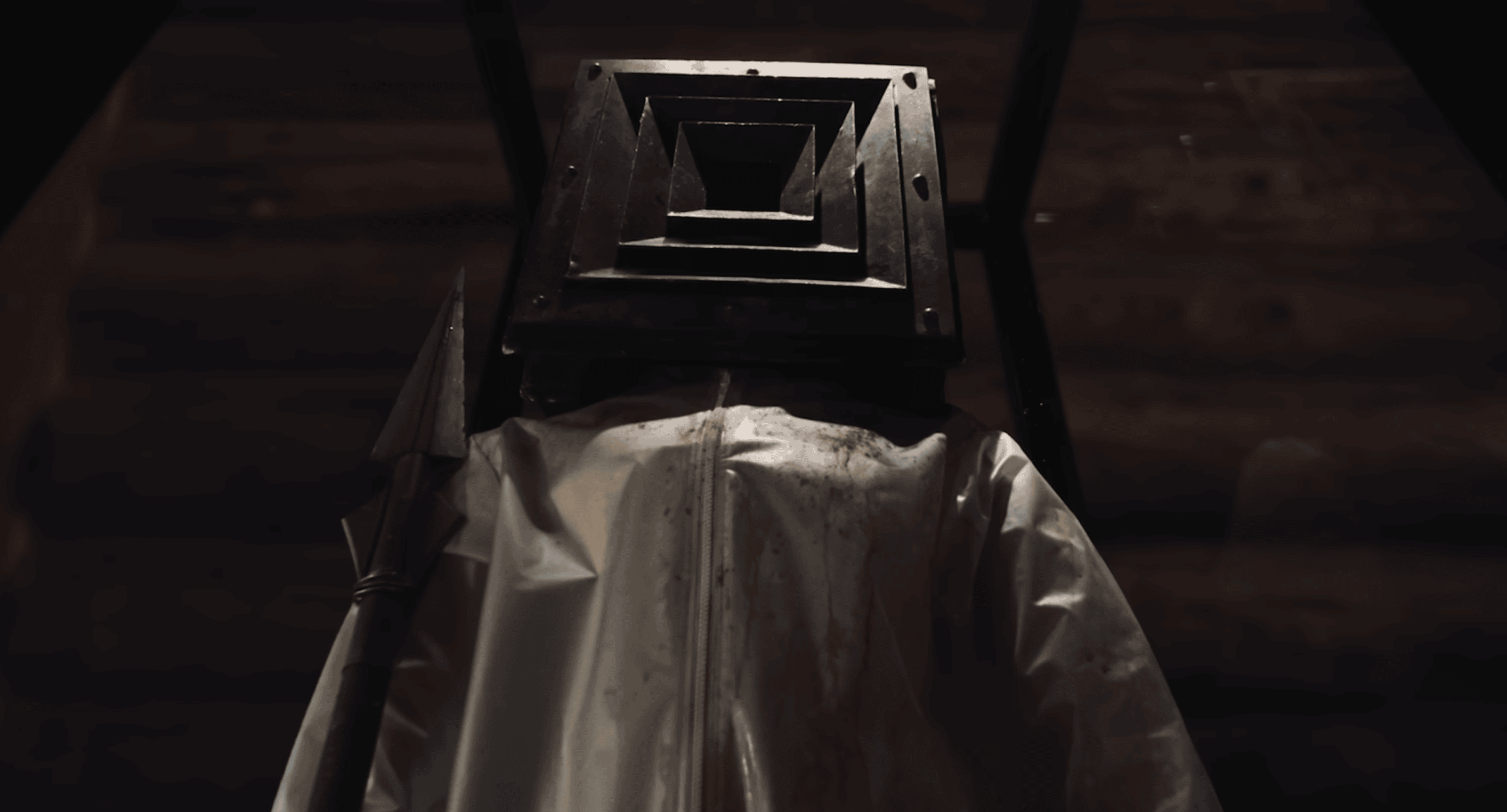
Chris: Film School is exactly on the money, very much an "in this essay" movie. I was annoyed because they mention Billy's status as the final girl quite a bit, but the entire movie feels like trying to just make a plot out of Carol J. Clover's "Her Body, Himself: Gender in the Slasher Film."
If you've never gone to Film School, first off: Good, keep it that way. But the main takeaway from the essay that's germane to this is the concept that slasher films intermingle the perspective of an often male (and quite often queer or feminine-coded) killer and a woman who must survive or overcome (often in a masculine manner).
Riley: I loved the part where Kris and Billy are watching the first movie and Kris whispers "This part's transphobic."
There isn't necessarily anything "wrong" with making a very film school film--Schoenbrun's work (the two of their three movies I've seen, anyway) is very much about media, and I think it's fair of them to want to do something that's more speaking to... I don't know, maybe their peers, or to other film buffs. That does mean if you aren't a Film Person it can be hard to enter into, though.
Chris: A big part of the third act of the film is Kris' sexual dysfunction, which is rooted, on some level, in being exposed to this media at a young age. It's media that's both fraught and also serves as a queer awakening. And much of working through that sexual dysfunction with Billy involves imagining herself as outside of her body, disassociating a la Clover's essay into the viewpoint of the problematic genderqueer killer, who is a direct reference to Sleepaway Camp specifically but also countless other fraught titles (Psycho, God Told Me To, The Silence Of The Lambs, Dressed To Kill). The metatextual element is Schoenbrun working through the contradiction there, but the problem is it feels like therapy. I find the use of VHS-tinged nostalgia treacly, and the actual murder scenes in the original Camp Miasma film are corny and unengaging.
Riley: Yeah, they're so over-the-top that I think it's hard to tell quite what they're doing. I thought that approach worked with the transphobic scene in question--it was so ridiculous that it didn't even feel like a sendup of the various slasher films the movie wants to critique, it just felt like making fun of transphobes in a way I appreciated. (Everyone has pointed this out, but: the in-world Camp Miasma movie is directed by Ray Blanchard, who invented the idea of autogynephilia that transphobes use to do their weirdo shit. So it felt like it was making fun of him more than anything, which I'm into.)
Chris: That part is good! Blanchard is a psycho. The problem is that the movie is both simultaneously underbaked in some parts and tediously over-explained in others. I quite like Schoenbrun's use of magical realism in this and I Saw The TV Glow; I just wish they trusted me enough to not have to explain it to me first. That feels overly defensive.
Riley: I think part of why I Saw The TV Glow was so affecting was that it left a bunch of stuff unsaid (though I have Thoughts on that, especially now that I've seen more of Schoenbrun's work), and I think here maybe they... said too much. But at the same time I came out of it not entirely sure what they were saying, big picture, at all.
Chris: I think Kris does say it quite bluntly: There's that libidinal impulse to wanting to be the hot girl covered in blood at the end of the movie. Covered in blood and laughing and thriving like Sally at the end of Texas Chainsaw. The idea of these things as fantasy, as play–I get that!
Riley: Right but like, what is it saying about that beyond "this is a thing" which, like, yes, it is. And maybe it doesn't have to come to some big conclusion, maybe it can just celebrate that, maybe that's fine!
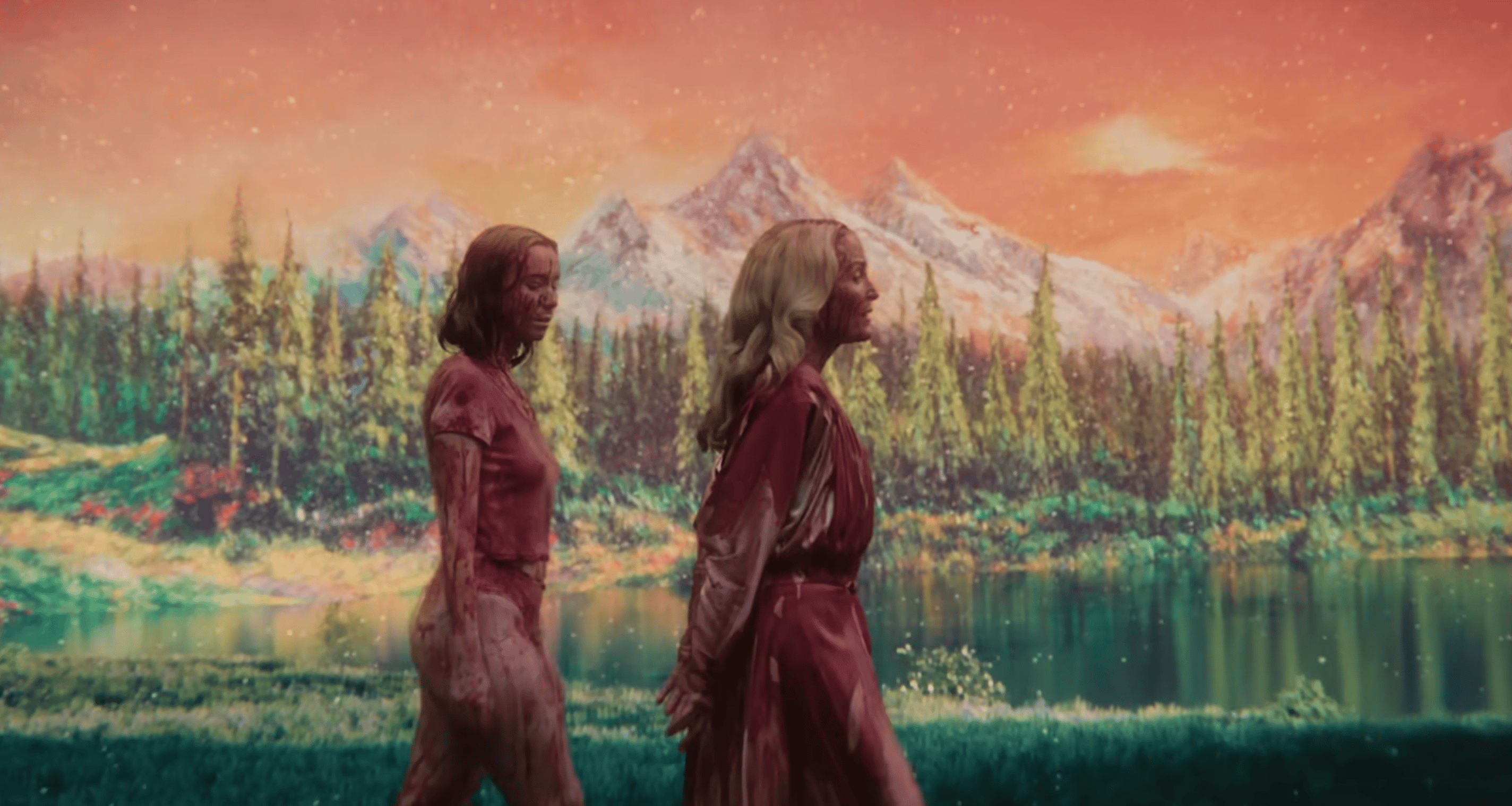
Chris: I think the problem for me is that Little Death exists as this eternal force, this divine androgyne who lives in a Videodrome-esque flesh cave in a hole under the lake "where the movies come from," and that is the part that feels explicitly trans but also kind of incoherent. The movie spends so long explaining Kris' hangups and then leaves that in an asymmetrically abstract place. I'd be fine if the whole movie was that abstract, but it isn't!
Also, there's a line that Billy says at one point, something to the effect of "you missed what those movies were about: flesh and fluid," which I agree with. But if you're going to say that, use really good-looking practicals for your gore!
Riley: Haha, right, what does it mean to make this whole big sexy thing out of slasher stuff but then not have the slasher stuff be... particularly sexy?
Chris: The sex scenes suck! I like sex scenes too!
Riley: I think that for me, personally, sex isn't that interesting, and so when Kris is like "ah my big sex hangup!" I'm like... "yeah, sex is weird, whatever." But I mean good for Kris ending up with Gillian Anderson and having a whole big sex and blood thing, like that's fun!
Chris: I think that's part of why I'm frustrated. I also had a huge crush on Gillian Anderson as a kid, and working that out on the big screen with Einbinder should work on paper! I agree with the impulse, I just dislike the execution.
Riley: Yeah, I thought if you're gonna do "weird relationship to media," I Saw The TV Glow did it in a way that felt a lot more relatable and affecting to me.
Chris: Yeah, I also think that TV Glow is more interesting because it is about the process of discovery, whereas this is about working through dysfunction after the fact.
Riley: Right, so here's my sort of hottest take: Having seen two of Schoenbrun's three movies, the way I interpret the project of transness and queerness they're on is one of, like, becoming. Transitioning or having a sort of healthy, integrated queer identity is this situation of longing for something you have to overcome barriers to attain and embody. And for myself as a trans person and particularly as a trans writer, I think the stories I'm most interested in–and the ones I think are the most valuable politically, in whatever way you want to interpret "politics"–are ones of being, of what it is to exist in the world particularly as trans. Which isn't to say Owen from TV Glow or Kris aren't trans or queer or anything like that, but there is a way I can read these movies as transitioning or coming out narratives.
And we need those, but I have also spent my personal artistic career trying to find different stories to tell. And so when I really dig into it, I start to find something almost retrograde about Schoenbrun's work as I interpret it. And, like, they don't have to live up to my standards or do what I'm doing, they can tell whatever stories they want! But it does start to... gnaw at me a little.
For the record, and as I wrote, I Saw The TV Glow would 100% be a worse movie if it ever said the word "trans," and the not saying gives it so much of its power, but I do also have to sort of ask myself, what does it mean to make a trans movie that never says the word "trans"?
Chris: Yeah, that's a case where it would not work to mention it, but this is a case where not centering it is somewhat detrimental. And the way that they mention transness is oblique and doesn't really work.
Riley: A lot of my friends, especially my trans friends, really liked Camp Miasma, so I'm excited to talk to people it really clicked with and hear more about why it worked for them. I don't think it worked for me, but I'm also not a big Film person, so maybe I'm just not the audience it's talking to. My parents called me when I was in the theater, and when I called them back the next day and told them the name of the movie they burst out laughing and were like "you New Yorkers," so that sort of felt worth it to me, haha.
Chris: That's the thing: Even when I don't like the movies or think they work for me, I'm still happy they do for others. I can speak to queerness in slasher films, but not to transness. But I just wish the films worked for me a little more, because even when I dislike them, the process of locating why is an interesting process for me. Maybe the next one I won't slide off as hard.


